Author: Tian Mi
Knowing how to use AI has already become a hard requirement in the workplace.
Rules like "Token consumption counts towards KPI" have trickled down from giants like Alibaba and ByteDance, with even small factories of a few dozen employees following the trend and issuing notices forcing everyone to embrace AI.
No one can clearly calculate how much efficiency has actually increased. But workers' wallets have definitely shrunk first.
Not all companies are like Alibaba, providing Token quotas as a free office benefit. More bosses only inspect the results, without reimbursing the costs. To avoid falling behind or being laid off, workers can only dig into their own pockets, topping up subscriptions one after another.
AI memberships have become the most hidden assassin in the workplace.
The Wallet Can't Take It Anymore
Before mid-April, another account in Long Shen's AI toolkit was running dry.
Long Shen is a front-end programmer at a major e-commerce company, hired as a campus recruit in 2024, among the company's first batch of "AI-native employees." From day one, he tried using AI to assist with coding. Last year, he started paying for AI tools.
His first payment went to Cursor, the hottest AI programming tool in the developer circle. Its regular monthly fee is $20 on the official website, but an annual subscription can bring it down to $16 per month.
This $16 doesn't buy unlimited use, but a monthly resetting quota pool. Cursor charges based on actual Token consumption. A few long-context conversations for complex requirements can deplete the $16 equivalent of calls in just days.
The money is spent for work, but there's nowhere to claim reimbursement. At the major tech company where he works, the slogan "AI boosts efficiency" is shouted from the rooftops. Internal emails are full of grand declarations about "intelligent transformation." But when it comes to implementation, no one mentions how Token quotas will be allocated or how much can be reimbursed monthly. Workers can only pay out of pocket.
Long Shen skillfully opens Xianyu (a second-hand marketplace app) and types "Cursor" into the search bar. The page pops up with a bunch of items: "White accounts," "Quick-finished accounts," "Exclusive accounts." Like an underground rendezvous, he clicks a link, and the seller replies instantly: "Brand new exclusive account. If banned within 30 days, refunded proportionally."
Behind these links are mostly shared accounts from grey areas or dubious recharge quotas. Long Shen sometimes wonders: Could these accounts be topped up with stolen overseas credit cards?
He hasn't completely ruled out topping up directly on the official website. But when work gets busy, Token consumption flows like water. To ensure output, his "arsenal" extends far beyond Cursor. ChatGPT Plus, Midjourney, various API interfaces—spending an average of over a thousand yuan per month is common. In his highest-spending month, he shelled out a full 2000 yuan on various AI tools.
Paying to work—you save where you can. Hesitating for a moment, Long Shen still risks account suspension and clicks "Purchase."
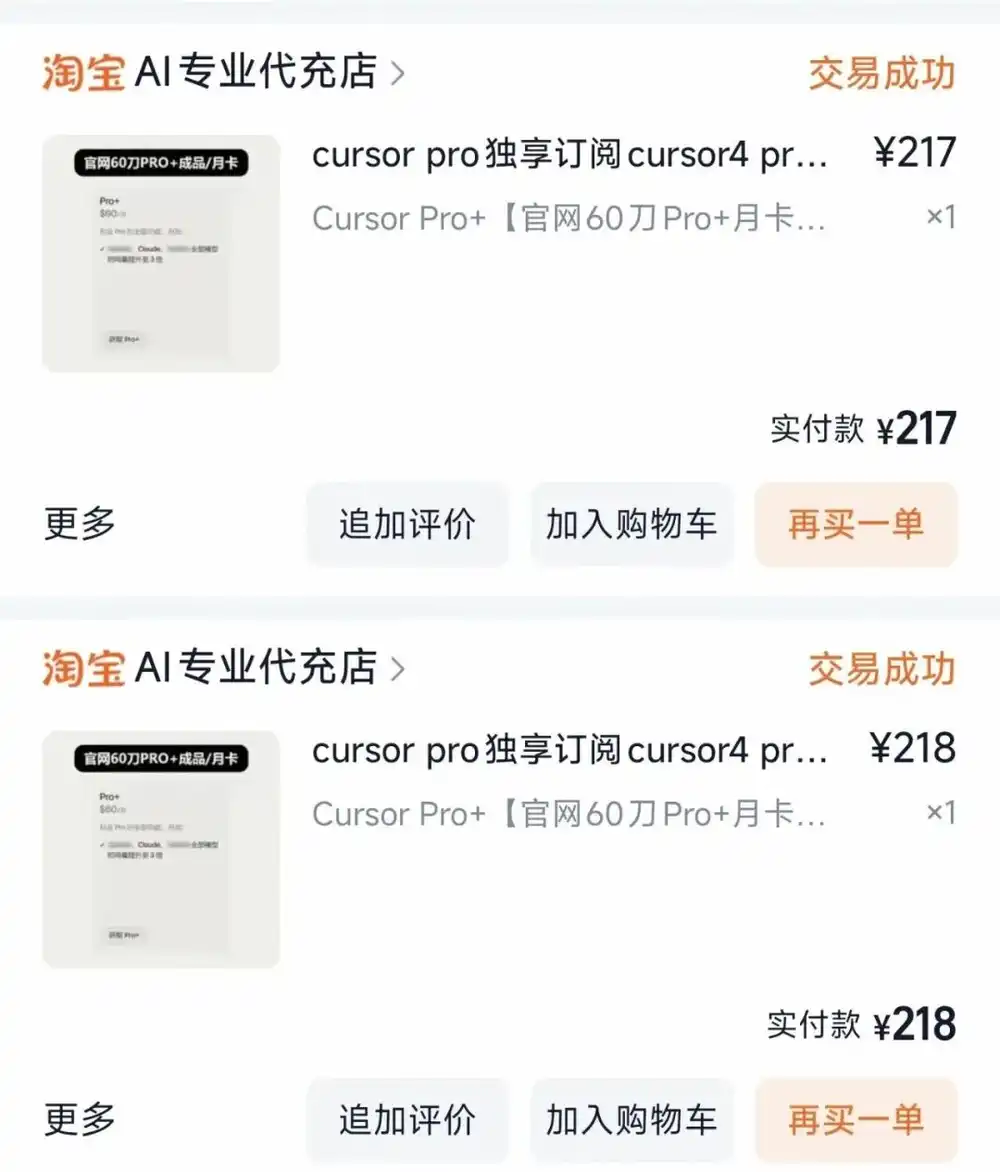
Image|Some of Long Shen's payment records
The expense stings a bit, but he's done the math in his head: spending an extra 1000 yuan a month, which is only about 3% of his monthly salary, can help complete 80% to 90% of his coding tasks. That cost-performance ratio leaves no room for hesitation.
After paying, Long Shen's work style changed completely. He once took on a graphics-related project. This field has a high barrier to entry for most front-end engineers, who rarely touch it. He started with almost zero knowledge but didn't explain much to his manager. He just dove in using AI for three months.
"The manager doesn't read code; he just sees if the page runs and functions correctly." The project eventually launched successfully, and Long Shen earned his manager's recognition. Only after everything stabilized did he go back and slowly fill in the foundational knowledge.
The company actually provides a free internal programming tool. Long Shen tried it for a while but never found it comfortable. That tool only integrates domestic models, lacking top-tier core capabilities, making it feel restricted everywhere. After struggling for a bit, he completely abandoned it and continued paying for external tools himself.
He also tried promoting Cursor within his department. But after colleagues exhausted their free quotas, no one was willing to continue paying.
A colleague nearly 40 years old only hurriedly approached him this year when the company forced all employees to "all in AI," asking, "How do you use this thing? Teach me."
Not everyone spends as willingly as Long Shen.
"Sometimes I really think it'd be nice if there was no AI." Peng Peng calculates recharge amounts while navigating guerilla warfare between the company's AI ban and her manager's demands.
She works in design for a car company's R&D department. Company confidentiality rules are extremely strict; all external AI websites are directly blocked. Accessing them from a work computer shows "cannot connect."
Last August, after her manager encountered ChatGPT, things changed. Once he saw AI-generated images, he categorized all materials downloaded from Pinterest and Instagram as "second-hand goods"—those images were already circulating online, making them prone to duplication.
The manager felt AI images had a built-in futuristic feel, perfectly matching the need for avant-garde, eye-catching design. In meetings, he started directly requesting AI-generated images, his tone implying it was as simple as clicking a finger.
Caught in the middle, Peng Peng could only log into AI image generation tools on her personal devices, save the images, email them to herself, then transfer them to her work computer for editing. This convoluted, time-consuming workflow was her only option.
She gradually subscribed to Midjourney, Jiemeng, and Keling memberships, slowly learning each tool's quirks. The most commonly used are Doubao and Midjourney: Doubao is free and easy to use, good for simple color changes and basic adjustments, but its aesthetics are flat; Midjourney has strong image texture, best for high-quality renderings, but it's particularly hard to control—changing one detail often ruins the whole image.
One month, she spent five or six hundred yuan across several accounts. She tried mentioning reimbursement to her manager, who only replied, "There's no budget for that."
The money comes out of her own pocket, but the workload keeps increasing. After tasting the sweetness of AI-generated images, the manager's appetite grew. Before, there was a two-day buffer for design revisions; now he thinks AI should double efficiency, expecting new versions of today's requested changes by tomorrow morning. Produce 10 images, and he'll ask for 20.
"But people aren't AI, let alone machines." Peng Peng complains verbally, but she knows her manager only cares about results, not the process or how much you spend behind the scenes.
She sometimes thinks: Edison invented the electric light, but people didn't have easier evenings; they just got more work to do at night.
Once, the manager wanted a render with a specific material texture. Peng Peng fed the requirements into the AI repeatedly, generating over thirty images, none perfectly meeting the standard.
Finally, she simply turned off the AI, opened Photoshop, painstakingly stitched and color-corrected parts of several images for over two hours before daring to submit the final version.
The Membership Assassin, Disrupting the Workplace
Li Huahua has been getting increasingly paranoid lately.
Initially, the emergence of AI didn't pressure her. She works as a programmer at a state-owned enterprise with strict confidentiality rules restricting external tool use. She simply saw AI as someone else's business, unrelated to her.
Until late one night recently, a friend suddenly complained to her. Working in a private company, her friend secretly subscribed to an AI membership this month to boost efficiency. After achieving results, she excitedly reported to the boss, who not only didn't praise her but directly raised the department's KPI. Now everyone has to do at least the work of two people.
After hearing her friend's grievance, Li Huahua was silent for a long time before blurting out, "Aren't you exactly the kind of 'code traitor' people talk about online? Just caring about your own credit, screwing over the whole department."
Her friend, somewhat annoyed, retorted, "Well, you go use it now too."
Hanging up, Li Huahua couldn't sleep well all night. The next day, she spent the whole day researching how to subscribe to Codex's membership.
But after subscribing, she felt even more uneasy. Her friend's experience was like a mirror. Using AI to boost efficiency might not be a good thing; perhaps one day she herself would be used as an efficiency example. Then, KPI would definitely be raised, and some staff might even be optimized out. And she had already received low performance ratings for two consecutive months recently due to poor relations with her manager.
"When not using it, I'm afraid of being left behind; after using it, I worry everyone else is using it too. I always feel危机四伏 (crisis lurks everywhere), but I don't know where the crisis actually comes from."

Image|After using AI, Li Huahua always feels危机四伏 (crisis lurks everywhere)
Since then, she started secretly observing colleagues. Whenever someone's work pace suddenly quickened, she couldn't help but guess: Did this person also secretly subscribe to an AI membership? She never asked anyone, and of course, no one would tell the truth if asked.
While Li Huahua fears layoffs, Long Shen's company has begun recruiting AI talent on a large scale this year.
Long Shen was briefly involved in recruitment, receiving resumes until his head ached daily. The company explicitly requires candidates to have AI project experience and practical case studies. Yet those sitting in the interviewer seats are veteran engineers with ten or twenty years of experience. Their entire understanding of AI might just be letting their kids chat with Doubao about Ultraman.
After AI boosted his efficiency, Long Shen had more time to think, only to realize the company was actually letting amateurs guide experts.
But for management, this isn't a problem at all. They hold big meetings, give presentations, decompose KPIs layer by layer, letting engineers below摸索 (explore), produce, and report. They themselves neither need to learn nor pay for memberships.
"They treat us like Agents," Long Shen says helplessly. "Just give orders,消耗 (consume) us, they don't need to do anything themselves."
AI indeed saved him time, but that time eventually turned into another form of隐形劳动 (invisible labor)—performing the appearance of working hard.
Now he can basically finish a day's work in one morning. To prevent his manager from seeing him idle and assigning new tasks, he sits at his workstation, pretending to be busy. Company computers have monitoring; he doesn't even dare connect for side gigs. Often having nothing to do but unable to leave.
This empty feeling is particularly uncomfortable, his mind involuntarily wandering: Should I invest in stocks? Buy gold? Will I just keep working like this until optimized out at 35?
He clearly knows AI's红利期 (golden period) is fading fast. In 2024, he could still leverage AI to stand out and gain recognition. By 2026, when the whole company uses AI, individuals can no longer build an advantage with it.
It's like during school years: when everyone goes to cram school, efficiency rises for all, homework increases accordingly, yet no one gets to leave school earlier.
At another major tech company, programmer Zhang Mu finds himself in the窘境 (predicament) of being "AI-praised to death" by his manager.
One day, the department's big boss suddenly posted the March Token consumption ranking in the work group chat, announcing that regularization, KPI, and promotions would all reference Token usage. Those using little might be replaced.
Zhang Mu莫名其妙 (inexplicably) became the top-ranked. The boss publicly praised him, asking him to share his efficient AI usage experience after the holiday. He instantly felt头皮发麻 (his scalp tingling with fear): over half of his Tokens were actually spent on organizing personal data, taking notes—things unrelated to work.
This简直把他架在了火上 (literally put him on the grill). He had to硬着头皮 (grit his teeth) and prepare the分享 (sharing), but始终不敢 (never dared) to reveal the truly efficient methods. Those were his核心优势 (core advantages),摸索 (figured out) over several weeks. "Now I always feel离被取代越来越近 (getting closer to being replaced). Once shared, I lose all competitiveness."
This pressure is spreading from within companies to the entire industry. Before, people could勉强凑合 (barely manage) with free tools like Doubao and Kimi, chatting, editing materials, handling daily work.
But this退路 (escape route) is rapidly narrowing. Kimi started charging last September, at a minimum of 39 yuan per month; Doubao also posted a付费页面 (payment page) on the App Store this May, with Standard at 68 yuan, Enhanced at 200 yuan, and Professional at 500 yuan.
The era of the "free little assistant" is ending at a肉眼可见的速度 (visible pace). Want to use it? Pay up.
Can't Stop Now
Before starting his business, Jin Tu never imagined he'd spend so much on AI.
He worked for years in content within brand marketing. Like most, he used Doubao and Kimi to chat, edit copy, look up info, basically handling daily work.
Until one day, he saw a friend conversing with AI directly within a code editor and realized AI could generate documents locally, saving version after version, without反复翻找 (repeatedly searching) and copying-pasting in chat boxes.
Trying it back home, he instantly打开新世界 (opened a new world).
Since then, he started using AI for more creative and systematic tasks. He wanted to organize all his past WeChat public account articles into a knowledge base for AI, but WeChat反爬严格 (has strict anti-crawling), preventing direct scraping. He told Codex the需求 (requirement). In just 2 minutes and 25 seconds, it customized a browser plugin for him. Open any public account article, click the plugin, and一键导出 (one-click export) it as a local MD document.
Later, he built himself a私人知识库工作流 (private knowledge base workflow). Articles, excerpts, long-form insights刷到 (encountered)平时 (in daily life),随手丢进去 (tossed in casually), and AI automatically organizes them into systematic notes, even attaching its own analysis and comments.
Most震撼他的 (stunning to him) was his personal website, built from scratch entirely by AI; he本人一行代码都没写 (didn't write a single line of code himself). The site has now迭代 (iterated) 577 versions, with数千个访问 (thousands of visits). For each update, he just throws a sentence to AI: "Okay, proceed." AI automatically checks, modifies,提交 (commits), and generates a detailed运行日志 (operation log).
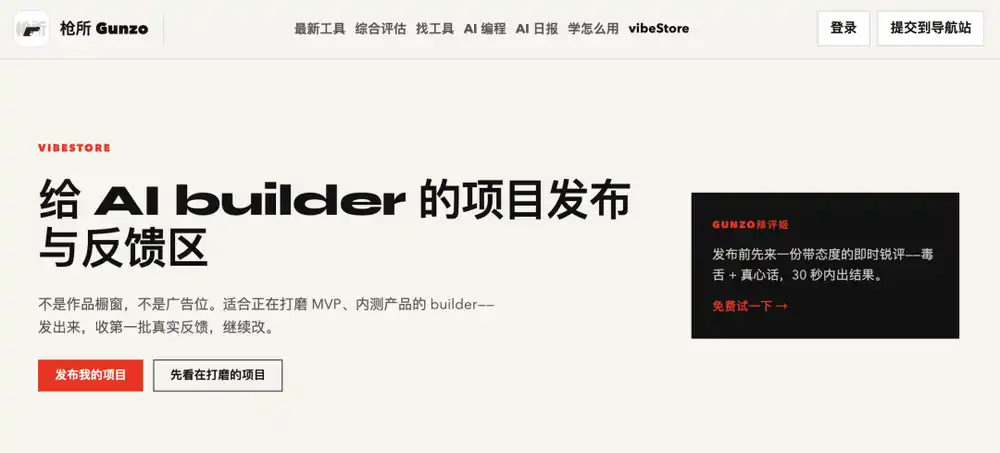
Image|The website Jin Tu designed with AI
Relying on this site, Jin Tu achieved a good ranking in an AI entrepreneurship competition and even secured local government创业扶持资源 (startup support resources).
To maintain this整套工具链 (entire toolchain), he spends considerable money monthly on AI memberships, but he finds it非常值 (very worthwhile). He quotes an AI entrepreneur: "Our $200-per-month top-tier Claude membership is equivalent to hiring a million-yuan-annual-salary development engineer for the team."
"Paying money lets you use真正的 AI (real AI)." In his view, most unwilling to pay only接触到了 (encounter)阉割 (castrated),打了折扣的 AI (discounted AI). Using "real AI" is like buying a good bag; you feel it's different from ordinary bags, but can't quite pinpoint why.
Currently, he has planned his next step. Soon, he will head to Hangzhou to创业 (start his business).
Peng Peng still occasionally subscribes to AI memberships.
Her manager特意夸 (specifically praised) her for getting better at using AI, telling her to继续保持 (keep it up). Peng Peng feels五味杂陈 (mixed emotions) inside. Half of what AI generates不完全属于她 (doesn't completely belong to her). The inspiration is hers, but the功劳 (credit) for the final image easily gets assigned to AI. For designers, the recognition when a方案最终被选中 (plan is finally chosen) is too important.
Is the manager truly satisfied with her idea or AI's idea? She始终说不清 (has never been able to clarify).
Li Huahua's "悬着的心" (anxious heart) has finally死了 (died) recently.
Even her department head, nearly fifty, recently started大谈 (talking big about) AI efficiency in meetings. Though暂时还没提到 (it hasn't been mentioned yet) "one person doing the work of two," Li Huahua knows that direction isn't far off. She now goes to work daily, secretly keeping her membership, secretly using it, waiting for that day to arrive.
Long Shen still buys accounts on Xianyu. With AI's assistance, he got promoted three times within a year and a half of joining, received the company's A-grade performance rating last year, and got a 9-month year-end bonus.
And this才是 (is exactly) where AI truly excels. It gives you甜头 (sweet rewards) bit by bit,蚕食 (erodes) your work rhythm, making you心甘情愿地 (willingly) hand over money and gradually become依赖 (dependent).
After writing tens of thousands of lines of code with AI, Long Shen finds he can't leave it now.
"It's impossible for me to review all the tens of thousands of lines of code written by AI before taking over. Once this循环 (cycle) starts, it's hard to退出 (exit)."
What he faces now is早已不是 (no longer) a question of掏不掏钱 (paying or not), but a formed技术依赖 (technical dependency). Maintenance work can only continue with AI; the cost of stopping is far greater than continuing to pay.