The 'Side Hustle Survival' of DAT Companies: After the Accumulation Flywheel Stops, They Begin Self-Rescue

marsbitXuất bản vào 2026-06-18Cập nhật gần nhất vào 2026-06-18

Tóm tắt

"Metaplanet's 'Side Hustle Survival': After the 'Crypto Hoarding Flywheel' Stops, They Begin Self-Rescue" The article discusses the strategic pivot of Digital Asset Treasury (DAT) companies as the once-lucrative model of hoarding cryptocurrencies, pioneered by MicroStrategy, faces challenges. With the crypto bear market and the rise of ETFs offering direct, low-premium exposure, many DAT firms are abandoning the passive treasury model. Prominent examples include ETHZilla, which sold ETH to repay debt and shifted to RWA tokenization, and others like Prenetics Global exiting completely. Facing stalled growth, remaining companies are pursuing two main survival paths. The first path is transforming into institutional crypto asset management platforms and yield funds. SharpLink Gaming exemplifies this by staking 100% of its ETH and partnering with Galaxy Digital to launch a yield fund. GameSquare is taking a more aggressive approach, using AI-driven algorithms across DeFi protocols to seek higher returns. The second path involves becoming blockchain infrastructure operators, particularly in the Solana ecosystem. Companies like DeFi Development and SOL Strategies are moving beyond holding SOL to operating validator networks and launching liquid staking tokens, building fee-based revenue models from ecosystem participation. The article notes these transitions reflect a broader industry maturation, shifting from financial engineering to building operational moats through technol...

How long has it been since you last heard news about Metaplanet?

In the first quarter of 2026, Metaplanet, Japan's and even Asia's largest corporate Bitcoin treasury, adjusted its capital strategy. It chose not to dilute equity when mNAV was less than 1 (meaning the company's market capitalization was lower than the value of its cryptocurrency holdings), turning instead to strategies including Bitcoin-collateralized financing and stock buybacks to maintain its stock price to a certain extent.

While the Q1 financial report showed that Metaplanet still purchased 5,075 Bitcoins, from the start of Q2 until now, aside from announcing the acquisition of the Japanese licensed securities firm Siiibo Securities about a week ago to promote Bitcoin-backed bond-like products and explore security tokenization, there have been no new cryptocurrency purchases.

Even Strategy, which guaranteed countless times that it would never sell Bitcoin, tested the market impact of a small sell-off of Bitcoin to replenish cash. The once "never sell" oath has turned into "ensuring total holdings increase." When the two DAT companies with the largest Bitcoin reserves are feeling the pinch, it's not hard to imagine the current predicament of other companies.

In fact, aside from a few companies like Strategy, Metaplanet, and BitMine who are still persisting, most former DAT companies have already begun seeking alternative paths.

Two Paths to Survival

Under the sudden bear market, many DAT companies directly chose to "stop playing."

ETHZilla is a typical example. Backed by Peter Thiel, this company held over 90,000 ETH at its peak in 2025, but sold a total of $115 million worth of ETH twice by the end of that year to repay debts. This year, it directly abandoned the DAT model, pivoting to businesses like RWA tokenization.

Bitcoin DAT companies like Prenetics Global and Sequans Communications also chose to give up, returning to their core businesses. Many copycat altcoin DAT companies fared even worse, with stock prices nearing zero and the coins in hand difficult to liquidate, so they simply gave up. Data shows that in July 2025 alone, DAT companies bought approximately $20 billion worth of cryptocurrency in total, while the total purchases in Q1 of this year were only about $3.7 billion.

Faced with the stalled flywheel, aside from quitting or giving up, mid-tier treasury companies have embarked on a collective strategic pivot, which can roughly be summarized into three directions. They all point to one core proposition: DAT must transform from passive balance sheet managers into active ecosystem participants to truly possess commercial value.

The first direction is repositioning themselves as institutional-grade crypto asset management platforms and yield funds. SharpLink Gaming is a representative of this path. From day one, this company has staked nearly 100% of its ETH holdings and attributed all staking rewards to shareholders without taking any commission.

This stands in sharp contrast to spot ETH ETFs, which, although granted staking permission by the SEC, can only stake about 50% of holdings to meet daily liquidity requirements. Building on this, SharpLink partnered with the Wall Street veteran crypto investment bank Galaxy Digital in early 2026 to launch the $125 million "Galaxy Sharplink On-Chain Yield Fund," deploying about $100 million worth of staked ETH into DeFi liquidity protocols to seek超额回报 (supernormal returns).

This company is transforming from a simple cryptocurrency holding entity into a management platform providing institutional clients with channels for on-chain yield allocation.

GameSquare, which holds about 15,000 ETH, is exploring even more radical paths. This publicly traded company, which owns gaming assets like FaZe Clan, partnered with crypto asset management firm Dialectic to introduce the latter's self-developed Medici platform. The platform uses machine learning models and automated algorithms to dynamically allocate funds across 72 to 250 different DeFi protocols, aiming for 8% to 14% annualized returns, far above Ethereum's standard staking benchmark of 3% to 4%.

The second direction is transforming into blockchain infrastructure operators, which is particularly evident in the Solana ecosystem. DeFi Development is one that has gone the furthest. This company not only purchased large amounts of SOL but also acquired a validator company and launched its own liquid staking token, dfdvSOL.

dfdvSOL has been integrated into several core Solana DeFi protocols like Kamino, Orca, Drift, and Jupiter Lend, used as lending collateral and liquidity pool assets. DeFi Development earns fee income from every staking operation and protocol integration, building a self-reinforcing network effect cycle.

SOL Strategies, by acquiring three validator companies, constructed a complete business line from digital asset holding to infrastructure operation. It manages over 3.4 million SOL in delegated staking, far exceeding its own treasury size, shifting from serving its own balance sheet to providing staking infrastructure for institutional clients across the entire ecosystem.

Forward Industries is similar. Besides launching the liquid staking token fwdSOL, Forward Industries also partnered with Galaxy Digital and Jump Crypto to launch the propAMM project BisonFi. Since its launch, BisonFi almost immediately became the highest-volume DEX on Solana, squeezing the once-dominant HumidiFi to less than 4% market share.
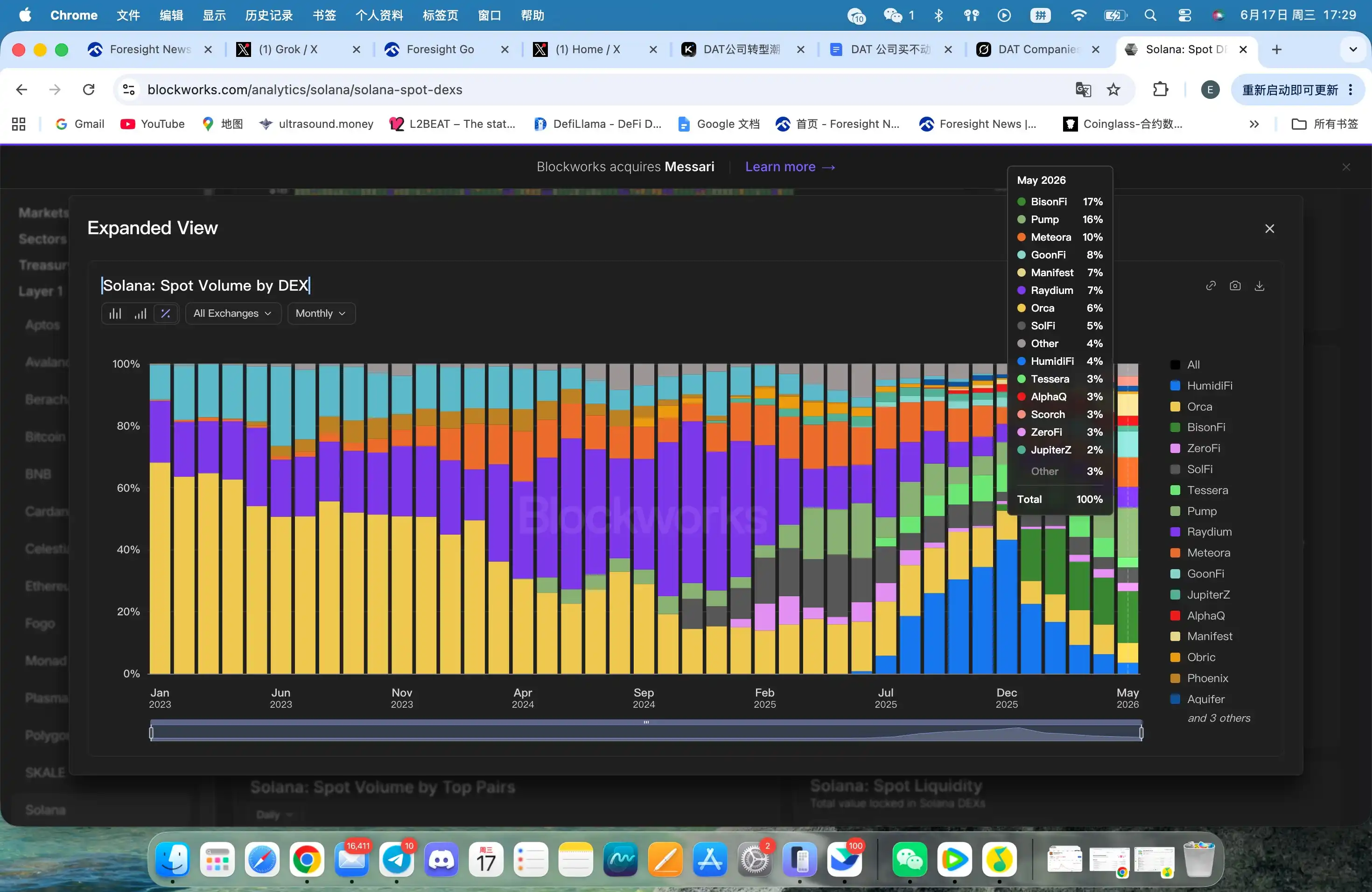
These two routes also essentially correspond to the capital market's different attitudes towards Ethereum and Solana.

ETH itself is still recognized more as an "asset" than SOL. ETH treasury companies can position themselves as "funds managing ETH," providing institutions with exposure to yield-generating assets. On the other hand, Solana's crypto-native nature is more pronounced. SOL treasury companies need to demonstrate their profitability within this ecosystem, proving their value through logic closer to ordinary listed companies—"looking at financial reports."

Will the Transformation Succeed?

The collective transformation of DAT companies actually reflects a profound cognitive upgrade the entire crypto industry is undergoing. The treasury model pioneered by Strategy was essentially a form of financial engineering that leveraged the convenience of public market financing and investor sentiment for capital arbitrage. When participants expanded from a few pioneers to hundreds of companies, and from Bitcoin to various altcoins, scarcity was diluted, and the premium naturally disappeared.

The launch of cryptocurrency ETFs further accelerated this process. When investors could directly buy ETH ETFs with staking yields at prices close to net asset value through traditional brokerage accounts, the logic of holding DAT stocks at a premium was fundamentally undermined.

The answer given by successful transformation cases is operational capability. Whether it's SharpLink's 100% staking strategy and institutional-grade yield fund, DeFi Development's dfdvSOL ecosystem and validator network, or GameSquare's machine-learning-driven yield platform, they are all attempting to build hard-to-replicate operational moats around crypto assets. This moat may come from technological advantages, network effects, institutional partnerships, or deep participation in the on-chain financial ecosystem.

However, these transformations are not without risks. The 8% to 14% DeFi yields pursued by GameSquare are built on smart contract risk and protocol risk. Any significant DeFi protocol vulnerability or extreme market event could lead to severe losses. DeFi Development's business model heavily relies on the healthy development of the Solana network; once the ecosystem cools, its entire business would be impacted.

For the Web 3.0 market, the impact of this transformation is profound and complex. Those DAT companies that successfully evolved into infrastructure operators and asset management platforms are building bridges between traditional finance and the blockchain ecosystem, promoting the maturation and standardization of institutional-grade services.

But the process of the DAT model moving from frenzy to sobriety also sends an important signal to the market: in the crypto space, not everyone can play the pure capital game. Entities that truly participate in network construction, create actual cash flow, and provide user value possess greater resilience against market cycles.

The DAT movement is entering a phase of冷静重构 (calm reconstruction) from a capital carnival. This might not be bad news. An industry can only truly see who is swimming naked and who is building the ark after the泡沫退去 (bubble subsides). The collective pivot of treasury companies is both a passive response to survival pressure and an inevitable growing pain for an emerging industry moving towards maturity.

Câu hỏi Liên quan

QWhat are the two main survival paths that some DAT companies are adopting after their 'flywheel' of accumulating crypto has stopped turning?

AThe two main survival paths are: 1) Re-positioning as institutional-grade crypto asset management platforms and yield funds, like SharpLink Gaming. 2) Transforming into blockchain infrastructure operators, as seen with companies in the Solana ecosystem like DeFi Development.

QAccording to the article, what is the core proposition that DAT companies must address to create real business value during their strategic shift?

AThe core proposition is that DAT companies must transform from being passive balance sheet managers into active ecosystem participants.

QHow does the article differentiate the typical transformation strategies for ETH-based DAT companies versus Solana-based DAT companies?

AETH-based DAT companies (like SharpLink, GameSquare) focus on becoming 'funds that manage ETH,' offering institutional investors access to yield-bearing assets. Solana-based DAT companies (like DeFi Development, SOL Strategies) aim to demonstrate profitability within the ecosystem, transforming into infrastructure operators to align with traditional public market 'financial reporting' logic.

QWhat major event, according to the article, has fundamentally undermined the logic for investors to pay a premium for DAT company stock?

AThe launch of cryptocurrency ETFs, particularly those offering staking yields like ETH ETFs, has fundamentally undermined that logic, as investors can now buy the underlying asset directly at close to Net Asset Value (NAV) through traditional brokerage accounts.

QWhat key operational barrier are successful DAT company transformations trying to build, and what are the associated risks mentioned in the article?

ASuccessful transformations are trying to build operational barriers around crypto assets that are difficult to replicate, based on technical advantages, network effects, institutional partnerships, or deep involvement in on-chain finance. The associated risks include smart contract and protocol risks in DeFi (e.g., GameSquare's strategy), and high dependency on the health of a specific blockchain ecosystem (e.g., DeFi Development's reliance on Solana).

Nội dung Liên quan

Bitcoin: Liệu động thái của cá voi 130,5 triệu USD có làm trật bánh đà đưa BTC tiến tới 70.000 USD?

Một cá voi Bitcoin đã thực hiện giao dịch chuyển 2.000 BTC, trị giá 130,5 triệu USD, sau 6 năm tích lũy. Trong đó, 800 BTC được chuyển đến Cumberland để giao dịch OTC (cho thấy ý định bán tiềm năng), trong khi 1.200 BTC được chuyển sang địa chỉ mới, cho thấy có thể đây là động thái tái định vị danh mục hơn là thoát hoàn toàn. Mặc dù động thái của cá voi lớn thu hút sự chú ý, nhưng giá Bitcoin dường như không bị ảnh hưởng tiêu cực. BTC tiếp tục xu hướng tăng, đạt mức cao hàng tháng khoảng 66.314 USD, với các chỉ báo kỹ thuật như Stochastic Momentum Index và Squeeze Momentum Indicator cho thấy động lượng tăng vẫn còn mạnh, mở đường cho mục tiêu vượt 70.000 USD. Tuy nhiên, một số chỉ số on-chain lại cảnh báo áp lực bán có thể gia tăng trong ngắn hạn. Tỷ lệ Dòng chảy Quỹ (Fund Flow Ratio) và Chênh lệch dòng vào sàn (Exchange Netflow) đều tăng lên mức dương, báo hiệu nhiều BTC đang được chuyển vào các sàn giao dịch. Điều này thường làm tăng rủi ro bán tháo và có thể làm suy yếu động lượng, khiến giá có nguy cơ điều chỉnh về vùng 64.800 USD nếu áp lực bán gia tăng.

ambcrypto26 phút trước

Bitcoin: Liệu động thái của cá voi 130,5 triệu USD có làm trật bánh đà đưa BTC tiến tới 70.000 USD?

ambcrypto26 phút trước

Tích Hợp Axelar Vào XRP Ledger Mở Ra Một Lộ Trình DeFi Đa Chuỗi Mới

XRP Ledger đã tích hợp với Axelar, mở ra một tuyến đường mới cho XRP và các tài sản gốc của XRPL di chuyển vào các môi trường DeFi đa chuỗi rộng lớn hơn. Việc tích hợp này cho phép XRP kết nối với các ứng dụng trên các hệ sinh thái EVM và Cosmos thông qua công nghệ tương tác chuỗi chéo của Axelar. Điều này không biến XRPL thành một chuỗi EVM gốc, mà cung cấp một cây cầu rõ ràng hơn để tài sản XRPL vào các mạng và ứng dụng khác. Tính thanh khoản là lợi thế của XRP, nhưng trong DeFi, tài sản cần có khả năng di chuyển giữa các giao thức và chuỗi. Kết nối này giúp XRP tiếp cận nhiều ứng dụng DeFi hơn bên ngoài hệ sinh thái riêng của nó, tăng cường tính hữu dụng trong một thị trường đa chuỗi. Tuy nhiên, cần lưu ý rằng tích hợp này không làm cho XRPL chạy hợp đồng thông minh Ethereum một cách gốc. Người dùng có thể di chuyển tài sản nhưng sẽ đối mặt với rủi ro từ cầu nối. Thách thức thực sự nằm ở việc liệu người dùng và nhà phát triển có thực sự sử dụng tuyến đường mới này hay không, điều này phụ thuộc vào thanh khoản, sự tin cậy của cầu nối và các ứng dụng được xây dựng xung quanh nó. Trong bối cảnh thị trường tiền mã hóa đang hướng tới khả năng tương tác, việc kết nối này giúp XRP tham gia vào sự phát triển DeFi bên ngoài môi trường ban đầu của nó. Bài kiểm tra thực sự sẽ là khối lượng giao dịch và hoạt động bền vững thông qua các tuyến đường được kết nối bởi Axelar.

bitcoinist27 phút trước

Tích Hợp Axelar Vào XRP Ledger Mở Ra Một Lộ Trình DeFi Đa Chuỗi Mới

bitcoinist27 phút trước

Ripple Đạt Ủy Quyền MiCA Mở Rộng Làn Đường Thanh Toán Châu Âu

Ripple đã đạt được ủy quyền đầy đủ theo khung MiCA ở châu Âu, mở ra con đường pháp lý rõ ràng hơn để mở rộng các dịch vụ thanh toán bằng tiền mã hóa tại EU và EEA. Sự ủy quyền này áp dụng cho thực thể thanh toán doanh nghiệp của Ripple, cho phép hoạt động tuân thủ theo MiCA, chứ không phải là sự chấp thuận trực tiếp cho việc giao dịch XRP. Đây là một bước quan trọng cho hoạt động kinh doanh của công ty. MiCA tạo ra một khung quy định thống nhất, giúp các công ty như Ripple dễ dàng mở rộng quy mô tại châu Âu. Điều này có thể tăng cường khả năng hợp tác của Ripple với các ngân hàng, tổ chức tài chính và đối tác thể chế, nhờ vào sự rõ ràng về mặt pháp lý. Đối với XRP, sự phát triển này củng cố môi trường hoạt động cho doanh nghiệp thanh toán trọng tâm của Ripple, có khả năng hỗ trợ trường hợp sử dụng tiện ích lâu dài của token. Tuy nhiên, ủy quyền không đảm bảo nhu cầu đối với XRP; tác động thực tế sẽ phụ thuộc vào việc áp dụng sản phẩm, thanh khoản và khối lượng thanh toán thực tế. Việc Ripple được ủy quyền sớm theo MiCA có thể mang lại lợi thế cạnh tranh tại châu Âu - một thị trường đang trở thành điểm nóng về cấp phép tiền mã hóa. Thách thức thực sự bây giờ là chuyển giấy phép thành các đối tác, khối lượng và mức độ sử dụng thực tế trong thanh toán xuyên biên giới.

bitcoinist42 phút trước

Ripple Đạt Ủy Quyền MiCA Mở Rộng Làn Đường Thanh Toán Châu Âu

bitcoinist42 phút trước

Chainlink CCIP Tham Gia Các Chương Trình Thử Nghiệm Tài Sản Kỹ Thuật Số của Ngân Hàng Trung Ương

Chainlink CCIP đang được sử dụng trong các dự án thí nghiệm tiền tệ kỹ thuật số của ngân hàng trung ương (CBDC), đánh dấu một bước tiến trong việc áp dụng cơ sở hạ tầng blockchain bởi các tổ chức được quản lý. Các thử nghiệm liên quan đến sáng kiến Drex của Brazil, mạng lưới Ensemble của Hồng Kông và chương trình e-HKD+ với sự tham gia của A$DC từ ANZ Bank. Mặc dù đây chỉ là các thí nghiệm chứ không phải hệ thống thương mại đầy đủ, chúng có ý nghĩa quan trọng vì tập trung vào khả năng tương tác – yếu tố then chốt cho tương lai của các hệ thống thanh toán số hóa, tài sản mã hóa và giao dịch xuyên biên giới. CCIP được định vị như một giao thức nhắn tin và thanh toán xuyên chuỗi, đáp ứng các yêu cầu khắt khe về bảo mật và tuân thủ trong môi trường ngân hàng. Sự tham gia này củng cố định hướng của Chainlink trong việc phục vụ thị trường tổ chức, vượt ra ngoài chức năng oracle cơ bản. Tuy nhiên, cần lưu ý rằng thí nghiệm không đảm bảo việc áp dụng thương mại lâu dài. Thành công thực tế sẽ phụ thuộc vào hiệu quả kỹ thuật, phê duyệt quy định và tạo ra giá trị kinh tế rõ ràng. Dù vậy, sự hiện diện của CCIP trong các dự án này cho thấy token hóa và cơ sở hạ tầng tài chính có thể lập trình đang trở thành chủ đề nghiêm túc được các tổ chức lớn quan tâm.

bitcoinist57 phút trước

Chainlink CCIP Tham Gia Các Chương Trình Thử Nghiệm Tài Sản Kỹ Thuật Số của Ngân Hàng Trung Ương

bitcoinist57 phút trước

Giao dịch

Giao ngay
活动图片