Author: Jonah Burian, Investor at Blockchain Capital
Compiled by: Felix, PANews
Summary: In this three-party game, users may ultimately be the beneficiaries and receive the majority of the profits.
In recent years, as stablecoin issuers have generated massive annual profits, the battle for benefits among issuers, application layers, and users has intensified. An investor from Blockchain Capital reveals the profit distribution mechanisms and evolving business logic of stablecoins. Below are the details.
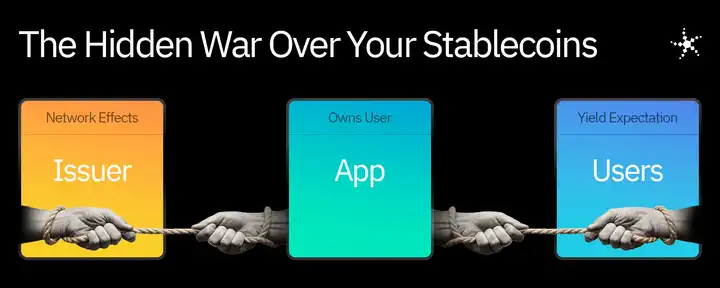
Stablecoin issuers possess one of the most profitable business models on Earth, and these substantial profits have made them a target for various stakeholders. At Blockchain Capital, we have closely observed the three-way tug-of-war among issuers, application layers, and users as they compete for these profits.
We have invested in several major issuers (such as Tether, Circle, and Paxos) and also in applications trying to claim their share (such as Aave, Phantom, Polymarket, and RedotPay). Here are our observations.
Issuers Reap Significant Profits
Users send fiat currency to issuers, who then mint digital dollars on the blockchain. Behind the scenes, issuers invest this fiat in cash or cash equivalents, earning a risk-free interest rate. That’s the entire business. In contrast, banks take your deposits but must lend them out, manage credit risk, and maintain branches; insurers collect premiums but ultimately must pay claims. Stablecoin issuers essentially hold government bonds, generating cash flow without complexity or risk.
Issuer revenue grows with the increase in assets under management, while operational costs remain largely unchanged: this is a pure, unconstrained cash flow machine. Tether reports a team size of about 300 people and expects to achieve $10 billion in profits by 2025. This is arguably one of the best business models in history.
However, massive profits inevitably attract competition.
Applications Also Want a Share
Most users never interact directly with issuers; they access stablecoins through applications like Phantom, which control the user relationship.
Large exchanges, DeFi protocols, and well-known wallets have significant bargaining power over issuers. They can designate default stablecoins and integrate or deprecate them through single product decisions, exerting some control over fund flows. If tens of billions of dollars in stablecoins remain within an application, that app can demand a share of the float interest. The logic is simple: we are distributing your assets and anchoring user behavior, so you must share the profits, or we will steer users toward competing stablecoins.
This is already happening. The most typical example is the relationship between Coinbase and Circle. Early on, Coinbase was the primary distribution engine for USDC and negotiated a profit-sharing agreement. It is reported that Coinbase receives 100% of the interest income generated by USDC on its platform and 50% of the interest income from USDC outside the platform. Whether within or outside the portfolio, applications are increasingly adopting this strategy, actively negotiating for their share.
Creating Branded Stablecoins: Bypassing Issuers
Applications can also attempt to launch their own branded stablecoins or "wrappers," completely bypassing issuers. Instead of directly steering users to USDC or USDT, they offer a dollar balance backed by a combination of stablecoins and short-term notes. In this case, the distributor is partially involved in the issuance business. Aave’s GHO stablecoin is one such example.
However, applications often lack the resources or licenses required to build a full issuance infrastructure. Therefore, they opt for white-label solutions like "Issuer-as-a-Service." Paxos is currently the leading white-label provider, supporting PayPal’s PYUSD. This allows PayPal to profit from the float interest without negotiating with large issuer.
Issuer Leverage
Applications cannot fully control issuers. Established stablecoins like USDC and USDT have strong network effects. They are the reserve assets of the entire DeFi ecosystem and the base trading pairs for most transactions. Branded stablecoins may be less attractive to users due to lower liquidity and integration compared to other stablecoins.
Additionally, white-label stablecoins are not as "neutral" as USDT. A company competing with PayPal at the application layer may be reluctant to accept PYUSD, as doing so would fund a competitor. Similarly, this dynamic may have affected Circle’s early development, as exchanges like Binance may have been hesitant to fully promote USDC due to its close ties with rival Coinbase, which is why Binance instead defaulted to supporting USDT. Today, USDT trading volume on Binance is about five times that of USDC.
User Demand for Floating Returns
In developed markets, user expectations for returns put pressure on issuers and applications. When the risk-free interest rate is around 4%, users in the U.S. naturally ask why their digital dollars aren’t earning any yield. When one wallet offers returns and a competitor doesn’t, users flock to the former.
If this expectation becomes the norm, the application layer faces a dilemma. To remain competitive, we expect applications may have to return some of the profits to users, forcing them to negotiate more aggressively with issuers. If an application cannot secure a share, it will struggle to pay interest to users without incurring losses. As more products promote "stablecoin balance returns," the model where "all profits remain with the underlying issuer" will be difficult to sustain.
However, this pressure is not universal. In many overseas markets, the core value of dollar stablecoins lies in hedging against local inflation and foreign exchange controls, rather than pursuing returns. A user struggling to prevent their assets from halving in value each year may not care much about earning 4% interest. For global issuers with high penetration in these regions, user demand for returns is not as urgent as in the U.S. market. We believe this dynamic may benefit Tether, which has the largest overseas user base.
Conclusion
In summary, user expectations and issuer profits have placed applications in a difficult position. They are caught between users who expect returns and issuers who want to retain profits. The stablecoin architecture is evolving rapidly, and the distribution of profits is still being contested. My guess is: users may ultimately be the beneficiaries of this game and receive the majority of the profits.
Related reading: A Guide to Stablecoin Returns: Which of the 8 Types Is Best?