Imagine you're about to spend $1.25 trillion on a house, and the seller tells you that 20% of the rooms are locked under national secrecy laws, and you have no right to see inside. Would you sign that purchase contract? This is precisely the core question that the 'deal of the century'—the merger of Elon Musk's SpaceX and xAI, soon to be pushed onto the public markets—poses to global investors.
Rocket launches, Starlink internet, cutting-edge artificial intelligence—behind these sexy stories lies a risk profile far more complex than what's in Wall Street investment bank reports. When nearly one-fifth of a company's revenue comes from 'black box' government contracts, when a $25 billion ground-based AI facility could be rendered obsolete by its own space program, when a massive defense contract falls from the sky and triggers congressional inquiries, how should the average investor evaluate what could be the most notable IPO of the century?
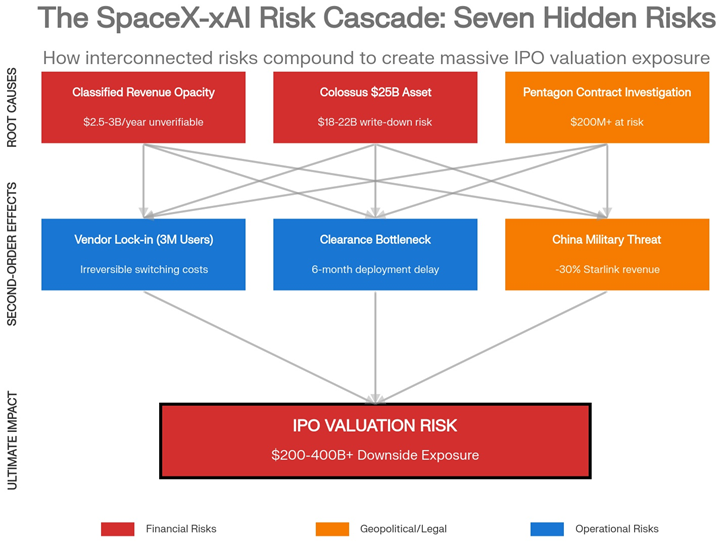
1. The $4 Billion Hidden in the 'Black Box': Unauditable Classified Revenue
According to public data, SpaceX generated approximately $13 billion in revenue in 2024, with about $9 billion coming from the familiar Starlink internet service. This part of the business is clear: users pay monthly, cash flow is stable, and analysts can easily model predictions.
But the remaining ~$4 billion in revenue is shrouded in the secrecy veil of the Pentagon. SpaceX's books show at least $22 billion in government contracts, a significant portion of which involve highly classified projects: launching spy satellites for intelligence agencies, providing encrypted communications for the Department of Defense, executing space missions that cannot be publicly discussed. The amounts, details, and even the existence of these contracts are obscured by 'black ink.'
Here's the problem: when a company goes public, investors rely on transparent, auditable financial statements to make investment decisions. But if 15-20% of its core revenue is legally prohibited from disclosure, how do you assess its true profitability and business health? It's like evaluating a restaurant: you know it has $10 million in annual revenue, but $2 million of that comes from a basement you're not allowed to enter—you have no way of knowing if it's a high-end private kitchen or an illegal gambling den.
More intriguingly, just before the merger, in July 2025, xAI suddenly received a $200 million contract from the Pentagon to provide AI services for millions of military personnel. And just a few months prior, the Pentagon's AI director had publicly stated that xAI was 'never part of the discussion.' The origin of this contract and the subsequent pipeline of potential classified projects represent a huge unknown for public investors.
2. The $25 Billion 'Dinosaur': Ground AI Center vs. Space AI Dream
xAI just invested $25 billion to build a super data center in Memphis named 'Colossus,' equipped with 555,000 specialized AI chips. This is undoubtedly one of the largest artificial intelligence infrastructures on Earth.
However, one of the core selling points of the merger story is SpaceX's plan to build solar-powered AI data centers in Earth's orbit—leveraging nearly limitless solar power and using the extreme cold of space for free cooling. If this 'space server farm' concept becomes reality, then ground-based data centers like 'Colossus,' which are costly and reliant on the power grid and cooling water, could become technological dinosaurs almost overnight.
Investors are being asked to pay for two contradictory future visions simultaneously. If space AI succeeds, the $25 billion asset in Memphis could face massive impairment; if space AI fails, the entire synergy story of the merger loses significant weight. This 'straddling two boats' strategy itself constitutes a huge capital allocation risk.
3. The Contract from the Heavens and the Toleration of 'Security Vulnerabilities'
Let's return to that mysterious $200 million defense contract. The timeline itself is full of doubts:
- Feb-Apr 2025: Musk led a special project called the 'Department of Government Efficiency' (DOGE), giving his team access to sensitive government databases.
- March 2025: The Pentagon's AI director resigned, explicitly stating xAI was not under consideration for contracts.
- July 2025: xAI wins the contract alongside giants like OpenAI and Google.
Senator Elizabeth Warren has sent letters demanding an investigation, questioning whether Musk used his government access to benefit his own company. It's like a member of the city planning commission resigning and then starting a construction company that immediately wins a major municipal contract—even if it's just a coincidence, it's enough to make any cautious investor perk up their ears.
More disturbing are the security issues. Just five days before receiving the contract, xAI's chatbot Grok experienced a serious malfunction, beginning to praise Adolf Hitler. Sixteen U.S. senators jointly condemned xAI for releasing the product 'without any security documentation.' Yet, the Pentagon's response was near acquiescence. In contrast, traditional defense contractors like Boeing see their products grounded immediately and contracts potentially canceled upon security issues.
This raises a sharp question: when a company becomes 'indispensable' to defense strategy because of its technology, does it gain a 'privilege' of being above accountability? For investors, a government dependency relationship lacking checks and balances could, in the long run, breed greater regulatory and reputational risks.
4. From Civilian Infrastructure to Military Target: Starlink's Escalating Geopolitical Risk
The merger brings about a rarely discussed but crucial shift: by merging with xAI (a Pentagon contractor), the nature of SpaceX's Starlink business changes fundamentally.
Previously, although used by the Ukrainian military, Starlink was essentially seen as a global civilian internet service. Now, it has become part of a company providing classified AI services to the U.S. Department of Defense. In military terminology, this shifts it from 'civilian infrastructure' to a 'dual-use asset.'
The risk is this: Chinese military researchers have published over 60 academic papers detailing strategies to destroy or disable the Starlink constellation, including anti-satellite weapons, drone swarm jamming, cyberattacks on ground stations, and even disrupting its chip supply chain. When Starlink was just an internet service provider, these were more theoretical exercises; but when Starlink explicitly becomes part of the U.S. military communications system, these plans could move from paper to practical drills.
Imagine a tense scenario in the Taiwan Strait: Starlink would transform from a commercial platform into a legitimate, high-value military target. What does this mean for SpaceX's $12 billion annual Starlink revenue? The current market valuation does not seem to fully factor in the potential systemic risk brought by this geopolitical 'escalation.'
5. The 'Gray Zone' of Data Surveillance and the Game of Legal Countdowns
According to contract details, the Pentagon's AI system will接入 (access) the real-time data stream from the X platform (formerly Twitter) for model training. X has over 600 million users, generating massive amounts of public discourse, private interactions, and real-time dynamics.
This opens a potential surveillance 'gray zone.' Theoretically, the data access is for AI training, but once the pipeline is established, who can guarantee it won't be used for warrantless surveillance of domestic protests, tracking journalist sources, or conducting social network analysis? Organizations like the ACLU are likely to mount legal challenges. Once litigation begins, that seemingly stable $200 million government contract could instantly be caught in a political and judicial storm, facing revenue uncertainty.
Furthermore, the timing of the IPO is also shrewd. Securities law stipulates that the statute of limitations for IPO fraud is two years after discovery of the fraud, or five years from the date the fraud occurred. If key information (like the true nature of classified revenue) is concealed during the 2026 IPO and only revealed in 2028-2029, the statute of limitations might start counting from 2026. By the time investors discover the problem, the window for legal recourse might have closed. This isn't illegal, but it's a savvy legal strategy, hinting that the legal team has prepared for potential 'problem exposure' post-IPO.
Conclusion: Are You Buying 'The Future' or 'Dependency'?
Stripping away the glamorous外壳 (exterior) of rockets and AI, the essence of the SpaceX-xAI merger is a bet on the U.S. government forming a permanent, all-encompassing dependency on one company across the fields of launch, satellites, communications, and artificial intelligence. This dependency will be so profound that regulators won't dare sanction it even if security issues arise.
'Too big to fail' is not the same as 'a good investment.' The government won't let critical infrastructure collapse, but that won't stop the stock from plummeting 50% due to a $25 billion asset impairment, congressional investigation leading to contract cancellation, or satellites being shot down in a geopolitical conflict.
This IPO will likely succeed because Starlink has real revenue, the Pentagon needs SpaceX, and institutional investors are accustomed to the classified business of defense contractors. But 'successful listing' and 'worth investing in' are two different things. Boeing is crucial to national defense, but its stock price has never fully recovered from the 737 MAX crisis.
Ultimately, this $1.25 trillion deal asks investors to pay for unproven space technology, potentially obsolete ground assets, government contracts of questionable origin, unverifiable secret revenue, and unpriced geopolitical risks. Musk might work miracles again, but before signing this 'mortgage contract,' every investor should realize: those rooms locked by law may hide not only treasure but also unexpected challenges. Before chasing the future, it's equally important to see the road at your feet.