Silicon Valley Godfather Naval Takes the Helm, AngelList Packs Pre-IPO Growth Companies into USVC Fund

marsbitXuất bản vào 2026-04-24Cập nhật gần nhất vào 2026-04-24

Tóm tắt

This article discusses the USVC Venture Capital Access Fund (USVC), a new investment vehicle co-founded by prominent Silicon Valley investor Naval Ravikant through AngelList. The fund's core mission is to provide retail investors access to high-growth, pre-IPO companies—a segment of the market traditionally reserved for venture capitalists and accredited investors. USVC invests in a portfolio of late-stage private companies, including notable names like xAI, Anthropic, and OpenAI. Its key selling point is allowing ordinary investors to gain exposure to the significant value creation that occurs before a company goes public, as the average age of companies at IPO has increased from 6 years in 1980 to 13 years today. However, the article highlights several important constraints: investors buy fund shares, not direct stock; the fund carries a net annual fee of 2.5%; it offers limited liquidity through quarterly share repurchases; and investments are long-term with no fixed end date. The fund has also garnered attention in the Web3 community due to Naval’s and AngelList’s history of supporting crypto and blockchain projects, positioning USVC at the intersection of traditional venture capital and emerging digital asset investment trends.

Author: KarenZ, Foresight News

In Silicon Valley, the name Naval Ravikant is synonymous with credibility.

He is the co-founder of AngelList and one of the most representative early-stage investors of the past decade, having backed companies like Uber, Twitter, and Notion. Now, in the new USVC Venture Capital Access Fund (USVC), Naval is not just a symbolic figure. According to the fund's April 2026 supplemental disclosure document, he serves as the Chairman of the Investment Committee, responsible for portfolio construction and strategy oversight.

This arrangement is significant because USVC is not merely selling the concept of a "low-threshold fund." What it is truly attempting to package and offer is a capability that was previously available only to a select few: earlier access to pre-IPO growth-stage companies.

On the surface, USVC is most easily understood as a "venture capital fund for retail investors." But when viewed together—the official website, the prospectus, and the portfolio page—the core story AngelList wants to tell becomes clearer and more pointed: the most imaginative companies today are taking longer to go public; IPOs are increasingly becoming exit points rather than entry points; what ordinary investors are shut out of is not just the risk, but also the most "lucrative" period of growth.

The significance of USVC lies in its attempt to pry that door open a little.

The Core of USVC: Not a Fund, But Selling 'Pre-IPO' Access

The USVC homepage states the problem bluntly: The next wave of growth is happening in the private markets. The website also provides a telling comparison: in 1980, the median age of a U.S. company at IPO was 6 years; today, it's 13 years. Those extra 7 years mean a massive amount of value creation is occurring outside the public markets.

This is the crucial product logic behind USVC. The USVC prospectus clearly states that USVC primarily invests in VC funds, SPVs, and private, pre-IPO growth-oriented companies. The most easily overlooked, yet most critical term here is "pre-IPO growth-oriented companies." The definition in the document is equally direct: private companies that the investment adviser believes "have significant growth potential at the time of investment."

In other words, USVC's selling point is not the abstract "allocation to venture capital," but rather bringing ordinary investors face-to-face with the truly most attractive segment of assets in the private markets. It aims to sell a channel for accessing pre-IPO growth companies.

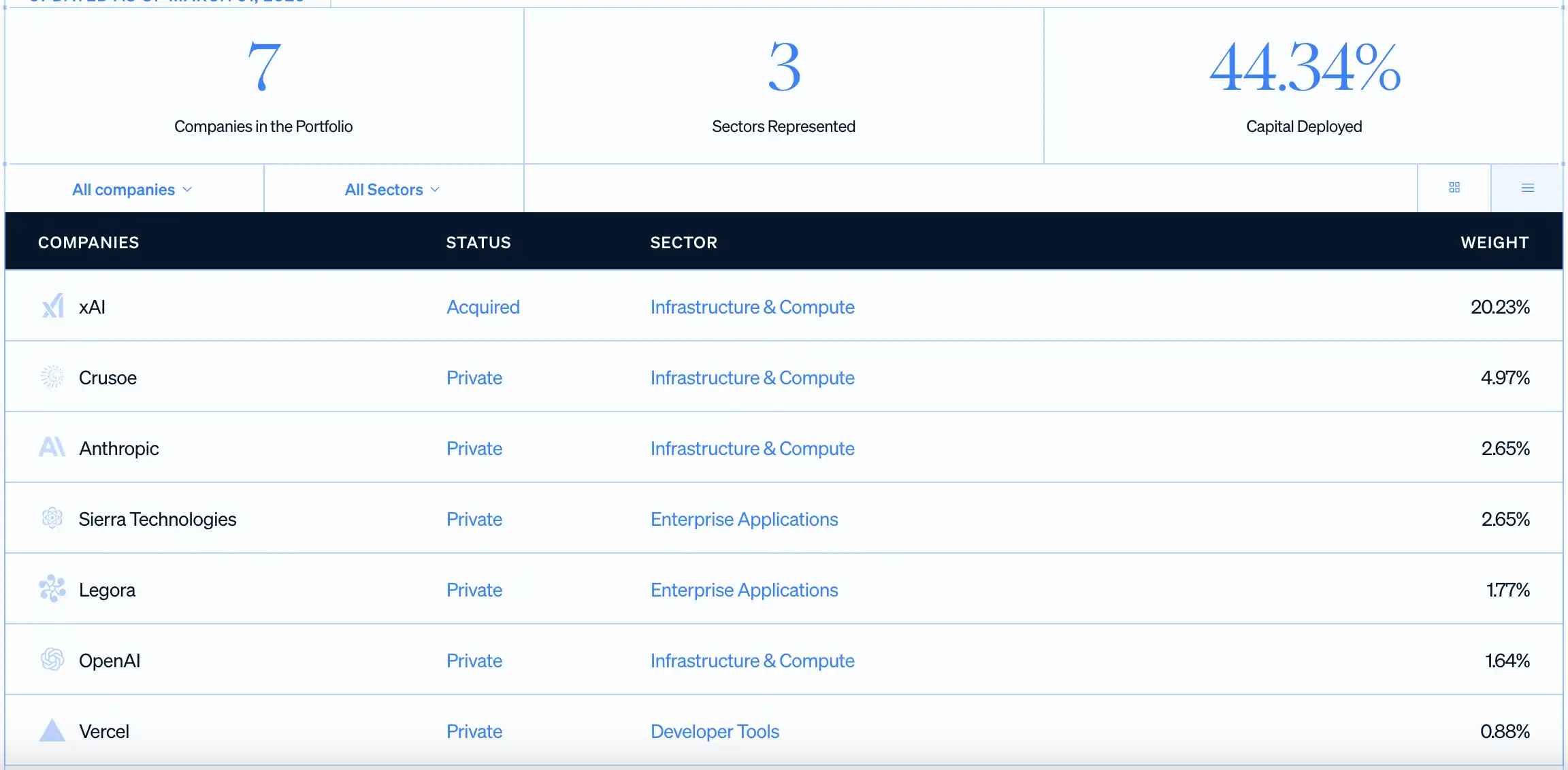
This is also why it consistently emphasizes names like OpenAI, Anthropic, xAI, and Vercel. The portfolio page on the website shows that as of March 31, 2026, USVC had deployed 44.34% of its capital, with 7 companies in its portfolio. The largest single holding is xAI, followed by Crusoe, Anthropic, Sierra, Legora, OpenAI, and Vercel. Regardless of the eventual performance of these positions, the message AngelList wants to send investors is clear enough: companies you once only read about in the news, you can now gain some exposure to *before* they go public, through a single fund.
This is highly attractive to ordinary investors. Because under the traditional path, they typically only get the chance to buy in *after* a company's IPO. And by that point, the earliest, most explosive growth has likely already been captured by the founding team, employees, early-stage funds, and institutional shareholders.

Legally, this fund is registered as a closed-end management investment company under the U.S. Investment Company Act of 1940. It was initially established on April 8, 2021, converted to a Delaware statutory trust on August 7, 2025, and is currently raising capital through a continuous offering. The initial investment threshold is $500, with no minimum for subsequent additions; the website even supports monthly dollar-cost averaging.

This packaging is clever. It retains the core attraction of the private markets—pre-IPO growth companies—while making the purchase process resemble a retail financial product as much as possible. U.S. users don't need to first become accredited investors, enter high-net-worth circles, or deal with the complex tax forms typical of traditional private funds. At the point of purchase, at least, AngelList tries to make it seem simple enough.

Access to Pre-IPO Companies Does Not Mean a Simple Investment

Precisely because USVC's narrative is so enticing, it's the constraints behind it that need to be clearly spelled out.

First, investors are buying a share of a fund. The fund holds these pre-IPO growth companies indirectly or directly through VC funds, SPVs, and direct investments. This means investors get *access* to pre-IPO growth companies, not the clear, readily realizable ownership experience of buying a stock.

Second, this access comes at a cost, and it's not low. The fee table on page 20 of the Prospectus shows that USVC has a management fee of 1.00%, a shareholder servicing fee of 0.25%, underlying fund fees and expenses of 0.95%, other expenses of 1.41%, resulting in a total annual expense ratio of 3.61%. After fee waivers (in place at least until October 29, 2026), the net annual expense ratio is 2.50%. After accounting for the underlying VC vehicle and operational costs, investors are facing a product with a current net expense ratio that is not insignificant.
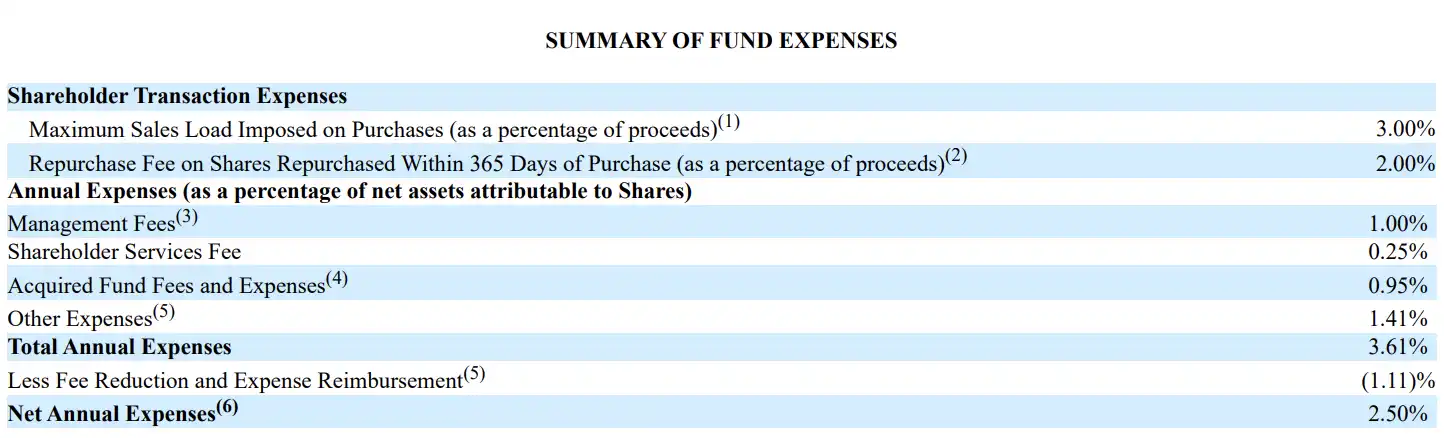
Third, this fund does not provide ordinary investors with a truly high-liquidity exit path. USVC is not listed on an exchange, has no public trading market, and liquidity primarily depends on whether the Board of Directors initiates quarterly share repurchases, which typically will not exceed 5% of net assets. The documents originally included a 2% repurchase fee for shares held less than a year, but the Board has currently decided to waive it (subject to modification or termination). This means it offers slightly more flexibility than a traditional VC fund, but is still far from "in and out anytime."

Fourth, USVC does not have a fixed termination/ liquidation date like a traditional 10+2 year venture capital fund, but it is still a long-term, closed-end structure with no defined end date. When the underlying assets realize their value still depends on liquidity events like IPOs, mergers and acquisitions, or private secondary transactions. The prospectus also clearly warns that many portfolio investments may take several years to appreciate significantly.

And even after a portfolio company goes public, it is often subject to lock-up restrictions, commonly for 180 days. During this period, the fund itself, or the managers of the underlying VC/SPV the fund invested in, may not be able to sell immediately.

Why is the Web3 Circle Paying Attention to This Fund?

The additional attention USVC is receiving from the Web3 circle is also related to Naval's and AngelList's sustained investment in the crypto industry over the years.

Naval has long been one of Silicon Valley's most publicly supportive investors of crypto assets and the Web3 narrative. In 2017, he told Laura Shin in an interview that his attention had largely shifted to Crypto; by 2021, he systematically discussed Web3, NFTs, and digital property rights with a16z partner Chris Dixon in a long conversation with Tim Ferriss.

On the platform side, AngelList has not treated Crypto as a fringe business in recent years, beginning to support investments in USDC on its platform in 2022. AngelList's website currently has a dedicated Crypto solutions page, explicitly stating its collaboration with CoinList to support Crypto SPVs and related fund vehicles.

Furthermore, on the other side, more and more cryptocurrency exchanges and Web3 projects are accelerating the launch of Pre-IPO products. USVC represents a slow-moving variable within the system, while most Web3 Pre-IPO products represent fast-moving variables driven by efficiency, often offering the ability to exit at any time.

These two worlds originally spoke different languages but are now competing for the same investors, the same narrative, and the same anxiety: If great companies are taking longer to go public, can ordinary people still get a share of the pie *before* the IPO?

Naval's name can push that door open. AngelList's platform network can bring pre-IPO companies closer. But the world behind the door hasn't necessarily become much easier because of it.


Câu hỏi Liên quan

QWhat is the primary investment focus of the USVC Venture Capital Access Fund (USVC)?

AThe USVC primarily invests in VC funds, SPVs, and private growth-oriented companies that are not yet publicly traded, aiming to provide access to high-growth potential companies before they IPO.

QWho is Naval Ravikant and what role does he play in the USVC fund?

ANaval Ravikant is the co-founder of AngelList and a prominent early-stage investor. In the USVC fund, he serves as the Chairman of the Investment Committee, responsible for portfolio construction and strategy oversight.

QWhat are some of the constraints or risks associated with investing in USVC?

AConstraints include high fees (a net annual fee rate of 2.50% after waivers), limited liquidity with no public trading market and reliance on quarterly share repurchases, no fixed expiration date, and underlying assets subject to lock-up periods post-IPO.

QWhy is the USVC fund particularly relevant to the Web3 and crypto community?

AIt is relevant because Naval Ravikant and AngelList have been strong supporters of crypto and Web3, with AngelList offering Crypto SPVs and fund vehicles. The fund also addresses the same narrative as Web3 Pre-IPO products: providing access to high-growth companies before public listing.

QHow does USVC lower the barrier to entry for average investors compared to traditional venture capital investments?

AUSVC lowers barriers by allowing an initial investment of just $500, supporting monthly investments, and not requiring investors to be accredited or high-net-worth individuals, while simplifying tax reporting compared to traditional私募 funds.

Nội dung Liên quan

Hướng dẫn sử dụng chế độ Goal của Codex: Cách để AI không ngừng thúc đẩy một mục tiêu cụ thể

Biên tập viên: Bài viết này từ Dominik Kundel, thành viên quan hệ nhà phát triển của OpenAI, tổng kết kinh nghiệm sử dụng tính năng "goal mode / /goal" của Codex. Nó không chỉ nói về kỹ thuật nhắc lệnh thông thường, mà nói về sự thay đổi vai trò của công cụ lập trình AI: Codex không còn chỉ là trợ lý mã hóa phản hồi lệnh đơn lẻ, mà bắt đầu trở thành một tác nhân hành động có thể liên tục thúc đẩy theo đuổi một mục tiêu rõ ràng. Trong chế độ /goal, điều thực sự quan trọng không phải là viết yêu cầu càng dài càng chi tiết, mà là thiết lập tiêu chuẩn thoát rõ ràng, có thể xác minh cho Codex. Ví dụ: "giảm 30% thời gian triển khai", "đạt 100% parity về phạm vi kiểm thử", "LCP xuống dưới 2,5 giây". Những chỉ số này cho phép Codex đánh giá nhiệm vụ đã hoàn thành hay chưa, đồng thời tránh nó thử sai vô hạn trong mục tiêu mơ hồ. Đồng thời, người dùng cần cung cấp đủ định hướng, công cụ và môi trường thực tế để Codex có thể đo lường tiến độ, xác minh kết quả, thay vì chỉ hoàn thành một giải pháp khả thi trong điều kiện giả định cục bộ. Bài viết đặc biệt nhắc nhở, nhiệm vụ liên quan đến hình ảnh dễ khiến Codex sa lầy vào chi tiết nhất. Thay vì yêu cầu "khôi phục chính xác đến từng pixel 100%", nên phân giải mục tiêu hình ảnh thành danh sách chức năng, quy tắc hệ thống thiết kế và chỉ số có thể đánh giá. Đối với nhiệm vụ dài hạn kéo dài hàng giờ thậm chí vài ngày, cũng cần theo dõi liên tục thông qua commit, draft PR, tài liệu tiến độ, cập nhật Slack hoặc side chat, tránh cuối cùng chỉ nhận được một loạt thay đổi không thể truy nguyên. Thông tin tăng thêm của bài viết nằm ở việc định nghĩa lại /goal như một "cơ chế quản lý nhiệm vụ dài hạn". Khi AI có thể thực thi liên tục hàng chục thậm chí hàng trăm giờ, năng lực cốt lõi của nhà phát triển cũng thay đổi: không chỉ là để AI tạo mã, mà là định nghĩa mục tiêu cho nó, thiết lập hệ thống đo lường, cấu hình môi trường thực thi, và cuối cùng hoàn thành xem xét và tổng kết. Nói cách khác, lập trình AI đang chuyển từ "viết lời nhắc" sang "quản lý một tác nhân thực thi kỹ thuật làm việc liên tục".

marsbit26 phút trước

Hướng dẫn sử dụng chế độ Goal của Codex: Cách để AI không ngừng thúc đẩy một mục tiêu cụ thể

marsbit26 phút trước

Từ Ethereum đến 'CROPS' của AI: Hệ thống 'biến số chậm' mà Vitalik nhấn mạnh liên tục này rốt cuộc là gì?

Trong thời gian gần đây, Vitalik Buterin đã nhiều lần nhắc tới khái niệm "CROPS" - viết tắt của **C**hống kiểm duyệt, **R**esistance (Chống chiếm đoạt), **O**pen source (Mã nguồn mở), **P**rivacy (Quyền riêng tư), **S**ecurity (Bảo mật). Đây là những giá trị cốt lõi được Ethereum Foundation xác định là định hướng phát triển dài hạn, nhấn mạnh việc trao quyền kiểm soát cuối cùng cho người dùng trong môi trường phi tập trung. Bài viết chỉ ra rằng, trong bối cảnh AI ngày càng tích hợp vào ví và tự động hóa các giao dịch, CROPS không còn chỉ là triết lý của Ethereum mà trở thành vấn đề sống còn đảm bảo người dùng vẫn làm chủ được đời sống số của mình. Một hệ thống AI tuân thủ CROPS cần có khả năng chạy cục bộ, bảo vệ quyền riêng tư và minh bạch, đặc biệt khi xử lý các tác vụ liên quan đến tài sản. Giao điểm giữa "CROPS Ethereum" và "CROPS AI" nằm ở việc xây dựng một lớp truy cập an toàn và riêng tư, chẳng hạn thông qua việc sử dụng bằng chứng không tiết lộ thông tin (ZK) cho các lệnh gọi AI từ xa hay truy vấn dữ liệu Ethereum riêng tư. Điều này định hình tương lai của ví Web3, không chỉ là công cụ ký giao dịch mà còn là bảng điều khiển giúp người dùng hiểu rõ, xác minh và kiểm soát mọi tương tác với DApp và AI Agent. Tóm lại, CROPS đặt ra một khuôn khổ tư duy quan trọng cho kỷ nguyên AI: Làm thế nào để xây dựng các hệ thống số mạnh mẽ mà vẫn bảo toàn quyền tự chủ, quyền riêng tư và sự an toàn tối thượng cho người dùng. Đây chính là biến số tích cực dài hạn cho giá trị của Ethereum.

marsbit30 phút trước

Từ Ethereum đến 'CROPS' của AI: Hệ thống 'biến số chậm' mà Vitalik nhấn mạnh liên tục này rốt cuộc là gì?

marsbit30 phút trước

Hãy Quên Bitcoin Đi, Vàng Có Liên Quan Gì Đến Mùa Altcoin?

Mùa altcoin tiếp theo có thể không bắt đầu từ sự thống trị của Bitcoin, dòng tiền ETF hay các tín hiệu luân chuyển thông thường. Một góc nhìn thú vị hướng đến một yếu tố ít rõ ràng hơn: vàng. Lập luận cho rằng đợt biến động lớn sắp tới của kim loại quý này có thể quyết định liệu đợt phục hồi tiếp theo của thị trường crypto là thật hay chỉ là một cái bẫy khác, cuối cùng dẫn đến một mùa altcoin mới. Giá vàng hiện giao dịch quanh 4.460 USD, vẫn tăng khoảng 37% so với cùng kỳ năm ngoái. Một dự báo kỹ thuật cho thấy vàng có thể phục hồi lên vùng 4.800 USD (mức thoái lui Fibonacci 61,8%) trước khi tiếp tục xu hướng điều chỉnh. Điểm quan trọng là đợt tăng giá này của vàng được kỳ vọng sẽ kích hoạt một đợt tăng tương tự trên thị trường altcoin, thu hút sự chú ý của nhà đầu tư nhỏ lẻ (FOMO). Sau đó, thị trường dự kiến sẽ trải qua một đợt điều chỉnh mạnh, đánh dấu sự đầu hàng (capitulation) - thời điểm mà mùa altcoin thực sự được cho là sẽ bắt đầu. Song song đó, vốn hóa tổng thị trường crypto (loại trừ stablecoin) đang ở khoảng 2,04 nghìn tỷ USD và đang thử nghiệm một đường hỗ trợ tăng dài hạn. Chỉ số mùa altcoin hiện đang trong lãnh thổ của "mùa Bitcoin" với tỷ trọng thống trị là 57,8%, trong khi vốn hóa thị trường altcoin (loại trừ Bitcoin) đã giảm xuống khoảng 882 tỷ USD. Phân tích vàng gợi ý thị trường có thể cần một đợi xả cảm xúc cuối cùng, trong khi biểu đồ vốn hóa tổng cho thấy thị trường đang ở vùng hỗ trợ quan trọng, nơi các đợt mở rộng lớn thường hình thành. Đợt tăng tiếp theo có thể chưa đủ, và đợt điều chỉnh sau đó mới chính là thứ dọn đường cho một mùa altcoin thực sự.

bitcoinist37 phút trước

Hãy Quên Bitcoin Đi, Vàng Có Liên Quan Gì Đến Mùa Altcoin?

bitcoinist37 phút trước

Giao dịch

Giao ngay
Hợp đồng Tương lai
活动图片




