This weekly report covers the period from January 17, 2026, to January 23, 2026.
This week, the total on-chain RWA market cap steadily increased to $22.59 billion, with holders surpassing 640,000, driven primarily by user expansion. The total stablecoin market cap slightly decreased to $2.9619 trillion, while the monthly transfer volume surged to $8.99 trillion, with a turnover rate jumping to 30.3 times, indicating the market has entered a stage of high turnover of existing funds, while the inflow of new capital has slowed.
On the regulatory front, Hong Kong is expected to issue its first batch of stablecoin licenses within the year, and the technical support for China's digital yuan smart contracts has been clarified. Institutionally, the NYSE announced the development of a tokenized securities platform, and F/m Investments applied to the SEC for a pilot program of tokenized shares, showing that mainstream trading venues and asset management institutions are actively bringing traditional assets onto the blockchain.
At the project level, Ondo Finance expanded its tokenized stocks and ETFs to Solana, RedStone acquired Security Token Market to strengthen RWA data infrastructure, and Superstate completed a large funding round to build an on-chain issuance layer. Payment scenarios continue to deepen, with companies like Argentina's Pomelo securing funding to advance the implementation of stablecoin credit cards.
Overall, the market, led by traditional finance, is shifting from user expansion to a focus on efficiency and scale, while the stablecoin market presents a complex landscape of high-frequency settlement and differentiated ecosystem activity.
Data Overview
RWA Sector Overview
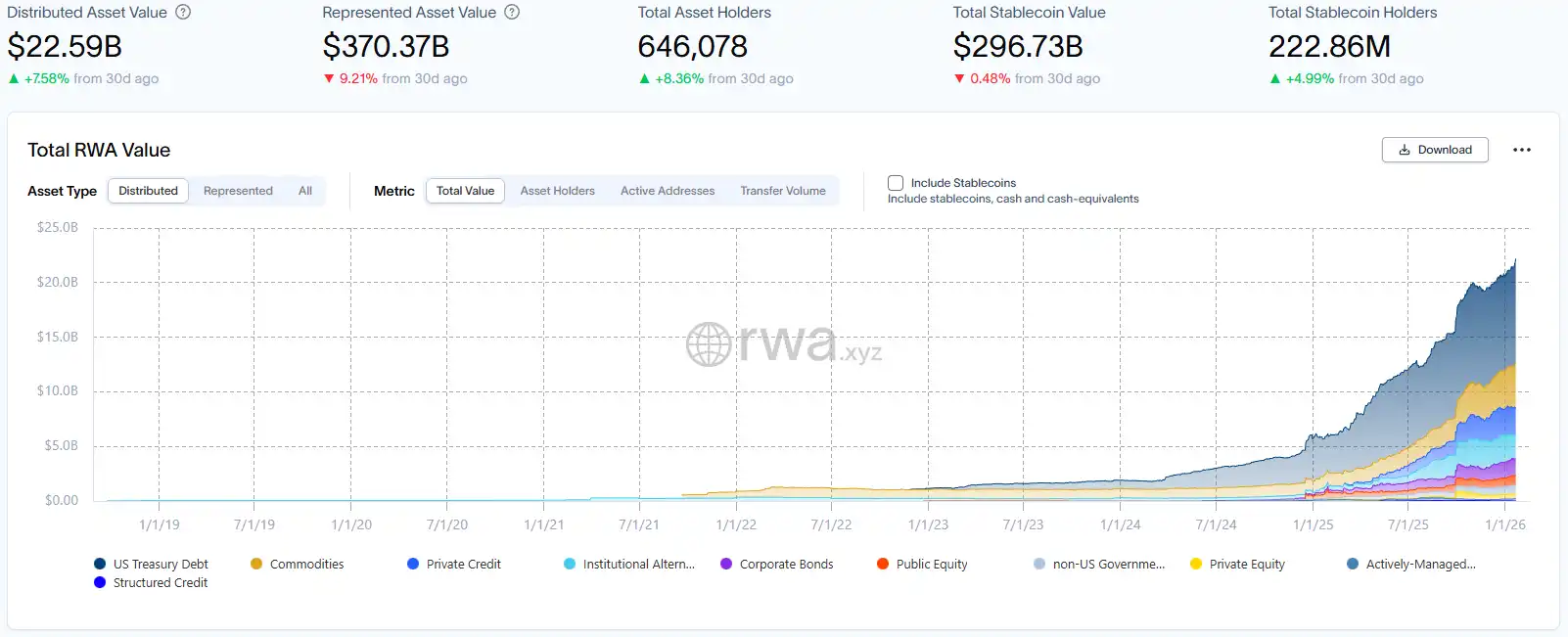
Latest data from RWA.xyz reveals that as of January 23, 2026, the total on-chain RWA market cap reached $22.59 billion, a 7.58% increase month-over-month, showing steady growth; the total number of asset holders increased to approximately 646,100, up 8.36% month-over-month.
The growth rate of asset holders is higher than that of asset scale, indicating the market is still in a "user expansion-driven" phase.
Stablecoin Market
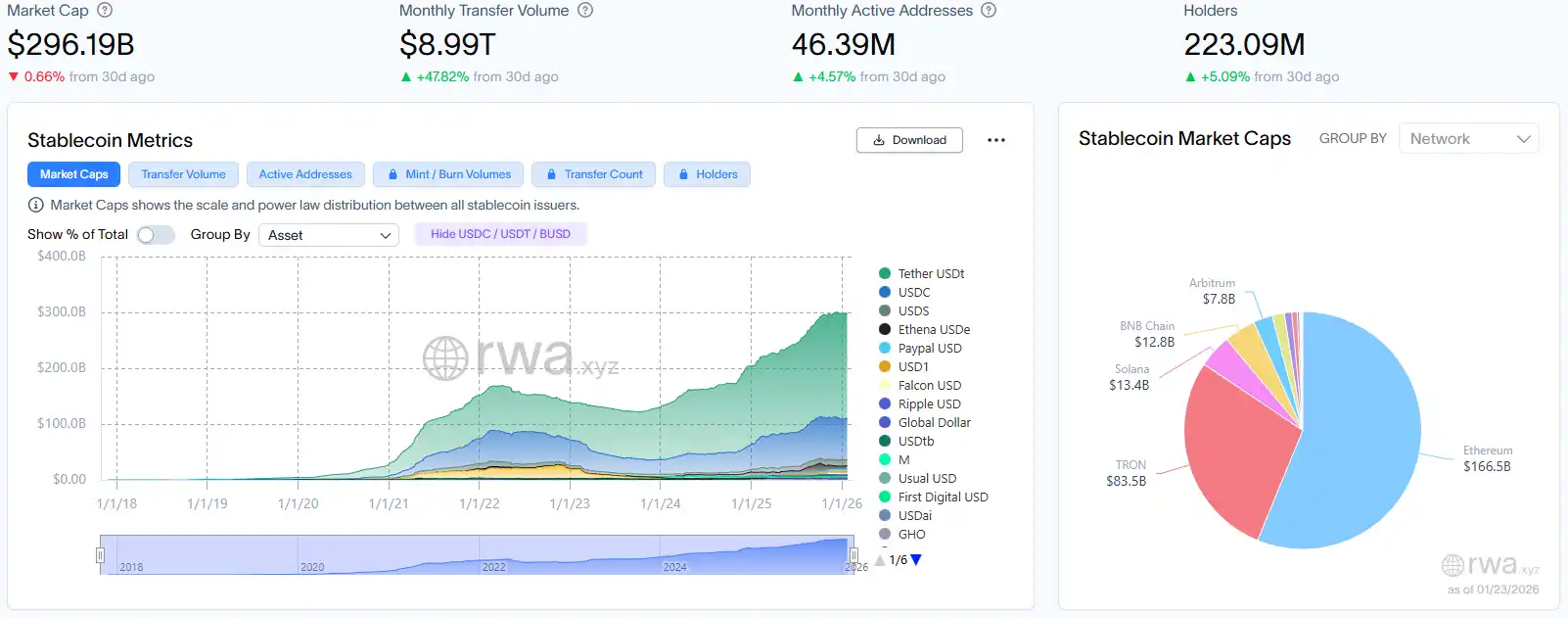
The total stablecoin market cap contracted to $2,961.9 billion, a slight decrease of 0.66% month-over-month, reflecting a drying up of new capital inflows or potential net outflow pressure; the monthly transfer volume surged to $8.99 trillion, a sharp increase of 47.82% month-over-month, and the turnover rate (transfer volume/market cap) jumped significantly to 30.3 times, highlighting the high liquidity advantage of stablecoins.
The total number of monthly active addresses increased to 46.39 million, up 4.57% month-over-month; the total number of holders reached 223 million, a 5.09% increase month-over-month, indicating a continued broadening of the user base.
The data suggests the market has entered a "normalized phase of存量博弈 (stock game/competition for existing resources)". The divergence between the contracting market cap and surging turnover rate implies that funds might be "circulating idly" within the system through high leverage, derivative collateral, or arbitrage strategies, rather than being used for ecosystem expansion.
The leading stablecoins are USDT, USDC, and USDS. Among them, USDT's market cap decreased slightly by 0.04% month-over-month; USDC's market cap decreased slightly by 0.01% month-over-month; USDS's market cap increased slightly by 0.11% month-over-month.
Regulatory News
Paul Chan: Hong Kong Expected to Issue First Batch of Stablecoin Licenses Later This Year
Hong Kong's Financial Secretary, Paul Chan, stated at the Davos Forum that Hong Kong will issue the first batch of stablecoin-related licenses later this year, implementing the principle of 'same activity, same risk, same regulation' to steadily promote the development of digital assets. So far, licenses have been issued to 11 virtual asset trading platforms, and three batches of tokenized green bonds totaling approximately $2.1 billion have been issued. He emphasized that digital assets can enhance financial efficiency and risk management and are a key force in integrating the real economy with technology.
Local Developments
Caixin: Digital Yuan Smart Contract Development Supports Fully Turing-Complete Languages Like Ethereum's Solidity
According to Caixin Net, a technical source familiar with the digital yuan revealed that the smart contracts based on the digital yuan's account system and those on public chains are essentially "code that executes automatically upon triggered conditions," with the difference lying in whether they are fully Turing-complete. The smart contracts based on the digital yuan's account system are restricted Turing-complete, with programming strictly limited to template scripts approved by the central bank, supporting only preset, simple conditional trigger functions. This design is primarily for security and risk control considerations. The development of digital yuan smart contracts supports various programming languages, including fully Turing-complete languages like Ethereum's Solidity, so it's not a technical issue, but the core challenge is designing a standard access and audit mechanism acceptable to the financial system.
KuCoin Reaches Investment Intent with Gold Jun Services, Plans Joint Venture with Hong Kong Gold Exchange to Advance Integrated Gold Industry Platform
KuCoin announced today that it has reached an intent for equity investment with Gold Jun Services Limited and will support its in-depth cooperation with the Hong Kong Gold Exchange (HKGX) to jointly promote the construction of a comprehensive gold industry chain platform integrating trading, settlement, warehousing, and related management functions.
Against the backdrop of Hong Kong's gold market accelerating its upgrade, this cooperation aims to enhance the cross-regional circulation and synergy efficiency of the gold market through technology and system integration. This strategic investment reflects KuCoin's ongoing exploration in financial infrastructure construction, aiming to promote the integration of digital technology and the physical gold industry, and help build a more efficient and transparent gold industry ecosystem.
Project Progress
Bhutan to Run Sei Network Validator Node, Explore Payments and Tokenization Cooperation
According to Cointelegraph, Bhutan's sovereign wealth fund, Druk Holding and Investments (DHI), will deploy and operate a Sei Network validator node in collaboration with the Sei Development Foundation in the first quarter of this year, as part of its digital transformation. The head of DHI stated that the two parties may subsequently cooperate in areas such as payments, tokenization, and digital identity. The report noted that Bhutan has already provided an Ethereum-based self-sovereign identity system for approximately 800,000 residents and has accumulated about 11,286 BTC through Bitcoin mining for national projects, including the Gelephu Mindfulness City.
New York Stock Exchange Announces Development of Tokenized Securities Platform
According to Businesswire, the New York Stock Exchange announced that it is developing a tokenized securities trading and on-chain settlement platform and will seek regulatory approval for it. The platform will support a tokenized trading experience, including 24/7 operation, instant settlement, dollar-denominated orders, and stablecoin-based financing. Its design incorporates the exchange's Pillar matching engine and a blockchain-based post-trade processing system, with capabilities to support multi-chain settlement and custody.
Upon regulatory approval, the platform will provide the NYSE with a new trading venue supporting the trading of tokenized stocks interchangeable with traditional securities and natively issued digital security tokens. Tokenized shareholders will enjoy traditional shareholder dividends and corporate governance rights. The design of this trading venue complies with established market structure principles and will be distributed through non-discriminatory channels to all qualified broker-dealers.
F/m Investments Applies to SEC for Tokenized Shares Pilot
According to Bloomberg, F/m Investments has applied to the U.S. Securities and Exchange Commission (SEC) for an exemptive relief, planning to record a portion of the shares of its $6.3 billion U.S. Treasury 3-Month ETF (ticker TBIL) on the blockchain, making it a testing ground for tokenizing traditional assets. The application does not change the ETF's holding structure or trading methods; it only implements on-chain registration of shares in the backend, ensuring consistency with existing shares in terms of fees, rights, and information disclosure. If approved, this case will become a key test for the integration of blockchain technology into the U.S. asset management system.
Laser Digital, Backed by Nomura, Launches Tokenized Bitcoin Yield Fund
According to CoinDesk, Laser Digital, a crypto trading firm under Nomura, has launched a tokenized Bitcoin yield fund. The fund aims to provide asset yields for long-term holders through market-neutral arbitrage, lending, and options strategies. Its target is to achieve a net return exceeding the spot Bitcoin performance by more than 5% over a rolling 12-month period.
The fund will be natively tokenized through the tokenization specialist KAIO and custodied by Komainu, a joint custody venture between Nomura, CoinShares, and Ledger. It is only open to specific qualified investors in eligible jurisdictions (non-U.S.), with a minimum subscription amount of $250,000 or the equivalent in Bitcoin.
Jupiter: To Explore More Stablecoin Use Cases, JupUSD Focuses on Security, Inclusivity, and Transparency
Jupiter, a DEX on the Solana ecosystem, stated on platform X that the初衷 (original intention) behind launching the stablecoin JupUSD is to focus on security, inclusivity, and transparency. Currently, JupUSD is still in its early stages and will continue to be developed within the project and the ecosystem:
1. JupUSD will actively return native treasury yields to the ecosystem;
2. JupUSD reserves are backed by 90% BlackRock's BUIDL fund and 10% USDC;
3. Providing JupUSD on Jupiter Lend will earn native treasury yields;
4. The yield-bearing asset jlJupUSD can be used as a core composable trading token and DeFi building block, just like JLP;
5. Jupiter will seek more stablecoin use cases, integrations, and partners to enhance JupUSD.
Ondo Finance Expands 200+ Tokenized U.S. Stocks and ETFs to Solana Chain
According to CoinDesk, Ondo Finance announced the expansion of its tokenized stocks and ETF business to the Solana blockchain, bringing over 200 tokenized U.S. stocks and ETFs to the network for the first time. This will expand its platform, Ondo Global Markets, from the original Ethereum and BNB Chain.
RedStone Acquires Data Platform Security Token Market to Accelerate Adoption of Tokenized Assets
According to Cryptobriefing, oracle service provider RedStone has acquired the digital asset data platform Security Token Market (STM.co) and its flagship conference TokenizeThis to accelerate the adoption of real-world asset tokenization and expand its influence in the U.S. and institutional markets.
STM, founded in 2018, operates the world's largest database of tokenized RWAs, tracking over 800 on-chain stocks, real estate, debt instruments, and funds with a total market cap exceeding $60 billion. Its annual conference, TokenizeThis, brings together banks, asset managers, regulators, issuers, and blockchain leaders to discuss asset tokenization in both traditional and decentralized finance.
USD.AI Approves Up to $500 Million GPU Financing Facility for Sharon AI
According to an official announcement from USD.AI, USD.AI has approved an asset-backed, non-recourse debt facility of up to $500 million for Australian AI computing provider Sharon AI, financing GPU deployment through an on-chain credit system with stablecoin liquidity; it is expected to be utilized as early as Q1 2026, with the first tranche being approximately $65 million.
Tokenized Risk Startup Cork Completes $5.5 Million Seed Round Led by a16z and CSX
According to The Block, startup Cork announced the completion of a $5.5 million seed funding round led by Andreessen Horowitz (a16z), CSX, and Road Capital, with participation from 432 Ventures, BitGo Ventures, Cooley, DEPO Ventures, Funfair Ventures, G20 Group, Gate Labs, Hyperithm Gate, IDEO Ventures, PEER VC, Stake Capital, and WAGMI Ventures.
Cork is committed to building a "programmable risk layer" aimed at making the implicit risks in real-world assets transparent and tradable through tokenization. Its infrastructure allows asset managers, issuers, and others to create customized swap markets to enhance the redemption liquidity, risk transparency, and market confidence of on-chain assets. This tool can also be used to assess the risks of crypto-native products like stablecoins and staking tokens. The team plans to launch the first production-grade risk markets in the coming months and expand cooperation with treasuries and asset issuers.
Fintech and Asset Tokenization Company Superstate Completes $82.5 Million Series B Funding
According to Cointelegraph, fintech and asset tokenization company Superstate announced the completion of an $82.5 million Series B funding round led by Bain Capital Crypto and Distributed Global, with participation from Haun Ventures, Brevan Howard Digital, Galaxy Digital, Bullish, ParaFi, and others. The company plans to use this funding to build a complete on-chain issuance layer on the Ethereum and Solana blockchains for issuing and trading SEC-registered shares. Its goal is to use blockchain technology to make the company fundraising and listing process more efficient.
Superstate currently manages over $1.23 billion in assets and operates two tokenized funds. As an SEC-registered transfer agent, the company, through its "Opening Bell" platform, has supported listed companies in directly issuing and selling digital shares to investors on public blockchains since late 2025, enabling real-time management of issuance, settlement, and ownership records.
Argentine Payment Startup Pomelo Completes $55 Million Series C Funding, to Launch Stablecoin Credit Card
According to Bloomberg, Argentina-based fintech company Pomelo has completed a $55 million Series C funding round led by Kaszek and Insight Partners, aiming to deepen its presence in the Latin American market and expand its global business. The funds will be used to expand its credit card payment processing business in Mexico and Brazil and to launch a global credit card settled with the stablecoin USDC. Pomelo also plans to develop real-time and intelligent agent payment systems that can operate cross-border, serving traditional banks and large international clients. Current partners already include Visa, Mastercard, Binance, Western Union, and others.
River Completes $12 Million Strategic Funding Round with Participation from Maelstrom Fund, The Spartan Group, etc.
River announced the completion of a $12 million strategic funding round with investors including Tron DAO, Justin Sun, the Maelstrom Fund founded by Arthur Hayes, The Spartan Group, and several U.S. and European Nasdaq-listed companies. This funding will support River's expansion into EVM and non-EVM ecosystems, including TRON, Sui, and other networks, and continue building on-chain liquidity infrastructure.
Insights
Fortune Magazine: Stablecoins May Disrupt Remittance Market After Genius Act Takes Effect, Intensifying Competition Between Traditional Giants and Crypto Companies
Fortune Magazine writes that the Genius Act, which took effect last July, has begun to impact the $900 billion remittance market, and competition between cryptocurrency companies and traditional remittance firms like Western Union and MoneyGram is expected to become more intense. Nate Svensson, a senior equity research analyst at Deutsche Bank, believes traditional remittance companies still have certain advantages, especially having established a comprehensive regulatory framework globally. Jessica Wachter, a finance professor at the Wharton School, stated that crypto-native companies have the advantage of being able to flexibly apply the technical advantages of stablecoins, while traditional remittance companies might end up "competing with themselves" after integrating stablecoins with existing fiat remittance systems.
NYSE's On-Chain Surprise Attack, Is This the 'Endgame' for Tokenized Securities?
PANews Summary: The world's largest stock exchange, the NYSE, has officially announced the development of an independent tokenized securities trading and settlement platform, marking a deep "surprise attack" by traditional financial giants who may dominate the future landscape of asset tokenization.
The platform adopts a hybrid architecture of "high-performance matching engine + on-chain final settlement," aiming to achieve stock "fragmentation," support 24/7 trading and instant atomic settlement, thereby significantly improving capital efficiency and retail accessibility.
This move not only triggers a digital "arms race" with global exchanges like Nasdaq but also may have a profound impact on the crypto ecosystem: on one hand, it brings unprecedented mainstream regulatory certainty and institutional trust to tokenized assets; on the other hand, it might siphon funds and users from the crypto market, forcing native crypto projects to transform and catalyzing a new generation of "amphibious" liquidity providers that blend traditional market makers with DeFi protocols.
This预示着 (signals) that the underlying logic of the financial system is undergoing an irreversible "code-level" restructuring, and asset tokenization has leapt from边缘创新 (marginal innovation) to a必争之地 (must-win territory) for mainstream financial infrastructure.
While Wall Street Still Debates, the Digital Yuan Gives Users 'Dividends' First
PANews Summary: Starting January 1, 2026, the digital yuan now gives users "interest." Money placed in tier 1-3 real-name wallets can earn收益 (yield) at the demand deposit rate (cited as 0.05% in the article), giving people a new reason to keep idle funds there. Simultaneously, its positioning has shifted from being purely cash (M0) in the past to a broader monetary aggregate (M1), allowing banks to use部分资金 (part of the funds) to conduct business, thus giving them more incentive to promote it. Additionally, leveraging programmable smart contracts, the digital yuan can achieve more complex financial functions like prepaid funds paid in installments and restricted spending purposes, and it supports dual-offline payment, adapting to more scenarios. Although its interest rate is not high and its usage scope is not as wide as Alipay and WeChat Pay yet,凭借 (relying on) the security guaranteed by national credit and正在拓展的 (expanding) cross-border payment applications, the digital yuan is attempting to transform from a policy-driven tool into a more attractive and practical digital financial infrastructure.
10,000-Word Exploration of Stablecoin Payments: How Crypto Cards Connect Digital Assets with Global Commerce
PANews Summary: Crypto cards (payment cards that allow users to spend stablecoins or cryptocurrencies) have become one of the fastest-growing areas in digital payments, with their annual transaction volume surging to over $18 billion by the end of 2025, comparable to the scale of mainstream peer-to-peer stablecoin transfers. Their rapid growth relies on a three-layer infrastructure: payment networks (Visa dominates), card issuers (divided into program management platforms and full-stack platforms), and consumer-facing products (such as exchange cards, wallet cards, etc.).
Market opportunities are concentrated in specific regions like India (using credit cards to fill compliance needs) and Argentina (used for hedging against inflation), while opportunities in developed markets lie in serving high-value crypto-native users.
Although merchants may directly accept stablecoins in the future, crypto cards, with their成熟的全球受理网络 (mature global acceptance network), fraud protection, credit, and rewards value-added services, remain the most convenient and efficient bridge connecting digital assets to physical commerce in the medium term, especially难以被取代 (hard to replace) in daily consumption scenarios.
Scanning the New Financial Ecosystem Map: 'Hundred Regiments Battle' in Nine Sectors, Tokenization, Stablecoins, and Neobanks Become Main Battlefields
PANews Summary: The Neo Finance ecosystem, centered around tokenization (RWA), stablecoins, and emerging banks (Neobank), is becoming the fastest-growing area in the global financial system and may孕育 (give birth to) numerous "billion-dollar unicorns."
Tokenization entered the large-scale application phase in 2025, bringing real-world assets like government bonds and stocks onto the chain; stablecoins, as the most successful crypto product, have seen rapid growth in their "yield-bearing" variants; emerging banks provide users with a yield experience far higher than traditional banks (e.g., 5% demand deposit rate) through a DeFi backend.
This ecosystem, through the combination of front-end friendly experience and back-end efficient DeFi infrastructure, is彻底改变 (thoroughly changing) how users interact with funds, marking the moment when crypto technology moves from conceptual hype to reshaping real finance—"梦想成真" (the dream comes true).





