Pricing the Death of Iran's Leader: Where Are the Ethical Boundaries of Prediction Markets?

Odaily星球日报Xuất bản vào 2026-03-02Cập nhật gần nhất vào 2026-03-02

Tóm tắt

The article discusses the ethical boundaries of prediction markets, triggered by the death of Iran's Supreme Leader Ayatollah Khamenei in a military strike. Prediction markets like Kalshi and Polymarket had active markets on whether Khamenei would leave office. Kalshi’s CEO opposed profiting from death, refunded fees, and settled trades at pre-death prices to prevent incentivizing harm. This sparked debate: some argue such markets could encourage violence, while others claim it undermines market fairness and hedging value. U.S. senators had previously urged regulators to ban death-related contracts, citing risks of incentivizing real-world harm. The controversy highlights the tension between free market principles and social responsibility in prediction markets.

Original | Odaily Planet Daily (@OdailyChina)

Author | Azuma (@azuma_eth)

Iran has become the focus of the world.

On February 28, the United States and Israel jointly launched a large-scale military strike against Iran. About 30 targets within Iran, including the Iranian presidential palace, were attacked. Iran's Supreme Leader Khamenei was confirmed to have died in the attack.

In this attack, prediction markets once again demonstrated their intelligence value distinct from traditional channels. Hours before the airstrike occurred, the probability in related markets around "whether the U.S. military would attack Iran" had significantly increased, and heavy betting by new addresses was also monitored on-chain — in such globally watched public incidents, the fluctuations of prediction markets once again outpaced the reports of mainstream media.

This should have been another moment for prediction markets to declare victory after the 2024 presidential election, but Khamenei's death has plunged the industry into a major discussion about ethical boundaries.

Does Death Count as Stepping Down?

From a micro perspective, the focus of the contradiction lies in the event of "whether Khamenei will step down as Iran's Supreme Leader." As the most watched dynamic in the Iranian situation, leading platforms such as Kalshi and Polymarket had long provided betting options for related events on their platforms. However, the manner (or rather the speed) in which Khamenei ended his rule clearly took people by surprise.

After Khamenei's death was confirmed, Kalshi CEO Tarek Mansour was the first to express opposition to profiting from individual deaths on social media. "We do not list markets that are directly linked to death. When a market might result in death, we design rules to prevent people from profiting from death."

Given that death is now a fait accompli, Kalshi will handle the event related to "Khamenei stepping down as Supreme Leader" as follows:

  1. Refund all handling fees for this market;
  2. The market will be settled based on the last trading price before the confirmation of Khamenei's death. All positions, regardless of when they were opened, will be settled at this price;
  3. If users built positions after Khamenei's death, Kalshi will fully compensate for the price difference cost.
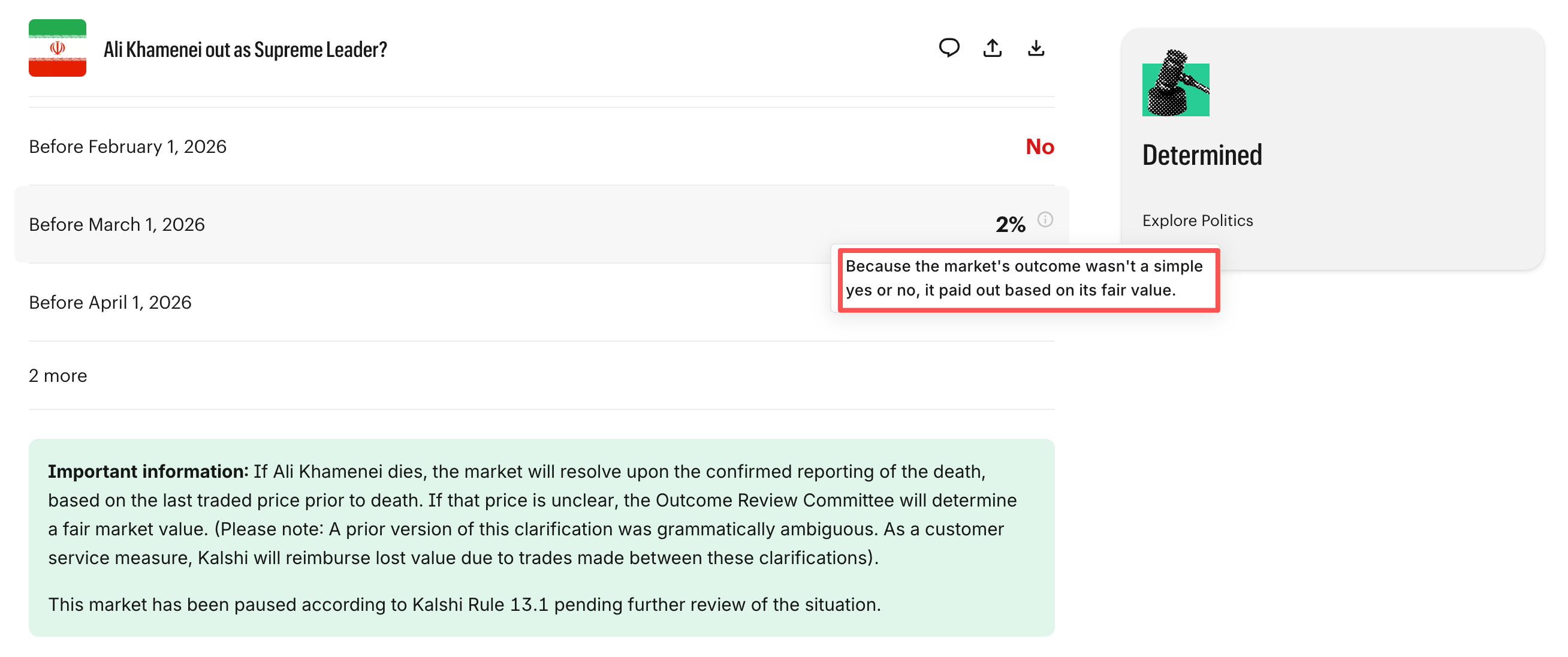
Opening the homepage of the related event on Kalshi shows that the event has been suspended by Kalshi and specially marked. Kalshi also noted that "because the market outcome is not a simple YES or NO, it is settled based on its fair value."

Kalshi's approach has sparked intense discussion in the community.

  • Those supporting Kalshi believe that avoiding events related to "death" aligns with mainstream values and the constraints of regulations on commodity contracts (the regulatory system prediction market events currently fall under). Especially considering that prediction markets have shown a certain reactive force on the real world, if boundaries are not set, over time, betting could indirectly incentivize "physical harm or murder," causing prediction markets to gradually become darknet-like.
  • Those opposing Kalshi believe that this move undermines the original transactional fairness of prediction markets and also damages their hedging value against real-world sudden changes — those who bet YES did not get the expected returns; although Tarek Mansour claimed that "not a single user will lose even $1 in this market," in reality, those who had bet NO and cut losses early cannot receive corresponding compensation.

In contrast, Polymarket has not made any statement on this matter, and the event can still be traded normally. The current price for YES shares for stepping down before March 31 is temporarily quoted at 99.9 cents, and NO at 0.2 cents.
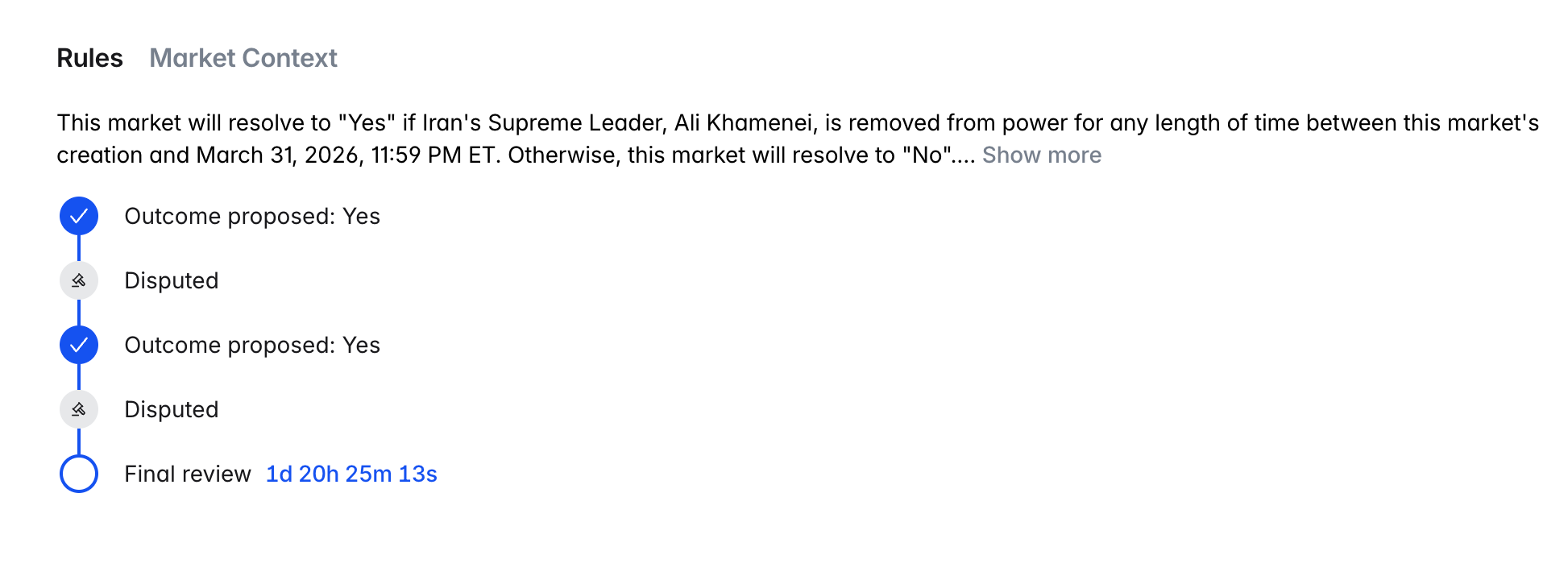
In the judgment rules for this event, Polymarket has stated that "if Khamenei resigns, is detained, or otherwise loses his position or is unable to perform his duties as Supreme Leader of Iran within the time specified by this market, it will be considered removal from office," which seems to cover the unexpected death situation. However, disagreements have still arisen in the settlement process of this event — clearly, there are also divisions within the community.

  • Odaily Note: For details on Polymarket's adjudication mechanism and the handling process in case of disputes, please refer to "Who 'Defines the Facts'? The Truth About Power and the Space for Malice in Polymarket's Adjudication Mechanism."

Calls for Bans from the Regulatory Side

The debate over whether prediction markets should list events related to "individual death" had already been discussed on the regulatory side days before Khamenei's death drew widespread industry attention.

On February 24, just a few days before the end of Khamenei's life, six U.S. Democratic senators, including Adam Schiff, jointly sent a letter to U.S. Commodity Futures Trading Commission (CFTC) Chairman Michael Selig, requesting that the CFTC categorically prohibit any prediction market contracts that use individual death as a settlement condition or are highly related to individual death.

The legal basis cited in the letter is that according to federal commodity regulations, the CFTC has already "categorically prohibited" contracts involving or referring to terrorism, assassination, war, or similar acts.

Adam Schiff and others stated that such events would create incentives for "physical harm or even death," even constituting a "dangerous national security risk" — "These contracts could incentivize real-world harm because they establish economic reward mechanisms for turbulent events or physical injury and encourage actors to influence or bring about these outcomes for personal gain."

The CFTC did not immediately publicly respond to the letter. A few days later, the news of Khamenei's death quickly made headlines in major media outlets, and Kalshi and Polymarket were plunged into a whirlpool of public opinion before regulators had made a clear stance.

Free Market vs. Social Responsibility

Prediction markets offer a new path to glimpse the probability of future events using market mechanisms, but this does not mean prediction markets are necessarily suitable for all events.

From the perspective of the prediction market's own operation, platforms tend to prefer listing events with clearly defined outcomes that are not easily manipulated by single points to avoid陷入条款解释或公平性争议陷入 (falling into disputes over clause interpretation or fairness); 而从外部影响以及监管压力来看,预测市场则需要尽量避开不符合主流价值观的事件 (from the perspective of external influence and regulatory pressure, prediction markets need to try to avoid events that do not conform to mainstream values) — if the setup of the prediction market itself could lead people to disrupt social order or harm others for profit, then it easily faces ethical and legal challenges.

The controversy over whether "death" related events should be banned is essentially a divergence in倾向 (inclination) towards free markets versus social responsibility. Those emphasizing free markets value the unique advantage of prediction markets in pricing future events more and are unwilling to compromise this ability due to any external restrictions; those valuing social responsibility worry that excessive laissez-faire could gradually evolve into a harm to public interest and social stability. This divergence has a universal solution: as friction emerges and deepens, both sides will gradually find a suitable balance point through struggle and concession.

Like every emerging industry, the regulatory details and industry self-discipline of prediction markets will not materialize out of thin air. The future of the industry will be shaped by participants, regulators, and society together. The path is walked by people. Khamenei's death is pushing prediction markets to personally step out the ethical boundaries.


Câu hỏi Liên quan

QWhat ethical dilemma did the death of Iran's Supreme Leader spark in the prediction market industry?

AThe death of Iran's Supreme Leader sparked a debate about the ethical boundaries of prediction markets, specifically whether events involving an individual's death should be allowed for betting, as it could incentivize real-world harm or assassination.

QHow did Kalshi handle the market regarding the resignation of Iran's Supreme Leader after his death?

AKalshi refunded all fees for the market, settled all positions at the last trading price before the death was confirmed, and compensated users who built positions after the death for the full cost difference.

QWhat was the regulatory action mentioned in the article regarding prediction markets and events related to death?

ASix U.S. Democratic senators sent a joint letter to the CFTC chairman requesting that the CFTC categorically ban any prediction market contracts that use an individual's death as a settlement condition or are highly related to death, citing existing bans on contracts involving terrorism, assassination, or war.

QWhat is the core conflict between the two sides in the debate over prediction markets offering death-related events?

AThe core conflict is between free market principles, which value the predictive power and hedging value of these markets, and social responsibility, which worries that such markets could incentivize physical harm or murder and pose a danger to public safety and national security.

QHow did Polymarket's rules for the 'resignation of Iran's Supreme Leader' event potentially cover the outcome of his death?

APolymarket's rules stated that the event would be considered resolved if the Supreme Leader resigned, was detained, or otherwise lost his position or became unable to perform his duties, which could be interpreted as covering the unexpected outcome.

Nội dung Liên quan

Cuộc Đàn Áp Tội Phạm Tiền Mã Hóa Gia Tăng Khi Myanmar Nhắm Mục Tiêu Vào Các Kẻ Lừa Đảo Với Hình Phạt Tử Hình

Theo báo cáo của FBI, người Mỹ mất hơn 11 tỷ USD vì lừa đảo liên quan đến tiền mã hóa vào năm ngoái, làm gia tăng áp lực lên các chính phủ Đông Nam Á. Đáp lại, chính quyền quân sự Myanmar đã đề xuất một trong những luật chống lừa đảo mạng nghiêm khắc nhất thế giới. Dự luật Chống Lừa đảo Trực tuyến, công bố hôm thứ Năm, quy định hình phạt tù từ 10 năm đến chung thân cho tội danh lừa đảo tiền số. Trong những trường hợp nghiêm trọng nhất, khi hoạt động lừa đảo dẫn đến cái chết của công nhân bị cưỡng bức hoặc buôn người, thủ phạm có thể phải đối mặt với án tử hình. Quốc hội Myanmar cho biết dự luật được soạn thảo để đối phó với các mối đe dọa đến chủ quyền và ổn định đất nước. Myanmar không đơn độc trong cách tiếp cận cứng rắn. Trung Quốc đã xử tử 11 người vào tháng 1 có liên quan đến các hoạt động lừa đảo từ Myanmar. Hoa Kỳ cũng tăng cường phản ứng, phối hợp bắt giữ hơn 200 người và đóng cửa 9 trung tâm lừa đảo vào tháng 4. Các trung tâm lừa đảo trực tuyến ở Đông Nam Á, hoạt động từ các hình thức như "giết lợn", lừa đảo tình cảm đến nền tảng đầu tư giả mạo, đang trở thành vấn đề nan giải cho cơ quan thực thi pháp luật toàn cầu, với nhiều vụ việc sử dụng tiền mã hóa. Bối cảnh đề xuất luật này diễn ra sau khi chính quyền quân sự Myanmar nắm quyền sau cuộc đảo chính năm 2021, với một quốc hội vừa tái nhóm họp vào tháng 3/2026 sau các cuộc bầu cử bị chỉ trích. Dự luật dự kiến được thảo luận vào tuần đầu tháng 6.

bitcoinist2 giờ trước

Cuộc Đàn Áp Tội Phạm Tiền Mã Hóa Gia Tăng Khi Myanmar Nhắm Mục Tiêu Vào Các Kẻ Lừa Đảo Với Hình Phạt Tử Hình

bitcoinist2 giờ trước

Không Cần Viết Code, 2 Ngày Xây Dựng AI Agent Đầu Tiên Của Bạn (Hướng Dẫn Đầy Đủ)

Bài viết hướng dẫn người dùng phổ thông xây dựng AI Agent đầu tiên mà không cần biết lập trình trong 2 ngày. **Ngày thứ Bảy - Hiểu và Bắt đầu:** * **Sáng:** Hiểu sự khác biệt cơ bản: Chatbot trả lời câu hỏi, trong khi Agent tự động thực hiện một mục tiêu đa bước (lập kế hoạch, dùng công cụ, kiểm tra, lặp lại). Chọn một nhiệm vụ lặp lại trong công việc/cuộc sống để tự động hóa. * **Chiều:** Viết "Bản thiết kế Agent" rõ ràng với 5 yếu tố: Mục tiêu cụ thể, Các bước thực hiện, Công cụ cần dùng, Định dạng đầu ra mong muốn, Quy tắc xử lý lỗi. Sau đó, sử dụng Claude (Cowork hoặc Projects) để chạy Agent lần đầu dựa trên bản thiết kế. **Ngày Chủ Nhật - Tối ưu và Mở rộng:** * **Sáng:** Chấp nhận kết quả đầu tiên thường chỉ đạt 60-70%. Gỡ lỗi bằng cách so sánh đầu ra với mong đợi, xác định lỗ hổng trong bản thiết kế (mơ hồ, thiếu bước, thiêu tiêu chuẩn chất lượng), sau đó tinh chỉnh và chạy lặp lại. Quy trình tối ưu lặp này là chìa khóa để đưa Agent từ "dùng được" lên "đáng tin cậy". * **Chiều:** Xây dựng Agent thứ hai để củng cố kỹ năng. Có thể chọn từ các mẫu có sẵn như Agent nghiên cứu, tái định dạng nội dung, chuẩn bị cuộc họp, theo dõi đối thủ, hoặc soạn thảo email. **Thông điệp chính:** Bất kỳ ai cũng có thể tự động hóa công việc bằng Agent. Kỹ năng quan trọng duy nhất là mô tả nhiệm vụ một cách rõ ràng và có cấu trúc. Bằng cách bắt đầu với một nhiệm vụ nhỏ, lặp lại để tối ưu, bạn có thể xây dựng hệ thống Agent hữu ích mà không cần viết mã.

marsbit3 giờ trước

Không Cần Viết Code, 2 Ngày Xây Dựng AI Agent Đầu Tiên Của Bạn (Hướng Dẫn Đầy Đủ)

marsbit3 giờ trước

Hàn Quốc Sẽ Công Bố Quy Định Về Chứng Khoán Token Hóa Vào Tháng Bảy Khi Quy Định Crypto Tiến Triển

Các nhà chức trách Hàn Quốc dự kiến sẽ công bố các quy tắc chi tiết cho việc phát hành, cơ sở hạ tầng và phân phối chứng khoán mã hóa (tokenized securities) vào tháng 7 tới đây. Động thái này nằm trong kế hoạch thực hiện đầy đủ các quy định về thị trường tiền mã hóa vào năm 2027. Cơ quan Giám sát Tài chính (FSC) cho biết họ đang xem xét các biện pháp để xây dựng hệ sinh thái cân bằng giữa đổi mới và niềm tin, đồng thời phát triển lộ trình từng bước để mã hóa các chứng khoán tiêu chuẩn như cổ phiếu, trái phiếu. FSC nhấn mạnh sẽ duy trì các nguyên tắc bảo vệ nhà đầu tư nhưng không áp dụng cách tiếp cận quản lý một chiều, và cho phép phát hành chứng khoán đầu tư phân đoạn. Song song với Luật Thể chế hóa Chứng khoán Mã hóa có hiệu lực từ 4/2/2027, chính phủ cũng dự kiến áp dụng Luật Thuế Thu nhập vào năm này. Theo đó, thuế thu nhập đối với tài sản ảo sẽ là 20%, lên tới 22% nếu bao gồm thuế địa phương, bắt đầu từ ngày 1/1/2027. Dù có một số nỗ lực phản đối, việc hủy bỏ hoặc trì hoãn loại thuế này được cho là khó xảy ra. Bên cạnh đó, các nhà lập pháp Hàn Quốc tiếp tục thúc giục chính phủ sớm thông qua luật về stablecoin, vốn đang bị trì hoãn do bất đồng giữa Ngân hàng Trung ương Hàn Quốc (BOK) và FSC.

bitcoinist3 giờ trước

Hàn Quốc Sẽ Công Bố Quy Định Về Chứng Khoán Token Hóa Vào Tháng Bảy Khi Quy Định Crypto Tiến Triển

bitcoinist3 giờ trước

Cấu Trúc Hàng Tháng Của Bitcoin Cho Thấy Sự Tiếp Diễn Của Xu Hướng Lịch Sử Lớn

Cấu trúc giá Bitcoin dài hạn tiếp tục thu hút sự chú ý khi tài sản này tuân theo một mô hình lịch sử mạnh mẽ trên khung thời gian hàng tháng. Dữ liệu cho thấy khi BTC giao dịch trên mức giá mở cửa tháng vào ngày 15, thị trường có tỷ lệ đóng cửa tháng trong vùng tích cực lên tới 77%. Xu hướng này cung cấp một lợi thế thống kê, cho thấy tháng 5 có khả năng kết thúc ở mức gần $76,000 hoặc cao hơn. Mặc dù có sự biến động ngắn hạn, 11 trong số 13 tháng gần đây đã theo đúng mô hình này. Nếu tháng 5 tiếp tục xanh, đây sẽ là tháng thứ ba liên tiếp tăng giá – một điều chưa từng xảy ra trong bất kỳ thị trường gấu nào trước đây của BTC. Hiện tại, Bitcoin đang tái kiểm tra các mức then chốt và cần một phiên đóng cửa tuần trên đường trung bình động hàm mũ 21 tuần để duy trì đà tăng ngắn hạn. Theo phân tích, đợt giảm giá gần đây chủ yếu do thanh lý các vị thế mua (long) ký quỹ, chứ không phải áp lực bán mạnh từ thị trường giao ngay. Ở đáy gần nhất, nhiều vị thế bán khống (short) mới đã bị mắc kẹt. Điều này tạo điều kiện cho sự hấp thụ tăng giá, nếu có lực mua mạnh vào thì việc các vị thế bán khống này phải chốt lời/cắt lỗ có thể đẩy giá lên cao hơn.

bitcoinist3 giờ trước

Cấu Trúc Hàng Tháng Của Bitcoin Cho Thấy Sự Tiếp Diễn Của Xu Hướng Lịch Sử Lớn

bitcoinist3 giờ trước

Giao dịch

Giao ngay
Hợp đồng Tương lai
活动图片




