Pricing OpenAI Pre-IPO: A New, Life-or-Death Business on Hyperliquid Lasting Half a Year

marsbitXuất bản vào 2026-06-16Cập nhật gần nhất vào 2026-06-16

Tóm tắt

Pricing OpenAI Pre-IPO: Hyperliquid's High-Stakes, Six-Month Business Venture The article analyzes the nascent market for pre-IPO perpetual contracts on the Hyperliquid blockchain, exemplified by two contrasting teams: Trade.xyz and Ventuals. Trade.xyz, an anonymous team, successfully built the largest pre-market on Hyperliquid. Its strategy focused on near-term events, like the SpaceX IPO. By listing a SpaceX contract with a known launch date and price, the market had a tangible "anchor" (the eventual Nasdaq opening price) to converge upon, which kept speculation in check. This approach fueled significant growth. In stark contrast, Ventuals, backed by Paradigm, failed despite holding coveted contracts for OpenAI and Anthropic. Its critical flaw was its pricing mechanism for these companies, which have no imminent IPO. Ventuals' oracle price was half-derived from infrequent private market transactions and half from its own contract's moving average. This created a self-reinforcing loop where buying pressure artificially inflated the price, disconnecting it from real supply and demand. The market became illiquid and structurally skewed. Ventuals shut down nine months after launch, reportedly through an acquisition. Its final settlement prices—OpenAI at ~$1,341 and Anthropic at ~$1,618—were thus partially products of its flawed model. Ironically, some company employees and late-stage VCs reportedly used these prices for valuation reference, highlighting the desperate demand...

Author: Curry, TechFlow Shenchao

During SpaceX's listing days, the pre-IPO price of SPCX on Hyperliquid flooded social feeds, but few took a closer look at who was deploying this market behind the scenes.

Actually, it's a team called Trade.xyz. Anonymous, emerging only this year, and now it alone accounts for over 90% of the open interest in pre-IPO contracts on Hyperliquid. The hype around SpaceX's on-chain Pre-IPO was largely driven by this single entity.

And just three days after SpaceX's bell ringing, on June 15th, another team in the same business announced it was shutting down.

This one was called Ventuals, backed by Paradigm, and it also offered SpaceX pre-IPO contracts, plus ones for OpenAI and Anthropic. It launched earlier this year and lasted only nine months from start to finish.
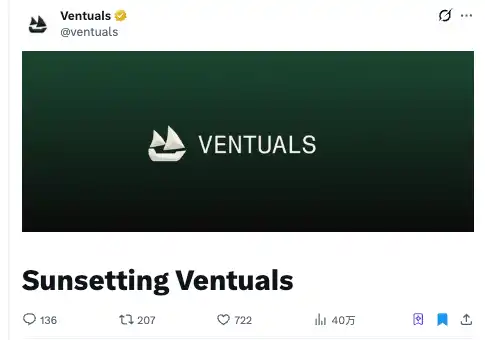
The same chain, the same HIP-3 play, the same track. One made SpaceX the largest market on the platform, while the other held OpenAI and Anthropic in its hands, only to end up failing.

What's noteworthy is the way Ventuals exited. According to its official social media posts, it wasn't a case of running away after losing too much; the announcement stated it was acquired, with the team integrated into another project within the Hyperliquid ecosystem. User principal was returned 1:1, marking a respectable exit.

The paradox lies right here. Holding the two most coveted brands, OpenAI and Anthropic, it should have been the last one to fail. What went wrong?

Trade XYZ vs. Ventuals

The successful one, Trade.xyz, remains anonymous to this day.

The project founder only gave a glimpse of his background in an interview with Hyperliquid founder Jeff Yan, saying he bought his first Bitcoin for $66 in 2013, had been an investor since, never built a project before, and would have left the crypto space long ago if not for meeting Jeff.

It was this relative newcomer who built the largest pre-IPO market on Hyperliquid. According to Colossus, Trade.xyz has grown 38% weekly since last October, with cumulative trading volume exceeding $130 billion.

It started with silver, then crude oil, then the S&P 500, and finally SpaceX.
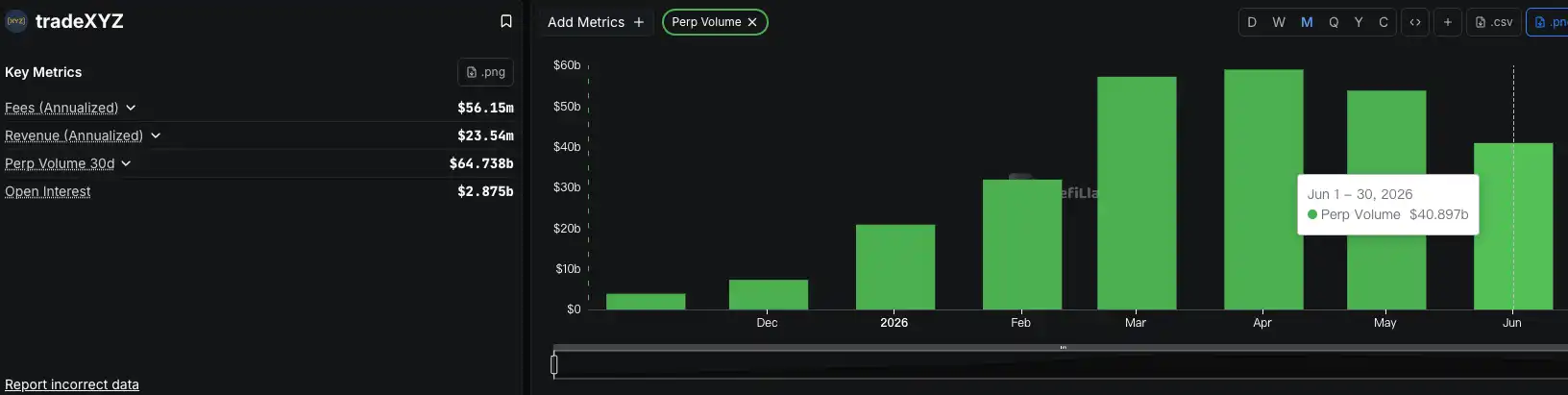
Its choice of SpaceX was shrewd.

SpaceX was set to ring the bell on Nasdaq on June 12th, with its IPO price and listing date already fixed. By listing pre-IPO contracts, Trade.xyz was essentially betting on an event with a certain outcome; the Nasdaq would provide a real price on listing day. This real price acted like an anchor, preventing the pre-IPO price from straying too far. Even if the quote deviated in between, it would snap back at the moment of listing.

This is exactly what happened. SPCX traded between $154 and $172 in the days before listing, betting on a premium above the $135 IPO price, and indeed surged on debut, proving the bet correct.

Ventuals chose a different type of asset.

Backed by Paradigm, one of crypto's top-tier VCs, its pedigree was far more respectable than the anonymous Trade.xyz. Its chosen assets were also bigger names: OpenAI and Anthropic, the two most coveted targets.

However, these two companies have no imminent listing date.

It's not that there's no external reference price. According to Bloomberg, Anthropic allowed employees to sell shares this year at a $350 billion valuation, and OpenAI does similar periodically. But such prices are set behind closed doors; often in secondary share transactions, buyers and sellers are existing major shareholders, and the asset hasn't genuinely changed hands in a public market.

This pricing might be precise at times, but it lacks a public order book where everyone can participate to correct errors.

By putting such prices on-chain as contracts, Ventuals essentially hung the entire market on a couple of off-chain price feeds. Even more problematic, it added a mechanism that pits the price against itself.

Some on-chain analysts have dissected Ventuals' pricing logic:

Its oracle price, half came from external secondary transactions and funding round valuations, and the other half came from a moving average of its own contract price. In other words, half the price was referencing itself. When buy orders pushed the price up, the moving average was pulled higher, the oracle followed suit, raising the price ceiling further, inviting more buying pressure.

The result was that contracts for OpenAI, Anthropic, etc., were perpetually pinned near their upper limits, with sell orders and liquidations difficult to execute. The chart looked like a steady uptrend, but in reality, it was structurally stuck, having little to do with real supply and demand.
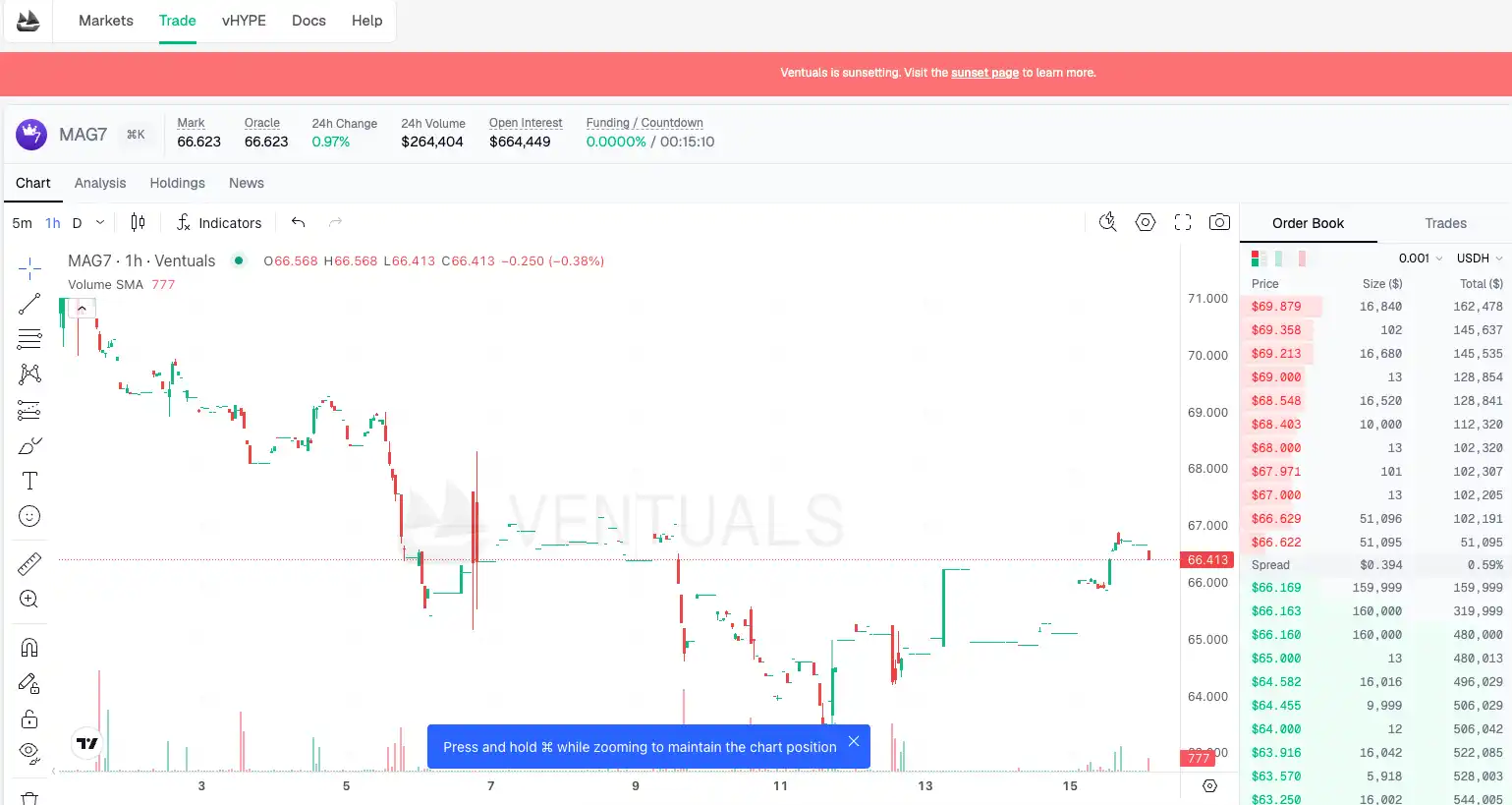
Source: Chart for MAG7 targets on Ventuals, showing intermittent candlesticks with no trades in some periods

So this kind of Pre-IPO trading wasn't so much the market telling you OpenAI's value, but rather a machine pushing the price up and then climbing higher based on the price it had already elevated.

Trade.xyz bet on an asset that would inevitably be settled by Nasdaq, with the real price as a backstop; Ventuals bet on assets existing only in internal valuations, then layered a self-referential price feed on top, leaving the price suspended in mid-air with no floor.

Shutdown Reference Prices: OpenAI $1300, Anthropic $1600

When it came time to shut down, did the last quoted price count?

To settle all positions upon closure, Ventuals needed a final price for its contracts. Its method was to freeze the 24-hour average price. OpenAI was ultimately set at $1,341.80 per share, Anthropic at $1,618.90.

These two numbers are now etched into the settlement records, becoming the final on-chain quotes for these companies.

As mentioned earlier, this price was half external reference, half moving average of its own price, perpetually climbing along the ceiling. In other words, a significant portion of $1,341.80 resulted from the machine lifting the price further based on the price it had already inflated.

It's precise down to two decimal places, but it may not be true.

The ultimate irony is that some people outside actually took this price seriously.

According to Bloomberg, employees of SpaceX, OpenAI, Anthropic, and some late-stage venture capitalists approached Ventuals, saying they used the platform to value their own equity holdings.

This needs to be examined carefully.

These individuals hold real, valuable equity; in theory, they should know best what their stock is worth. But private market valuations are only updated once a year like squeezing toothpaste; between funding rounds is a void, with no indication of price movement.

Meanwhile, a place like Ventuals, however unreliable, at least quotes a number 24/7 and shows price movements.

Thus, a paradoxical situation emerged. Those who should have the most pricing power were instead looking to a number from a retail-facing trading table for some psychological comfort.

This is the most twisted aspect of the pre-IPO pricing business.

The most coveted assets lack a fair price the most; the greater this lack, the more people are willing to grasp at anything that resembles a price, even if it's a machine-generated, self-referential figure.

Ventuals is gone, and those final prices are frozen. But the demand for such reference points likely hasn't diminished one bit.

The Pre-IPO Pricing Business: Players Flocking In

Demand hasn't waned, yet supply is increasing, and becoming more formalized.

In the same week Ventuals shut down, Coinbase launched its own pre-IPO perpetual contracts, with SpaceX as the first target, available to users outside the US.

Not just Coinbase. Polymarket uses Nasdaq data to open prediction markets for private company valuations; Citi introduced tokenized private company stock for wealth and institutional clients. The crypto side is doing it, and traditional investment banks are too.

This is no longer just small-scale experiments by a few anonymous teams on Hyperliquid. Providing a continuously tradeable price for pre-public companies is becoming a legitimate business everyone wants a piece of.

For readers in China, this demand isn't unfamiliar. IPO subscriptions involve long queues, private market shares are only allocated among institutions and high-net-worth individuals, leaving ordinary people shut out. Now, someone is posting prices for companies like OpenAI and SpaceX, allowing 24/7 trading; for many, it's the first time they can touch such assets. The demand is real.

But Ventuals' shutdown over these past six months also laid bare the Achilles' heel of this business.

A price isn't enough just because people are willing to trade it; it requires a public, open market where anyone can participate and oppose to continuously correct errors. If Coinbase takes over, this fundamental issue doesn't magically disappear. It just swaps the credibility of an anonymous team for the credibility of a bigger brand. The underlying company still isn't public, and that fair, consensus price still doesn't exist.

Will the next entity tasked with pricing it be more accurate than Ventuals? The answer might only be revealed when OpenAI actually stands before the bell on its listing day.

Câu hỏi Liên quan

QWhat is the main topic discussed in the article regarding the Hyperliquid pre-market?

AThe article discusses the business of pre-market pricing for private companies like SpaceX and OpenAI on the Hyperliquid platform. It contrasts the success of an anonymous team, Trade.xyz, with the failure of the well-funded Ventuals, which handled OpenAI and Anthropic contracts, highlighting the challenges of pricing companies without a near-term IPO date and the reliance on self-referential or illiquid external price feeds.

QWhy did Ventuals fail despite having high-profile assets like OpenAI and Anthropic?

AVentuals failed primarily because its pricing mechanism was flawed. For assets like OpenAI and Anthropic, which have no imminent IPO date, it relied on a hybrid oracle: half from external private share transactions and half from its own contract's price moving average. This created a self-reinforcing loop where buy pressure would raise the average, which then raised the oracle price, pushing the price ceiling higher artificially. This led to illiquid markets with prices detached from real supply and demand, unlike Trade.xyz's successful SpaceX contracts which were anchored to a definitive public Nasdaq listing price.

QWhat were the final settlement prices for OpenAI and Anthropic on Ventuals, and what is the article's critique of these prices?

AThe final settlement prices on Ventuals were $1,341.80 per share for OpenAI and $1,618.90 per share for Anthropic, based on a 24-hour average before shutdown. The article criticizes these prices as potentially unreliable because they were significantly influenced by Ventuals' own self-referential pricing mechanism, where the contract's price moving average fed back into the oracle. Thus, while precise, these numbers may not reflect a true market consensus or fair value.

QAccording to the article, what ironic behavior did some SpaceX, OpenAI, and Anthropic insiders exhibit regarding Ventuals?

AIronically, some employees and late-stage venture capitalists of SpaceX, OpenAI, and Anthropic reportedly used Ventuals' platform to gauge the value of their own private holdings. This is ironic because these insiders, who possess the actual private shares and should have the most informed view of their value, turned to a potentially flawed and illiquid public derivatives market for price discovery, seeking psychological comfort due to the lack of frequent, transparent pricing in the private primary market.

QHow is the broader landscape for pre-market pricing of private companies evolving beyond platforms like Hyperliquid?

AThe landscape is expanding and becoming more institutional. Major players like Coinbase have launched pre-market perpetual contracts (starting with SpaceX for non-US users). Polymarket uses Nasdaq data for prediction markets on private company valuations, and traditional institutions like Citi are offering tokenized private company shares to wealth and institutional clients. This indicates that providing tradable prices for pre-IPO companies is becoming a serious, mainstream business opportunity, moving beyond niche crypto platforms to attract established financial entities.

Nội dung Liên quan

Vụ Tiêu Hao Ngân Khố BonkDAO Cho Thấy Rủi Ro Quản Trị Trên Solana Là Có Thật

Kho bạc BonkDAO đã bị rút cạn khoảng 20 triệu USD sau khi một đề xuất quản trị độc hại được thông qua thông qua nền tảng Realms, minh họa rõ ràng về rủi ro quản trị DAO trên Solana. Vụ việc không phải do lỗi của blockchain Solana, mà là một cuộc tấn công vào cơ chế quản trị, nơi kẻ tấn công lợi dụng các quy tắc bỏ phiếu và trọng số biểu quyết để chiếm đoạt tài sản một cách hợp lệ về mặt kỹ thuật. Sự kiện này cảnh báo rằng thiết kế quản trị cần được xem xét kỹ lưỡng như bảo mật mã hợp đồng. Các hệ thống bỏ phiếu, quy tắc đề xuất và quyền kiểm soát kho bạc có thể trở thành mặt tấn công nếu có điểm yếu. Realms, một công cụ quản trị DAO phổ biến trên Solana, là trung tâm của vụ việc, thúc đẩy nhu cầu xem xét lại các cấu hình về ngưỡng tán thành, thời gian bỏ phiếu và giới hạn thực thi. Vụ việc đặt ra thử thách về niềm tin đối với cộng đồng BONK, một tài sản meme quan trọng trên Solana. Phản ứng rõ ràng và các kế hoạch khắc phục, cải cách từ nhóm phát triển sẽ quyết định khả năng phục hồi niềm tin. Bài học then chốt là quản trị DAO không chỉ là vấn đề tổ chức mà còn là cơ sở hạ tầng bảo mật; tài sản cộng đồng có thể gặp rủi ro ngay cả khi blockchain nền hoạt động hoàn hảo.

bitcoinist11 phút trước

Vụ Tiêu Hao Ngân Khố BonkDAO Cho Thấy Rủi Ro Quản Trị Trên Solana Là Có Thật

bitcoinist11 phút trước

Bitcoin: Liệu động thái của cá voi 130,5 triệu USD có làm trật bánh đà đưa BTC tiến tới 70.000 USD?

Một cá voi Bitcoin đã thực hiện giao dịch chuyển 2.000 BTC, trị giá 130,5 triệu USD, sau 6 năm tích lũy. Trong đó, 800 BTC được chuyển đến Cumberland để giao dịch OTC (cho thấy ý định bán tiềm năng), trong khi 1.200 BTC được chuyển sang địa chỉ mới, cho thấy có thể đây là động thái tái định vị danh mục hơn là thoát hoàn toàn. Mặc dù động thái của cá voi lớn thu hút sự chú ý, nhưng giá Bitcoin dường như không bị ảnh hưởng tiêu cực. BTC tiếp tục xu hướng tăng, đạt mức cao hàng tháng khoảng 66.314 USD, với các chỉ báo kỹ thuật như Stochastic Momentum Index và Squeeze Momentum Indicator cho thấy động lượng tăng vẫn còn mạnh, mở đường cho mục tiêu vượt 70.000 USD. Tuy nhiên, một số chỉ số on-chain lại cảnh báo áp lực bán có thể gia tăng trong ngắn hạn. Tỷ lệ Dòng chảy Quỹ (Fund Flow Ratio) và Chênh lệch dòng vào sàn (Exchange Netflow) đều tăng lên mức dương, báo hiệu nhiều BTC đang được chuyển vào các sàn giao dịch. Điều này thường làm tăng rủi ro bán tháo và có thể làm suy yếu động lượng, khiến giá có nguy cơ điều chỉnh về vùng 64.800 USD nếu áp lực bán gia tăng.

ambcrypto39 phút trước

Bitcoin: Liệu động thái của cá voi 130,5 triệu USD có làm trật bánh đà đưa BTC tiến tới 70.000 USD?

ambcrypto39 phút trước

Tích Hợp Axelar Vào XRP Ledger Mở Ra Một Lộ Trình DeFi Đa Chuỗi Mới

XRP Ledger đã tích hợp với Axelar, mở ra một tuyến đường mới cho XRP và các tài sản gốc của XRPL di chuyển vào các môi trường DeFi đa chuỗi rộng lớn hơn. Việc tích hợp này cho phép XRP kết nối với các ứng dụng trên các hệ sinh thái EVM và Cosmos thông qua công nghệ tương tác chuỗi chéo của Axelar. Điều này không biến XRPL thành một chuỗi EVM gốc, mà cung cấp một cây cầu rõ ràng hơn để tài sản XRPL vào các mạng và ứng dụng khác. Tính thanh khoản là lợi thế của XRP, nhưng trong DeFi, tài sản cần có khả năng di chuyển giữa các giao thức và chuỗi. Kết nối này giúp XRP tiếp cận nhiều ứng dụng DeFi hơn bên ngoài hệ sinh thái riêng của nó, tăng cường tính hữu dụng trong một thị trường đa chuỗi. Tuy nhiên, cần lưu ý rằng tích hợp này không làm cho XRPL chạy hợp đồng thông minh Ethereum một cách gốc. Người dùng có thể di chuyển tài sản nhưng sẽ đối mặt với rủi ro từ cầu nối. Thách thức thực sự nằm ở việc liệu người dùng và nhà phát triển có thực sự sử dụng tuyến đường mới này hay không, điều này phụ thuộc vào thanh khoản, sự tin cậy của cầu nối và các ứng dụng được xây dựng xung quanh nó. Trong bối cảnh thị trường tiền mã hóa đang hướng tới khả năng tương tác, việc kết nối này giúp XRP tham gia vào sự phát triển DeFi bên ngoài môi trường ban đầu của nó. Bài kiểm tra thực sự sẽ là khối lượng giao dịch và hoạt động bền vững thông qua các tuyến đường được kết nối bởi Axelar.

bitcoinist41 phút trước

Tích Hợp Axelar Vào XRP Ledger Mở Ra Một Lộ Trình DeFi Đa Chuỗi Mới

bitcoinist41 phút trước

Ripple Đạt Ủy Quyền MiCA Mở Rộng Làn Đường Thanh Toán Châu Âu

Ripple đã đạt được ủy quyền đầy đủ theo khung MiCA ở châu Âu, mở ra con đường pháp lý rõ ràng hơn để mở rộng các dịch vụ thanh toán bằng tiền mã hóa tại EU và EEA. Sự ủy quyền này áp dụng cho thực thể thanh toán doanh nghiệp của Ripple, cho phép hoạt động tuân thủ theo MiCA, chứ không phải là sự chấp thuận trực tiếp cho việc giao dịch XRP. Đây là một bước quan trọng cho hoạt động kinh doanh của công ty. MiCA tạo ra một khung quy định thống nhất, giúp các công ty như Ripple dễ dàng mở rộng quy mô tại châu Âu. Điều này có thể tăng cường khả năng hợp tác của Ripple với các ngân hàng, tổ chức tài chính và đối tác thể chế, nhờ vào sự rõ ràng về mặt pháp lý. Đối với XRP, sự phát triển này củng cố môi trường hoạt động cho doanh nghiệp thanh toán trọng tâm của Ripple, có khả năng hỗ trợ trường hợp sử dụng tiện ích lâu dài của token. Tuy nhiên, ủy quyền không đảm bảo nhu cầu đối với XRP; tác động thực tế sẽ phụ thuộc vào việc áp dụng sản phẩm, thanh khoản và khối lượng thanh toán thực tế. Việc Ripple được ủy quyền sớm theo MiCA có thể mang lại lợi thế cạnh tranh tại châu Âu - một thị trường đang trở thành điểm nóng về cấp phép tiền mã hóa. Thách thức thực sự bây giờ là chuyển giấy phép thành các đối tác, khối lượng và mức độ sử dụng thực tế trong thanh toán xuyên biên giới.

bitcoinist55 phút trước

Ripple Đạt Ủy Quyền MiCA Mở Rộng Làn Đường Thanh Toán Châu Âu

bitcoinist55 phút trước

Giao dịch

Giao ngay
活动图片

