MSTR Earnings Review: The 'Flywheel' Now Has a 'Safety Valve', Arbitrage Opportunity Emerges

marsbitXuất bản vào 2026-05-08Cập nhật gần nhất vào 2026-05-08

Tóm tắt

MicroStrategy's recent earnings call has fundamentally changed its strategy. Management has explicitly stated a key metric: a 1.22x premium to its mNAV (adjusted net asset value). This acts as a trigger for the company's actions regarding its Bitcoin holdings. If MicroStrategy's stock trades at a premium **above** 1.22x mNAV, the company will continue its established playbook: issuing equity to raise capital and buying more Bitcoin. However, if the premium falls **below** 1.22x, the strategy reverses. Management committed to selling Bitcoin to generate cash, which would then be used for debt management, dividends, or stock buybacks. This clear threshold creates a potential arbitrage opportunity. Should the premium dip below 1.22x, a trade involving going long MSTR stock while shorting an equivalent value of Bitcoin could profit. The logic is that the company's promised actions (selling BTC, buying back stock) would directly work to close that valuation gap, providing a catalyst for the trade. For holders of MicroStrategy's high-yield preferred stock (STRC), this policy introduces a significant safety net. The commitment to sell BTC to protect the balance sheet and meet obligations reduces the prior risk of the company facing a liquidity crisis during a deep Bitcoin downturn, making STRC resemble a more traditional corporate bond. Regarding Bitcoin's market impact, the announcement has mixed implications. In the short term, it is sentimentally bearish as it ends the narrat...

This MicroStrategy (MSTR) earnings report has completely changed its game: it used to be "mindlessly print shares to buy Bitcoin," but now the company has provided a clear-cut metric – a 1.22x mNAV (asset value premium). This number will determine whether MSTR buys or sells coins next.

● For MSTR:

○ Premium > 1.22x: Continue the old playbook: issue high-priced shares, take the money to buy BTC.

○ Premium < 1.22x (the core reversal): It no longer makes sense for the company to issue more shares. Management has explicitly stated that if the premium falls below this level, they will sell BTC, use the cash to repay debt or repurchase shares.

● How to arbitrage: If MSTR's premium falls below 1.22x, it will trigger a conditional arbitrage opportunity: "long MSTR, short BTC." Because at that point, the company will personally step in to "sell Bitcoin, buy its own shares." The company's selling action will close the price gap. Management's stance is the core confidence behind this arbitrage trade.

● For STRC (Preferred Stock): Previously, people feared that a MicroStrategy blow-up would render these 11.5% dividend preferred shares worthless. Now, the official statement "will sell Bitcoin to repay debt if necessary" means STRC has a solid safety net; it's no longer a Ponzi gamble.

● For the broader BTC market: The myth of "MicroStrategy will never sell" is shattered, which is negative for short-term sentiment. The benefit is that the company's proactive selling to reduce leverage completely eliminates the future risk of a "forced, cascading liquidation" during a deep bear market.

Diamond Hands No More: The 1.22x mNAV is the Lifeline and Bitcoin's Bull/Bear Dividing Line

Over the past two years, there has been much FUD in the market regarding MSTR, particularly about how they manage their leverage and interest expenses. Bitcoin is an asset without cash flow, yet MSTR has to pay significant interest for financing it. Where would this come from? In this Q1 earnings call, management personally declared: they will sell Bitcoin if the mNAV premium falls below 1.22x.

This is equivalent to revealing the company's "bottom card" and "auto-execution program":

● Above the waterline (balance sheet expansion phase): The company is a die-hard BTC bull. As long as retail investors are willing to give a premium higher than 1.22x, MicroStrategy can engage in "risk-free arbitrage balance sheet expansion." Issue shares to raise capital -> massively buy BTC -> increase book assets -> push the stock price higher. This positive flywheel keeps spinning.

● Below the waterline (defensive balance sheet contraction phase): The flywheel slams on the brakes. If MSTR trades at too steep a discount relative to its Bitcoin holdings, issuing more shares would mean selling company assets at a discount. Management very rationally stated that at this point, selling BTC for cash, using it to pay dividends, manage debt, or directly repurchase MSTR common shares at low prices would provide the greatest value enhancement for existing shareholders.

This means MSTR finally has a hard "value support line." It is no longer a runaway train without brakes.

Arbitrage Opportunity: Long MSTR / Short BTC when the mNAV premium falls below 1.22

What is the biggest fear in arbitrage? It's finding an excellent price discrepancy, but the market remains irrational for an extended period (e.g., MSTR stays at a discount), and eventually, your hedge position gets worn down by funding rates or interest costs.

However, the 1.22x threshold provided by MSTR this time offers an arbitrage opportunity with strong certainty.

In-depth practical logic:

● Strict trigger condition: Only when MSTR's mNAV premium falls significantly below 1.22x.

● Position entry: At this point, MSTR's price is "excessively undervalued" relative to its underlying BTC assets. Traders should go long MSTR and simultaneously short an equivalent market value of BTC.

● The winning underlying logic: Even if market participants don't close the gap, MicroStrategy's management will force it to converge. Once the threshold is breached, to maximize "Bitcoin per share," management will initiate their promised self-rescue operation – "sell BTC, repurchase undervalued MSTR shares." Do you see it? The direction of your long/short position will be completely synchronized with the official market intervention direction of MicroStrategy's tens of billions of dollars. You don't need to predict whether BTC will rise or fall tomorrow; you just need to calmly capture the "price gap convergence" profit, which is essentially risk-free.
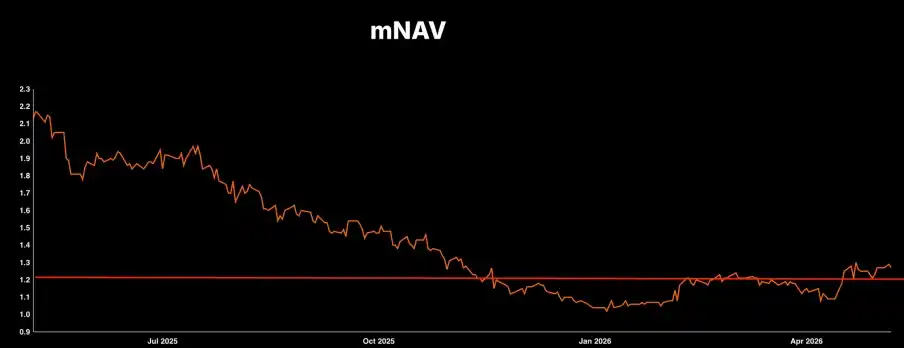
Monitoring tip: Currently, MSTR's premium is fluctuating around 1.28x, not yet triggering the arbitrage condition. Blindly opening positions is premature. However, it has already entered an excellent targeting zone. Set up price alerts and wait for it to drop below the threshold before acting.

3. Significantly Enhanced Safety Net for STRC (Preferred Shares)

STRC offers a high dividend yield of 11.5%. In the previous bearish narrative, MicroStrategy was a gambler with massive leverage. Once Bitcoin faced a black swan event like a halving or more in price, MicroStrategy's cash flow would break, and STRC preferred shares would instantly become worthless.

But the Q1 earnings report completely revealed the company's true financials, not only refuting the shorts but also giving fixed-income investors a dose of confidence:

● Impressive asset thickness: On the liabilities side, the company has $13.5 billion in preferred shares and $8.2 billion in convertible bonds. On the asset side, there is a corresponding $64 billion in BTC reserves. The net leverage ratio is a negligible 9%, which is considered extremely robust in traditional finance.

● Extreme downside stress test: Even if the crypto market experiences another major crash, with BTC plummeting 90% from current levels (all the way down to $7,300), selling their coins would still be enough to repay all net debt.

● Cash moat: As a last resort, even if Bitcoin liquidity dries up and they can't sell quickly, the company still holds $2.25 billion in pure cash on its books. The interest earned from this cash alone, even at a savings rate, would be enough to cover the future 1.5 years (annual $1.5 billion) of debt interest and preferred dividends without lifting a finger. Overall, as long as BTC appreciates by a mere 2.3% annually, STRC's interest obligations can be perfectly covered.

The most crucial expectation reversal lies in this: management has broken the dogma of "never selling coins." This means they will proactively and gradually sell Bitcoin to preserve the company's credit rating and ability to pay interest before an extreme crisis hits. STRC has completely shed the label of "crypto Ponzi high-yield debt." Its risk pricing logic is now moving closer to that of traditional high-quality corporate bonds, making it highly likely to attract allocation buys from traditional institutional funds.

4. Impact on the Broader BTC Market: Losing a "Die-hard Buyer," Removing a "Cascade Liquidation Landmine"

The sentiment shock from this earnings call on the broader BTC spot market is two-sided, requiring traders to view it through different timeframes:

● Short-term pain (sentiment negative): Retail investors previously viewed MicroStrategy as a "bottomless pit" that only buys and never sells, providing perpetual support. Now, management's admission that "they will sell if valuation is wrong" directly shatters this bullish totem. In the short term, this is a significant blow to market optimism and speculative hype.

● Long-term benefit (structural upgrade of the foundation): Traders who understand a bit of cycle history know why the last bear market (2022) fell so hard. Because giants like LUNA, Three Arrows Capital, and Celsius "held on to the bitter end," until liquidity completely dried up and they were forcibly liquidated, leading to cascading sell-offs. The current MicroStrategy is no longer a "believer" swept up by狂热; it's a savvy "Wall Street veteran" who knows how to crunch numbers. It has set a clear early warning line for selling and understands how to proactively reduce leverage by adjusting its portfolio at the onset of a crisis. This is equivalent to defusing the largest "systemic liquidation nuke" hanging over the crypto market in advance.

Summary: MicroStrategy remains the largest "BTC bull commander-in-chief" in the entire U.S. stock market. However, it has evolved from a reckless charger into a precise calculator that knows when to advance and retreat, even harvesting market sentiment in reverse.


Câu hỏi Liên quan

QWhat is the significance of the 1.22x mNAV threshold for MicroStrategy, according to the article?

AThe 1.22x mNAV (premium to net asset value) is a critical threshold that dictates MicroStrategy's capital allocation strategy. If MSTR's premium is above 1.22x, the company will continue its historical playbook of issuing stock to buy more Bitcoin (BTC). If the premium falls below 1.22x, management has explicitly stated they will reverse course, selling BTC to raise cash for debt repayment, stock buybacks, or dividends. This provides a hard 'value floor' and removes uncertainty for investors.

QHow does the article describe the arbitrage opportunity related to MSTR and BTC?

AThe article describes a conditional arbitrage strategy triggered when MSTR's premium to its Bitcoin holdings falls below the 1.22x mNAV threshold. At that point, a trader would go long on MSTR stock while simultaneously shorting an equivalent amount of BTC. The 'sure win' logic is that if the market doesn't correct the price disparity, MicroStrategy's management will force it to converge by executing their promised action of selling BTC to buy back their own undervalued shares, aligning with the trader's position.

QWhy is the STRC (Series 2 Preferred Stock) considered to have a significantly improved safety cushion after MicroStrategy's Q1 report?

ASTRC's safety cushion improved because the Q1 report and management commentary changed the risk profile. Previously, STRC, which pays an 11.5% dividend, was seen as risky if a crypto crash forced MSTR into insolvency. Now, management's commitment to sell BTC if necessary to manage liabilities provides a concrete backstop. The article highlights that MSTR's leverage is low (9%), and even a 90% drop in BTC's price would still leave enough value to cover net debt, while the company's cash reserves could cover interest and preferred dividends for 1.5 years without selling any BTC.

QWhat are the two-sided impacts of MicroStrategy's new policy on the broader Bitcoin (BTC) market, as outlined in the article?

AThe impacts are twofold: 1) Short-term negative sentiment (bearish): The policy shatters the myth of MicroStrategy as a 'diamond hands' perpetual buyer that would never sell, removing a key psychological and speculative support pillar for the market. 2) Long-term structural positive (bullish): By establishing a clear selling threshold and showing willingness to de-leverage proactively, MicroStrategy eliminates the risk of a future 'forced liquidation cascade' during a deep bear market. This removes a major potential systemic risk, making the market's foundation healthier.

QHow has MicroStrategy's role in the market evolved, according to the article's conclusion?

AAccording to the article's conclusion, MicroStrategy has evolved from being a reckless, dogma-driven 'believer' or 'charging fool' into a strategic 'Wall Street veteran' or 'actuary.' It remains the largest 'BTC bull commander' in the stock market, but it has transformed into a more rational entity that calculates carefully, advances and retreats with discipline, and can even profit from market sentiment reversals, rather than just blindly accumulating Bitcoin at any cost.

Nội dung Liên quan

Ngân hàng Ý không nhìn thấy lợi thế hệ thống của stablecoin trong chuyển tiền

Một nghiên cứu của Ngân hàng Ý kết luận rằng stablecoin không mang lại lợi thế hệ thống bền vững về chi phí và tốc độ trong chuyển tiền quốc tế so với các dịch vụ tiêu chuẩn. Các ưu điểm tiềm năng bị mất đi bởi phí chuyển đổi sang/và từ tiền pháp định và hiệu quả của cơ sở hạ tầng thanh toán địa phương. Nghiên cứu so sánh việc chuyển 200 USDC qua 10 hành lang giữa Ý và các nước như Brazil, Argentina, Nhật Bản, UAE và Nam Phi. Tổng chi phí chuyển stablecoin dao động từ 0,3% đến gần 9%, tùy tuyến. Thời gian giải quyết giao dịch dưới 20 phút ở những nơi có hệ thống thanh toán tức thời, nhưng có thể kéo dài 1-2 ngày làm việc ở khu vực không có. Chi phí và độ trễ chủ yếu đến từ việc trao đổi, chuyển đổi tiền tệ và chất lượng hạ tầng địa phương, không phải từ phí blockchain. Dù stablecoin rẻ hơn mức trung bình toàn cầu là 6,65%, chúng chỉ rẻ hơn dịch vụ Wise ở 3/7 tuyến so sánh được. Các tác giả cho rằng lợi ích sẽ rõ ràng hơn nếu stablecoin có thể được chi tiêu trực tiếp mà không cần đổi sang tiền địa phương. Họ cũng lưu ý rằng các quy định cấm đoán không làm giảm nhu cầu với stablecoin, trong khi quy định quá chặt chẽ lại gây khó khăn cho người dùng phổ thông.

cryptonews.ru1 giờ trước

Ngân hàng Ý không nhìn thấy lợi thế hệ thống của stablecoin trong chuyển tiền

cryptonews.ru1 giờ trước

Cơn sốt Bitcoin đang bùng nổ: Tuyên bố mới của Saylor gây nên những đồn đoán về việc mua vào

Giám đốc điều hành của Strategy Inc. (Nasdaq: MSTR), Michael Saylor, một lần nữa khơi dậy những đồn đoán về việc công ty sẽ thông báo mua Bitcoin mới vào thứ Hai, sau khi đăng thông điệp "Bitcoin Drive engaged" vào ngày 2 tháng 8. Thông báo này đi kèm với biểu đồ mua hàng quen thuộc của công ty, phù hợp với thói quen báo hiệu thay đổi kho bạc trước các báo cáo hàng tuần của Saylor. Báo cáo kèm theo cho thấy dự trữ Bitcoin của Strategy là 843.775 BTC, trị giá khoảng 53,25 tỷ USD. Giá mua trung bình được ghi nhận là 75.653 USD/BTC, với lỗ chưa thực hiện là 10,58 tỷ USD (-16,58%). Một tín hiệu tương tự vào Chủ nhật tuần trước đã dẫn đến thông báo vào ngày 27/7 về việc công ty gia tăng dự trữ tiền mặt. Sổ cái thời gian thực của Strategy hiển thị 116 giao dịch đã đăng ký với tổng số 843.775 BTC được mua, đồng thời ghi nhận hai đợt bán Bitcoin gần đây tổng cộng 3.588 BTC (giảm từ 847.363 BTC), nhằm mục đích tài trợ cho cổ tức ưu đãi và bổ sung dự trữ USD. Công ty được báo cáo là đã không mua BTC trong tuần kết thúc ngày 26/7, đồng thời tăng dự trữ USD lên khoảng 3,75 tỷ USD. Bối cảnh tài chính đầy thách thức khi Strategy báo lỗ hoạt động 8,33 tỷ USD trong quý II/2026, chủ yếu do lỗ chưa thực hiện trên tài sản kỹ thuật số. Ban lãnh đạo có thể bán thêm tới 1,25 tỷ USD Bitcoin để củng cố dự trữ USD. Thông báo cập nhật dự kiến vào thứ Hai sẽ cho thấy liệu "Bitcoin Drive" có đánh dấu việc tái tích lũy hay không, khi Strategy cân bằng giữa kho dự trữ Bitcoin khổng lồ và các nghĩa vụ tiền mặt ngày càng tăng.

cryptonews.ru1 giờ trước

Cơn sốt Bitcoin đang bùng nổ: Tuyên bố mới của Saylor gây nên những đồn đoán về việc mua vào

cryptonews.ru1 giờ trước

Cổ phiếu các công ty trí tuệ nhân tạo được giao dịch như 'meme coin', trong khi Bitcoin hầu như không thay đổi giá - Tổng quan tuần

**Tóm tắt:** Bài viết phân tích các diễn biến chính trên thị trường tài chính và tiền điện tử trong tuần, với trọng tâm là sự biến động mạnh ở lĩnh vực AI và sự trầm lặng tương đối của Bitcoin. **Thị trường chứng khoán & AI:** * Cổ phiếu AI được giao dịch như "meme coin" với biến động cực đoan. Thị trường Hàn Quốc lao dốc 8% trong một phiên, chịu ảnh hưởng từ đợt bán tháo chip toàn cầu. * Quỹ "Situational Awareness" của Leopold Aschenbrenner bị thua lỗ nặng, dẫn đến thanh lý tài sản lớn, góp phần gây ra biến động. Citadel được cho là đã mua lại phần lớn danh mục của quỹ này. * Các chuyên gia như Ram Ahluwalia và Flood khuyên nên kiên nhẫn, trong khi Jim Bianco lưu ý thị trường thường tìm đáy sau khi một sự kiện lớn (như sự sụp đổ của một quỹ) xảy ra. **Macro & Tiền tệ:** * Các phát biểu của Chủ tịch Fed Kevin Warsh được cho là đã góp phần gây ra biến động, với một số ý kiến cho rằng ông thiếu năng lực. * Bộ Tài chính Nhật Bản can thiệp để hỗ trợ đồng Yên, nhưng hiệu quả hạn chế. * Có dấu hiệu về việc giảm thanh khoản toàn cầu và đà tăng trưởng sản xuất Mỹ chậm hơn kỳ vọng. **Thị trường Tiền điện tử:** * Bitcoin ít biến động, dao động quanh mức 64,000 USD, trong khi sự chú ý đổ dồn sang thị trường truyền thống. * Nhiều công ty tiền điện tử gặp khó khăn: BitMart và Storj Labs tuyên bố đóng cửa/phá sản; Coinbase (COIN) lao dốc sau báo cáo tài chính yếu; Uphold và các sàn khác cắt giảm nhân sự. * MicroStrategy tiếp tục tích lũy Bitcoin và mua lại cổ phiếu của chính mình, một chiến lược bị chỉ trích là "vòng xoáy Ponzi". * Cảnh báo bảo mật nghiêm trọng về lỗ hổng trên ví phần cứng Coldcard có thể làm lộ khóa riêng tư, đòi hỏi người dùng hành động ngay. **Các chủ đề khác:** * **DeFi/Blockchain:** Trade.xyz trên Hyperliquid và Pump.fun trên Solana cực kỳ thành công, đặt ra câu hỏi liệu họ có tự khởi chạy blockchain riêng hay không. Nghi ngờ giao dịch nội gián trên Hyperliquid. * **AI & Crypto:** Jason Calacanis và Barry Silbert nhiệt tình ủng hộ dự án Bittensor (TAO), coi đó là mô hình AI phi tập trung. Tác giả cảnh báo nên thận trọng trước sự cổ xúy của các nhà đầu tư mạo hiểm. * Các tranh cãi trong ngành: Kyle Samani chỉ trích Multicoin Capital; Charles Hoskinson khó chịu vì câu hỏi về quá khứ đồng sáng lập Ethereum. **Thông điệp chính:** Thị trường đang trải qua giai đoạn biến động mạnh, đặc biệt ở mảng AI, trong khi tiền điện tử chịu áp lực. Tính kỷ luật, sự kiên nhẫn và cảnh giác cao độ (đặc biệt về bảo mật) là cần thiết trong bối cảnh hiện tại.

cryptonews.ru2 giờ trước

Cổ phiếu các công ty trí tuệ nhân tạo được giao dịch như 'meme coin', trong khi Bitcoin hầu như không thay đổi giá - Tổng quan tuần

cryptonews.ru2 giờ trước

Giao dịch

Giao ngay
活动图片




