Justin Sun Sues Trump Family: What $75 Million Bought Was Only a Blacklist

marsbitXuất bản vào 2026-04-23Cập nhật gần nhất vào 2026-04-23

Tóm tắt

Justin Sun, founder of Tron, has filed a lawsuit in federal court against World Liberty Financial (WLF), alleging he was made the "primary target of a fraudulent scheme" after investing $75 million. Sun claims the investment secured him an advisor title and WLFI tokens, which were later frozen by WLF, causing "hundreds of millions in losses." The dispute began in late 2024 when Sun's investment helped revive WLF's struggling token sale, which ultimately raised $550 million. Shortly after, the SEC dropped its lawsuit against Sun following Donald Trump's inauguration. However, relations soured when Sun refused WLF's demands for additional funding. In August 2025, WLF added a "blacklist" function to its smart contract, allowing it to unilaterally freeze tokens. Sun's holdings, worth approximately $107 million, were frozen, and he was threatened with token destruction. The lawsuit highlights WLF's structure, which directs 75% of token sale profits to the Trump family, who had earned $1 billion by December 2025. WLF's CEO is Zach Witkoff, son of U.S. Middle East envoy Steve Witkoff. The project faces scrutiny for opaque operations, including a controversial loan arrangement on the Dolomite platform, co-founded by a WLF advisor. Despite Sun's history with the SEC, the case underscores centralization risks within DeFi, as WLF controls governance and holds powers to freeze assets arbitrarily. Sun's tokens remain frozen as legal proceedings begin.

Author: Ada, Deep Tide TechFlow

Justin Sun invested $75 million and got an advisor title, a pile of frozen tokens, and a federal court lawsuit in return.

On April 22, the founder of Tron formally sued World Liberty Financial in San Francisco federal court, accusing it of making him "the primary target of its fraudulent scheme," causing him and his companies to suffer "losses amounting to hundreds of millions of dollars." He also accused WLF of being currently "on the verge of collapse" and "severely insolvent," and planning to pay 95% of the token sale proceeds to "company insiders."

The person in the crypto circle best at calculating got calculated this time.
The $75 Million "Pledge of Allegiance"

Rewind to the end of 2024.

World Liberty Financial had just launched the sale of WLFI tokens, and the scene was embarrassingly quiet, with only $22 million in sales in the first month.

Justin Sun stepped in. First, he threw in $30 million, later increased to $45 million, plus 1 billion tokens received for advisory services, totaling an investment of approximately $75 million. He became World Liberty's largest public investor.

After Sun bought, other investors followed, and the project ultimately raised about $550 million. World Liberty Financial later publicly admitted that Sun helped the project "come back to life."

At that time, the SEC was suing Sun, accusing him of market manipulation, selling unregistered securities, and paying celebrities to promote without disclosure. However, after Trump took office in January 2025, the SEC voluntarily suspended its lawsuit against Sun. In March 2026, the two sides settled for $10 million, with Sun not admitting any wrongdoing.

A $30 million investment got rid of a lawsuit that could have bankrupted him. Sun calculated this account very clearly.

Refused to Inject More Capital, Immediately Blacklisted

The honeymoon period was short.

According to the complaint, World Liberty Financial continuously asked Sun to make additional investments throughout 2025, including asking him to mint World Liberty Financial's USD1 stablecoin on the Tron network. Sun refused.

By July 2025, the relationship completely broke down.

What happened next was less a commercial dispute and more an on-chain manhunt.

In August 2025, World Liberty Financial modified the WLFI token's smart contract, inserting a "blacklist" function. The project team could unilaterally freeze any holder's tokens without notice, without reason, and without a governance vote.

A month later, Sun tried to transfer his WLFI tokens. But his wallet was blacklisted, and approximately $107 million worth of governance tokens were frozen, with voting rights revoked.

Later, World Liberty Financial threatened to "burn" (destroy) his tokens. In the blockchain world, burn means permanent eradication; the asset ceases to exist.

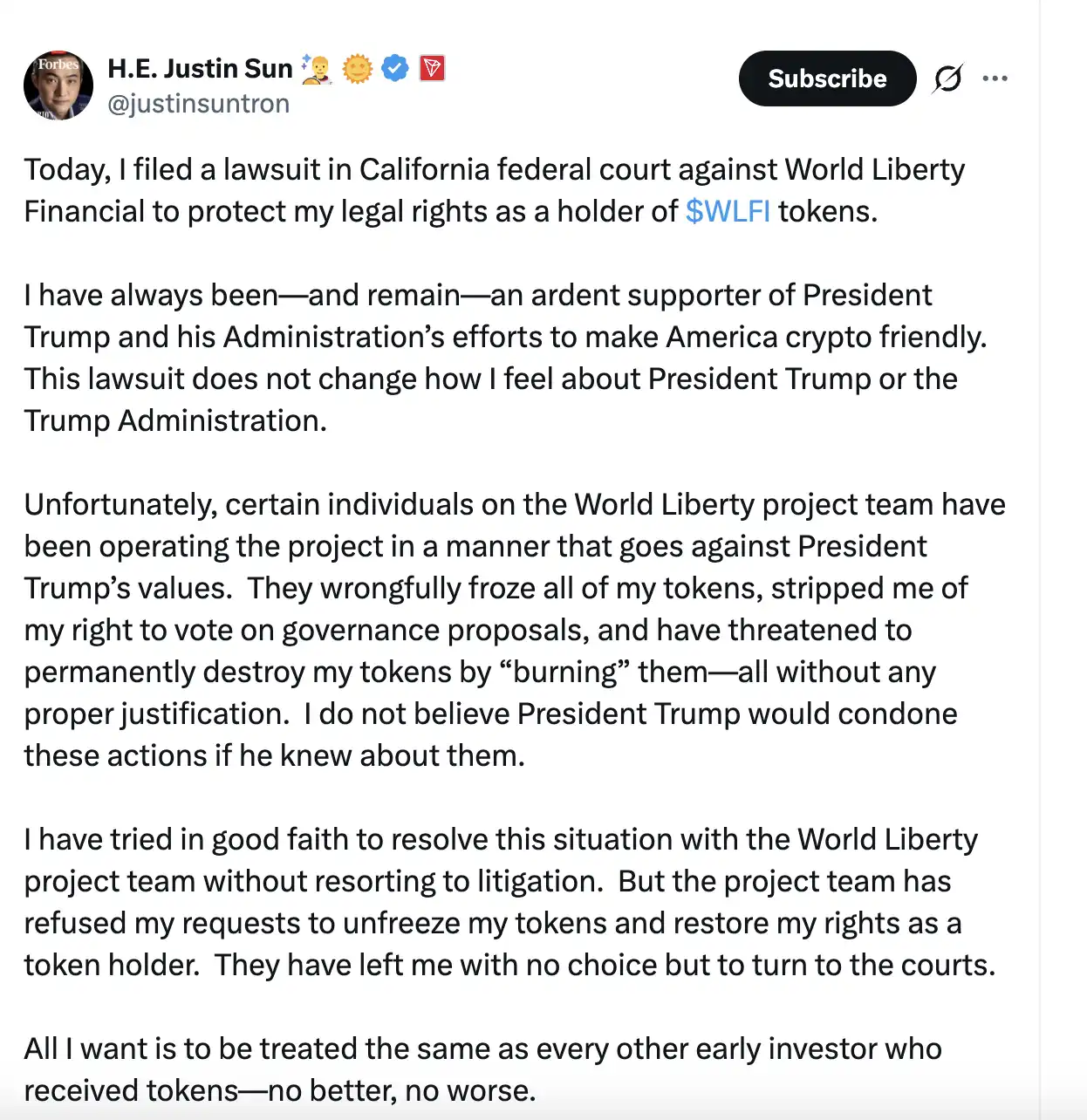
Sun claimed he had tried to "resolve the matter amicably," but the other party refused to unfreeze the tokens and restore his rights.

"They left me with no choice but to turn to the courts," he wrote on X.

World Liberty Financial CEO Zach Witkoff responded that Sun's allegations were "completely without merit" and said Sun had engaged in "improper conduct," forcing World Liberty Financial to take action to "protect itself and its users."

No one explained what this "improper conduct" specifically was.

The President's ATM

To understand why Sun was frozen, one must first see what World Liberty Financial really is.

On the surface, it is a "decentralized finance" project, claiming to let small investors control their own funds. It has a governance token WLFI, a stablecoin USD1, and DeFi lending products.

But peel back this layer, and the core structure is a profit pipeline.

The Trump family receives 75% of the net proceeds from WLFI token sales. By December 2025, the family had already profited $1 billion from this, while holding $3 billion worth of unsold tokens. The reserve assets for the USD1 stablecoin are invested in U.S. Treasury bonds, and the interest income generated also flows to family entities. Based on a market cap of $4.2 billion and current Treasury yields, the stablecoin alone could generate approximately $160 million in annual income.

This doesn't even include the biggest chunk.

In January 2025, just four days before Trump's inauguration, an investment entity of Abu Dhabi royal family member Sheikh Tahnoon bin Zayed acquired a 49% stake in World Liberty Financial for $500 million. The agreement was signed by Eric Trump. $187 million flowed directly into entities controlled by the Trump family, and at least $31 million went to entities linked to the Witkoff family.

Zach Witkoff, CEO and co-founder of World Liberty Financial. His father, Steve Witkoff, is the U.S. Special Envoy to the Middle East.

Senator Elizabeth Warren called it "blatant corruption." The House of Representatives subsequently launched an investigation. Trump himself said he was "unaware" of the deal.

Dolomite: Borrowing Your Own Money

In early 2026, on-chain data showed World Liberty Financial deposited 5 billion of its own WLFI tokens into the DeFi lending platform Dolomite as collateral, borrowing approximately $75 million in stablecoins. Over $40 million of this was transferred to Coinbase Prime, which usually means the tokens were converted into fiat currency.

And Dolomite's co-founder, Corey Caplan, is simultaneously an advisor to World Liberty Financial.

Your own tokens, deposited into a platform run by your own advisor, borrowing your own issued stablecoins, and then converting to cash.

This operation pushed the utilization rate of Dolomite's USD1 lending pool to 100%. Ordinary depositors were locked in, unable to withdraw their funds. And World Liberty Financial's collateral accounted for 55% of Dolomite's total value locked (TVL).

World Liberty Financial's response: "We, as an anchor borrower, created attractive yields for the platform."

In other words, they used their own issued tokens as collateral on their advisor's platform to borrow their own issued stablecoins. In traditional finance, this is called a related-party transaction, requiring separate auditing and disclosure. In DeFi, there wasn't even an announcement.

Sun publicly challenged this on April 12, saying the World Liberty Financial team treated users as a "personal ATM" and that he was the "first and biggest victim." Three days later, World Liberty Financial introduced a governance proposal.

Ultimatum

The governance proposal on April 15 was nominally about "governance restructuring." The actual content: 6.228 billion WLFI tokens (62% of the total supply) would be subject to a new unlocking schedule. The 45.2 billion tokens held by founders, team, and advisors needed to accept a 10% burn (approx. 4.52 billion tokens), then enter a 2-year lock-up period followed by 3-year linear release.

Holders who did not accept the new terms would have their tokens frozen indefinitely.

Sun called this proposal "one of the most ridiculous governance scams I have ever seen." But he couldn't vote against it because his tokens were already frozen.

Look at the distribution of voting power. In a USD1 governance proposal passed in January 2026, the top nine wallets controlled nearly 60% of the voting power.

WLFI's price action says it all. It hit an all-time high of $0.46 in September 2025 and has been falling since. On April 11, it touched an all-time low of $0.0767, down 84% from its high.

Early buyers who got in at $0.015 still have paper gains. But if you're Justin Sun, your $75 million investment bought tokens once worth over $1 billion, but now they are frozen and potentially facing permanent destruction.

The Same Mirror

Justin Sun is no innocent victim.

He has been accused by the SEC of market manipulation and fraud, and his investment timing precisely coincided with his legal troubles.

Precisely because he is not innocent, this case is interesting.

A person who made his fortune by "rug pulling" is treated with the same tactics by a larger power structure. The contrast here speaks volumes, more than any whitepaper.

World Liberty Financial promised "decentralized finance," user control over assets, no middlemen, no censorship.

But in reality, the smart contract has a backdoor, the project team can freeze your tokens at any time, governance votes are controlled by nine wallets, and the founders use your deposits to lend to themselves.

Sun's original words on X were: "Unfortunately, certain individuals within the World Liberty Financial project team are operating the project in a manner inconsistent with President Trump's values."

Even at the moment of filing the lawsuit, he was still saving face for Trump. A person who spent $75 million, after having all his assets frozen, still carefully distinguished between "President Trump" and "certain individuals within the project team" in the complaint.

The most interesting part of this case is not whether Sun can get his tokens back. It's how the court will characterize WLFI. If it is a security, then World Liberty Financial's act of modifying the contract and freezing holder assets without a vote could constitute fraud under federal securities law.

WLFI is currently quoted at $0.078, down about 84% from its high. The adequacy of the USD1 stablecoin reserve is being questioned. The risk in Dolomite's lending pool remains unresolved. The House investigation is ongoing. But the Trump family has already cashed out over $1 billion.

The earliest maturity window for Sun's convertible bonds is in 2027. Court scheduling could take over a year. During this time, WLFI tokens will continue to unlock, and more people will be forced to accept the choice of "either agree to the new terms or be frozen forever."


Câu hỏi Liên quan

QWhat is the core allegation in Justin Sun's lawsuit against World Liberty Financial?

AJustin Sun alleges that World Liberty Financial made him 'the primary target of its fraudulent scheme,' causing him and his companies to suffer 'hundreds of millions of dollars in losses.' He also claims the company is 'on the brink of collapse' and 'severely insolvent,' with plans to pay '95% of the token sale proceeds to company insiders.'

QWhat specific action did World Liberty Financial take that led to Justin Sun's assets being frozen?

AIn August 2025, World Liberty Financial modified the WLFI token's smart contract to include a 'blacklist' function. This allowed the project to unilaterally freeze any holder's tokens without notice, reason, or a governance vote. Sun's tokens, worth approximately $107 million, were frozen when he tried to transfer them a month later.

QHow is the Trump family financially connected to World Liberty Financial according to the article?

AThe Trump family receives 75% of the net proceeds from WLFI token sales, having already profited $1 billion by December 2025. They also hold $3 billion in unsold tokens. Furthermore, interest income from the USD1 stablecoin's treasury reserves flows to family entities, generating an estimated $160 million annually.

QWhat controversial transaction involving Dolomite is described in the article?

AWorld Liberty Financial deposited 5 billion of its own WLFI tokens into the DeFi lending platform Dolomite as collateral to borrow approximately $75 million in stablecoins. Over $40 million of this was transferred to Coinbase Prime, likely to be converted to cash. This is controversial because Dolomite's co-founder is also an advisor to World Liberty Financial, creating a clear conflict of interest.

QWhat was the 'ultimatum' presented to token holders in the April 15th governance proposal?

AThe proposal required that 45.2 billion tokens held by founders, team, and advisors be subject to a 10% burn (approx. 4.5 billion tokens) and then locked for 2 years with a 3-year linear release schedule. Holders who did not accept these new terms would have their tokens frozen indefinitely.

Nội dung Liên quan

CẬP NHẬT – Michael Saylor Cố Gắng Giảm Nhiệt Cho Cuộc Xung Đột Nội Bộ Trong Bitcoin — Nhưng Ông ấy Có Thành Công?

Michael Saylor, chủ tịch điều hành của MicroStrategy, đã công bố một bài viết phân chia cộng đồng Bitcoin thành bốn nhóm chính: Người theo chủ nghĩa tối đa (Bitcoin Maximalists), Nhà tư bản Bitcoin (Bitcoin Capitalists), Nhà công nghệ Bitcoin (Bitcoin Technologists) và Người theo chủ nghĩa cơ bản (Bitcoin Fundamentalists). Ông cho rằng sự khác biệt này phản ánh sự trưởng thành và phát triển của Bitcoin chứ không phải là dấu hiệu sụp đổ. Mỗi nhóm có quan điểm riêng về cách Bitcoin nên phát triển, từ việc giữ nguyên tính chất "tiền tệ mạnh" chống lạm phát cho đến việc tích hợp sâu vào hệ thống tài chính truyền thống, hay tập trung cải tiến công nghệ và bảo vệ các nguyên tắc phi tập trung ban đầu. Saylor lập luận rằng Bitcoin có thể giữ vững lớp nền tảng (base layer) trong khi vẫn cho phép thị trường và các sản phẩm tài chính phát triển xung quanh nó. Bài viết của ông xuất hiện trong bối cảnh MicroStrategy vừa thực hiện lần bán Bitcoin đầu tiên kể từ năm 2022, gây chú ý trên thị trường. Câu hỏi đặt ra là liệu Saylor có thể xoa dịu những tranh cãi nội bộ này hay không, khi mà tiền bạc, chính trị và nguyên tắc đều đang va chạm trong hệ sinh thái Bitcoin.

bitcoinist16 phút trước

CẬP NHẬT – Michael Saylor Cố Gắng Giảm Nhiệt Cho Cuộc Xung Đột Nội Bộ Trong Bitcoin — Nhưng Ông ấy Có Thành Công?

bitcoinist16 phút trước

Hoskinson Phủ Nhận Tin Đồn Rời Cardano: ‘Tôi Không Bỏ Đi’

Người sáng lập Cardano Charles Hoskinson đã bác bỏ tin đồn rời khỏi hệ sinh thái, khẳng định trong một buổi phát trực tiếp ngày 4/6 rằng ông chỉ tạm lùi lại khỏi các kênh giao tiếp công chúng chứ không từ chức. Động thái này được đưa ra sau một bài đăng "tạm nghỉ ngơi" trên X của ông khiến cộng đồng lo lắng. Trong buổi phát trực tiếp, Hoskinson tập trung chỉ trích môi trường mạng xã hội độc hại, đặc biệt là trên X, nơi ông cho biết khoảng 30% phản hồi cho các tweet của mình là thù địch, lạm dụng hoặc chứa nội tục tĩu, khiến việc tương tác ý nghĩa trở nên bất khả thi. Ông nói rằng chi phí tâm lý để duy trì hoạt động ở đó là quá cao. Hoskinson cũng nêu bật sự khác biệt giữa tiến bộ công nghệ của Cardano và hiệu suất giá của ADA, gọi đây là "câu chuyện về hai Cardano". Trong khi giao thức, nghiên cứu và tính phi tập trung đã tiến bộ vượt bậc kể từ năm 2021, thì giá ADA lại sa sút khiến nhiều người chỉ trích. Ông kêu gọi cộng đồng cần giải quyết sự "mâu thuẫn nhận thức" này bằng cách rời bỏ X như là địa điểm thảo luận chính, suy nghĩ lại về động lực cho các nhà phát triển và xây dựng một lộ trình mới. Hoskinson chỉ trích cấu trúc quản trị của Quỹ Cardano, gọi đó là "sai lầm tồi tệ nhất" trong sự nghiệp của mình. Kết thúc, Hoskinson tuyên bố sẽ tạm nghỉ khỏi các video công khai, phỏng vấn và mạng xã hội để tập trung làm việc cho Midnight, đồng thời suy ngẫm và đưa ra các đề xuất cho tương lai của Cardano sau đó.

bitcoinist1 giờ trước

Hoskinson Phủ Nhận Tin Đồn Rời Cardano: ‘Tôi Không Bỏ Đi’

bitcoinist1 giờ trước

Anthropic khởi động IPO: Phép màu kinh doanh hay bong bóng định giá?

Tác giả: Phó Thịnh Tuần này, Anthropic, công ty AI cạnh tranh trực tiếp với OpenAI, đã bí mật nộp đơn IPO, dự kiến niêm yết vào tháng 10 với sự bảo lãnh của Morgan Stanley và Goldman Sachs. Định giá trước IPO của họ đã đạt 9650 tỷ USD sau đợt gọi vốn H, và được dự báo có thể chạm 1.5-2 nghìn tỷ USD khi lên sàn, vượt qua SpaceX. Nhiều người đặt câu hỏi liệu đây có phải bong bóng như thời kỳ dot-com 2000 hay không. Tác giả chỉ ra sự khác biệt cốt lõi: Các công ty thời dot-com thường định giá dựa trên "giấc mơ" và ý tưởng thuần túy, trong khi Anthropic có mô hình kinh doanh rõ ràng với doanh thu thực tế khổng lồ và đang bắt đầu có lãi. Doanh thu năm hóa (ARR) của Anthropic tăng vọt từ 10 tỷ USD đầu 2025 lên 470 tỷ USD vào tháng 5 năm nay, với mục tiêu cuối năm là 1000 tỷ USD. Họ dự kiến có lợi nhuận hoạt động trong quý II/2026. Với khoảng 3000 nhân viên, doanh thu trên mỗi nhân viên vượt 10 triệu USD. Khách hàng của họ bao gồm 8/10 công ty trong Fortune 10 và hơn 1000 doanh nghiệp lớn. Tác giả cho rằng định giá của Anthropic dựa trên mô hình SaaS truyền thống với hệ số Price-to-Sales, và doanh thu ổn định từ các gói đăng ký API cho doanh nghiệp hỗ trợ cho mức định giá này. Bài viết cũng đề cập đến một xu hướng lớn hơn: nền kinh tế thế giới đang chuyển dịch từ nền tảng "carbon" (dựa vào con người) sang kết hợp với nền tảng "silicon" (dựa vào AI và sức mạnh tính toán). Các công ty hàng đầu như Nvidia đã chứng kiến chi phí đầu tư vào năng lực tính toán vượt quá chi phí nhân sự. Việc Anthropic lên sàn không chỉ là câu chuyện của một công ty, mà có thể là điểm neo giá cho một mô hình kinh tế mới - nơi trí tuệ và năng lực được đo lường bằng sức mạnh tính toán và khả năng mở rộng quy mô của AI.

链捕手3 giờ trước

Anthropic khởi động IPO: Phép màu kinh doanh hay bong bóng định giá?

链捕手3 giờ trước

Các Thượng Nghị Sĩ Hoa Kỳ Gây Sức Ép Lên Cơ Quan Quản Lý Ngân Hàng Để Có Quy Định Vốn 'Công Bằng' Cho Crypto

Một nhóm thượng nghị sĩ đảng Cộng hòa Mỹ, đứng đầu là Chủ tịch Tiểu ban Tài sản Số Cynthia Lummis, đã gửi thư tới các cơ quan quản lý ngân hàng hàng đầu bao gồm Cục Dự trữ Liên bang, FDIC và OCC. Trong thư, họ kêu gọi xây dựng một khuôn khổ vốn rõ ràng và công bằng hơn cho các hoạt động tài sản tiền mã hóa của ngân hàng. Các thượng nghị sĩ chỉ trích tiêu chuẩn vốn của Ủy ban Basel, áp dụng trọng số rủi ro 1250% - mức phân loại trừng phạt nhất - đối với tài sản tiền mã hóa, coi đó là lệnh cấm thực tế thay vì đánh giá rủi ro thực tế. Họ hoan nghênh hướng dẫn chung gần đây về chứng khoán token hóa, khẳng định việc xử lý vốn nên dựa trên đặc điểm rủi ro của tài sản cơ bản chứ không phải công nghệ ghi nhận. Các nghị sĩ thúc giục nguyên tắc này cần được áp dụng nhất quán cho cả các tài sản số khác. Lời kêu gọi này được đưa ra khi các cơ quan quản lý đang chuyển sang mô hình giám sát dựa trên rủi ro. Chủ tịch FDIC Travis Hill nhấn mạnh vai trò của tiêu chuẩn vốn mạnh mẽ, đồng thời cho biết đã có các đề xuất quy định cho các công ty con phát hành stablecoin. Tương tự, Giám đốc OCC Jonathan Gould khẳng định nhiệm vụ là tạo điều kiện cho đổi mới có trách nhiệm, xem xét lại các hành động giám sát trước đây và chống lại việc ngân hàng từ chối dịch vụ bất hợp pháp.

bitcoinist3 giờ trước

Các Thượng Nghị Sĩ Hoa Kỳ Gây Sức Ép Lên Cơ Quan Quản Lý Ngân Hàng Để Có Quy Định Vốn 'Công Bằng' Cho Crypto

bitcoinist3 giờ trước

Giao dịch

Giao ngay
Hợp đồng Tương lai

Bài viết Nổi bật

Làm thế nào để Mua SUN

Chào mừng bạn đến với HTX.com! Chúng tôi đã làm cho mua SUN (SUN) trở nên đơn giản và thuận tiện. Làm theo hướng dẫn từng bước của chúng tôi để bắt đầu hành trình tiền kỹ thuật số của bạn.Bước 1: Tạo Tài khoản HTX của BạnSử dụng email hoặc số điện thoại của bạn để đăng ký tài khoản miễn phí trên HTX. Trải nghiệm hành trình đăng ký không rắc rối và mở khóa tất cả tính năng. Nhận Tài khoản của tôiBước 2: Truy cập Mua Crypto và Chọn Phương thức Thanh toán của BạnThẻ Tín dụng/Ghi nợ: Sử dụng Visa hoặc Mastercard của bạn để mua SUN (SUN) ngay lập tức.Số dư: Sử dụng tiền từ số dư tài khoản HTX của bạn để giao dịch liền mạch.Bên thứ ba: Chúng tôi đã thêm những phương thức thanh toán phổ biến như Google Pay và Apple Pay để nâng cao sự tiện lợi.P2P: Giao dịch trực tiếp với người dùng khác trên HTX.Thị trường mua bán phi tập trung (OTC): Chúng tôi cung cấp những dịch vụ được thiết kế riêng và tỷ giá hối đoái cạnh tranh cho nhà giao dịch.Bước 3: Lưu trữ SUN (SUN) của BạnSau khi mua SUN (SUN), lưu trữ trong tài khoản HTX của bạn. Ngoài ra, bạn có thể gửi đi nơi khác qua chuyển khoản blockchain hoặc sử dụng để giao dịch những tiền kỹ thuật số khác.Bước 4: Giao dịch SUN (SUN)Giao dịch SUN (SUN) dễ dàng trên thị trường giao ngay của HTX. Chỉ cần truy cập vào tài khoản của bạn, chọn cặp giao dịch, thực hiện giao dịch và theo dõi trong thời gian thực. Chúng tôi cung cấp trải nghiệm thân thiện với người dùng cho cả người mới bắt đầu và người giao dịch dày dạn kinh nghiệm.

Tổng lượt xem 704Xuất bản vào 2024.12.12Cập nhật vào 2025.03.21

Làm thế nào để Mua SUN

Thảo luận

Chào mừng đến với Cộng đồng HTX. Tại đây, bạn có thể được thông báo về những phát triển nền tảng mới nhất và có quyền truy cập vào thông tin chuyên sâu về thị trường. Ý kiến ​​của người dùng về giá của SUN (SUN) được trình bày dưới đây.

活动图片