Editor's Note: A decade ago, fintech neobanks improved the banking experience through mobile applications but did not change the underlying system of how money moves. Today, encryption technology is attempting to touch deeper changes, reconstructing "how money flows."
This article starts from the four dimensions of "store, spend, grow, and borrow" to sort out the development path and competitive landscape of crypto neobanks: from self-custody wallets and stablecoin payments to on-chain transactions, lending, and yield mechanisms. Author Jay Yu (Research and Investment Team Member at Pantera Capital) proposes that, with the speed of capital flow as a clue, the breakthrough of crypto neobanks may first appear in high-frequency, high-turnover growth and lending scenarios, and then gradually extend to payments and storage.
Before issues such as privacy, compliance, real-world connectivity, and credit systems are fully resolved, crypto neobanks are still in the early stages. But it is certain that they are not just new financial applications but are attempting to build a new set of money movement tracks.
Below is the original text:
Introduction
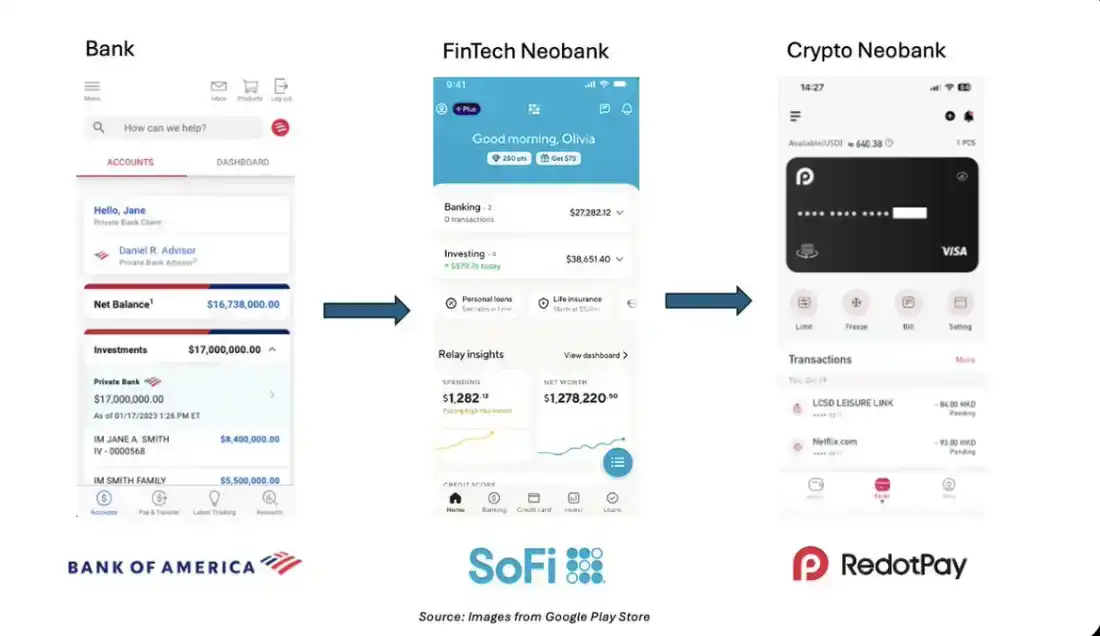
No matter which banking or fintech app you open today—be it Bank of America, Revolut, Chase, or SoFi—scrolling down the interface gives a sense of déjà vu: Accounts, Pay & Transfer, Earn Yield. These interfaces are almost interchangeable.
This highly similar design reveals the common underlying logic of banking: banks are essentially the interface of the four core relationships we have with "money":
Store: A place to hold and preserve assets
Spend: A mechanism for daily expenses and transfers
Grow: A set of tools for passive or active wealth management
Borrow: A channel to access external funds and leverage
Over the past decade, the popularity of mobile technology has driven the rise of "neobank" apps like SoFi, Revolut, and Wise. They have made financial services more inclusive and redefined what it means to "bank"—replacing physical branches with intuitive, always-on digital interfaces.
Today, as encryption technology enters its second decade, a new paradigm is emerging. From self-custody wallets and stablecoins to on-chain credit and yield mechanisms, the permissionless and programmable nature of blockchain enables banking-like experiences to be global, instant, and composable.
If mobile internet gave birth to neobanks, then encryption technology is nurturing permissionless neobanks: a unified, interoperable, self-custody-centric interface that allows users to store, spend, grow, and borrow funds in the on-chain economy.
History of Fintech Neobanks
Similar to the crypto industry, the rise of neobanks also occurred after the 2008 financial crisis. Unlike traditional banks that replicate physical branch layouts, neobanks are more like technology platforms, providing banking services to users through mobile interfaces.
Most neobanks partner with traditional banks in the background, with the latter providing deposit insurance and compliance infrastructure, while the neobanks themselves control the front-end user relationships. With fast account opening processes, transparent fee structures, and digital experience-centric designs, many neobanks have gradually become the preferred entry point for users to save, spend, and manage wealth.
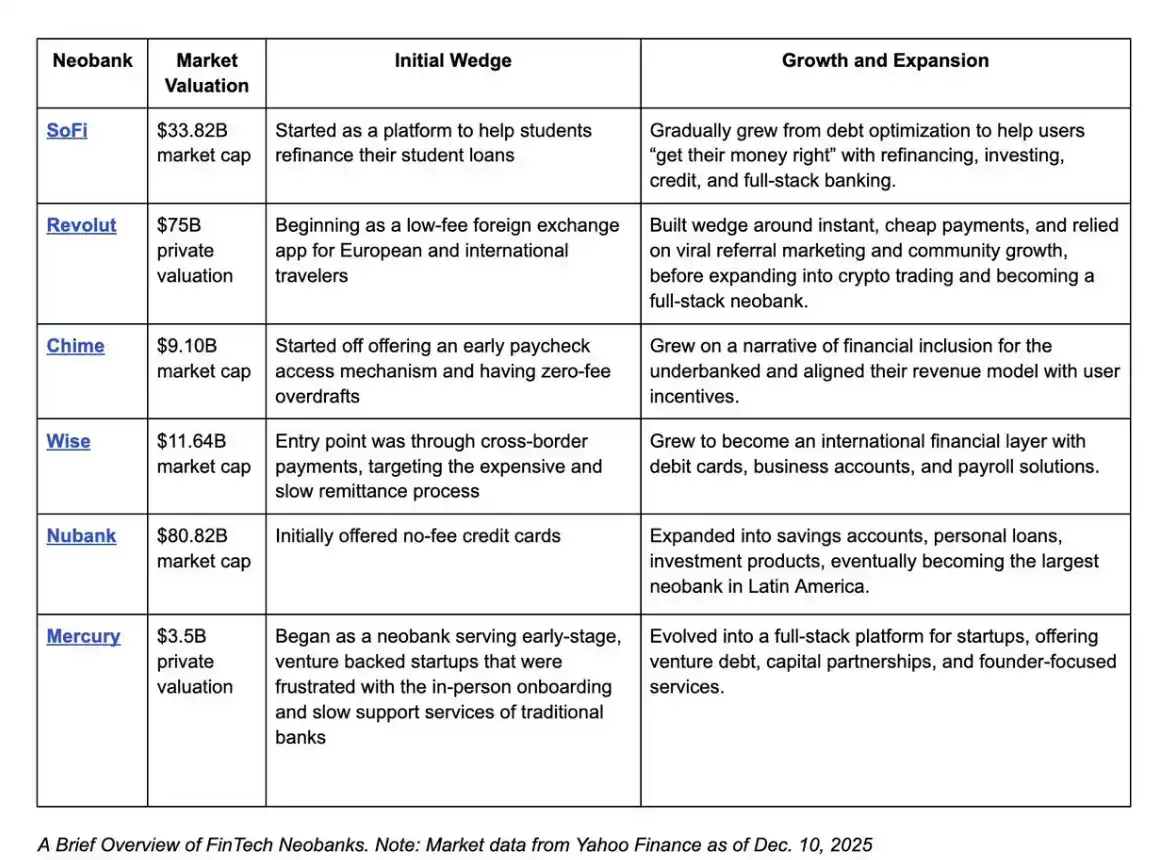
Looking back at the growth paths of these neobank startups with market capitalizations of billions of dollars, they share a common point: they master user relationships through unique digital product forms, whether it's refinancing services, early salary payments, transparent foreign exchange rates, or other differentiated features. This starts a user-centric transaction volume flywheel, which then gradually expands the product matrix to monetize existing users.
Simply put, the victory of fintech neobanks lies in their mastery of the "entry point of money": by reshaping the medium through which users save, spend, invest, and borrow, they firmly occupy the interface layer of capital interaction.
Today, the crypto industry is at a node similar to that of neobanks 5–10 years ago. Over the past decade, crypto has nurtured a series of its own "wedge products":
Anti-censorship asset storage through self-custody wallets
Low-threshold digital dollars through stablecoins
Permissionless credit markets represented by protocols like Aave
And 24/7 global capital markets that can even turn internet memes into wealth carriers
Just as mobile internet infrastructure opened the era of neobanks, programmable blockchains are providing a permissionless financial underlying architecture.
The logical next step is to combine these permissionless backend capabilities with neobank-like easy-to-use frontends. The first generation of neobanks moved the frontend of banks from physical branches to mobile interfaces while retaining the traditional banking system as the backend; today's crypto neobanks do the opposite—they retain the convenient mobile experience but begin to change the underlying path of capital flow: from traditional banking tracks to stablecoins and public blockchains.
In other words, if neobanks rebuilt the frontend of banks on mobile internet, then encryption technology is providing an opportunity: to rebuild the backend of banks on permissionless tracks.
Landscape of Crypto Neobanks
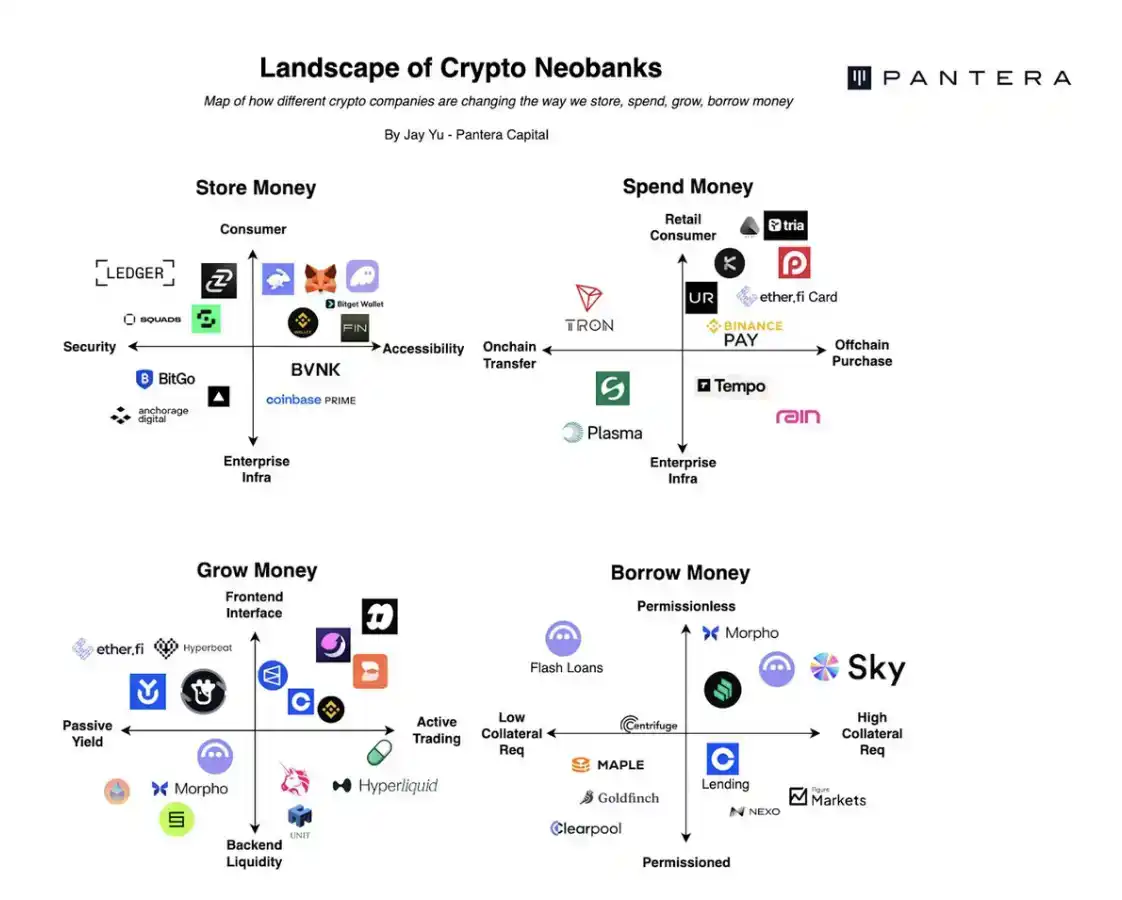
Today, more and more projects are gradually converging under the vision of "crypto neobanks." We have seen that on permissionless crypto tracks, the basic capabilities around the four financial relationships of store, spend, grow, and borrow are gradually taking shape:
Self-custody asset storage through hardware wallets like Ledger
Daily payments through Etherfi cards or Bitget QR codes
Trading on platforms like Hyperliquid for asset growth
On-chain lending through protocols like Morpho
At the same time, a large number of supporting participants are underpinning the underlying infrastructure, including: Wallet-as-a-Service, stablecoin clearing systems, compliance licensing services, localized on-ramp/off-ramp channel partners, and cross-protocol orchestration routers.
Additionally, in some cases, crypto exchanges themselves, such as Binance and Coinbase, are already moving closer to fintech neobanks, trying to further master the core relationship between users and their assets.
For example, Binance Pay supports payments for over 20 million merchants globally; while Coinbase allows users to automatically earn up to 4% rewards just by holding USDC on the platform.
In such a complex and multi-layered crypto neobank ecosystem, it is necessary to systematically sort out this landscape: How are different crypto platforms competing to become the user's "primary financial relationship interface"? Which links of saving, spending, investing, and borrowing are they targeting?
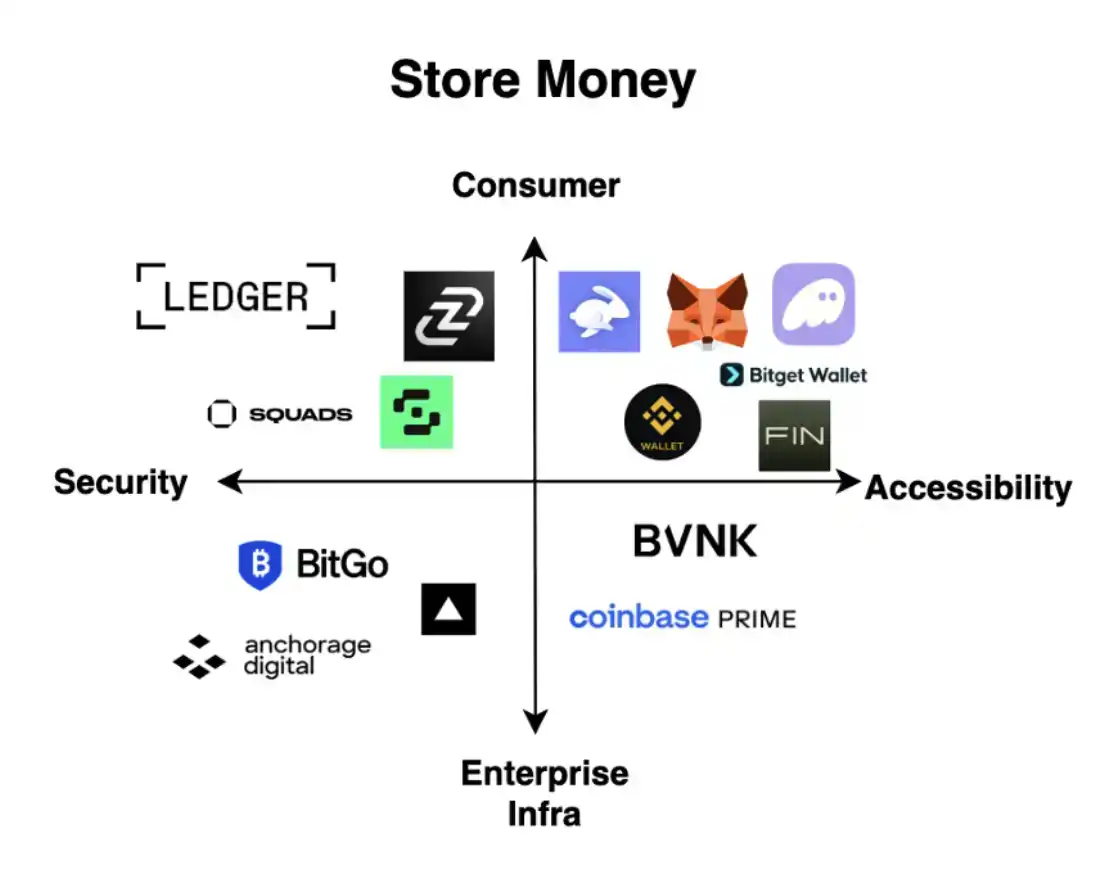
To truly achieve self-custody of crypto assets and interact with the blockchain, users must first have some form of crypto wallet. Roughly speaking, the crypto wallet ecosystem can be divided along two dimensions: the security ↔ usability axis, and the consumer application ↔ enterprise infrastructure axis.
In different quadrants, differentiated winners with strong distribution capabilities have emerged:
Ledger represents secure, consumer-oriented hardware wallets;
Fireblocks and Anchorage provide secure enterprise-grade wallet infrastructure;
MetaMask, Phantom, and Privy are consumer-oriented wallets focused on improving usability and user experience;
Turnkey and Coinbase Prime occupy more of the "high accessibility + enterprise-grade" infrastructure positions.
Using a wallet application as a beachhead to build a neobank has the core advantage that the wallet frontend—such as MetaMask and Phantom—often controls the entry layer for users to interact with crypto assets. The so-called "fat wallet thesis" believes that the wallet layer captures the vast majority of consumer-facing distribution capabilities and order flow, and for end users, the cost of switching wallets is extremely high.
Indeed: Currently, about 35% of Solana transaction volume is completed through the Phantom wallet. This moat formed by excellent mobile experience and user stickiness is extremely impressive.
Additionally, since consumers (especially retail investors) often value convenience over price, wallets like Phantom and MetaMask can charge up to 0.85%; in comparison, exchange protocols like Uniswap may only charge 0.3% per token swap.
On the other hand, building a complete, profitable neobank based solely on a single wallet platform is surprisingly difficult. The reason is that to achieve scale and profitability, users must not only "store" tokens but also frequently use these tokens within the wallet.
Phantom, MetaMask, and Ledger may have household brand recognition, but if users only use crypto wallets as "cash shoeboxes under the bed," they can hardly monetize. In other words, wallets must transform into active trading and payment platforms to turn distribution advantages into revenue.
MetaMask and Phantom are clearly moving in this direction.
For example, MetaMask recently launched the MetaMask card, trying to monetize its existing crypto-native user base and become the default solution for "spending with cryptocurrency." Phantom followed closely by launching Phantom Cash and further entered the "grow money" field—by integrating Hyperliquid's builder codes to provide perpetual contract trading functions within the app.
As Blockworks said: "Although Drift or Jupiter may be Solana's local favorites, the real money has flowed to Hyperliquid."
This is a universally meaningful lesson for the entire wallet track: you must not only master the user's wallet itself but also master the scale of funds flowing inside and outside the wallet through behaviors like 'spend, grow, borrow'.
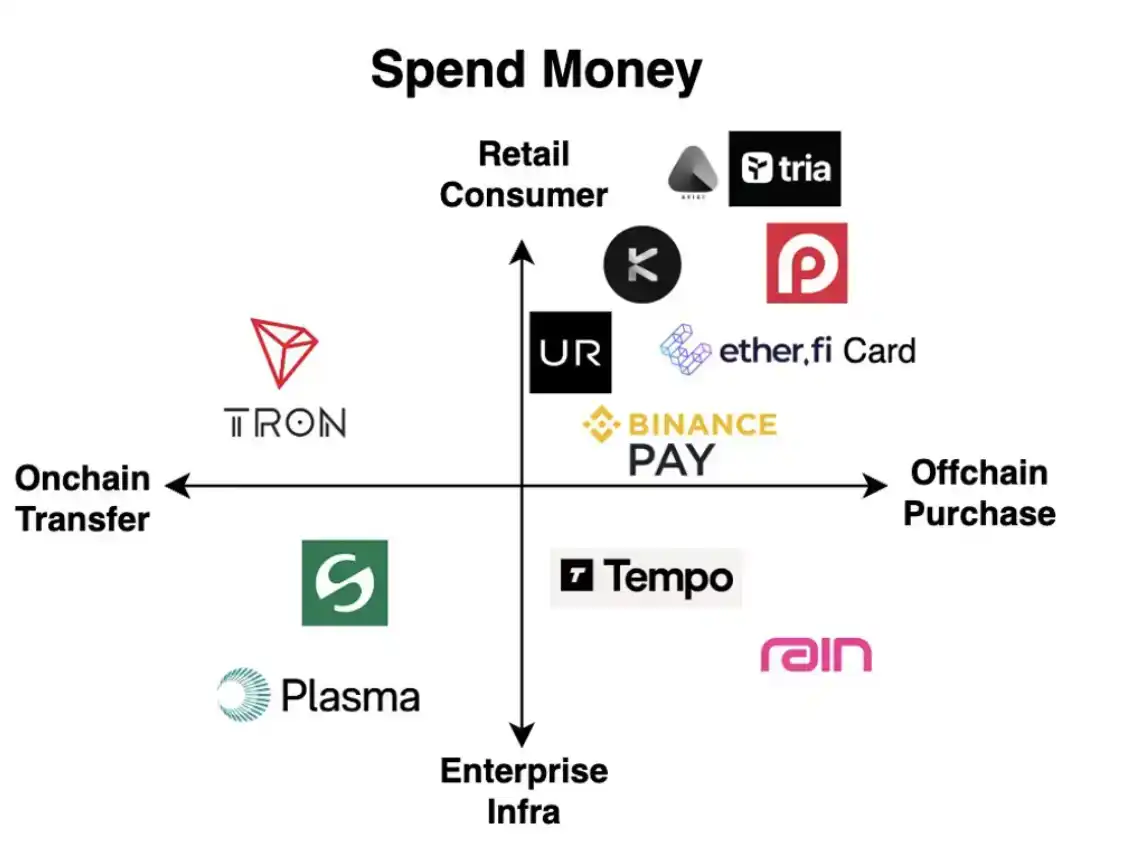
The second type of competitor for crypto neobanks is platforms that allow users to spend cryptocurrency.
Similar to "storing money in a crypto way," we can also divide applications for "spending money in a crypto way" along two dimensions: from on-chain transfers to off-chain consumption (e.g., buying a cup of coffee); and from retail consumer-facing applications to enterprise-facing infrastructure.
Interestingly, many "neobank" projects that have gained market attention in the past few months—such as Kast, Tria, Tempo, Stable—almost all target the "paying with cryptocurrency" entry point. Especially in two major directions, market heat is particularly concentrated:
Retail consumer-facing applications integrating stablecoin cards, such as Avici, Tria, Redotpay, EtherFi;
Enterprise-facing "stablecoin public chains" or "stablecoin infrastructure," such as Stable, Plasma, Tempo.
Retail End: Making Crypto Apps More Like Banks
The first type of "payment application" for retail users essentially makes crypto applications increasingly similar to traditional banks or fintech neobanks at the user experience level: familiar interface tabs like "Home, Banking, Card, Invest" are all available.
With the maturity of crypto card issuers like Rain and Reap, and the expansion of Visa and Mastercard's support for stablecoins, crypto cards themselves have gradually become commoditized. The real differentiation is not "issuing a card" but the ability to continuously drive and retain transaction volume—whether through innovative cashback mechanisms, localized promotion capabilities, or introducing non-crypto-native users to the platform.
This trajectory is highly similar to the rise of fintech neobanks: success was never just about "issuing cards" or "making apps," but about mastering a specific user group, from students (SoFi), to low-income families (Chime), to international travelers (Wise and Revolut), and building trust, loyalty, and scaled transaction volume on this basis.
If the path is correct, this type of "payment-first" crypto neobank could become an important entry point for large-scale adoption of blockchain infrastructure.
Furthermore, crypto neobanks may also guide users towards a new generation of payment systems that go beyond traditional bank card tracks.
Card-based consumption may only be a transitional stage—it still relies on the Visa and Mastercard clearing networks and inherits their centralized constraints. New signals have emerged: for example, Bitget Wallet has launched QR code-based stablecoin payment pilots in Indonesia, Brazil, and Vietnam. This points to a potential future: crypto-native settlement systems may completely bypass traditional card issuers.
Enterprise End: Stablecoin Infrastructure and "Stablecoin Chains"
The second type of recently emerging "neobank" applications are stablecoin infrastructure projects for enterprises, including Stable, Plasma, Tempo, Arc, etc., often called "stablecoin chains."
An important background for their rise is the increasing demand from institutional players—traditional banks, fintech companies like Stripe, and existing payment networks—for more efficient capital tracks.
These "stablecoin chains" often have similar characteristics:
Using stablecoins as Gas tokens to avoid fee instability caused by custom Gas token price fluctuations
Streamlining consensus mechanisms to accelerate high-frequency, large-amount payments from A to B
Enhancing transfer privacy through trusted execution environments (TEE)
Customizing data fields to adapt to international payment standards like ISO 20022
However, technical improvements alone do not guarantee adoption.
For payment-oriented public chains, the real moat is merchants. The key question is how many merchants and businesses are willing to migrate their operations to a specific chain.
For example, Tempo tries to leverage Stripe's vast merchant base and payment network to drive transaction volume and adoption [12], introducing a batch of new merchant groups into the crypto track. Other chains, such as Plasma and Stable, attempt to become "first-class citizens" of Tether USDT, strengthening the role of stablecoins in inter-institutional circulation.
In this field, the most enlightening case is Tron. It handles about 25–30% of global stablecoin transaction volume.
Tron's rise is largely due to its advantages in emerging markets—such as Nigeria, Argentina, Brazil, and Southeast Asia. With low fees, fast confirmation, and global coverage, Tron has become a common settlement layer for merchant payments, cross-border remittances, and US dollar-denominated savings accounts.
For all new payment-oriented public chains, Tron is an existing competitor that must be faced. To challenge it, a 10x improvement is needed on a foundation that is already "cheap, fast, and global"—which often means focusing on merchant expansion and network scale expansion rather than marginal technical optimization.
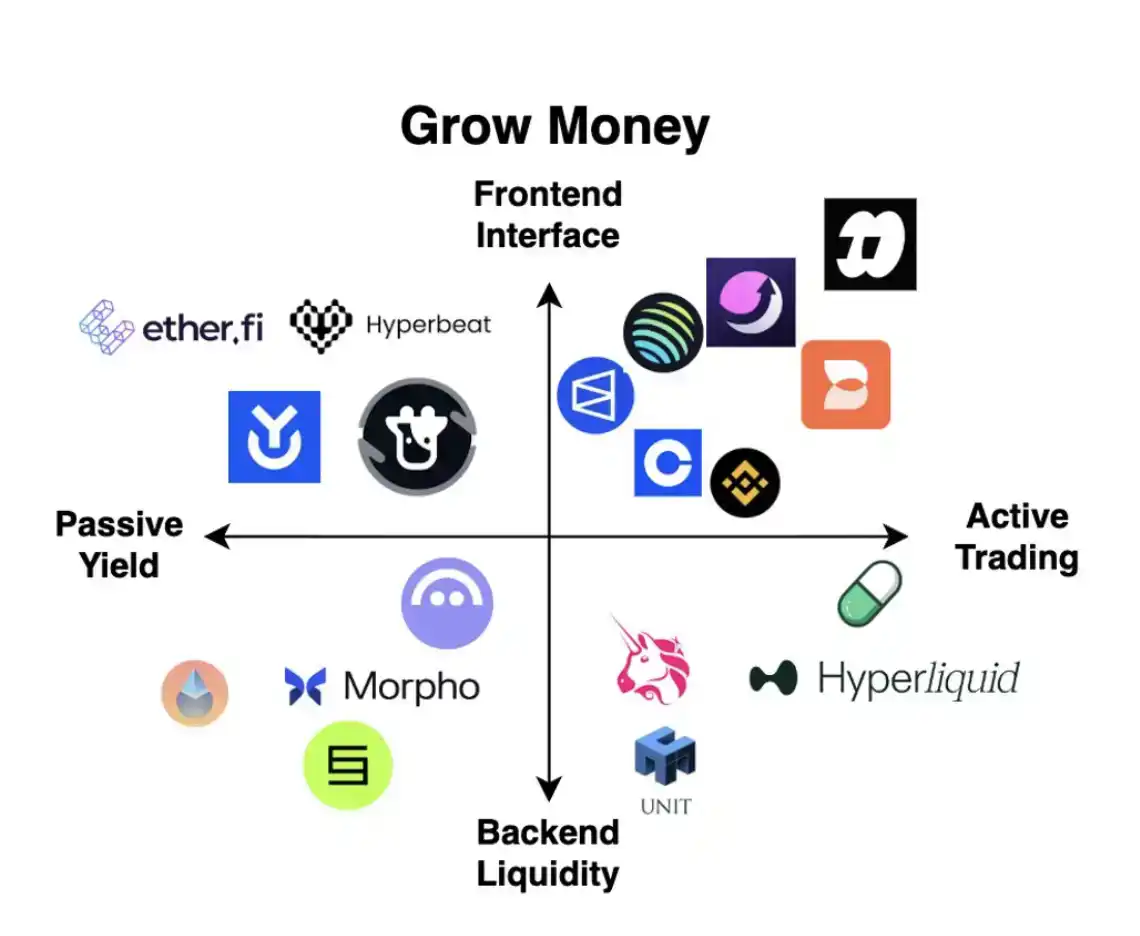
The third relationship that "crypto neobanks" establish with users is to help users grow their money. This is one of the most innovative sectors in the crypto field, giving birth to multiple financial primitives from 0 to 1—from staking vaults, perpetual contract trading, to token issuance platforms and prediction markets. Similar to the previous sections, we can also classify "grow money" applications along two dimensions: from passive income to active trading, and from frontend interfaces to backend liquidity.
A classic case of a "grow money" application evolving into a full-featured neobank comes from centralized crypto exchanges (CEX), such as Binance or Coinbase. Exchanges initially provided a simple and effective value proposition—"this is where you grow your wealth by trading crypto assets." As transaction volume continued to climb, exchanges gradually became core places not only for growth but also for storing and managing assets.
Coinbase and Binance have both launched their own blockchains, wallets, institutional products, and crypto cards, monetizing their core user base through new products and network effects. For example, Binance Pay's adoption rate continues to rise, with more and more merchants using it to accept crypto payments for daily goods.
The same path has been verified in DeFi projects. Take EtherFi as an example: it was initially an Ethereum liquid staking protocol, providing passive income for users who restake ETH to EigenLayer. Subsequently, EtherFi launched a DeFi strategy vault called "Liquid," allocating user funds to the DeFi ecosystem to pursue higher returns under controlled risk. Then, the project expanded to EtherFi Cash—a groundbreaking credit card product that allows users to directly spend their EtherFi balance in the real world.
This expansion path is highly similar to fintech neobanks: establishing a foothold through a unique product entry point (passive staking and yield), forming a "best solution" in a niche to gain scale, and then horizontally expanding the product matrix to monetize existing users (like the EtherFi card).
To date, the crypto field has given birth to multiple 0→1 innovations that support users to "grow money": for example, perpetual contract platforms like Hyperliquid have grown into one of the most profitable crypto companies; prediction markets like Polymarket have gradually entered the mainstream. It is very possible that the next step for these platforms is also to monetize through new product forms—allowing users to store more, spend more on the platform, and leveraging network scale effects.
Starting with a "grow money platform," especially an active trading platform, has a significant advantage: high trading frequency and large transaction volume. For example, Hyperliquid has processed $3 trillion in transaction volume in the past 18 months. Compared to "store money platforms" and "payment platforms," "grow money platforms" have stronger user flywheels and stickiness, meaning they control a larger "captured user pool" that can be converted and monetized in subsequent expansions.
However, these platforms are also highly dependent on market cycles and are often labeled "financial casinos." This reputation may limit their reach to a truly global mass user base—after all, people's psychological expectations for "banks" and "casinos" are ultimately very different.
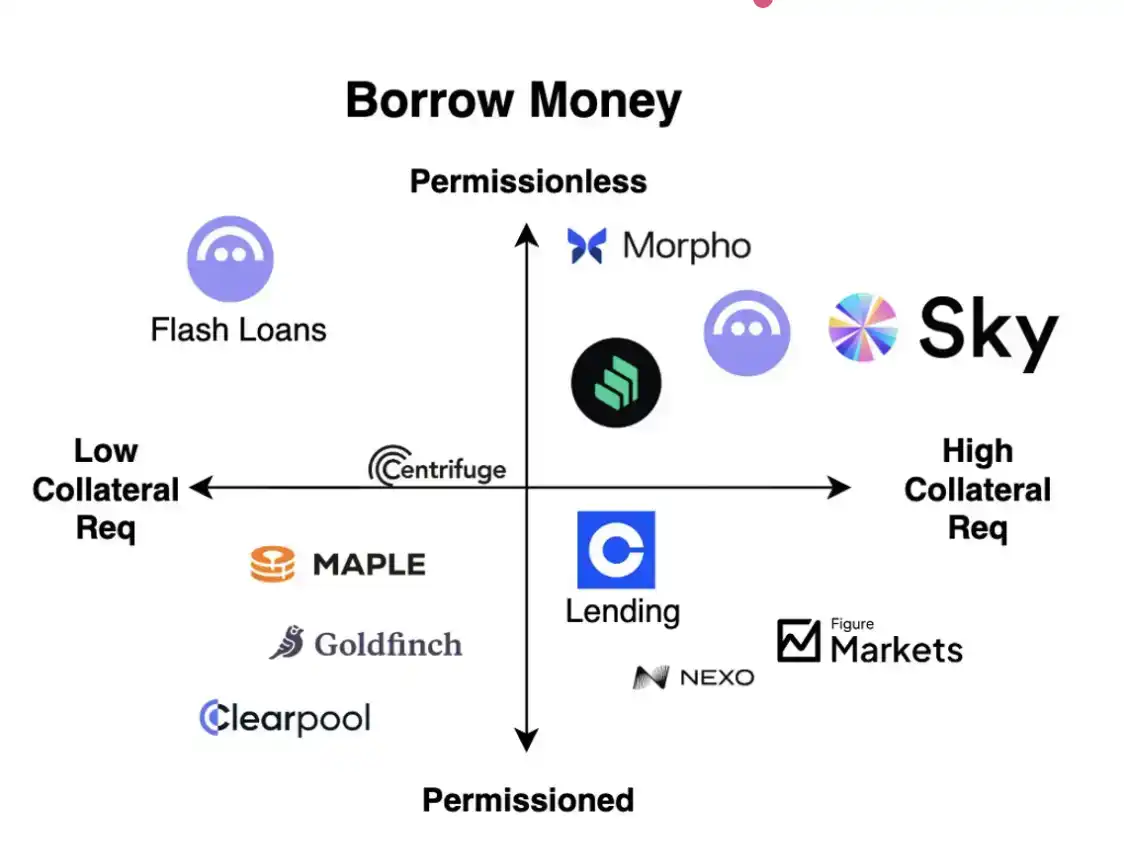
As in the traditional economic system, lending capacity is an important engine for driving on-chain economic growth. For crypto neobanks, lending is also one of the most critical and sustainable sources of income. In the traditional financial system, lending is a highly permitted activity that requires multiple reviews such as KYC, credit scores, and loan history; in the crypto world, the lending system has both permitted and permissionless models, corresponding to different collateral capital requirements.
The mainstream model in the current crypto field is a permissionless, on-chain operated, over-collateralized lending system. DeFi giants like Aave, Morpho, and Sky (formerly MakerDAO) embody the core spirit of crypto "code is law": since the blockchain naturally cannot obtain users' FICO credit scores or social reputation information, they can only ensure solvency through over-collateralization, sacrificing capital efficiency in exchange for broader accessibility and security protection against default risks.
Among them, Morpho is regarded as the next-generation evolution direction of this model. It introduces a more modular, permissionless system design and adopts a more refined risk pricing mechanism, improving capital efficiency while maintaining security.
At the other end of the spectrum is permitted lending. As more and more institutional capital allocators enter DeFi through market making and other methods, this model has gradually gained adoption. Protocols like Maple Finance, Goldfinch, and Clearpool mainly target institutional users and are essentially building "traditional credit counters" on-chain. They enable institutional borrowers to obtain non-over-collateralized loans through strict KYC and off-chain legal agreements.
The moat of these protocols comes not only from liquidity (like permissionless lending pools) but also from their compliance frameworks and B2B business development capabilities. Additionally, there are some projects in the permitted lending field—such as Figure Markets, Nexo, and Coinbase's lending products—that target retail borrowers and take a compliance-first approach. They require borrowers to complete KYC and also require asset over-collateralization, and in some cases, they are "wrapped" as upper-layer products on protocols like Morpho, such as Coinbase Lending. In these scenarios, the core attraction is often faster settlement speed and fund availability compared to traditional bank loans.
However, the real "holy grail" in the crypto lending field is non-over-collateralized credit for consumers—this is exactly the breakthrough that first-generation fintech products like SoFi and Chime were good at, which allowed them to cover the "unbanked population." So far, the crypto industry has not made substantial breakthroughs in this field and has not replicated the "consumer credit flywheel" established by fintech neobanks.
The fundamental reason is that the crypto world lacks a robust, Sybil-resistant identity system and lacks strong enough real-world constraints on default behavior. The only exception is "flash loans"—a form of instantaneous unsecured lending completely catalyzed by the characteristics of blockchain mechanisms, but they mainly serve arbitrage robots and complex DeFi strategies, not daily consumers.
For the next generation of crypto neobanks, the key to competition may lie in advancing into the "middle ground" of this landscape: retaining the speed and transparency of permissionless DeFi while introducing the capital efficiency of traditional lending. The ultimate winner is likely to be a platform that can solve the decentralized identity problem or commoditize it, thereby unlocking consumer credit and allowing crypto to truly rebuild the "credit card" financial mechanism. Before that, crypto neobanks may still mainly rely on over-collateralized lending as the core means of supporting DeFi yields.
Fundamentally, the core value proposition of crypto neobanks is to make money move faster—just as fintech neobanks like SoFi and Chime did through mobile applications over the past decade. The blockchain track essentially "flattens" the distance between any two accounts: a transfer can complete value transfer without having to jump layer by layer between international banks, the SWIFT system, and countless complex, outdated intermediate systems.
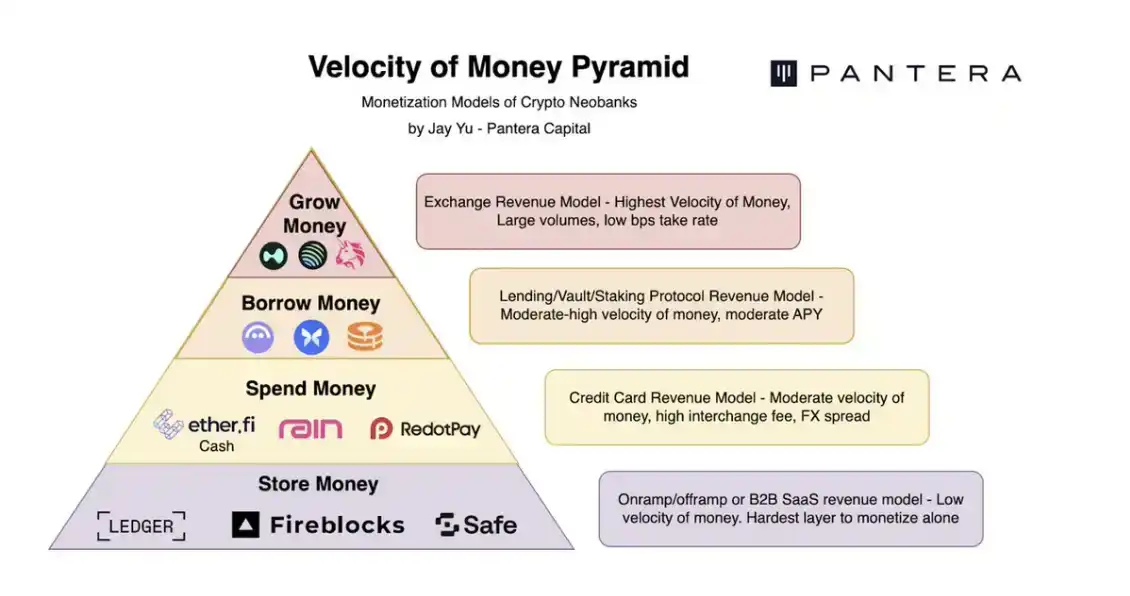
Although the four capital relationships of "store, spend, grow, borrow" utilize this "flattening effect" brought by the blockchain in different ways and correspond to different trade-offs and monetization models, I believe they can ultimately be understood as a pyramid structure defined by the **velocity of money**.
At the top of the pyramid is growing money, which has the highest capital turnover speed (e.g., Hyperliquid's transaction fees); followed by borrowing (monetized through interest); then payments (through handling fees and foreign exchange spreads); and at the bottom is storage (mainly monetized through on-ramp/off-ramp fees and B2B integration).
From this perspective, the easiest path to building a crypto neobank may be to start from the growth and borrowing layers—because these layers have the highest capital velocity and user participation. Protocols that first capture "value in motion" can often extend downward along the pyramid later, gradually converting existing users into full-stack financial users.
Opportunity Space for Neobanks
So, what might be the next step for crypto neobanks? Where exactly is the opportunity to build the next generation of permissionless neobanks?
I believe there are still several (interrelated) directions worth further exploration:
1) Parity of Privacy and Compliance
2) Real-World Composability
3) Full Utilization of "Permissionlessness"
4) Localization vs. Globalization
5) Non-Over-Collateralized Lending and Consumer Credit
1| Parity of Privacy and Compliance
Stablecoins and crypto tracks have obvious advantages over traditional financial systems in terms of speed and ease of use. But to truly compete head-on with fintech neobanks and the banking system, crypto neobanks must achieve functional parity in two key dimensions: privacy and compliance.
Although privacy is not universally considered a rigid demand in retail consumer scenarios, and stablecoins have achieved scaled adoption without strong privacy guarantees, when more and more enterprise applications—such as payroll, supply chain financing, cross-border clearing—migrate on-chain, privacy becomes crucial. The reason is that the public visibility of B2B transfers may leak business secrets and sensitive information. I believe this is an important reason why many newly launched stablecoin chains highly emphasize privacy capabilities in their roadmaps.
Conversely, crypto neobanks also need to think about how to achieve parity with their predecessors in terms of compliance. This includes gradually building a global regulatory moat and licensing system, and proving to consumers and merchants that crypto solutions are not inferior to traditional finance in compliance—perhaps using new technical paths like zero-knowledge proofs. Only by solving both enterprise-level privacy and compliance credibility can crypto neobanks truly achieve scaled expansion beyond their fintech predecessors.
2| Real-World Composability
"Composability" is often regarded as the core advantage of crypto tracks—relying on unified standards, frameworks, and smart contracts. But in reality, this composability is often limited to within the crypto world: between DeFi primitives, between yield protocols, and between (mainly EVM) blockchains.
The truly difficult composability challenge is how to connect blockchain standards with real-world legacy standards: such as international banking systems like SWIFT, merchant POS systems and standards like ISO 20022, and local payment networks like ACH and Pix. With the popularity of crypto cards and the increased use of stablecoins in cross-border payments, positive progress has been made in this direction.
Additionally, most crypto card products today still mainly serve crypto-native users, essentially serving as off-ramp tools for "crypto whales." But the real challenge facing crypto neobanks is to break through the crypto-native population and introduce new user groups through real-world composability and truly innovative financial primitives. Platforms that solve the composability problem will be significantly ahead in the on-ramp/off-ramp experience, thus more efficiently carrying user scale.
3| Full Utilization of "Permissionlessness"
Fundamentally, the goal of crypto neobanks is to reshape a more efficient monetary standard: instant settlement, global liquidity, infinitely programmable, and not constrained by the bottlenecks of a single entity or government.
Today, anyone with a crypto wallet can trade, transfer, or earn yields without the intermediaries of the fiat system. Crypto neobanks should make full use of this permissionless nature to accelerate capital flow and build a more efficient financial system.
On crypto tracks, global capital flows at internet speed, and its coordination mechanism is no longer administrative orders but incentives and game theory. The next generation of neobanks will use the permissionlessness of blockchain to enable new primitives like perpetual contracts, prediction markets, staking, and token issuance to quickly combine with existing financial tracks.
In economies with high stablecoin penetration, there is even an opportunity to build a permissionless bank card network—a system similar to Visa or Mastercard but in the opposite direction: no longer converting stablecoins into fiat at the consumption end, but settling on-chain by default; to be compatible with traditional payment methods, fiat is then "on-ramped" into stablecoins.
Furthermore, "permissionlessness" is not only applicable to human users but may also catalyze an agentic economy. For AI agents, obtaining a crypto wallet is much easier than opening a bank account; with stablecoins, AI agents can autonomously initiate on-chain transactions when authorized by users or under preset rules. Permissionless neobanks are precisely the underlying base and interaction interface for this "human-agent economy."
4| Localization vs. Globalization
Crypto neobanks also face a strategic choice: depth vs. breadth.
Some may choose a path similar to Nubank, establishing dominance in a single region through deep localization, cultural fit, and regulatory understanding, and then expanding outward; others may adopt a global-first strategy, launching permissionless products globally and doubling down in regions with the strongest network effects.
Both paths are valid: the former relies on local trust and distribution, the latter on scale and composability. Stablecoins may be the "highway" for international payments, but crypto neobanks still need "local exits"—deep integration with regional systems like Pix, UPI, Alipay, and VietQR to achieve true local usability.
In particular, crypto neobanks have a unique opportunity to "serve the unbanked," providing access to dollar or crypto-denominated capital for areas with weak financial infrastructure or unstable local currencies. In the future, regional "super apps" and globally composable neobanks may coexist for a long time.
5| Non-Over-Collateralized Lending and Consumer Credit
Finally, non-over-collateralized lending and consumer credit may be the true "holy grail" of crypto neobanks.
This problem converges multiple challenges mentioned above: it requires a robust, Sybil-resistant identity system; it needs to connect off-chain credit records with on-chain accounts; it needs to handle differences in credit models across regions and be compatible with traditional systems. Because of this, non-over-collateralized lending in DeFi is currently mainly concentrated in the field of institutional private credit, not consumer credit—although the latter is much larger in traditional finance.
Part of the answer may come from mechanism design innovation. Flash loans are a native unsecured lending form catalyzed by blockchain characteristics. Similarly, smart revolving credit lines built around stablecoins and interest-bearing assets, real-time LTV management, automatic liquidation buffers, and automatic repayment of yields may gradually reduce collateral requirements.
Once successful, on-chain consumer credit will significantly increase capital velocity, provide a strong motivation for the unbanked to get on-chain, and, like credit expansion in the real world, drive overall economic growth.
Conclusion
Just as the rise of fintech neobanks a decade ago reshaped banking, crypto neobanks are also trying to redefine how we save, spend, grow, and borrow in the digital age. But the difference is that fintech neobanks mainly innovated the frontend interface, while crypto neobanks are trying to update the bank backend itself—building a global, composable, censorship-resistant way of value transfer through stablecoins and public blockchains.
Therefore, crypto neobanks are not just an application interface but may be the entrance to a programmable financial system.
Of course, this road has just begun. Building a true "full-stack crypto neobank" is far more than launching a crypto card or a wallet protocol with a UI. It requires a clear target population, rapid expansion along the product matrix, and first establishing advantages in areas with high capital velocity.
If future crypto neobanks can continue to break through in privacy and compliance, real-world composability, permissionlessness, local and global strategies, and consumer credit, they have the potential to evolve from the marginal entry point of digital assets into the default operating system of the global economy.
Just as the first generation of neobanks changed the "interface" of banking with mobile internet, this generation may use encryption technology to rewrite the underlying logic of money itself.