Circle: Why Do 95% of Stablecoins Ultimately Fail?

marsbitXuất bản vào 2026-02-03Cập nhật gần nhất vào 2026-02-03

Tóm tắt

The article "The Stablecoin Trap: Issuing a Stablecoin Without the Infrastructure to Run One" by Kash Razzaghi of Circle discusses the critical considerations for companies interested in stablecoins. While many executives are drawn to the idea of issuing their own stablecoin due to the market's growth (from $2050B to over $3000B in 2025), the author argues this is a strategic, not just technical, decision. Creating a stablecoin is relatively simple from an engineering perspective, but operating a trusted, regulated one requires a robust, 24/7 financial infrastructure. This includes real-time reserve management, daily bank reconciliations, independent audits, compliance reporting, and risk management systems. These operational burdens are complex, costly, and amplify reputational risk. The market has seen hundreds of stablecoin projects, but approximately 95% fail to achieve lasting, global scale. The key differentiator is not technology but trust, built through transparency, consistent redeemability, and proven performance across market cycles. Incidents like accidental trillion-dollar mints or temporary de-peggings highlight the severe consequences of operational flaws. Instead of building their own, most companies should focus on integrating existing, established stablecoins like USDC or EURC into their businesses. This allows them to benefit from instant settlement, global reach, and interoperability without the immense operational overhead. The industry is converging o...

Original Title: The Stablecoin Trap: Issuing a Stablecoin Without the Infrastructure to Run One

Original Author: Kash Razzaghi, Circle

Compiled by: Peggy, BlockBeats

Editor's Note: As regulatory clarity improves and institutional participation increases, stablecoins are evolving from technical tools into critical financial infrastructure. This article points out that issuing a stablecoin is not merely a technical choice but a long-term strategy centered on trust, liquidity, and compliance capabilities. Most projects fail to scale, and the market is naturally converging toward a few mature networks. For most businesses, the real question is not "whether to issue a coin" but "how to effectively use stablecoins" to create growth opportunities for their operations.

Below is the original text:

In recent months, I have repeatedly had familiar conversations with executives from some of the world's largest companies. They have shown strong interest in stablecoins like USDC and EURC—digital versions of the US dollar and euro—that enable near-instant, cross-border transfers. Many of them are also considering: Should we issue our own stablecoin?

This impulse is understandable. The market has already achieved significant scale and sustained growth momentum. In 2025, the total market capitalization of stablecoins grew from approximately $205 billion on January 1, 2025, to over $300 billion by December 31, 2025. USDC, issued by Circle, remains one of the core assets in this category, closing out 2025 with a market cap exceeding $75 billion.

However, before entering the market, every company should first ask itself: Do you simply want to use stablecoins for your business, or do you intend to enter the "business of issuing stablecoins"?

This is not a technical question but a strategic one: Is issuing currency a core part of your business model?

Relatively speaking, creating a stablecoin on a blockchain is the easiest part. Essentially, it is a software engineering exercise: writing and deploying a token contract on a blockchain. With an engineering team or, in some cases, leveraging white-label partners, a token can be launched in a relatively short time. But once the product is live, operating a stablecoin means supporting a 24/7 financial infrastructure.

To operate a trusted, regulated stablecoin—one that meets the expectations of institutions, regulators, and millions of users—requires real-time reserve management across different market cycles, daily reconciliation with multiple banking partners, independent audits, and compliance and regulatory reporting across multiple jurisdictions. This means building round-the-clock compliance, risk management, treasury management, and liquidity operations systems, with clear escalation and resolution mechanisms in stress scenarios and zero tolerance for errors. These capabilities are not something that can be "outsourced once and forgotten"; as scale increases, they accumulate and amplify in cost, complexity, and reputational risk.

From a systemic perspective, each new, closed-loop proprietary stablecoin further fragments liquidity and trust. Each issuer is redundantly building reserves, compliance systems, and redemption channels, ultimately weakening the overall depth and resilience that stablecoins rely on during times of stress. In contrast, integrating USDC allows for the consolidation of liquidity, standards, and operational capabilities into a widely adopted, unified network from day one.

For corporate executives evaluating this decision, the differences between these two paths become particularly clear when viewed from an operational perspective:
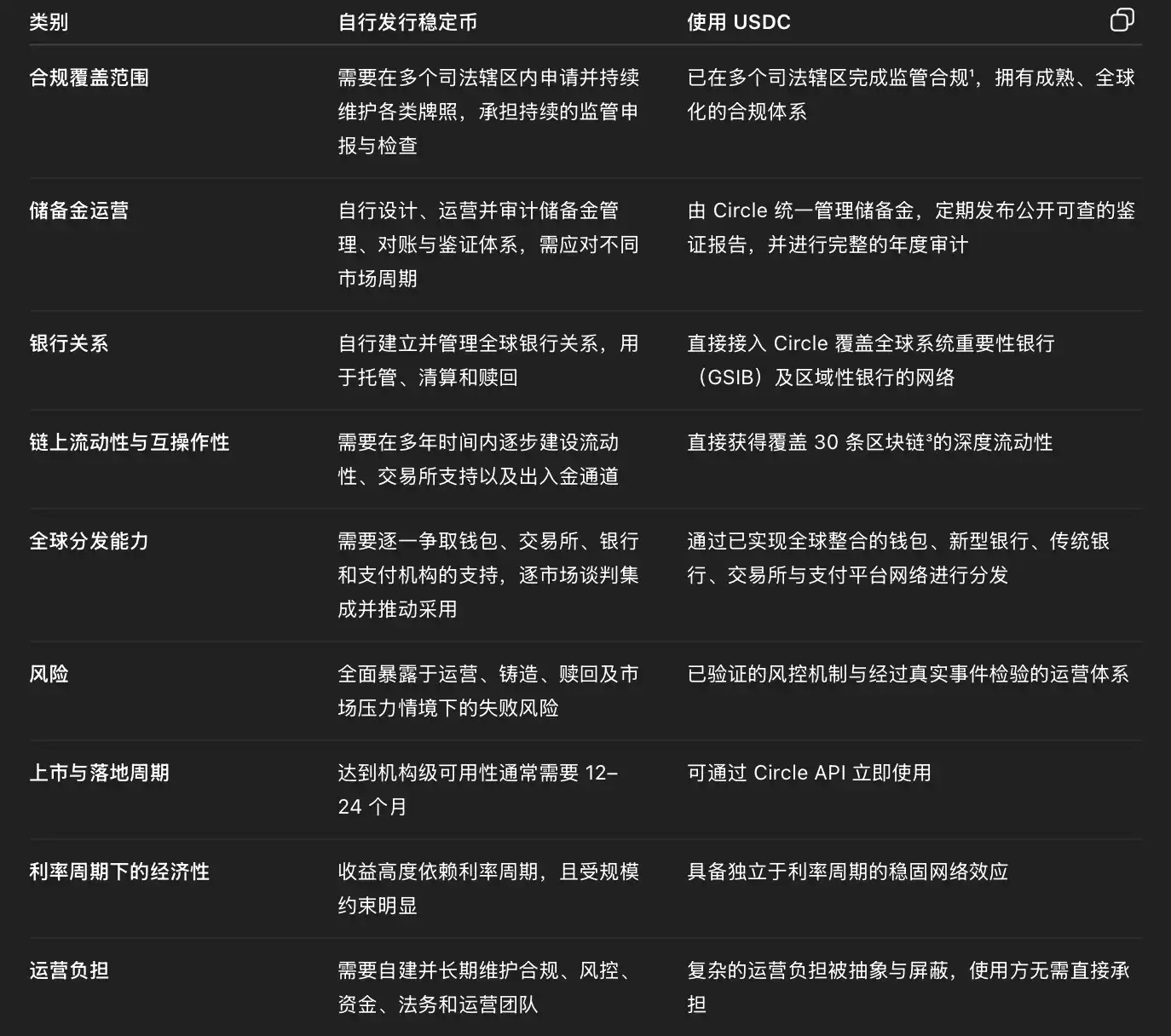
The Temptation of Shortcuts

Currently, a wide range of newcomers—from fintech companies and payment institutions to crypto projects—are exploring or directly launching their own stablecoins. The growth of the stablecoin market in 2025 reflects both the gradual clarity of the regulatory environment and rising institutional interest. But the reality is that, although hundreds of stablecoin projects have been launched, about 95% have never achieved lasting, global scale.

Some believe it is possible to replicate the same economic returns without bearing the heavy operational costs. The reality, however, is not so romantic. Whether issuing a stablecoin on your own or through a white-label service, you are entering an industry where trust, liquidity, and scale are matters of survival.

Sometimes, the cost of mistakes is measured in "trillions." According to media reports earlier this year, one issuer accidentally minted 300 trillion tokens due to an operational error. Although it was fixed within minutes, it was enough to make headlines. On another occasion, a well-known stablecoin briefly depegged during a period of extreme market volatility, again demonstrating that even minor infrastructure flaws can be amplified and transmitted under pressure.

These incidents serve as reminders that the viability of a stablecoin depends on operational rigor in high-pressure environments. Markets and policymakers are watching closely.

Trust Is the Real Network Effect

Anyone can create a token on a blockchain. In fact, thousands already exist—most minted in minutes and forgotten just as quickly. Even in the stablecoin niche, over 300 projects have been launched, but only a handful carry almost all real-world usage and value; the vast majority, about 95%, have never truly succeeded.

The difference lies not in technology but in scale and trust. The real challenge for stablecoins begins during the expansion phase: how to sustain liquidity, redeemability, compliance, and system availability as transaction volumes grow across different markets and cycles.

You can mint a token in minutes, but you cannot mint trust in minutes. Trust stems from transparency, scale, and consistent redeemability across market cycles, accumulating over time. This is why the stablecoin market has ultimately concentrated in the hands of a few issuers—and why, as of January 30, 2026, USDC's cumulative historical settlement volume has exceeded $60 trillion.

Rather Than Reinventing the Wheel, Choose Collaboration

For most businesses, the right question is not "How should we issue our own stablecoin?" but "How can we integrate stablecoins into our business to unlock new growth?"

With USDC and EURC, companies can today embed digital dollars and euros, gaining near-instant settlement, global reach, and interoperability across dozens of blockchains, without having to bear the complexities of reserve management and regulatory compliance themselves.

Writing the Next Chapter Together

The stablecoin industry is entering a new phase. Policymakers are establishing clearer rules, institutions are raising their standards, and the market is gradually converging on a simple consensus: trust, liquidity, and compliance are the real moats.

The goal is not to have more stablecoins but to have fewer and better ones—ones that can meet current demands with shared liquidity, transparent reserves, and proven performance across cycles.

For institutions formulating their stablecoin strategies, the first step should not be to decide "what to build" but "whom to build with." If you want stablecoins to empower your business but do not want to become a stablecoin issuer yourself, the time-tested choice is clear: talk to Circle and use USDC.


Câu hỏi Liên quan

QAccording to the article, what is the main reason why approximately 95% of stablecoin projects fail to achieve lasting, global scale?

AThe main reason is not a technical failure, but the immense operational challenge of scaling. This includes the inability to continuously maintain liquidity, redemption capabilities, regulatory compliance, and system availability across different markets and market cycles. Trust, which is built on transparency, scale, and consistent redeemability over time, is the true barrier to success that most projects cannot overcome.

QWhat key operational capabilities does the article state are required to run a trusted, regulated stablecoin?

AThe key operational capabilities include real-time reserve management across market cycles, daily reconciliation with multiple banking partners, undergoing independent audits, and fulfilling compliance and regulatory reporting across multiple jurisdictions. This requires building 24/7 systems for compliance, risk management, treasury operations, and liquidity, with clear escalation and resolution mechanisms for stress scenarios and a zero-tolerance policy for errors.

QWhat strategic question should a business ask itself before deciding to issue a stablecoin, as suggested by the Circle executive?

AThe business should ask itself: 'Do you simply want to use stablecoins for your business, or do you intend to go into the *business* of issuing a stablecoin?' This reframes the decision from a technical one to a strategic one, questioning whether issuing currency is core to its business model.

QWhat is the article's view on the proliferation of new, closed proprietary stablecoins from a system-wide perspective?

AThe article argues that each new, closed proprietary stablecoin further fragments liquidity and trust. Each issuer is duplicating the work of building reserves, compliance systems, and redemption channels, which ultimately weakens the overall depth and resilience that stablecoins rely on, especially during times of market stress.

QWhat alternative does the article propose for companies that want the benefits of stablecoins without the burden of issuing their own?

AThe article proposes that companies should integrate existing, large-scale stablecoins like USDC and EURC into their businesses. This allows them to gain access to near-instant settlement, global reach, and interoperability across dozens of blockchains without having to shoulder the complexities of reserve management and regulatory compliance themselves.

Nội dung Liên quan

CẬP NHẬT – Michael Saylor Cố Gắng Giảm Nhiệt Cho Cuộc Xung Đột Nội Bộ Trong Bitcoin — Nhưng Ông ấy Có Thành Công?

Michael Saylor, chủ tịch điều hành của MicroStrategy, đã công bố một bài viết phân chia cộng đồng Bitcoin thành bốn nhóm chính: Người theo chủ nghĩa tối đa (Bitcoin Maximalists), Nhà tư bản Bitcoin (Bitcoin Capitalists), Nhà công nghệ Bitcoin (Bitcoin Technologists) và Người theo chủ nghĩa cơ bản (Bitcoin Fundamentalists). Ông cho rằng sự khác biệt này phản ánh sự trưởng thành và phát triển của Bitcoin chứ không phải là dấu hiệu sụp đổ. Mỗi nhóm có quan điểm riêng về cách Bitcoin nên phát triển, từ việc giữ nguyên tính chất "tiền tệ mạnh" chống lạm phát cho đến việc tích hợp sâu vào hệ thống tài chính truyền thống, hay tập trung cải tiến công nghệ và bảo vệ các nguyên tắc phi tập trung ban đầu. Saylor lập luận rằng Bitcoin có thể giữ vững lớp nền tảng (base layer) trong khi vẫn cho phép thị trường và các sản phẩm tài chính phát triển xung quanh nó. Bài viết của ông xuất hiện trong bối cảnh MicroStrategy vừa thực hiện lần bán Bitcoin đầu tiên kể từ năm 2022, gây chú ý trên thị trường. Câu hỏi đặt ra là liệu Saylor có thể xoa dịu những tranh cãi nội bộ này hay không, khi mà tiền bạc, chính trị và nguyên tắc đều đang va chạm trong hệ sinh thái Bitcoin.

bitcoinist33 phút trước

CẬP NHẬT – Michael Saylor Cố Gắng Giảm Nhiệt Cho Cuộc Xung Đột Nội Bộ Trong Bitcoin — Nhưng Ông ấy Có Thành Công?

bitcoinist33 phút trước

Hoskinson Phủ Nhận Tin Đồn Rời Cardano: ‘Tôi Không Bỏ Đi’

Người sáng lập Cardano Charles Hoskinson đã bác bỏ tin đồn rời khỏi hệ sinh thái, khẳng định trong một buổi phát trực tiếp ngày 4/6 rằng ông chỉ tạm lùi lại khỏi các kênh giao tiếp công chúng chứ không từ chức. Động thái này được đưa ra sau một bài đăng "tạm nghỉ ngơi" trên X của ông khiến cộng đồng lo lắng. Trong buổi phát trực tiếp, Hoskinson tập trung chỉ trích môi trường mạng xã hội độc hại, đặc biệt là trên X, nơi ông cho biết khoảng 30% phản hồi cho các tweet của mình là thù địch, lạm dụng hoặc chứa nội tục tĩu, khiến việc tương tác ý nghĩa trở nên bất khả thi. Ông nói rằng chi phí tâm lý để duy trì hoạt động ở đó là quá cao. Hoskinson cũng nêu bật sự khác biệt giữa tiến bộ công nghệ của Cardano và hiệu suất giá của ADA, gọi đây là "câu chuyện về hai Cardano". Trong khi giao thức, nghiên cứu và tính phi tập trung đã tiến bộ vượt bậc kể từ năm 2021, thì giá ADA lại sa sút khiến nhiều người chỉ trích. Ông kêu gọi cộng đồng cần giải quyết sự "mâu thuẫn nhận thức" này bằng cách rời bỏ X như là địa điểm thảo luận chính, suy nghĩ lại về động lực cho các nhà phát triển và xây dựng một lộ trình mới. Hoskinson chỉ trích cấu trúc quản trị của Quỹ Cardano, gọi đó là "sai lầm tồi tệ nhất" trong sự nghiệp của mình. Kết thúc, Hoskinson tuyên bố sẽ tạm nghỉ khỏi các video công khai, phỏng vấn và mạng xã hội để tập trung làm việc cho Midnight, đồng thời suy ngẫm và đưa ra các đề xuất cho tương lai của Cardano sau đó.

bitcoinist2 giờ trước

Hoskinson Phủ Nhận Tin Đồn Rời Cardano: ‘Tôi Không Bỏ Đi’

bitcoinist2 giờ trước

Anthropic khởi động IPO: Phép màu kinh doanh hay bong bóng định giá?

Tác giả: Phó Thịnh Tuần này, Anthropic, công ty AI cạnh tranh trực tiếp với OpenAI, đã bí mật nộp đơn IPO, dự kiến niêm yết vào tháng 10 với sự bảo lãnh của Morgan Stanley và Goldman Sachs. Định giá trước IPO của họ đã đạt 9650 tỷ USD sau đợt gọi vốn H, và được dự báo có thể chạm 1.5-2 nghìn tỷ USD khi lên sàn, vượt qua SpaceX. Nhiều người đặt câu hỏi liệu đây có phải bong bóng như thời kỳ dot-com 2000 hay không. Tác giả chỉ ra sự khác biệt cốt lõi: Các công ty thời dot-com thường định giá dựa trên "giấc mơ" và ý tưởng thuần túy, trong khi Anthropic có mô hình kinh doanh rõ ràng với doanh thu thực tế khổng lồ và đang bắt đầu có lãi. Doanh thu năm hóa (ARR) của Anthropic tăng vọt từ 10 tỷ USD đầu 2025 lên 470 tỷ USD vào tháng 5 năm nay, với mục tiêu cuối năm là 1000 tỷ USD. Họ dự kiến có lợi nhuận hoạt động trong quý II/2026. Với khoảng 3000 nhân viên, doanh thu trên mỗi nhân viên vượt 10 triệu USD. Khách hàng của họ bao gồm 8/10 công ty trong Fortune 10 và hơn 1000 doanh nghiệp lớn. Tác giả cho rằng định giá của Anthropic dựa trên mô hình SaaS truyền thống với hệ số Price-to-Sales, và doanh thu ổn định từ các gói đăng ký API cho doanh nghiệp hỗ trợ cho mức định giá này. Bài viết cũng đề cập đến một xu hướng lớn hơn: nền kinh tế thế giới đang chuyển dịch từ nền tảng "carbon" (dựa vào con người) sang kết hợp với nền tảng "silicon" (dựa vào AI và sức mạnh tính toán). Các công ty hàng đầu như Nvidia đã chứng kiến chi phí đầu tư vào năng lực tính toán vượt quá chi phí nhân sự. Việc Anthropic lên sàn không chỉ là câu chuyện của một công ty, mà có thể là điểm neo giá cho một mô hình kinh tế mới - nơi trí tuệ và năng lực được đo lường bằng sức mạnh tính toán và khả năng mở rộng quy mô của AI.

链捕手3 giờ trước

Anthropic khởi động IPO: Phép màu kinh doanh hay bong bóng định giá?

链捕手3 giờ trước

Các Thượng Nghị Sĩ Hoa Kỳ Gây Sức Ép Lên Cơ Quan Quản Lý Ngân Hàng Để Có Quy Định Vốn 'Công Bằng' Cho Crypto

Một nhóm thượng nghị sĩ đảng Cộng hòa Mỹ, đứng đầu là Chủ tịch Tiểu ban Tài sản Số Cynthia Lummis, đã gửi thư tới các cơ quan quản lý ngân hàng hàng đầu bao gồm Cục Dự trữ Liên bang, FDIC và OCC. Trong thư, họ kêu gọi xây dựng một khuôn khổ vốn rõ ràng và công bằng hơn cho các hoạt động tài sản tiền mã hóa của ngân hàng. Các thượng nghị sĩ chỉ trích tiêu chuẩn vốn của Ủy ban Basel, áp dụng trọng số rủi ro 1250% - mức phân loại trừng phạt nhất - đối với tài sản tiền mã hóa, coi đó là lệnh cấm thực tế thay vì đánh giá rủi ro thực tế. Họ hoan nghênh hướng dẫn chung gần đây về chứng khoán token hóa, khẳng định việc xử lý vốn nên dựa trên đặc điểm rủi ro của tài sản cơ bản chứ không phải công nghệ ghi nhận. Các nghị sĩ thúc giục nguyên tắc này cần được áp dụng nhất quán cho cả các tài sản số khác. Lời kêu gọi này được đưa ra khi các cơ quan quản lý đang chuyển sang mô hình giám sát dựa trên rủi ro. Chủ tịch FDIC Travis Hill nhấn mạnh vai trò của tiêu chuẩn vốn mạnh mẽ, đồng thời cho biết đã có các đề xuất quy định cho các công ty con phát hành stablecoin. Tương tự, Giám đốc OCC Jonathan Gould khẳng định nhiệm vụ là tạo điều kiện cho đổi mới có trách nhiệm, xem xét lại các hành động giám sát trước đây và chống lại việc ngân hàng từ chối dịch vụ bất hợp pháp.

bitcoinist3 giờ trước

Các Thượng Nghị Sĩ Hoa Kỳ Gây Sức Ép Lên Cơ Quan Quản Lý Ngân Hàng Để Có Quy Định Vốn 'Công Bằng' Cho Crypto

bitcoinist3 giờ trước

Giao dịch

Giao ngay
Hợp đồng Tương lai
活动图片




