Original Author: Xinzhiyuan
The "gold content" of your job is being hollowed out by AI. Anthropic's latest report reveals a counterintuitive truth: the more complex a task is as measured by years of education required, the more dramatically AI accelerates it. More frightening than direct replacement is "deskilling"—AI takes away the joy of thinking, leaving you with only mundane chores. But the data also points to the only way out: mastering human-AI collaboration can increase your odds of success tenfold. In this era of computational surplus, this is a survival guide you must understand.
Anthropic just released its "Economic Index Report" on its official website yesterday.
The report not only focuses on what people are using AI for but also on the extent to which AI is truly replacing human thinking.
This time, they introduced a new dimension called "Economic Primitives" to quantify task complexity, required education level, and the degree of AI autonomy.
The future of the workplace reflected in the data is far more complex than simple "unemployment" or "utopian" theories.
The Harder the Task, the Faster AI Does It
In our traditional understanding, machines are usually good at repetitive, simple labor but appear clumsy in areas involving profound knowledge.
But Anthropic's data presents a completely opposite conclusion: the more complex the task, the more惊人 (stunning) the "acceleration" brought by AI.
The report shows that for tasks understandable with just a high school education, Claude can increase work speed by 9 times;
once the task difficulty rises to a level requiring a college degree, this acceleration multiplier soars to 12 times.

This means that the white-collar elite work that originally required humans to ponder for hours is currently the area where AI "harvests" most efficiently.
Even when considering the failure rate of AI occasionally producing hallucinations, the conclusion remains unchanged: the efficiency surge AI brings to complex tasks is enough to offset the cost of fixing its errors.
This explains why programmers and financial analysts are now more reliant on Claude than data entry clerks—because in these high-intelligence-density fields, the leverage effect demonstrated by AI is the strongest.
19 Hours: The "New Moore's Law" of Human-AI Collaboration
The most shocking data in this report comes from the test of AI's "endurance" (task horizons, measured by 50% success rate).
Standard benchmark tests like METR (Model Evaluation & Threat Research) suggest that current top models (like Claude Sonnet 4.5) see their success rate drop below 50% when handling tasks that would take a human 2 hours.
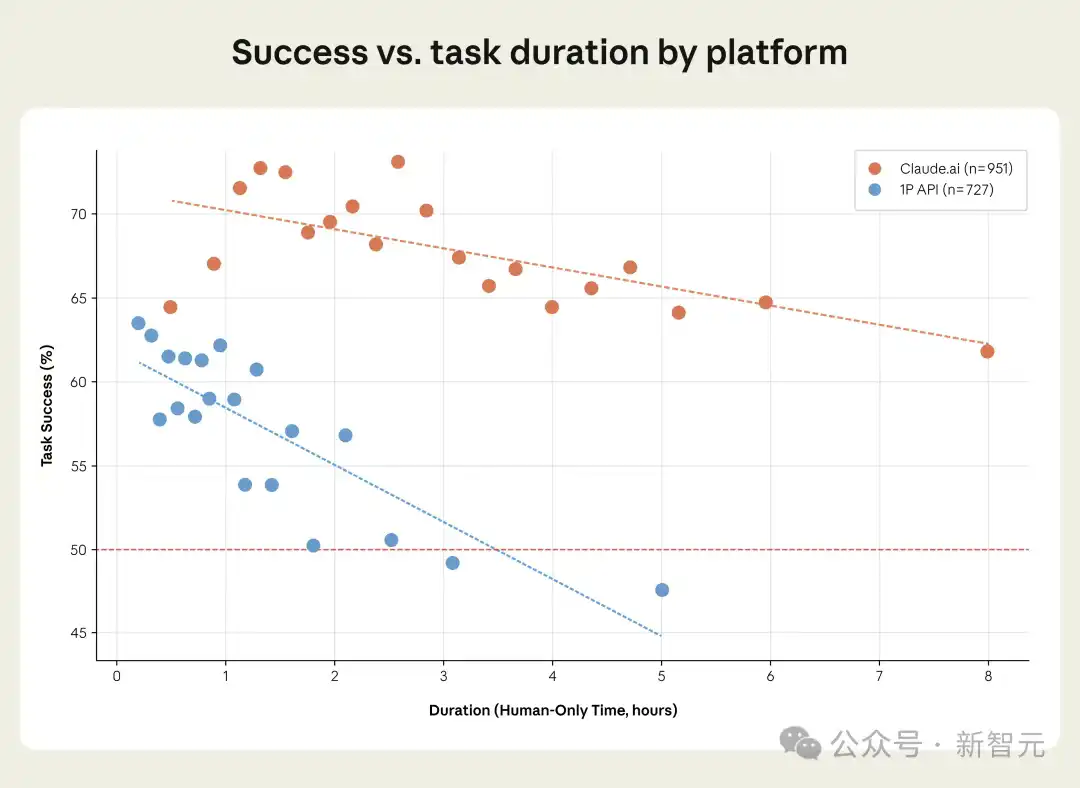
But in Anthropic's actual user data, this time limit is significantly extended.
In commercial scenarios using API calls, Claude can maintain a success rate of over 50% for tasks involving 3.5 hours of work.
And in the Claude.ai chat interface, this number is astonishingly pushed to 19 hours.
Why such a huge gap? The secret lies in human intervention.
Benchmark tests are AI facing the test alone, while real-world users break down a massive complex project into countless small steps, constantly correcting AI's course through feedback loops.
This human-AI collaborative workflow pushes the (50% success rate measured) task duration上限 (upper limit) from 2 hours to about 19 hours, nearly a 10-fold increase.
This might be the true shape of future work: not AI doing everything independently, but humans learning how to steer it through a marathon.
The Folded World Map: The Poor Learn Knowledge, the Rich Engage in Production
If we zoom out to a global perspective, we see a clear and slightly ironic "adoption curve".
In high per capita GDP developed countries, AI is already deeply embedded in productivity and personal life.
People use it to write code, create reports, and even plan travel itineraries.
But in countries with lower per capita GDP, Claude's primary role is "teacher," with大量 (a large number of) uses concentrated on coursework and educational tutoring.
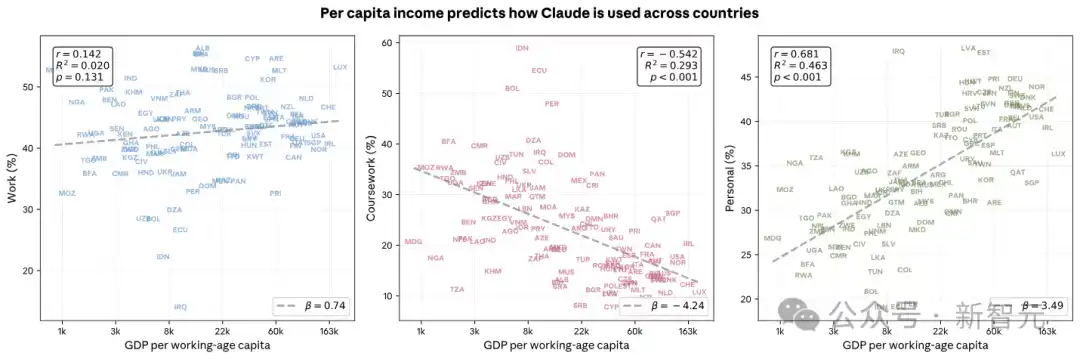
Beyond wealth disparity, this is also a manifestation of a technological gap.
Anthropic mentioned they are collaborating with the Rwandan government, trying to help people there leapfrog the mere "learning" phase and enter broader application layers.
Because without intervention, AI is likely to become a new barrier: people in wealthy regions use it to exponentially amplify output, while people in less developed regions are still using it to补习 (remedially learn) basic knowledge.
Workplace Concerns: The Specter of "Deskilling"
The most controversial and警惕 (warranting caution) part of the report is the discussion on "Deskilling".
Data indicates that the tasks currently covered by Claude require, on average, 14.4 years of educational background (equivalent to an associate degree), significantly higher than the 13.2 years required on average for overall economic activity.
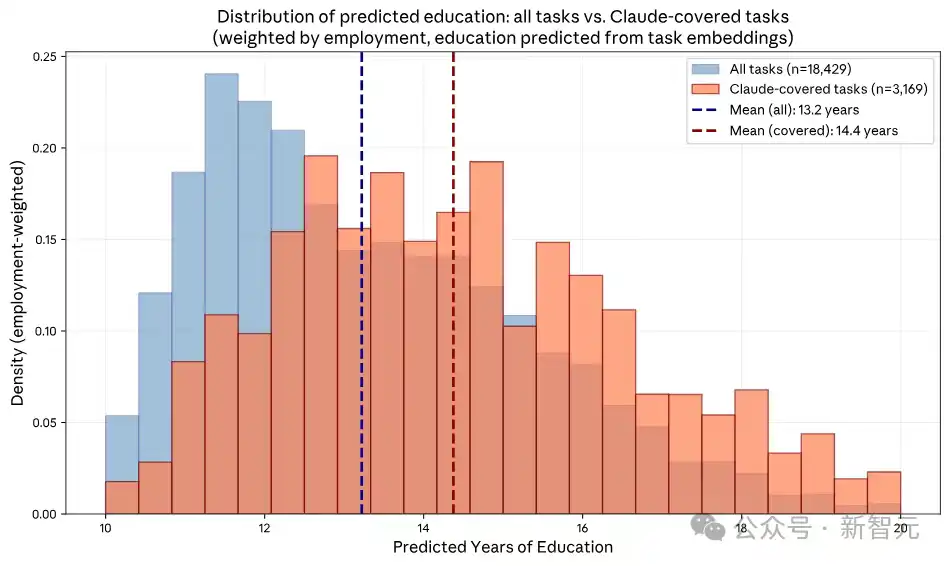
AI is systematically剔除 (removing) the "high-intelligence" parts of work.
For technical writers or travel agency agents, this could be disastrous.
AI takes over分析行业动态 (analyzing industry trends),规划复杂行程 (planning complex itineraries) — the tasks that require "brains" — leaving humans with only琐碎工作 (trivial tasks) like sketching or collecting invoices.
Your job remains, but the "gold content" of the job is hollowed out.
Of course, there are beneficiaries.
For example, real estate managers, when AI handles枯燥的行政工作 (tedious administrative work) like bookkeeping and contract comparison, can focus their energy on client negotiation and stakeholder management requiring high emotional intelligence—this is反而 (instead) a form of "Upskilling".
Anthropic cautiously states this is only an extrapolation based on the current situation, not an inevitable prophecy.
But the alarm it sounds is real.
If your core competitiveness is merely processing complex information, then you are at the eye of the storm.
A Return to the "Golden Age" of Productivity?
Finally, let's return to the macro perspective.
Anthropic revised its forecast for US labor productivity.
After剔除 (removing) possible AI errors and failures, they predict AI will drive productivity growth by 1.0% to 1.2% annually over the next decade.
This seems like a reduction of one-third compared to the previous optimistic estimate of 1.8%, but don't underestimate this 1 percentage point.
It is enough to bring US productivity growth back to the levels of the late 1990s internet boom.
Moreover, this is based solely on the model capabilities as of November 2025. With the entry of Claude Opus 4.5, and the gradual dominance of "augmented mode" (where people no longer try to dump all work on AI but collaborate with it more intelligently) in user behavior, this number has significant upside potential.
Conclusion
Reading through the entire report, what is most感慨 (striking) is not just how strong AI has become, but more how quickly humans are adapting.
We are undergoing a migration from "passive automation" to "active enhancement".
In this transformation, AI acts like a mirror; it takes over those tasks that require high education but can be completed through logical deduction, thereby forcing us to seek out value that cannot be quantified by algorithms.
In this era of computational surplus, humanity's scarcest ability is no longer finding answers, but defining problems.
References:
https://www.anthropic.com/research/economic-index-primitives
https://www.anthropic.com/research/anthropic-economic-index-january-2026-report







