After $HYPE Hits a New High, Is It Worth Considering the Stock of "HYPE Version MicroStrategy" $PURR?

marsbitXuất bản vào 2026-05-25Cập nhật gần nhất vào 2026-05-25

Tóm tắt

**HYPE Hits New Highs: Is $PURR, the "HYPE Version of MicroStrategy," Worth Considering?** The stock of Hyperliquid Strategies (NASDAQ: $PURR), a publicly-traded company that exclusively buys and holds the cryptocurrency HYPE, has gained over 100% year-to-date, mirroring HYPE's own 150% surge to new all-time highs. This has sparked discussions about PURR being a more "capital-efficient" play than MicroStrategy's bitcoin strategy, given its reported ~$1 billion unrealized gain on a ~$220 million investment. The article clarifies that PURR is essentially a pure-play wrapper for HYPE, with no other business. It resulted from a 2025 SPAC merger led by firms like Paradigm and Atlas Merchant Capital, bringing traditional finance veterans to its board. Its value is entirely derived from the price of HYPE. While PURR offers a crucial compliance bridge for US-based institutional and retirement accounts unable to access HYPE directly, the analysis questions the "capital efficiency" narrative. The outsized gains are attributed to HYPE's exceptional performance, not superior corporate strategy. For investors who can buy HYPE directly, holding PURR introduces unnecessary risks: potential shareholder dilution from future stock offerings, incomplete passthrough of staking rewards, market hour mismatches, and counterparty risk via its single custodian. A key metric is its mNAV (modified net asset value). Current calculations show PURR trades at a discount to its HYPE holdings, but this c...

Author: Deep Tide TechFlow

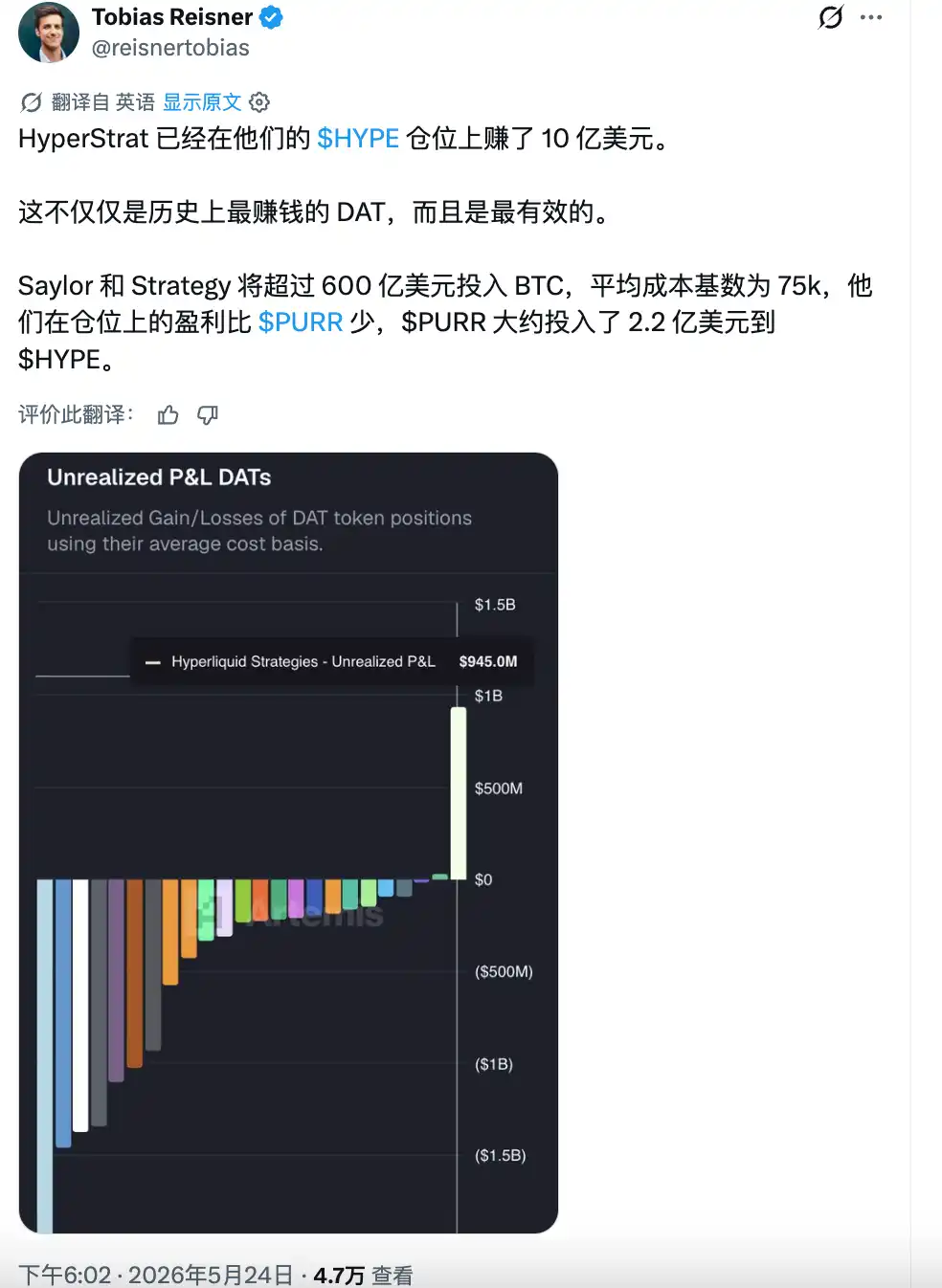
On May 24, a tweet about Hyperliquid Strategies(NASDAQ: PURR) sparked considerable discussion in the English Crypto Twitter (CT) space:

This company used approximately $220 million to buy HYPE, and its current unrealized profit has neared $1 billion, even surpassing the profit efficiency of Michael Saylor's Strategy (formerly MicroStrategy) on BTC.
This topic is now gradually spreading to the Chinese-speaking community. HYPE recently hit a new all-time high above $62, with a year-to-date increase of over 150%, making it one of the strongest-performing mainstream crypto assets this year.

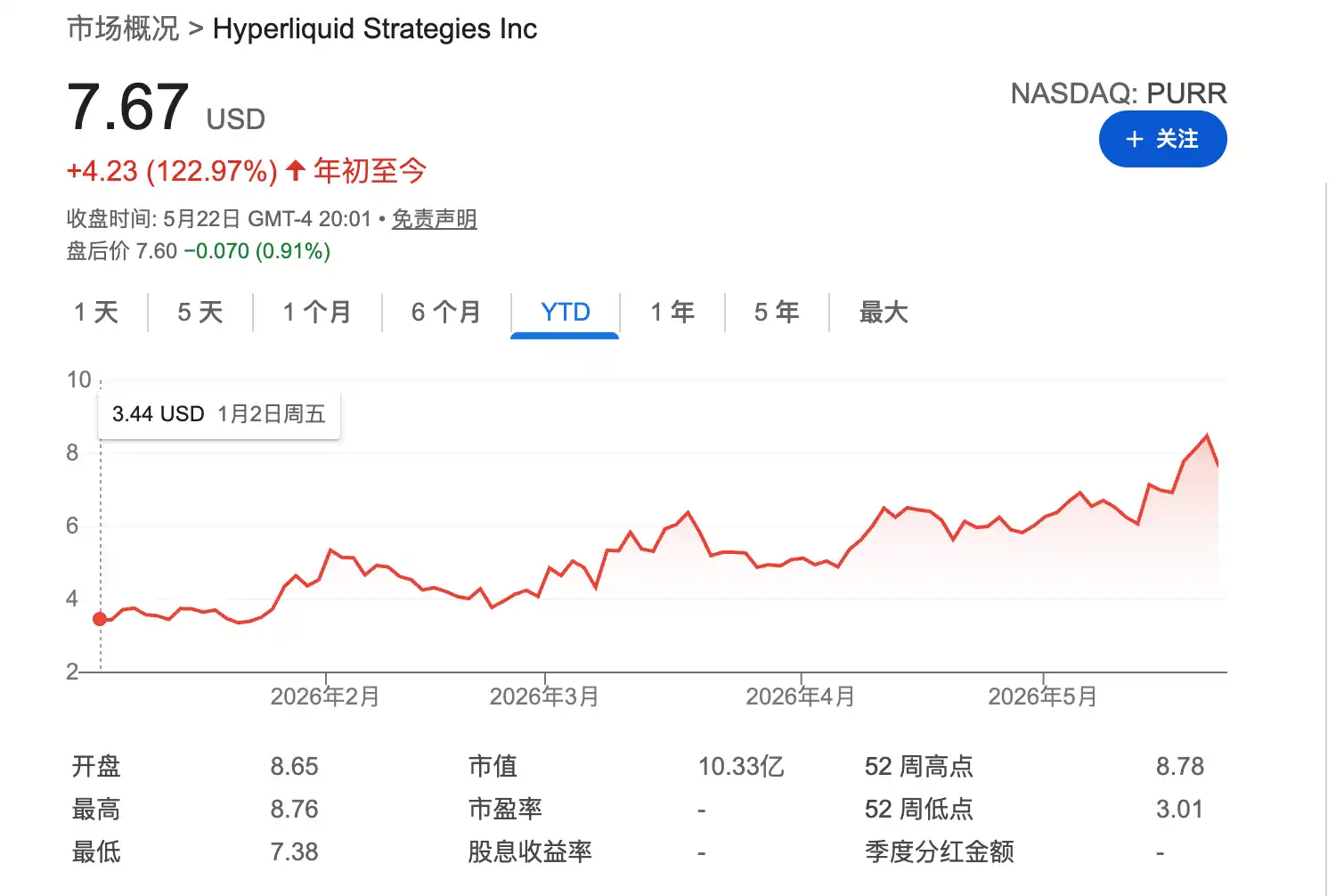
As the only listed company proxy for HYPE, PURR has also risen over 100% year-to-date, naturally becoming a target of FOMO during US stock research.
However, before following the trend, several questions need to be clarified:

1. What exactly is this company?

2. What's the difference between investing in it and directly buying HYPE?

3. Does the claim that its "capital efficiency exceeds MicroStrategy" hold up under scrutiny?

$PURR, a Pure DAT

First, the conclusion: PURR is not a company with actual operations; it's essentially a pure stock-wrapped product for $HYPE.

Its business model can be summarized in one sentence: buy HYPE, stake HYPE, hold HYPE. As of April 2026, public information shows the company holds approximately 20.8 million HYPE tokens, with about $114 million in cash and zero debt.

This means the entire value of this stock depends on one thing: the price of HYPE.

Since there is no business to analyze, evaluating such a company comes down to two dimensions: the underlying asset itself, and who is operating this shell.

The latter determines capital operation capabilities—such as when to issue shares to buy more tokens, when to buy back shares to support the price, how to manage the premium/discount between the stock price and net asset value... This also influences whether institutional capital is willing to enter through this vehicle.
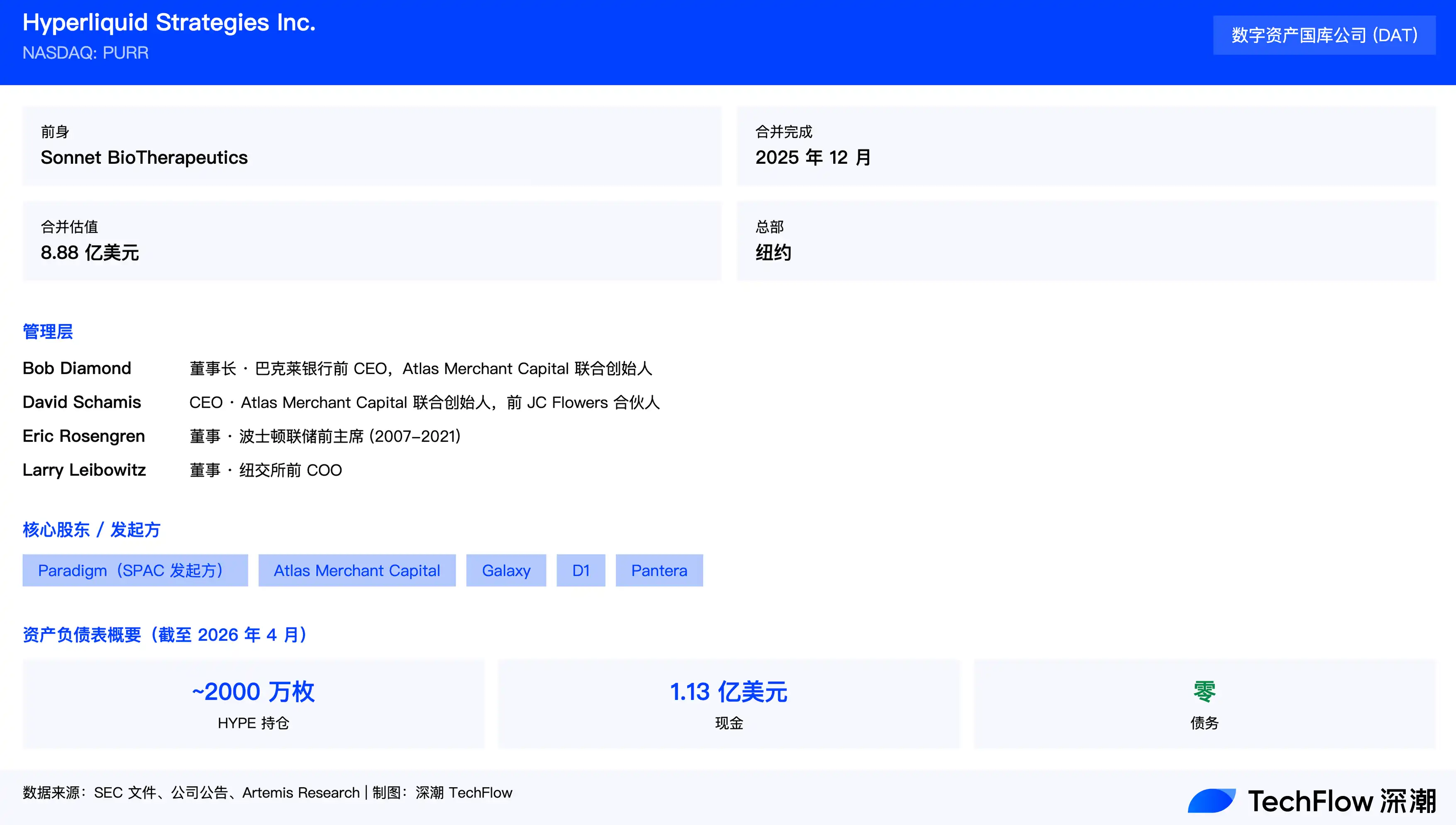
Historically, PURR's predecessor was Sonnet BioTherapeutics, a small biotech company listed on NASDAQ. In July 2025, it announced a merger with Rorschach I, completed the transaction in December of the same year, with an overall valuation of $888 million, renamed Hyperliquid Strategies, and ticker changed to PURR.

Notably, the initiators of this transaction were Paradigm and Atlas Merchant Capital.

Paradigm is one of the top-tier venture capital firms in the crypto industry, having invested in projects like Uniswap, Blur, Friend.tech, and has deep involvement in the Hyperliquid ecosystem, directly participating in the formation of this SPAC.

Atlas Merchant Capital is a financial services investment firm based in New York and London. Its two founders took key positions at PURR: Chairman Bob Diamond is the former CEO of Barclays, and CEO David Schamis is a former partner at JC Flowers.

The board also includes former Boston Fed President Eric Rosengren and former NYSE COO Larry Leibowitz. Other participants include Galaxy, D1, and Pantera, all leading institutions in crypto and macro fields.

While most DAT company management teams come from the crypto-native circle, PURR's team is almost entirely composed of traditional finance veterans.

$HYPE's Strength Propels $PURR Skyward

The reason PURR caught the attention of the Chinese-speaking community is directly tied to HYPE's own strength.

HYPE has surged from around $25 at the beginning of the year, breaking through $62 in May to set a new all-time high, with a year-to-date increase exceeding 150%. Against the backdrop of BTC's sideways movement and ETH and SOL's relatively flat performance this year, HYPE stands out as the most impressive mainstream crypto asset.

Our previous articles have deconstructed Hyperliquid's fundamental flywheel: a perp DEX with about 70% market share, weekly fee revenue exceeding ten million dollars, and 97% of protocol fees used for HYPE buyback and burn. This flywheel continues to accelerate.

(Reference reading: "Market Watch: From HYPE to ZEC, Grasping the 4 Narrative Threads Behind Recent Altcoin Hype")

When HYPE rises, PURR naturally follows suit.

As the only HYPE proxy listed on US stock exchanges, PURR has gained over 100% year-to-date, rising from the $3 range to a recent high of $8.79.

For investors with only US stock accounts who do not directly access the crypto market, PURR is almost the only choice to gain HYPE exposure. However, what propelled PURR from a "niche asset" to a "social media topic" were several concentrated institutional signals materializing since May.

Goldman Sachs disclosed in its Q1 13F filing the purchase of approximately 650,000 PURR shares. While the amount isn't huge (around $3.3 million), the Goldman Sachs name itself serves as endorsement. Concurrently, 21Shares and Bitwise's HYPE spot ETFs were listed on NASDAQ and NYSE respectively, and Cantor Fitzgerald raised its PURR price target from $6 to $8.

These events, superimposed on the timing of HYPE's new high, pushed PURR into more people's field of vision.

Then came the tweet mentioned at the beginning of the article: PURR used $220 million principal to buy HYPE, and its current unrealized profit is nearly $1 billion. Calculated in the short term, its capital efficiency definitely surpasses MicroStrategy's.

Under such a sharp rally, it's bound to attract significant attention. However, if you're considering trading this stock, caution is still advised.

The DAT with the Highest Capital Efficiency, Really?

Strategy (formerly MicroStrategy) invested over $60 billion to buy BTC at an average cost of around $75,000; PURR only used about $220 million to buy HYPE, yet its unrealized profit is close to or even exceeds the former's. The conclusion is that PURR's "capital efficiency" far surpasses MicroStrategy's?

This comparison holds up numerically but is logically misleading.

PURR's early HYPE holdings have an average cost of around $7, with the current price at $62, a nearly 9x increase. Strategy's BTC average cost is around $75,000, and BTC is currently hovering around that level, having barely moved.

Therefore, PURR's higher unrealized profit isn't due to any smarter operations by the company; it's simply because the underlying asset's appreciation is on a completely different scale. Anyone, at the same time, directly buying HYPE spot with the same amount of money could have achieved the same return rate, without bearing the risk of equity dilution.

In other words, it's a victory of "picking the right coin." If PURR's establishment date were pushed back half a year, entering when HYPE was at $40, this "capital efficiency" story wouldn't exist at all.

For US stock investors only noticing PURR today, a more practical question is: At the current price for PURR, are you paying a premium or a discount relative to the value of HYPE held by the company?

This involves the core valuation metric for DAT companies—mNAV (modified Net Asset Value per share).
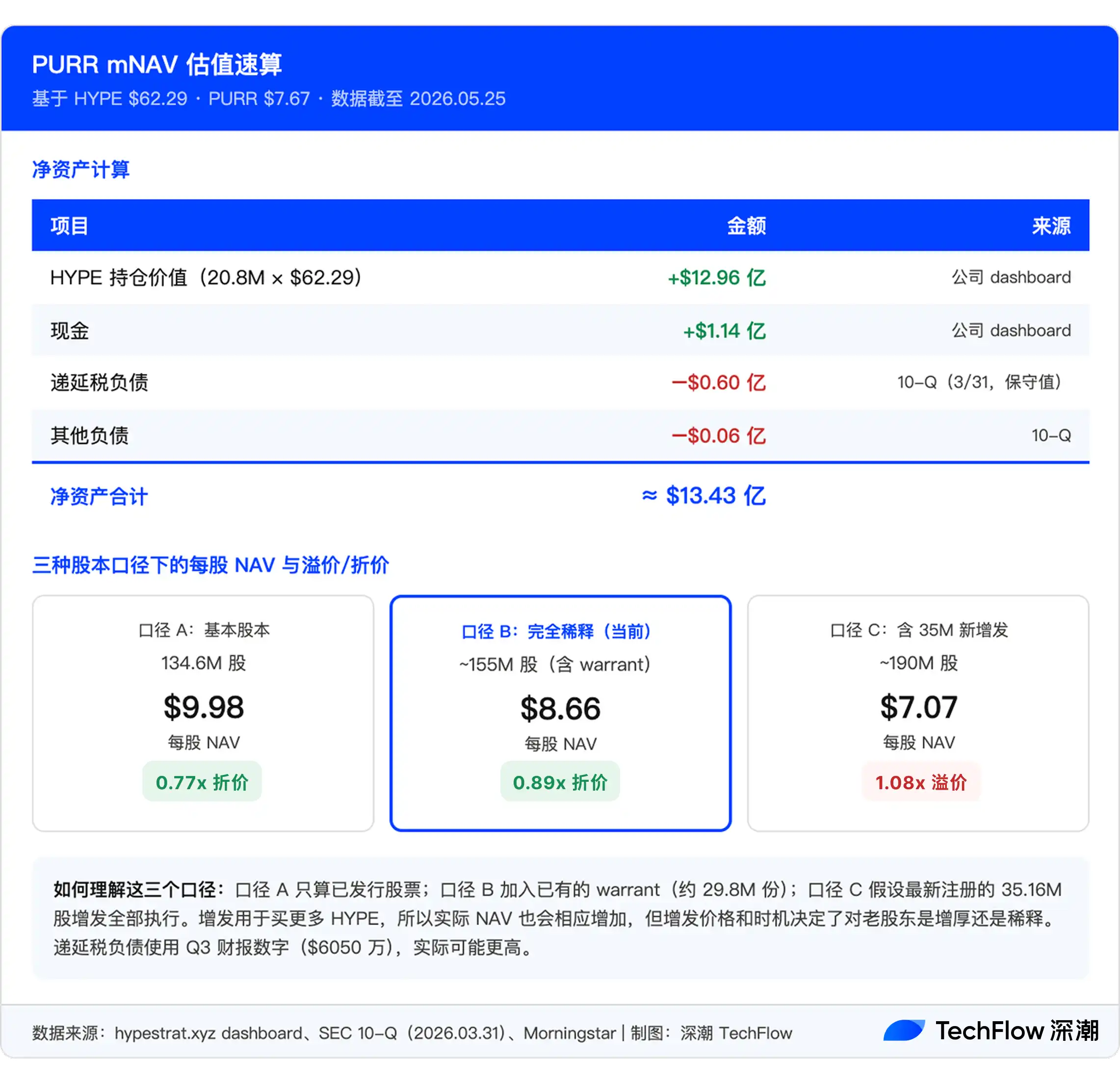
We pulled data from PURR's official dashboard and SEC filings for a quick mNAV calculation.

The company currently holds 20.8 million HYPE tokens (worth approximately $1.296 billion at the current price), plus $114 million in cash. After deducting deferred tax liabilities and other liabilities, the net asset value is around $1.34 billion.

Based solely on the 134.6 million shares issued, the NAV per share is about $9.98. With the current stock price at $7.67, this represents a discount of about 23%. If we include the approximately 29.8 million existing warrants, fully diluted to about 155 million shares, the NAV per share becomes about $8.66, a discount of about 11%. However, the company just registered an additional 35.16 million shares for issuance. If all these are executed, expanding the denominator to about 190 million shares, the NAV per share drops to $7.07, and the stock price would instead represent a slight premium of 1.08x.

Therefore, whether PURR is "cheap" or "expensive" depends on how much future dilution you anticipate.

Issuance itself isn't necessarily bad. If management issues shares at a high premium and uses the raised capital to buy more HYPE, the HYPE holdings per share could actually increase. But if they issue shares when market sentiment cools and the stock price falls below NAV, that dilutes existing shareholders.

This company has only been operating for half a year and hasn't experienced a full downcycle. There is no historical record to reference how management will operate under extreme market conditions.

Also note that the deferred tax liability used in the above calculation is $60.5 million from the Q3财报 cutoff date (March 31). However, HYPE has risen significantly since the end of March, so the tax liability corresponding to unrealized gains has likely increased further. The actual NAV might be slightly lower than our calculation.

What's the Difference Between Buying PURR and Directly Buying HYPE

This is the most practical question. Since PURR's entire value derives from HYPE, why not skip the middle layer and buy HYPE directly?

The answer is simple: for some investors, they can't. US retirement accounts (IRA, 401k), traditional brokerage accounts, and some institutionally-managed funds with strict compliance requirements cannot directly hold crypto assets.

Moreover, the Hyperliquid platform explicitly restricts access for US residents.

Therefore, PURR provides a NASDAQ-listed stock wrapper, allowing such capital to gain HYPE exposure through standard stock trading. The shell built by Paradigm essentially sells this compliant access channel.

If you belong to this category of investors, PURR is indeed currently almost the only option. Although 21Shares and Bitwise's HYPE spot ETFs were listed in mid-May, these products have been live for a very short time, and their liquidity and tracking error remain to be observed.

But if you have the ability to buy HYPE directly, then PURR's stock wrapper layer becomes purely a friction cost with negative effects; it cannot be considered a source of extra alpha on top of HYPE's beta.

This cost manifests on several levels:

First, dilution risk. By directly holding HYPE, your share cannot be diluted by others. But by holding PURR stock, the company can issue new shares at any time to buy more HYPE.

Second, incomplete profit transmission. Direct HYPE holders can stake themselves to earn staking rewards, and future airdrops/ecosystem incentives go directly to them. Through PURR, staking rewards go to the company's accounts first, and only indirectly reflect in the net asset value per share after deducting operational expenses and taxes.

Third, trading time and pricing friction. HYPE trades 24/7, while PURR trades only during US stock market hours. If HYPE experiences significant volatility over the weekend or after-hours, PURR holders must wait for the market to open to react.

Fourth, counterparty risk. SEC filings disclose that PURR's entire HYPE holdings are custodied with a single custodian. By holding PURR, your asset safety relies on this custodian's performance capability and the company's operational continuity.

The author's judgment is that PURR is more of a "channel product" than an "investment product." Its value lies in bridging the channel from traditional financial accounts to HYPE, nothing more. If you don't need this channel, then every additional risk brought by the middle layer is unnecessary.

Therefore, for crypto and US stock investors in the Chinese-speaking community, the conclusion is relatively straightforward:

The judgment you need to make is whether you are bullish on HYPE, not whether you are bullish on the PURR shell itself.

Câu hỏi Liên quan

QWhat is Hyperliquid Strategies (NASDAQ: PURR), and what is its core business model?

AHyperliquid Strategies (NASDAQ: PURR) is a publicly traded company that is essentially a pure-play investment vehicle for the HYPE cryptocurrency. Its business model is solely to buy, stake, and hold HYPE. As of April 2026, it held approximately 20.8 million HYPE tokens and around $113 million in cash, with zero debt. Therefore, the company's entire value depends on the price of HYPE.

QHow does PURR's claimed 'capital efficiency' compare to MicroStrategy (now Strategy) investing in Bitcoin, and is the comparison valid?

APURR has generated nearly $1 billion in unrealized gains from an initial investment of about $220 million in HYPE, which appears more capital efficient than Strategy's massive Bitcoin investments. However, this comparison is misleading. The difference in returns is primarily due to HYPE's price rising nearly 9x from PURR's average cost basis, while Bitcoin's price has remained relatively flat near Strategy's average cost. The 'efficiency' stems from choosing a high-performing asset, not from superior corporate strategy. An investor buying HYPE directly at the same time would have achieved the same return.

QWhat are the main risks or costs associated with investing in PURR compared to directly buying HYPE?

AInvesting in PURR instead of directly buying HYPE introduces several risks and costs: 1) **Dilution Risk**: PURR can issue new shares, diluting existing shareholders' ownership. 2) **Incomplete Yield**: Staking rewards, airdrops, or ecosystem incentives for HYPE go to the company first and are only indirectly reflected in net asset value after expenses and taxes. 3) **Trading Friction**: PURR trades only during U.S. market hours, while HYPE trades 24/7, creating a lag in price reaction. 4) **Counterparty Risk**: Investors rely on the security of PURR's single custodian and the company's operational continuity.

QAccording to the article, who are the key players behind the formation of PURR, and what is their background?

AThe formation of PURR was led by major traditional finance figures. The key participants include crypto venture capital firm Paradigm and investment firm Atlas Merchant Capital. Atlas Merchant Capital's founders hold core positions: Bob Diamond (former Barclays CEO) is Chairman, and David Schamis (former JC Flowers partner) is CEO. The board also includes former Boston Fed President Eric Rosengren and former NYSE COO Larry Leibowitz. Other backers include Galaxy, D1, and Pantera. Unlike many Digital Asset Trusts (DATs), PURR's leadership is dominated by traditional finance veterans rather than crypto-native individuals.

QFor which type of investor does PURR represent a valuable or necessary investment vehicle?

APURR is primarily valuable for investors who cannot directly purchase HYPE cryptocurrency due to regulatory or platform restrictions. This includes U.S.-based retirement accounts (IRAs, 401ks), traditional brokerage accounts, and certain institutional funds with strict compliance rules. Furthermore, the Hyperliquid platform restricts U.S. residents. For these investors, PURR provides a Nasdaq-listed, compliant channel to gain exposure to HYPE's price movements, making it practically their only option. For investors who can buy HYPE directly, PURR's wrapper adds unnecessary layers of cost and risk.

Nội dung Liên quan

Cuộc chiến AI PC: Đừng đặt cược vào phe phái, hãy đặt cược vào trạm thu phí

**Tóm tắt: Cuộc chiến AI PC: Đừng đặt cược vào phe phái, hãy đặt cược vào "trạm thu phí"** Bài viết phân tích cơ hội đầu tư trong cuộc cạnh tranh AI PC, nhấn mạnh rằng trọng tâm không nên là cuộc chiến ý thức hệ giữa kiến trúc x86 và Arm. Thay vào đó, nhà đầu tư nên tập trung vào các công ty nắm giữ vị trí then chốt, có khả năng thu lợi nhuận bền vững bất kể ai thắng. **Cơ hội được chia thành ba lớp:** 1. **Lớp "Trạm thu phí" công nghệ tiên tiến:** TSMC là bên hưởng lợi rõ ràng nhất, vì hầu hết chip AI PC cao cấp đều phụ thuộc vào quy trình sản xuất tiên tiến của họ. 2. **Lớp năng lực tính toán và nền tảng:** AMD (kết hợp CPU x86 và GPU) và NVIDIA (phần mềm và kiến trúc GPU) có lợi thế trong việc mở rộng ảnh hưởng. 3. **Lớp cơ hội co giãn và phục hồi:** Arm và Intel có tiềm năng tăng trưởng mạnh, nhưng đi kèm rủi ro cao hơn, đòi hỏi kỷ luật đầu tư chặt chẽ. **Quan điểm ngành:** AI PC đang chuyển từ giai đoạn khái niệm sang triển khai. Mặc dù dự báo ngắn hạn có thể điều chỉnh, xu hướng AI trở thành tính năng tiêu chuẩn trong dài hạn là không đổi. Động lực thay thế thiết bị thực sự sẽ phụ thuộc vào việc liệu các ứng dụng AI cục bộ (như xử lý riêng tư, cơ sở tri thức nội bộ) có đủ sức hút với doanh nghiệp hay không. **Đề xuất đầu tư:** Ưu tiên các công ty có dòng tiền ổn định và vị thế độc quyền trong chuỗi cung ứng. * **Nền tảng/Tài sản thế chấp:** TSMC. * **Cơ hội tấn công:** AMD. * **Cơ hội co giãn (thận trọng):** Intel và Arm. **Cảnh báo rủi ro:** Bao gồm ứng dụng AI PC kém hấp dẫn, khả năng tương thích Windows trên Arm cải thiện chậm, tác động của thuế quan và kinh tế vĩ mô đến nhu cầu, biến động nguồn cung công nghệ bán dẫn tiên tiến và định giá cao tổng thể của lĩnh vực AI. **Kết luận:** Cách tiếp cận khôn ngoan là xem AI PC như một sự chuyển dịch công nghiệp dài hạn, đầu tư vào các "trạm thu phí" và hệ sinh thái vững chắc sau khi cơn sốt thị trường lắng xuống, thay vì chạy theo các sự kiện marketing ngắn hạn.

marsbit5 phút trước

Cuộc chiến AI PC: Đừng đặt cược vào phe phái, hãy đặt cược vào trạm thu phí

marsbit5 phút trước

AI Trung chuyển gây tranh luận sôi nổi trên Zhihu: Đằng sau Token rẻ, người dùng thực sự lo lắng điều gì?

Một cuộc thảo luận trên Zhihu về "trạm trung chuyển AI" đã đưa chủ đề "Token giá rẻ" ra trước đông đảo người dùng, vượt khỏi phạm vi nhà phát triển. Cuộc thảo luận tập trung vào những lo ngại thực tế hơn là việc phán xét tính hợp pháp. Người dùng quan tâm hàng đầu tới tính xác thực của mô hình: liệu tên mô hình họ gọi có thực sự là mô hình đó hay đã bị "đánh tráo" thành phiên bản rẻ hơn, do nguồn cung token giá rẻ thường không minh bạch. Điều này tạo ra giao dịch thiếu cân bằng thông tin. Về chi phí, giá rẻ của trạm trung chuyển thường được so sánh với API chính thức tính theo lượng dùng, nhưng có thể không rẻ hơn gói đăng ký chính thức, mô hình trong nước hay hạn mức miễn phí. Người dùng cần xác định nhu cầu thực tế của mình trước. Nguồn gốc token giá rẻ được chỉ ra có thể từ kênh hợp pháp (mua số lượng lớn, tối ưu định tuyến) đến các kênh xám (chia sẻ tài khoản, lợi dụng chênh lệch giá, thẻ gian lận). Điều này làm tăng chi phí tin cậy, bao gồm rủi ro về tính ổn định dịch vụ và số dư tài khoản. Rủi ro an ninh dữ liệu là mối lo ngại lớn, đặc biệt khi xử lý mã nguồn, tài liệu kinh doanh hay thông tin khách hàng nhạy cảm. Trong các kịch bản Agent, rủi ro có thể leo thang từ "câu trả lời sai" sang "thực thi sai lệnh". Cuộc thảo luận đi đến đồng thuận chung: có thể sử dụng trạm trung chuyển cho các nhiệm vụ ít nhạy cảm, thay thế được, nhưng không nên coi đó là lựa chọn mặc định. Các khuyến nghị bao gồm: không nạp số tiền lớn, không ràng buộc toàn bộ quy trình làm việc, giữ đường dự phòng, kiểm tra chất lượng mô hình định kỳ và tuyệt đối không kết nối vào môi trường sản xuất của doanh nghiệp. Bài học cốt lõi là chi phí thực sự của việc sử dụng AI không chỉ nằm ở giá token, mà còn ở sự tin cậy, an toàn dữ liệu và trách nhiệm giải trình.

marsbit1 giờ trước

AI Trung chuyển gây tranh luận sôi nổi trên Zhihu: Đằng sau Token rẻ, người dùng thực sự lo lắng điều gì?

marsbit1 giờ trước

Hiệp hội Blockchain Thúc giục Thượng viện Thông qua Đạo luật CLARITY với Lá thư được Hỗ trợ bởi 160 Cựu Quan chức

Hiệp hội Blockchain, một trong những nhóm vận động hàng đầu ngành, đã gửi thư tới lãnh đạo Thượng viện Mỹ, thúc giục thông qua Đạo luật CLARITY. Thư có chữ ký của 160 cựu chuyên gia an ninh, tình báo và thực thi pháp luật. Các bên ký tên cho rằng thiếu khuôn khổ pháp lý rõ ràng sẽ đẩy hoạt động tiền mã hóa ra nước ngoài, gây khó khăn cho việc điều tra tội phạm tài chính. Đạo luật CLARITY nhằm tăng cường năng lực thực thi pháp luật và ngăn ngừa tội phạm tài chính trong lĩnh vực tài sản số. Các biện pháp chính bao gồm: củng cố nghĩa vụ chống tài chính bất hợp pháp (mở rộng yêu cầu theo Đạo luật Bảo mật Ngân hàng và luật trừng phạt), tăng cường chia sẻ thông tin giữa Bộ Tài chính, Bộ Tư pháp, FBI, DEA và khu vực tư nhân, cũng như tăng cường bảo vệ cho các máy giao dịch tài sản số (kiosk) thông qua giám sát giao dịch, báo cáo, hạn mức và các quy định chống gian lận. Hiệp hội nhấn mạnh đây là các biện pháp tăng cường thực thi, không phải bãi bỏ quy định. Một cuộc họp thị trấn trực tuyến sẽ được tổ chức để thảo luận về lợi ích của dự luật đối với thực thi pháp luật và an ninh quốc gia. Dự luật đã được Ủy ban Nông nghiệp Thượng viện thông qua một phần vào tháng 1 và dự kiến được đưa ra biểu quyết toàn thể tại Thượng viện vào mùa hè này. Tuy nhiên, nếu thông qua, nó vẫn cần được Hạ viện phê chuẩn, và có thể cần phải điều chỉnh để phù hợp với phiên bản đã được Hạ viện thông qua vào mùa thu năm ngoái.

bitcoinist1 giờ trước

Hiệp hội Blockchain Thúc giục Thượng viện Thông qua Đạo luật CLARITY với Lá thư được Hỗ trợ bởi 160 Cựu Quan chức

bitcoinist1 giờ trước

ByteDance Dùng CPU Arm, Ông Hoàng Nhân Huân: Đáng Tiếc Không Mua Được Arm

Bài báo đưa tin từ sự kiện Computex 2026, nơi CEO của Arm, Rene Haas, thông báo rằng ByteDance (TikTok) và Oracle đã áp dụng chip CPU dành cho trung tâm dữ liệu do Arm tự nghiên cứu, tên là Arm AGI. Arm đã tăng gấp đôi kỳ vọng về nhu cầu đối với CPU này, dự kiến đạt doanh thu 20 tỷ USD vào các năm tài chính 2027-2028 và 150 tỷ USD hàng năm trong khoảng 5 năm. Haas cũng chia sẻ quan điểm rằng việc Mỹ ngăn cản xuất khẩu CPU AI sang Trung Quốc là gần như không thể. Trong một cuộc đối thoại thú vị, CEO NVIDIA, Jensen Huang, đã tham gia và bày tỏ sự tiếc nuối khi NVIDIA không thể mua lại Arm trước đây. Ông cũng giải thích lý do đằng sau việc NVIDIA phát triển siêu chip RTX Spark dựa trên kiến trúc Arm, nhấn mạnh nhu cầu về CPU mạnh mẽ cho các tác nhân AI (AI agent) chạy cục bộ trên PC. Huang dự đoán ngành công nghiệp máy tính có thể mở rộng gấp mười lần nhờ sự phát triển của các tác nhân AI tự chủ. Bài báo cũng đề cập đến những tiến bộ của Arm trong lĩnh vực chip PC và CPU cho trung tâm dữ liệu. Nhiều đối tác lớn như OpenAI, Meta, Google và Microsoft đang sử dụng hoặc hợp tác với Arm. Haas đã công bố lộ trình phát triển cho các thế hệ CPU Arm AGI tiếp theo, khẳng định cam kết lâu dài trong việc tự sản xuất chip. Kết luận chỉ ra rằng sự bùng nổ của các tác nhân AI đang dịch chuyển sự chú ý trong cuộc đua sức mạnh tính toán sang CPU, thúc đẩy xu hướng tích hợp theo chiều dọc trong ngành công nghiệp bán dẫn, nơi hiệu quả năng lượng trở thành yếu tố cạnh tranh chính.

marsbit2 giờ trước

ByteDance Dùng CPU Arm, Ông Hoàng Nhân Huân: Đáng Tiếc Không Mua Được Arm

marsbit2 giờ trước

Hướng dẫn Q3 của Broadcom thấp hơn kỳ vọng 1,2 tỷ USD, giá cổ phiếu giảm hơn 13% sau giờ giao dịch, câu chuyện AI đang 'hạ nhiệt'?

Tóm tắt báo cáo kết quả kinh doanh Q2/2026 và dự báo Q3 của Broadcom Broadcom đã công bố kết quả kinh doanh quý 2 năm tài chính 2026 với doanh thu 221,9 tỷ USD, tăng 48%, trong đó doanh thu bán dẫn AI đạt 108 tỷ USD, tăng 143%, và đây là quý tăng trưởng thứ 13 liên tiếp cho phân khúc này. Lợi nhuận điều chỉnh EBITDA đạt mức kỷ lục 152 tỷ USD. Tuy nhiên, dự báo của công ty cho quý 3 đã khiến thị trường thất vọng. Mặc dù dự kiến tổng doanh thu đạt 294 tỷ USD (vượt kỳ vọng), doanh thu bán dẫn AI được hướng dẫn chỉ ở mức 160 tỷ USD, thấp hơn khoảng 7% so với kỳ vọng chung của các nhà phân tích (172 tỷ USD). CEO Hock Tan cũng không nâng dự báo doanh thu bán dẫn AI cho cả năm tài chính 2026, vẫn giữ ở mức hơn 1000 tỷ USD. Đặc biệt, ông Tan cho biết tỷ trọng doanh thu từ mạng AI trong doanh thu bán dẫn AI, hiện ở mức gần 40%, dự kiến sẽ trở về mức ~30% trong tương lai. Tuyên bố này có thể tạo ra áp lực định giá lại đối với các công ty con ngành quang học (như Zhongji Innolight, Eoptolink) vốn được định giá cao dựa trên kỳ vọng tăng trưởng liên tục của phân khúc mạng. Phản ứng thị trường rất tiêu cực. Cổ phiếu AVGO của Broadcom lao dốc hơn 13% trong giao dịch ngoài giờ, làm bốc hơi hơn 2700 tỷ USD vốn hóa thị trường. Hiệu ứng lan tỏa khiến cổ phiếu Marvell và một số công ty trong lĩnh vực kết nối AI khác cũng giảm theo. Sự sụt giảm này được cho là do việc chốt lời sau một đợt tăng mạnh trước đó và định giá cao (PE ~90 lần) so với mặt bằng ngành. Dù vậy, lãnh đạo Broadcom vẫn khẳng định nhu cầu chip AI "khó có thể được đáp ứng đầy đủ" và giữ vững tầm nhìn dài hạn. Đợt điều chỉnh này là điểm chuyển giao câu chuyện AI hay chỉ là đợt chốt lời thông thường sẽ cần được theo dõi thông qua các động thái chi tiêu vốn tiếp theo của các nhà cung cấp dịch vụ đám mây quy mô lớn.

marsbit2 giờ trước

Hướng dẫn Q3 của Broadcom thấp hơn kỳ vọng 1,2 tỷ USD, giá cổ phiếu giảm hơn 13% sau giờ giao dịch, câu chuyện AI đang 'hạ nhiệt'?

marsbit2 giờ trước

Giao dịch

Giao ngay
Hợp đồng Tương lai
活动图片

