Aave Scraps Avara and Family Wallet as SUBBD Momentum Builds

bitcoinistXuất bản vào 2026-02-04Cập nhật gần nhất vào 2026-02-04

Tóm tắt

Aave has retired its Avara brand and shut down the Family Wallet, signaling a strategic retreat from consumer-facing products to refocus on its core lending protocol and Lens ecosystem. This move reflects a broader market shift away from generalist "super-apps" toward specialized platforms that solve specific industry problems. In this context, SUBBD Token is gaining momentum by targeting the $85 billion creator economy. It combines AI and Web3 to disrupt high-fee structures and platform dependency faced by content creators. The project offers AI-driven tools like personal assistants, voice cloning, and influencer creation to automate and monetize content. SUBBD has raised over $4.5 million in its presale, with tokens priced at $0.05749. It also offers a 20% APY staking incentive to encourage long-term holding. The platform emphasizes creator sovereignty, reduced fees, and direct audience monetization—addressing key pain points that mainstream platforms like OnlyFans and Patreon fail to resolve. This utility-focused approach contrasts with Aave’s abandoned broader strategy, highlighting a market trend where crypto is valued for solving real-world problems rather than offering generalized interfaces.

Trusted Editorial content, reviewed by leading industry experts and seasoned editors. Ad Disclosure

Quick Facts:

  • ➡️ Aave has retired the Avara brand and shuttered the Family Wallet to refocus on its core lending protocol and Lens ecosystem.
  • ➡️ The market trend is shifting away from generalist “super-apps” toward specialized platforms that solve specific industry pain points.
  • ➡️ SUBBD Token is capitalizing on this shift by using AI and Web3 to disrupt the high-fee structures of the $85B creator economy.
  • ➡️ Early data shows strong demand for SUBBD’s model, with over $4.5 million raised during its presale phase.

The ‘crypto super-app’ dream took a hit this week. Aave, one of decentralized finance’s largest lending protocols, announced a strategic retreat from its consumer-facing wallet ambitions.

Stani Kulechov, Aave’s founder, confirmed the organization is retiring the ‘Avara’ parent brand and shutting down the Family Wallet, a product acquired just last year to bridge the gap between DeFi and everyday users.
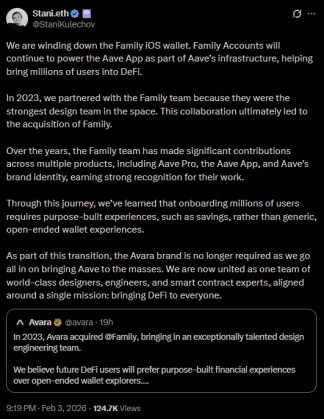

It’s a sharp pivot back to basics. For the past two years, the narrative was all about expansion—building social graphs (Lens Protocol), stablecoins (GHO), and wallets under one massive umbrella. But that era appears over.

The reversal suggests the market frankly no longer rewards broad, open-ended ecosystems that lack immediate stickiness. Instead, liquidity is flowing toward purpose-built protocols that solve specific, high-friction problems rather than general utility.

This restructuring comes as the broader crypto market hunts for the next major narrative beyond simple asset speculation. While infrastructure giants like Aave consolidate to defend their moats, capital is rotating into sectors offering tangible utility for non-crypto natives.

Specifically, the intersection of AI and the creator economy is seeing aggressive growth. It’s within this vacuum of consumer utility that projects like SUBBD Token ($SUBBD) are finding traction, using the exact kind of specialized focus that the ‘Family’ wallet missed.

Buy your $SUBBD here.

AI Tools Replace Generic Interfaces

The failure of the Family Wallet highlights a brutal truth in crypto: users don’t need another place to store private keys; they need a reason to use them.

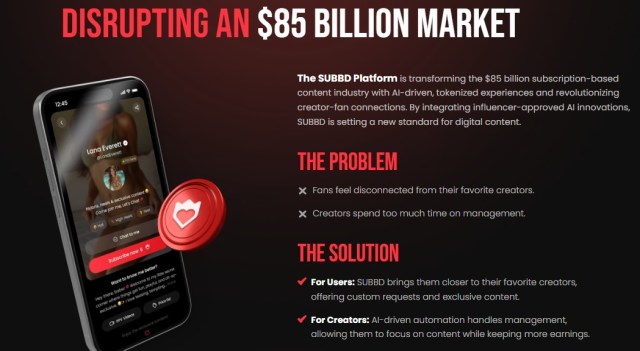
While Aave retreats to infrastructure, SUBBD Token ($SUBBD) is capitalizing on the $85 billion content creation industry by attacking the inefficiencies of Web2 incumbents. The current landscape for creators is defined by exploitation, platforms routinely extract up to 70% of earnings in fees, while arbitrary bans restrict audience reach.

SUBBD addresses this not by building a generic wallet, but by deploying an EVM-compatible ecosystem designed specifically for creator sovereignty. By merging Web3 payments with proprietary AI models, the platform offers tools that were previously fragmented across a dozen subscriptions.

Features like the AI Personal Assistant allow creators to automate interactions, while AI Voice Cloning and AI Influencer Creation open new revenue streams that don’t require the creator to be physically present 24/7.
This utility-first approach differs fundamentally from the strategy Aave just abandoned. Where Avara attempted to capture users through a generalist interface, SUBBD captures them through essential service provision. The platform’s decentralized architecture ensures creators maintain ownership of their content and earnings, removing the middleman risk that plagues platforms like OnlyFans or Patreon.

For the market, this represents a shift from ‘crypto as a wallet’ to ‘crypto as a business backend.’

Check out the SUBBD ecosystem.

SUBBD Presale Draws Capital Seeking Utility

The market’s appetite for this specific utility is quantifiable. While legacy DeFi tokens struggle with governance restructuring, SUBBD Token has maintained steady inflows during its presale phase.

According to current data, the project has successfully raised $1.4M, signaling strong confidence from early adopters who view the convergence of AI and content monetization as the next logical step for retail crypto adoption.

Investors are currently entering at a price point of $0.05749, positioning themselves before the platform’s full public rollout. Beyond the speculative aspect, the protocol’s staking mechanics are designed to encourage long-term ecosystem stability.
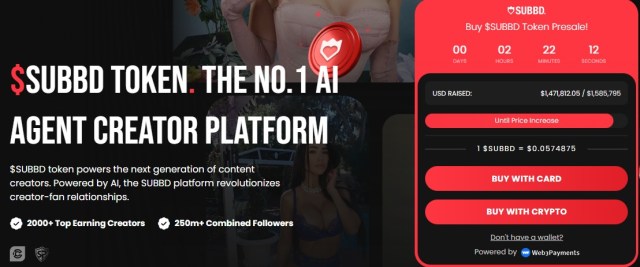
The project offers a fixed 20% APY for the first year to participants who lock their tokens. This incentive structure does two things: it reduces circulating supply volatility during the critical early growth phase, and it aligns incentives between the platform’s developers and its community.

Smart money monitors these metrics closely because they suggest a departure from ‘vaporware.’ The token serves a dual purpose: governance rights over platform features, such as voting on AI creator curation, and utility within the ecosystem for tipping, subscriptions, and accessing token-gated content.

As Aave refocuses on the backend of DeFi, projects like SUBBD are building the front-end utility that actually drives mass adoption.

You can buy $SUBBD here.

The content provided in this article is for informational purposes only and does not constitute financial advice. Cryptocurrency investments carry inherent risks, including high volatility and potential loss of capital. Always conduct your own due diligence before investing.

Editorial Process for bitcoinist is centered on delivering thoroughly researched, accurate, and unbiased content. We uphold strict sourcing standards, and each page undergoes diligent review by our team of top technology experts and seasoned editors. This process ensures the integrity, relevance, and value of our content for our readers.

patrubogdan

Follow

Full Profile

Related Posts

Crypto Market Structure Bill Nears Key Moment As CFTC Chair Signals Progress Within Months

Dubai’s $280M Diamond Tokenization Sets RWA Precedent as Bitcoin Hyper Secures $31.2M

Bitcoin Dominance Shifts: Crypto Usage Spreads Beyond Bitcoin as $HYPER Keeps Gaining

Binance Crushes Competition With $155B Asset Surge; $HYPER Emerging as Bitcoin L2 Leader

Criptomoneda prometedora para invertir ante el cambio de sentimiento: el auge de la infraestructura Bitcoin

Criptomoneda prometedora para invertir mientras cambia el sentimiento del mercado: Bitcoin Hyper redefine la Capa 2

Câu hỏi Liên quan

QWhat strategic changes did Aave announce regarding its consumer-facing products?

AAave announced it is retiring the 'Avara' parent brand and shutting down the Family Wallet, a product it acquired last year, to refocus on its core lending protocol and the Lens ecosystem.

QAccording to the article, what market trend is causing a shift away from 'super-apps'?

AThe market trend is shifting away from generalist 'super-apps' toward specialized platforms that solve specific, high-friction industry pain points and offer tangible utility.

QWhat specific industry is SUBBD Token targeting, and what is its total market size?

ASUBBD Token is targeting the content creator economy, which the article states is an $85 billion industry.

QWhat are two specific AI-powered tools the SUBBD platform offers to creators?

AThe SUBBD platform offers an AI Personal Assistant to automate interactions and AI Voice Cloning and AI Influencer Creation to open new revenue streams.

QHow much capital has the SUBBD Token presale raised, according to the data in the article?

AAccording to the article, the SUBBD Token presale has raised $1.4 million.

Nội dung Liên quan

Ngành Công nghiệp Tiền điện tử Theo dõi Khi Ba Lan Thúc đẩy Dự luật Quy định Bị Trì hoãn Lâu nay

Thủ tướng Ba Lan Donald Tusk đã liên hệ việc nước này nhiều lần thất bại trong việc thông qua luật tiền mã hóa với một vụ bê bối gian lận nổi tiếng tại sàn giao dịch Zondacrypto, nhấn mạnh sự cần thiết của khung pháp lý để bảo vệ nhà đầu tư. Trong phiên họp tuần này, Hạ viện Ba Lan (Sejm) cuối cùng đã thông qua dự luật số 2529 do chính phủ đề xuất, với tỷ lệ 241 phiếu thuận và 200 phiếu chống, sau hai lần bị Tổng thống Karol Nawrocki phủ quyết trước đó. Dự luật được thông qua trao quyền lực rộng rãi cho Cơ quan Giám sát Tài chính Ba Lan (KNF) để giám sát thị trường, áp đặt chế tài hành chính và tạm thời chặn tài khoản hoặc giao dịch khi cần thiết. Tuy nhiên, các điều khoản về quyền chặn này - nguyên nhân dẫn đến các lần phủ quyết trước - vẫn được giữ nguyên, khiến nhiều chuyên gia lo ngại Tổng thống có thể phủ quyết lần thứ ba. Điều này làm dấy lên mối lo về sự bất ổn pháp lý kéo dài, trong khi Ba Lan đang chịu áp lực phải tuân thủ Quy định về Thị trường Tài sản Mã hóa (MiCA) của EU trước thời hạn tháng 7. Dự luật trên đã vượt qua ba đề xuất cạnh tranh khác để được thông qua.

bitcoinist2 giờ trước

Ngành Công nghiệp Tiền điện tử Theo dõi Khi Ba Lan Thúc đẩy Dự luật Quy định Bị Trì hoãn Lâu nay

bitcoinist2 giờ trước

Đợt Đăng ký IPO tiền điện tử ẩm ướt: Consensys và Ledger đồng loạt hoãn kế hoạch

**Mùa đông IPO tiền mã hóa: Consensys và Ledger đồng loạt hoãn kế hoạch** Ngày 14/5, Consensys - nhà phát triển ví MetaMask - đã hoãn kế hoạch IPO sang mùa thu năm nay. Trước đó, Ledger, gã khổng lồ ví cứng, cũng tạm dừng kế hoạch IPO tại Mỹ. Kraken cũng liên tục trì hoãn niêm yết. Chuỗi sự kiện này đánh dấu sự thu hẹp rõ rệt của cửa sổ IPO năm 2026, sau cơn sốt niêm yết của các công ty tiền mã hóa vào năm 2025. Năm 2025 là một năm bội thu với các IPO như Circle, Bullish, Gemini, huy động tổng cộng khoảng 14,6 tỷ USD. Tuy nhiên, sang 2026, giá Bitcoin điều chỉnh mạnh, sở thích rủi ro của nhà đầu tư giảm, dẫn đến hiệu suất kém của các cổ phiếu tiền mã hóa như BitGo (IPO đầu năm 2026). Điều này làm các công ty như Kraken, Ledger và Consensys phải thận trọng hoãn kế hoạch. Trái ngược với sự "hạ nhiệt" của IPO tiền mã hóa, lĩnh vực AI đang trong giai đoạn cao trào với các kế hoạch IPO khổng lồ từ SpaceX (định giá mục tiêu 1,75-2 nghìn tỷ USD), OpenAI hay Anthropic. Sự khác biệt này đến từ việc doanh nghiệp AI được cho là có câu chuyện tăng trưởng "chắc chắn" hơn, trong khi doanh nghiệp tiền mã hóa phụ thuộc nhiều vào chu kỳ giá Bitcoin và khối lượng giao dịch. Hiện tượng này thúc đẩy quá trình chọn lọc tự nhiên, nguồn lực tập trung vào các doanh nghiệp có cơ sở hạ tầng vững mạnh và tuân thủ quy định. Nó cũng buộc ngành phải chuyển từ mô hình dựa trên câu chuyện sang tập trung vào dòng tiền và minh bạch. Triển vọng đợt IPO thứ hai vào nửa cuối 2026 phụ thuộc vào việc Bitcoin có ổn định ở mức cao hơn và môi trường pháp lý có được cải thiện hay không.

marsbit2 giờ trước

Đợt Đăng ký IPO tiền điện tử ẩm ướt: Consensys và Ledger đồng loạt hoãn kế hoạch

marsbit2 giờ trước

Hai Cấu Trúc Sự Sống của Nhà Tạo Thị Trường và Nhà Kinh Doanh Chênh Lệch Giá

Trong giao dịch tần suất cao, hai chiến lược chính tồn tại: tạo lập thị trường và chênh lệch giá giữa các sàn. Bài viết so sánh đặc điểm rủi ro của họ. **Nguồn gốc rủi ro:** * **Tạo lập thị trường:** Chấp nhận rủi ro "tồn kho" để đổi lấy quyền kiểm soát giá (maker). Rủi ro phát sinh khi lệnh không được khớp cân bằng. * **Chênh lệch giá:** Sử dụng lệnh taker, rủi ro xuất hiện từ sự khác biệt về quy tắc giao dịch (như quy mô lô) và độ trễ giữa các sàn. **Đặc điểm phơi sáng rủi ro:** * **Tạo lập thị trường:** Rủi ro phân mảnh, xảy ra liên tục và ngẫu nhiên do sự khớp lệnh thụ động. Có thể là thuận lợi (trong điều kiện thị trường ổn định) hoặc bất lợi (trong xu hướng mạnh). * **Chênh lệch giá:** Rủi ro phát sinh chủ yếu từ các yếu tố kỹ thuật như quy tắc sàn, sự can thiệp funding rate, hoặc sự phá vỡ tương quan tài sản. **Mối quan hệ giữa rủi ro và lợi nhuận:** * **Tạo lập thị trường:** Sử dụng vốn hiệu quả 100%, chấp nhận rủi ro tồn kho có kiểm soát để đổi lấy spread và phí maker thấp, nhắm đến tỷ lệ thắng cao và vòng quay nhanh. * **Chênh lệch giá:** Hiệu suất sử dụng vốn trên danh nghĩa chỉ 50% (do cần ký quỹ ở cả hai sàn), chịu phí taker cao. Rủi ro phơi sáng chủ yếu là nhân tố làm hao hụt lợi nhuận, được chấp nhận để đổi lấy chênh lệch giá hoặc lợi tức cấu trúc (như funding rate). **Hội tụ:** Cả hai chiến lược đều tiến hóa thành một hệ thống lai, linh hoạt sử dụng cả lệnh maker và taker dựa trên tính toán chi phí và rủi ro. Về bản chất, tạo lập thị trường "bán" thời gian (kiểm soát giá) để đổi lấy lợi nhuận, trong khi chênh lệch giá "bán" không gian (cam kết vốn trên nhiều sàn). Họ cùng sử dụng các dạng phơi sáng rủi ro khác nhau để đổi lấy phần chắc chắn mong manh từ thị trường.

链捕手6 giờ trước

Hai Cấu Trúc Sự Sống của Nhà Tạo Thị Trường và Nhà Kinh Doanh Chênh Lệch Giá

链捕手6 giờ trước

Giao dịch

Giao ngay
Hợp đồng Tương lai
活动图片





