Intel Data Center Revenue Soars 59%, CEO Chan: CPU Demand 'Taking Off', Supply Can't Keep Up

链捕手Xuất bản vào 2026-07-24Cập nhật gần nhất vào 2026-07-24

Tóm tắt

Intel Reports Strong Q2 2026 Results, Led by Surging Data Center Revenue Intel demonstrated a robust recovery, posting second-quarter revenue of $16.1 billion, a 25% year-over-year increase—its highest growth rate since 2011. On a non-GAAP basis, net income was $2.2 billion, with earnings per share of $0.42, far exceeding analyst expectations. A key highlight was the performance of the Data Center and AI (DCAI) business, where revenue soared 59% to $6.3 billion, significantly outperforming overall company growth. CEO Patrick Gelsinger noted that "CPU demand is taking off" in the data center segment, with demand outpacing the company's growing supply capacity. This supply-demand dynamic has granted Intel renewed pricing power, with server CPU prices in China reportedly rising over 40% since the start of 2026. The company has secured ten long-term supply agreements with customers. The Client Computing Group (CCG), which includes PC chips, saw revenue grow 13% to $8.9 billion. Intel Foundry revenue grew 31% to $5.8 billion and achieved a milestone by signing its first named external customer, cybersecurity firm Fortinet. The company reported strong progress on its Intel 18A manufacturing process, with yields improving approximately 7% per month. To support future growth, Intel raised its full-year 2026 capital expenditure forecast from $18 billion to $20 billion, including a $5.7 billion investment to expand manufacturing capacity for its Xeon processors. For the third quar...

By Su Yang, Tencent Tech

Intel is gradually entering a strong recovery cycle.

On July 23 (US time), Intel announced its financial results for the second quarter of 2026, ending June. Among them, revenue reached $16.1 billion, a 25% year-over-year increase. This growth rate is the highest since the third quarter of 2011. In contrast, analysts surveyed by the London Stock Exchange Group (LSEG) had an average expectation of $14.42 billion.

Under Generally Accepted Accounting Principles (GAAP), Intel reported a net loss of $11.0 billion for the second quarter, with a loss per share of $2.16. However, this significant loss is related to the 10% equity stake held by the US government being in an "escrow" state. It does not affect the company's actual cash flow nor reflect the true performance of its core operations.
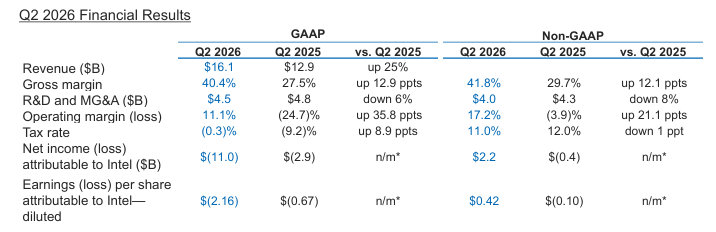
Intel's Key Financial Data for Q2 2026

On a Non-GAAP basis, Intel's net income for the quarter was $2.2 billion, with earnings per share (EPS) of $0.42, compared to a net loss of $400 million and a loss per share of $0.10 in the same period last year. Analysts had previously expected EPS of only $0.21. It is worth noting that since turning profitable in the third quarter of 2025, Intel has achieved profitability for four consecutive quarters, with profits gradually expanding.

The recovery in profitability is also reflected in gross margin.

On a Non-GAAP basis, gross margin was 41.8%, significantly higher by 12.1 percentage points compared to 29.7% in the same period last year. Intel CFO David Zinsner emphasized that the margin improvement benefited from the scale effects of higher revenue and the company selling chips with higher profitability and better pricing.

Following the release of a series of positive signals, Intel's stock price rose approximately 11% in after-hours trading.

01

Price Hikes Drive 59% Data Center Revenue Growth

The biggest highlight in the earnings report is undoubtedly the data center business.

In the second quarter of 2026, Intel's Data Center and AI Group (DCAI) achieved revenue of $6.3 billion, a sharp increase of 59% year-over-year. This not only far exceeded the company's overall growth rate but also easily surpassed analyst expectations of $5.6 billion.

"AI is driving unprecedented demand for computing power. As we continue to execute our stated strategy, Intel is well-positioned in CPUs, ASICs, advanced packaging, and a vast foundry network, helping us seize sustainable growth opportunities," said CEO Patrick (Pat) Gelsinger in a statement.

More notably, market demand has reached a "sweet trouble" level. Gelsinger revealed: "In the data center space, CPU demand is taking off, and demand is outpacing our growing supply capacity."

It is precisely this supply-demand imbalance that has given Intel long-lost pricing power. Zinsner added: "From a pricing perspective, the situation is better than we expected."

In China, prices for some server CPU products have increased by more than 10% quarter-over-quarter, and cumulative increases since the beginning of 2026 have exceeded 40%. Foreign media reported that both Intel and AMD are actively negotiating long-term agreements with Chinese server customers—locking in purchase volumes but not prices, with some covering periods of up to two years or more.

Intel disclosed in its earnings report that the company has secured 10 such long-term agreements so far, and acknowledged that customer demand has exceeded current production capacity, putting the company in a supply-constrained state.

Compared to the strong momentum of the data center business, the client business was relatively steady. The Client Computing and Physical AI Group (CCPG), which includes the PC business, generated revenue of $8.9 billion in the quarter, up 13% year-over-year.

Zinsner stated that PC sales are expected to be flat in the third quarter due to memory shortage impacts.

02

Foundry Business Accelerates: Revenue Up 31%, Welcomes First Named Customer

Another major strategic pillar for Intel—the foundry business—achieved revenue of $5.8 billion in the second quarter, a 31% year-over-year increase. However, most of its revenue still comes from providing manufacturing services for Intel's own products, resulting in significant internal elimination. The financial report shows that the business remains in an operating loss for the period.
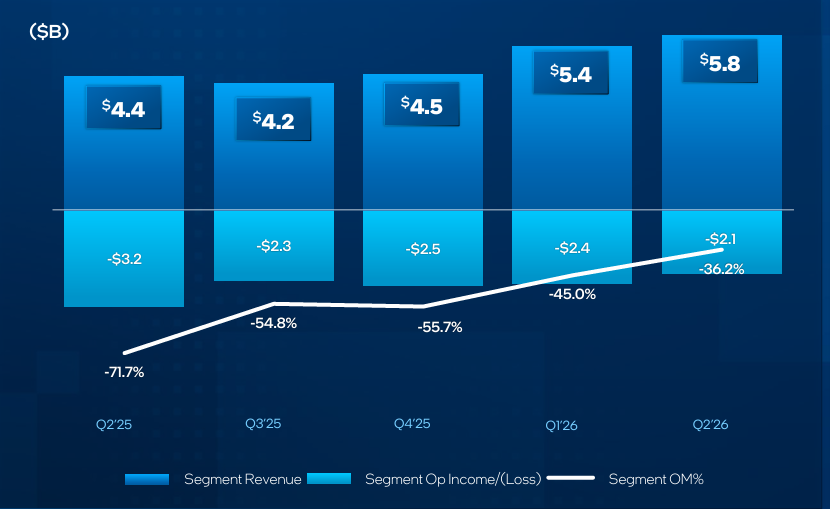
Intel Foundry Recovery Accelerates: Q2 Revenue $5.8B, Loss Narrows to $2.1B

Regarding the much-discussed 18A yield, Intel remains optimistic.

In May, Gelsinger revealed at J.P. Morgan's 54th Annual Global Technology, Media and Communications Conference that the Intel 18A process is already supporting the volume production of the Core Ultra 3 series processors codenamed Panther Lake. Yields are improving at a rate of about 7% per month, exceeding the company's internal expectations. Meanwhile, the data center processor Xeon 6+ has also entered volume production using the 18A process.

At the same time, the more advanced Intel 18A-P has also entered the risk production phase on schedule. Intel has even begun using ASML's High-NA EUV lithography machines to prepare for mass production of the "graphics layers" for the transistors of the Panther Lake processors.

In terms of external customer acquisition, Intel achieved a historic breakthrough this quarter. Cybersecurity company Fortinet announced a strategic collaboration with Intel to leverage its design, packaging, and manufacturing capabilities to develop Fortinet's security processors. This is the first named customer publicly disclosed by Intel's foundry business.

Meanwhile, market rumors about Apple collaborating with Intel to build factories have also attracted significant attention. Although President Trump publicly stated in June that Apple had agreed to partner with Intel to design and produce chips in the US, neither company has confirmed this.

Bernstein analysts speculate that if the collaboration is true, the initial focus may be on low-volume, low-risk, entry-level PC chips, more of a proof-of-concept nature. While the short-term revenue contribution might be limited, its symbolic significance is enormous.

When discussing the foundry business outlook in post-earnings interviews, Zinsner stated that Intel has "received significant customer interest" in advanced chip packaging products and the business has accumulated "a significant backlog." He also revealed that the most advanced 14A process technology is still under development as planned and is expected to enter volume production in 2028.

On a broader industrial collaboration front, Intel and Google Cloud expanded their multi-year strategic partnership to extend AI capabilities to all employees and drive internal AI-driven transformation. Additionally, strategic collaborations were established with companies like Foxconn, Siemens, and Hitachi to jointly develop industry-specific AI and computing solutions powered by Intel processors and specialized chips.

Facing a fundamental shift in the CPU market's supply-demand landscape, competitor AMD's CEO Lisa Su recently also significantly raised the projected CPU market size for 2030 from $120 billion to $220 billion, citing strong demand driven by agent workloads. This echoes Intel's current assessment of supply shortages.

However, after the stock price's strong rally, some cautious voices are beginning to emerge in the market.

Thomas George, portfolio manager at Grizzle Investment Management, pointed out that Intel's current forward price-to-earnings ratio is about 74x, far above its 10-year average (22x) and also higher than competitors like Nvidia and Broadcom. "This is a stock where the market has already moved ahead, at least from a valuation perspective."

03

Capital Expenditure Raised to $20 Billion to Fuel Future Growth

To convert customer interest into growth, Intel has decided to decisively increase investment.

The company announced it is raising its full-year 2026 capital expenditure plan from $18 billion to $20 billion. Zinsner stated that the previously relatively conservative spending plan has shifted. The company is now committing to a higher budget and predicts that spending in 2027 will further increase to support expected growth in products and foundry business next year.

In terms of specific investment actions, Intel announced an investment of approximately $5.7 billion to expand manufacturing capacity for Xeon 6 and next-generation Xeon processors based on the Intel 3 process. Additionally, Intel expanded capacity at its Bowers Park campus in California, USA, to enhance mask-making capabilities, supporting the development and manufacturing of current and future leading process technologies.

"We delivered a strong second quarter, benefiting from robust demand and improved execution, with revenue exceeding our financial guidance," Zinsner said in the statement. "AI-driven computing demand continues to strengthen. To support expected growth in both our product and foundry businesses this year and next, we are significantly increasing investments in equipment, cleanroom space, and substrates."

Meanwhile, Intel's guidance for the third quarter is also quite optimistic.

The company expects third-quarter revenue to be in the range of $15.8 billion to $16.8 billion, significantly higher than analysts' expectation of $15.1 billion. Non-GAAP EPS is expected to be $0.38, also better than the analyst expectation of $0.27. Gross margin is expected to remain around 42%.


Tiền kỹ thuật số thịnh hành

Câu hỏi Liên quan

QWhat was the year-over-year growth rate of Intel's Data Center and AI (DCAI) business revenue in Q2 2026?

AIntel's Data Center and AI (DCAI) business revenue grew by 59% year-over-year in the second quarter of 2026.

QWhat key reason did CFO David Zinsner give for the improvement in Intel's Non-GAAP gross margin to 41.8%?

ACFO David Zinsner attributed the gross margin improvement to higher revenue leading to better economies of scale and the company selling higher-margin, better-priced chips.

QAccording to CEO Chen Lifu, what is the supply-demand situation for CPUs in the data center segment?

ACEO Chen Lifu stated that in the data center segment, CPU demand is 'taking off' and is exceeding the company's growing supply capacity, putting them in a supply-constrained state.

QWhat was the first named external customer publicly disclosed for Intel's Foundry business?

AThe first named external customer publicly disclosed for Intel's Foundry business is cybersecurity company Fortinet, which will collaborate with Intel to develop Fortinet security processors.

QWhat did Intel raise its full-year 2026 capital expenditure forecast to, and what is a key area this investment will target?

AIntel raised its full-year 2026 capital expenditure forecast from $18 billion to $20 billion. A key area for this investment is expanding manufacturing capacity for Xeon 6 and next-generation Xeon processors based on the Intel 3 process, with an allocation of approximately $5.7 billion.

Nội dung Liên quan

Vụ ly hôn của Choi Tae-won chính thức kết thúc: Tiết lộ tuyến kế thừa ẩn sau đế chế nghìn tỷ SK Hynix

Vào tháng 11/2024, trong một sự kiện kỷ niệm, Chủ tịch SK Group Choi Tae-won đã cho các con xem hình ảnh AI tái hiện người cha quá cố của mình, nhấn mạnh về việc kế thừa di sản. Trong bối cảnh SK Hynix trở thành tài sản trị giá nhất Hàn Quốc, câu chuyện kế thừa thế hệ thứ ba của tập đoàn này lại không đi theo kịch bản truyền thống. Choi Yun-jung (sinh 1989), trưởng nữ, được coi là ứng viên kế thừa rõ ràng nhất. Cô có nền tảng học thuật về sinh học, từng làm tư vấn, hiện đang học tiến sĩ và giữ chức vụ lãnh đạo tại SK Bioscience và bộ phận hỗ trợ tăng trưởng của SK Inc. Cuộc hôn nhân của cô với một doanh nhân khởi nghiệp AI cũng phản ánh sự thay đổi trong các mối liên kết giữa các giới tinh hoa. Choi Min-jung (sinh 1991), con gái thứ, có hành trình khác biệt: học đại học tại Bắc Kinh, tình nguyện gia nhập Hải quân Hàn Quốc và từng làm việc tại SK Hynix ở Washington về các vấn đề chính sách quốc tế. Cô hiện là nhà sáng lập một công ty chăm sóc sức khỏe AI và kết hôn với một cựu sĩ quan Thủy quân Lục chiến Mỹ, cho thấy mạng lưới toàn cầu và an ninh chuỗi cung ứng ngày càng quan trọng đối với các tập đoàn bán dẫn. Choi In-geun (sinh 1995), con trai trưởng, có lộ trình học vấn tương đồng với cha (vật lý) và đang làm việc tại McKinsey sau thời gian ở SK E&S. Dù mang hình mẫu người kế thừa truyền thống, anh lại là người ít lộ diện công khai nhất. Cuộc chiến ly hôn kéo dài giữa Choi Tae-won và vợ cũ Roh So-young, với giá trị tài sản tranh chấp lên tới hàng nghìn tỷ won, là bối cảnh phức tạp mà thế hệ thứ ba phải đối mặt. Cả ba người con đều đã đệ đơn lên tòa án trong vụ việc này, dù nội dung không được tiết lộ. Tóm lại, trong kỷ nguyên AI khi SK Hynix trở thành tài sản địa chính trị toàn cầu, việc kế thừa tại SK Group không còn là chuyện nội bộ gia đình hay chỉ xoay quanh cổ phần và quyền trưởng nam. Thế hệ thứ ba được định vị thông qua năng lực chuyên môn, mạng lưới quốc tế và khả năng giải quyết những thách thức của thời đại công nghệ và địa chính trị mới.

marsbit13 giờ trước

Vụ ly hôn của Choi Tae-won chính thức kết thúc: Tiết lộ tuyến kế thừa ẩn sau đế chế nghìn tỷ SK Hynix

marsbit13 giờ trước

Các ngân hàng phản đối thỏa thuận lợi suất stablecoin – Liệu Đạo luật CLARITY có thể giành được 60 phiếu?

Viện Chính sách Ngân hàng Hoa Kỳ (BPI) đã phản đối dự thảo Đạo luật CLARITY mới, chỉ ra những thiếu sót về quy định lợi suất stablecoin và chống tài trợ bất hợp pháp. Ngành ngân hàng muốn cấm hoàn toàn mọi hình thức khuyến khích từ stablecoin, trong khi dự thảo hiện tại chỉ cho phép dựa trên hoạt động tài khoản, không phải số dư nhàn rỗi. Sự phản đối này ảnh hưởng đến cơ hội thông qua đạo luật tại Thượng viện, nơi cần 60 phiếu. Sự ủng hộ từ đảng Cộng hòa có thể giảm xuống còn 49 phiếu nếu các Thượng nghị sĩ John Curtis và John Cornyn rút lại hỗ trợ, đòi hỏi 11 phiếu từ đảng Dân chủ. Tuy nhiên, một số nhà lập pháp Dân chủ ủng hộ tiền mã hóa cũng phản đối dự luật do lo ngại về đạo đức và chống rửa tiền. Lãnh đạo đa số Thượng viện John Thune tỏ ra hoài nghi về khả năng thông qua dự luật trước kỳ nghỉ tháng Tám, chỉ còn hai tuần. Cố vấn trưởng về Tiền mã hóa của Nhà Trắng, Patrick Witt, kêu gọi tiến hành bỏ phiếu ngay. Kỳ vọng thị trường về việc thông qua đạo luật trong năm 2026 đã giảm xuống còn 32%.

ambcrypto13 giờ trước

Các ngân hàng phản đối thỏa thuận lợi suất stablecoin – Liệu Đạo luật CLARITY có thể giành được 60 phiếu?

ambcrypto13 giờ trước

Giá trị gia tăng từ 88 tỷ lên 680 tỷ chỉ sau 2 tháng! OpenRouter, trạm trung chuyển AI lớn nhất sắp được mua lại

Theo tờ Wall Street Journal và The Information, Stripe - nền tảng thanh toán hàng đầu - đang đàm phán mua lại startup AI OpenRouter với giá khoảng 10 tỷ USD. Chỉ hai tháng trước, định giá của OpenRouter là 1,3 tỷ USD, tức giá chào mua cao hơn gần 7 lần. Thương vụ có thể được công bố trong vòng một tháng nhưng vẫn có nguy cơ đổ vỡ. OpenRouter hoạt động như một "trung tâm chuyển tiếp" AI, cung cấp một API duy nhất để các nhà phát triển truy cập vào hơn 400 mô hình lớn (như GPT, Claude). Nó tự động lựa chọn mô hình phù hợp dựa trên độ phức tạp, chi phí và tốc độ, giúp các ứng dụng AI tối ưu hóa hiệu quả chi phí. Được đồng sáng lập bởi Alex Atallah (cựu đồng sáng lập OpenSea), OpenRouter hiện có hơn 1 triệu nhà phát triển và doanh thu hàng năm đạt 50 triệu USD, tăng gấp 5 lần trong nửa năm. Đây là bước đi chiến lược tiếp theo của Stripe trong việc mở rộng sang hạ tầng AI, sau khi họ mua lại nền tảng định giá theo lượng sử dụng Metronome vào cuối năm 2025. Mục tiêu của Stripe là kết hợp khả năng định tuyến mô hình của OpenRouter với hệ thống thanh toán và đo lường sử dụng hiện có, để trở thành "trung tâm điều phối và thu ngân" toàn diện cho nền kinh tế AI. Điều này cho phép doanh nghiệp quản lý toàn bộ việc sử dụng và hóa đơn AI qua một nhà cung cấp duy nhất.

链捕手13 giờ trước

Giá trị gia tăng từ 88 tỷ lên 680 tỷ chỉ sau 2 tháng! OpenRouter, trạm trung chuyển AI lớn nhất sắp được mua lại

链捕手13 giờ trước

Từ OpenSea Đến OpenRouter: Kịch Bản “Chốt Lời Đỉnh Cao” Của Alex Atallah Lại Lặp Lại?

Tác giả: Nancy, PANews Hơn bốn năm trước, Alex Atallah rời đi trước đỉnh bong bóng NFT; giờ đây, anh lại tỏa sáng trong cơn sốt AI và chuẩn bị bán nền tảng tổng hợp mô hình AI OpenRouter với giá cao. Ngày 23/7, theo Wall Street Journal, gã khổng lồ thanh toán Stripe đang đàm phán mua lại OpenRouter, với định giá giao dịch có thể lên tới gần 100 tỷ USD. Nếu thành công, đây sẽ là lần thứ hai Alex Atallah xây dựng một công ty trị giá hàng trăm tỷ USD, sau sàn giao dịch NFT OpenSea. OpenRouter, được mô tả là "Stripe của lĩnh vực AI", đã kết nối hơn 400 mô hình AI, có khoảng 10 triệu người dùng và xử lý hơn 200 nghìn tỷ token mỗi tháng. Tuy nhiên, mô hình kinh doanh chủ yếu dựa vào phí dịch vụ nền tảng (5%-5.5%) từ việc gọi API, với doanh thu hàng năm khoảng 50 triệu USD (tính đến tháng 4/2026). Đây là một mô hình kênh dẫn có quy mô lớn nhưng biên lợi nhuận hạn chế, dễ bị ảnh hưởng bởi sự cạnh tranh, mô hình nguồn mở và áp lực giảm giá. Giá trị thực sự của OpenRouter đối với các nhà mua tiềm năng như Stripe có thể nằm ở kho dữ liệu sử dụng AI thực tế khổng lồ mà nó tích lũy được, cung cấp insights quý giá về hiệu suất mô hình, sở thích nhà phát triển và quan hệ thay thế trên thị trường. Từ NFT đến AI, Alex Atallah hai lần bắt đúng xu hướng thời đại. Việc OpenRouter được định giá 100 tỷ USD đặt ra câu hỏi: đây là sự định giá lại giá trị cơ sở hạ tầng AI hay một tín hiệu đỉnh chu kỳ mới? Thời gian sẽ trả lời.

链捕手14 giờ trước

Từ OpenSea Đến OpenRouter: Kịch Bản “Chốt Lời Đỉnh Cao” Của Alex Atallah Lại Lặp Lại?

链捕手14 giờ trước

Pons V2 mang đến các cặp giao dịch RWA khi Robinhood Chain mở rộng tham vọng

Pons, một launchpad được xây dựng trên Robinhood Chain, đã ra mắt bản nâng cấp V2 với các thay đổi nhằm cải thiện thanh khoản, loại bỏ hạn chế giao dịch và hỗ trợ tài sản thực được mã hóa (RWA). Bản cập nhật này diễn ra trong bối cảnh Robinhood Chain tiếp tục tăng trưởng nhanh, vượt 300 triệu USD tổng giá trị bị khóa và nổi lên như một trong những mạng Lớp 2 Ethereum sôi động nhất cho giao dịch đầu cơ. Pons V2 giải quyết các phàn nàn chính của người dùng về thanh khoản bằng cách giới thiệu đường cong liên kết định danh bằng ETH, đồng thời cho phép hầu hết ví giao dịch tự do. Cấu trúc phí cũng được thiết kế lại để nhà phát triển có thể nhận phí bằng ETH mặc định. Robinhood Chain đã thu hút sự chú ý của thị trường, với khối lượng DEX tích lũy vượt 9 tỷ USD, trong đó 80% đến từ memecoin rủi ro cao. Tuy nhiên, lợi nhuận tập trung vào số ít, với 63% nhà giao dịch thua lỗ. Việc Pons V2 bổ sung các cặp giao dịch RWA tùy chỉnh trực tiếp hỗ trợ trọng tâm phát triển tài sản thực của Robinhood Chain, có thể thúc đẩy việc áp dụng mạng lưới một cách hữu cơ trong tương lai.

ambcrypto14 giờ trước

Pons V2 mang đến các cặp giao dịch RWA khi Robinhood Chain mở rộng tham vọng

ambcrypto14 giờ trước

Giao dịch

Giao ngay

Bài viết Nổi bật

Làm thế nào để Mua DATA

Chào mừng bạn đến với HTX.com! Chúng tôi đã làm cho mua DATA Network (DATA) trở nên đơn giản và thuận tiện. Làm theo hướng dẫn từng bước của chúng tôi để bắt đầu hành trình tiền kỹ thuật số của bạn.Bước 1: Tạo Tài khoản HTX của BạnSử dụng email hoặc số điện thoại của bạn để đăng ký tài khoản miễn phí trên HTX. Trải nghiệm hành trình đăng ký không rắc rối và mở khóa tất cả tính năng. Nhận Tài khoản của tôiBước 2: Truy cập Mua Crypto và Chọn Phương thức Thanh toán của BạnThẻ Tín dụng/Ghi nợ: Sử dụng Visa hoặc Mastercard của bạn để mua DATA Network (DATA) ngay lập tức.Số dư: Sử dụng tiền từ số dư tài khoản HTX của bạn để giao dịch liền mạch.Bên thứ ba: Chúng tôi đã thêm những phương thức thanh toán phổ biến như Google Pay và Apple Pay để nâng cao sự tiện lợi.P2P: Giao dịch trực tiếp với người dùng khác trên HTX.Thị trường mua bán phi tập trung (OTC): Chúng tôi cung cấp những dịch vụ được thiết kế riêng và tỷ giá hối đoái cạnh tranh cho nhà giao dịch.Bước 3: Lưu trữ DATA Network (DATA) của BạnSau khi mua DATA Network (DATA), lưu trữ trong tài khoản HTX của bạn. Ngoài ra, bạn có thể gửi đi nơi khác qua chuyển khoản blockchain hoặc sử dụng để giao dịch những tiền kỹ thuật số khác.Bước 4: Giao dịch DATA Network (DATA)Giao dịch DATA Network (DATA) dễ dàng trên thị trường giao ngay của HTX. Chỉ cần truy cập vào tài khoản của bạn, chọn cặp giao dịch, thực hiện giao dịch và theo dõi trong thời gian thực. Chúng tôi cung cấp trải nghiệm thân thiện với người dùng cho cả người mới bắt đầu và người giao dịch dày dạn kinh nghiệm.

Tổng lượt xem 117Xuất bản vào 2026.07.01Cập nhật vào 2026.07.01

Làm thế nào để Mua DATA

Thảo luận

Chào mừng đến với Cộng đồng HTX. Tại đây, bạn có thể được thông báo về những phát triển nền tảng mới nhất và có quyền truy cập vào thông tin chuyên sâu về thị trường. Ý kiến ​​của người dùng về giá của DATA (DATA) được trình bày dưới đây.

活动图片













