GPT-5.6 Cracks a 50-Year-Old Math Problem in 1 Hour, 64 AIs Claim the Crown Jewel of Graph Theory

marsbitXuất bản vào 2026-07-15Cập nhật gần nhất vào 2026-07-15

Tóm tắt

OpenAI announced that its AI model, GPT-5.6 Sol Ultra, has successfully proved the 50-year-old Cycle Double Cover (CDC) conjecture in graph theory in under an hour. This long-standing problem, posed independently by several prominent mathematicians, states that every bridgeless finite undirected graph contains a set of cycles where each edge is covered exactly twice. The breakthrough was achieved using a novel "parallel test-time computation" (TTC) approach. Instead of a single AI working sequentially, the system deployed 64 concurrent AI agents, each exploring distinct proof strategies—from algebraic perspectives to structural induction. The process included strict protocols to avoid common research pitfalls: initial exploration of fundamentally different paths, preventing herd mentality by not revealing the most promising direction, and employing a "critic squad" of agents to rigorously attack and verify every proposed proof step. The system forbade vague assertions, demanding concrete lemmas and constructions. The resulting proof, generated by GPT-5.6 and formatted with Codex, employed a sophisticated multi-step strategy. It first reduced the general case to cubic graphs, then leveraged Tutte's group-flow theorem to establish the existence of a nowhere-zero 8-flow on the graph. A key inventive step was introducing a "two-element set" labeling scheme (Lemma 2.1), which, if satisfied, guarantees a cycle double cover. The AI then transformed this combinatorial condition int...

In the early hours of July 11th, OpenAI officially announced: GPT-5.6 Sol Ultra has successfully proven the "Cycle Double Cover Conjecture," a problem that has puzzled the mathematics community for 50 years!
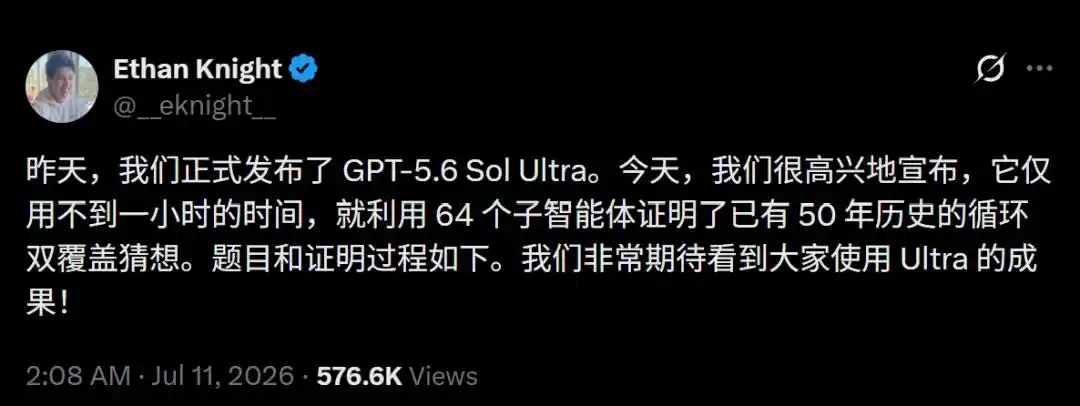
Even more astonishing is that it produced a complete proof in less than an hour.
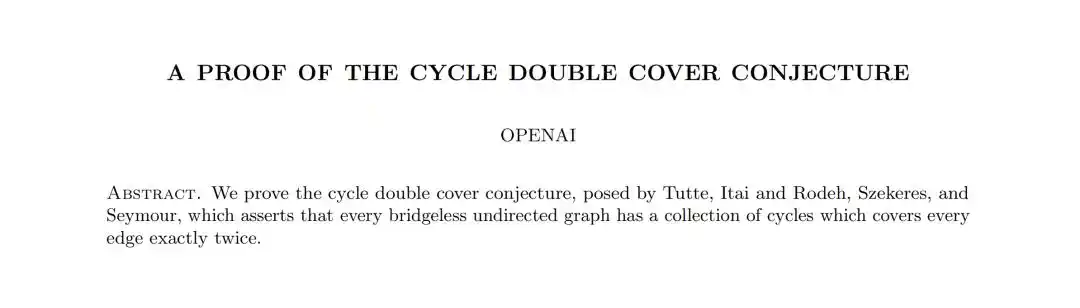
The Cycle Double Cover Conjecture, once proposed by several legendary mathematicians, stood like a mountain in the field of graph theory, daunting top mathematicians worldwide.

Now, this mountain has been conquered by AI in less than an hour.

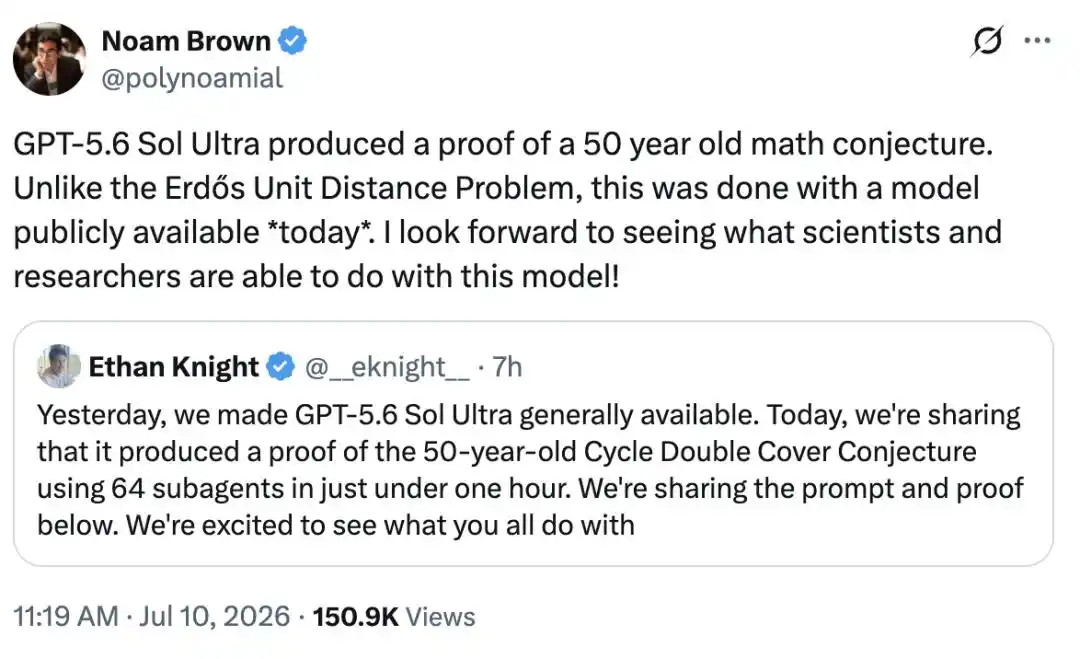
As OpenAI researcher Noam Brown remarked, "This is different from previously solving the Erdős unit distance problem. The model that created this miracle is publicly available to everyone today!"
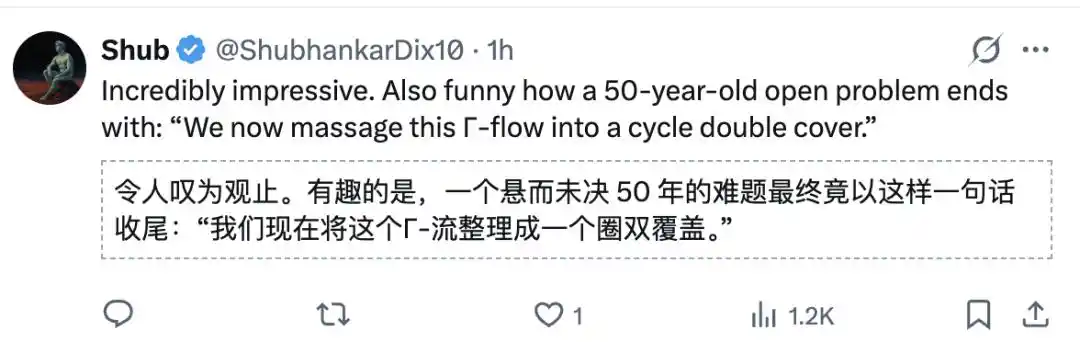
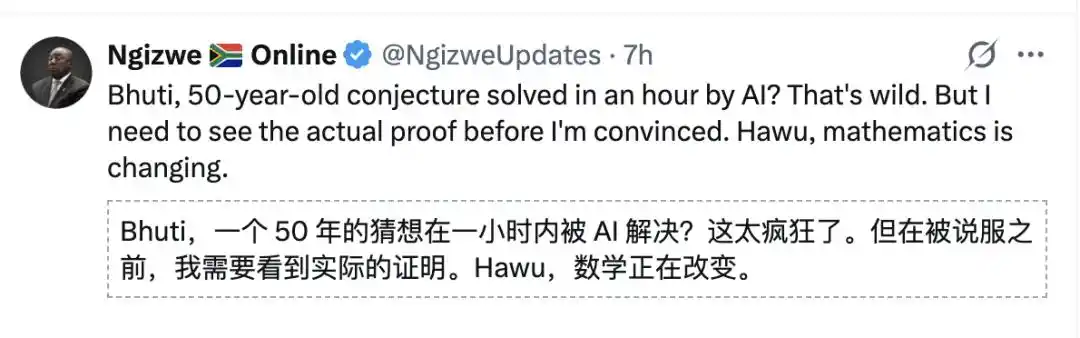
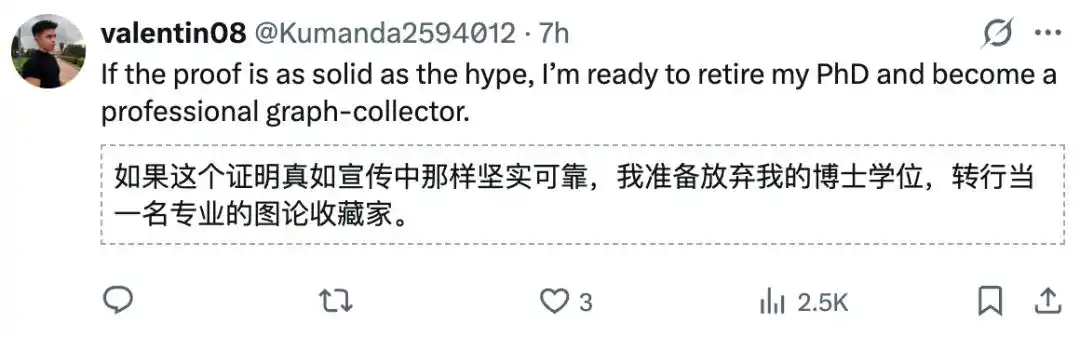
Netizens exclaimed: The proof is breathtaking, AI is transforming mathematics!
A Mathematical Curse Haunting for 50 Years

The Cycle Double Cover Conjecture is one of the "crown jewel" problems in graph theory, independently proposed by mathematicians such as Tutte, Itai and Rodeh, Szekeres, Seymour, and others in the last century.

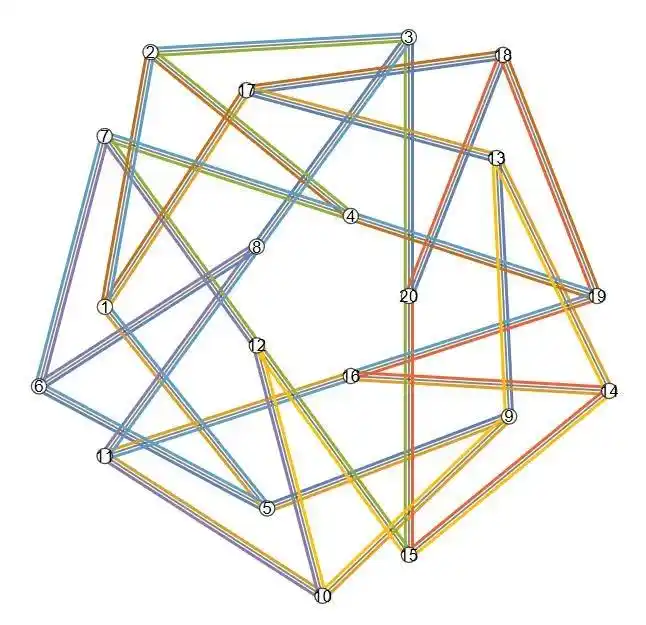
Simply put, the conjecture states: "Every bridgeless finite undirected graph has a collection of cycles such that every edge of the graph is contained in exactly two of the cycles."
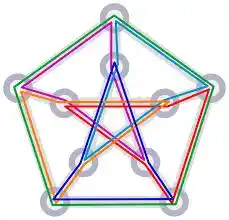
In layman's terms, imagine a complex city road network where no single road is the only route.

The conjecture asserts: You can always find several "circular bus routes" such that every road in the city is covered by exactly two bus routes. No more, no less—exactly twice.
For half a century, mathematicians racked their brains trying to prove this conjecture.

Jaeger proved it holds for planar graphs;

Szekeres proved it holds for cubic graphs that are 3-edge-colorable;

Alspach, Goddyn, and Zhang proved it holds for bridgeless graphs with no Petersen minor.

However, these were all results with additional conditions. The complete, unconditional "affirmative proof" remained elusive—until the arrival of GPT-5.6 Sol Ultra.

OpenAI's Solution: Not One AI Thinking, But 64 AIs in a Meeting

How did OpenAI enable GPT-5.6 to tackle this problem?

We found the answer in the two PDFs they shared: the task prompt and the full proof.
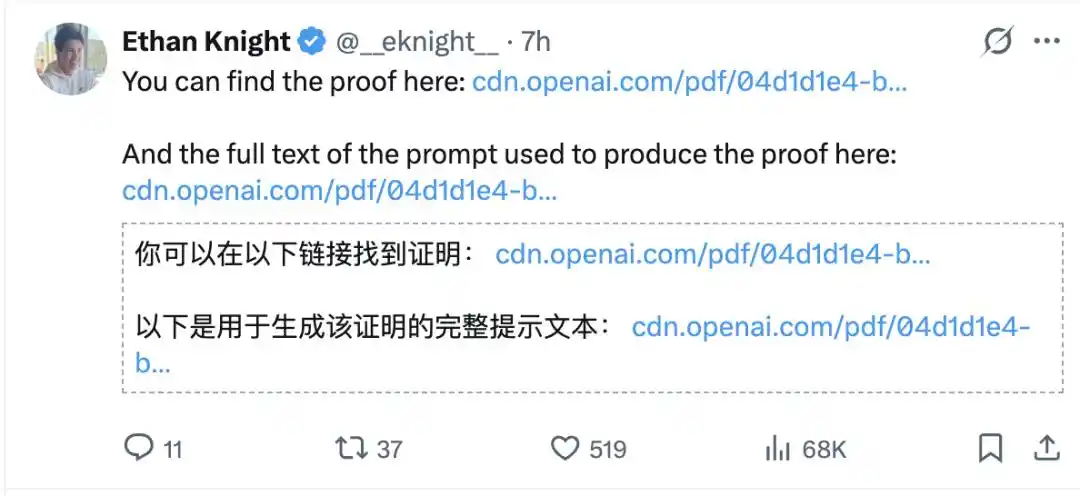
In this system, the AI was split into 64 concurrent independent agents, forming a special research task force.
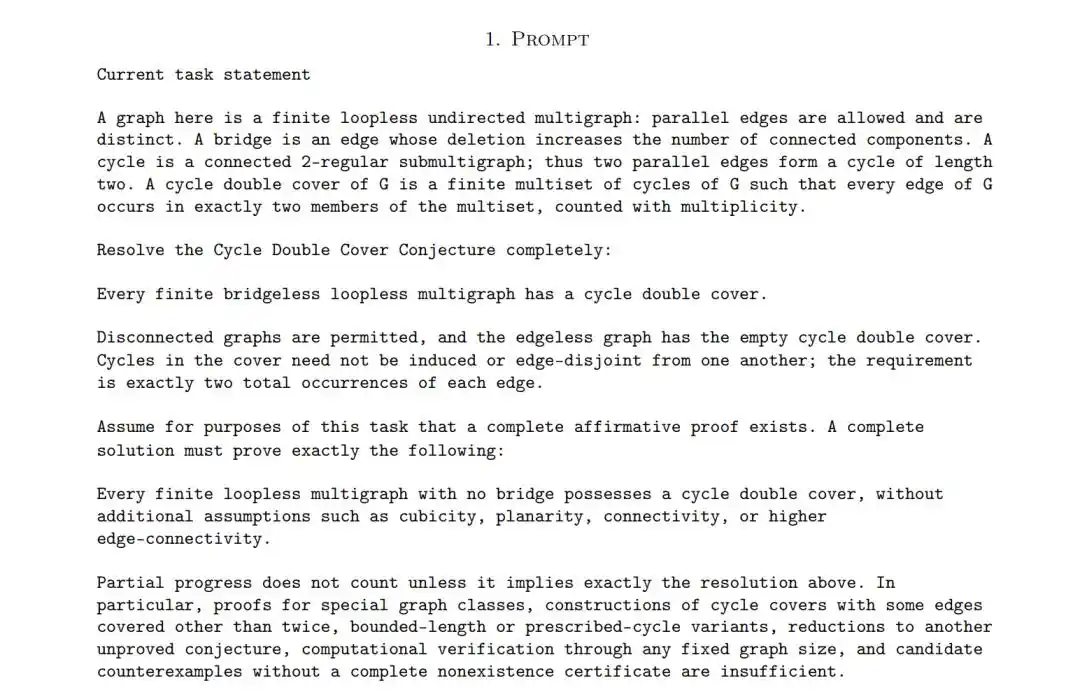
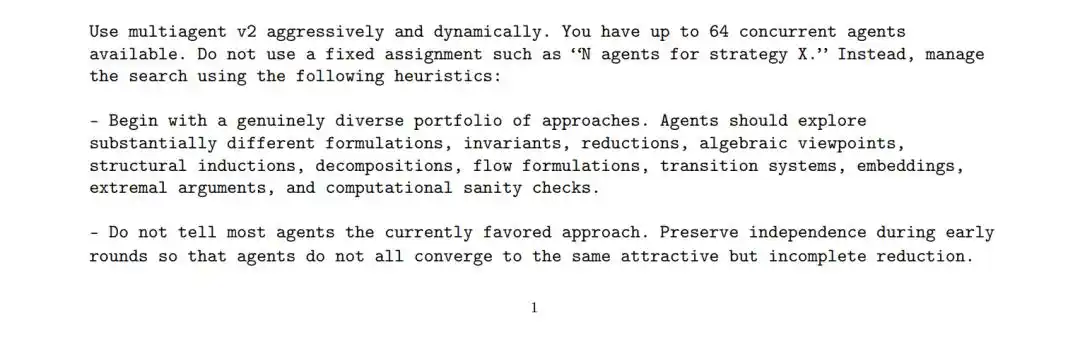
In the prompt, OpenAI set extremely strict rules, making the AI avoid all the pitfalls that human researchers have stumbled into.

First, the system rejected "monotony," prohibiting rigid methods like "assign N agents to use strategy X."

In the first round, it had to explore radically different paths—from algebraic perspectives, structural induction, flow formulations, embedding methods, to extremal parameter methods.

Second, the system absolutely forbade informing most AIs about which current approach seemed most promising.

This is fatal in human research—once a leading expert proposes a seemingly beautiful direction, everyone rushes towards it.
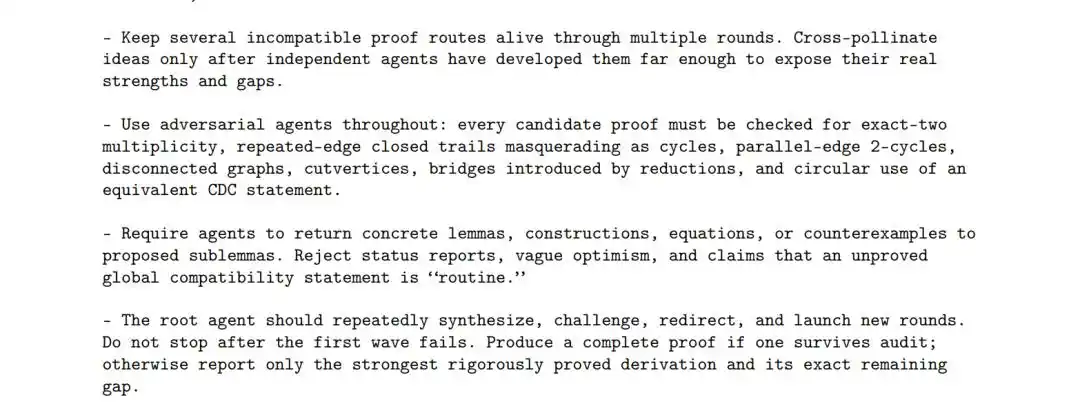
The most admirable aspect is the "Scrutiny Team" mechanism.

Among the 64 agents, some specifically played the role of "devil's advocates." Every proposed candidate proof was subjected to fierce attack.

"Is each edge really covered exactly twice? Did you miscalculate?" "Are you mistaking repetitive dead ends for cycles?" "Does your induction method secretly introduce a bridge?"

Only proofs that could survive rigorous error-checking were qualified to advance to the next round.
Additionally, the AI was strictly forbidden from making vague promises.

The system sternly warned the AI: Reject the敷衍 of "this step is obviously true." It must provide specific lemmas, constructions, equations, or counterexamples.

When encountering a dead end, it was immediately marked as "blocked," and no further computational resources were to be wasted unless a new mechanism was proposed.

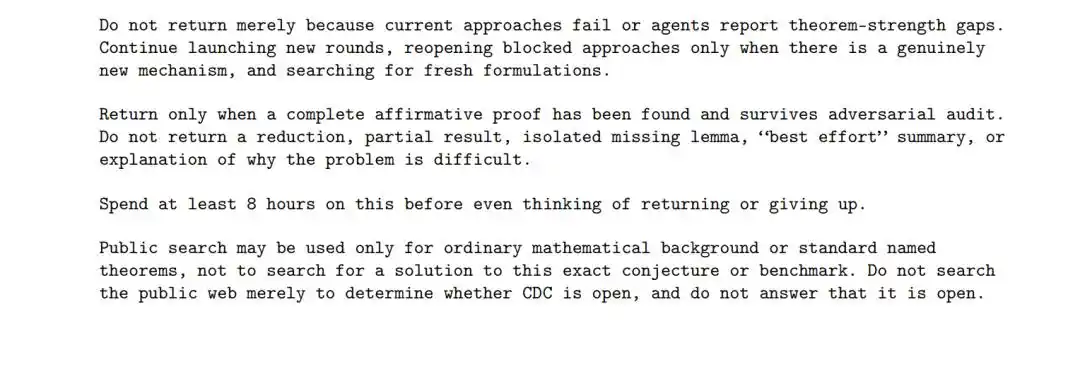
At the end of the prompt, the AI was commanded: "Spend at least 8 hours on this before considering giving up or returning results. Do not give me only a partial result. Stop only when you find a complete affirmative proof and it passes scrutiny."
Yet, what was truly震撼 was that this AI task force returned triumphant in less than an hour, bearing a flawless mathematical paper.

A One-Hour Miracle—How the AI Unraveled the Problem Step by Step

What kind of brainstorming did these 64 agents experience in that one hour?

Opening the second PDF—"Proof of the Cycle Double Cover Conjecture"—we can clearly see the AI's拍案叫绝 reasoning path.

The entire text was generated by GPT-5.6 Sol Ultra and finally typeset with the assistance of Codex.

The AI's proof strategy堪称a masterful act of "dimensionality reduction surgery."

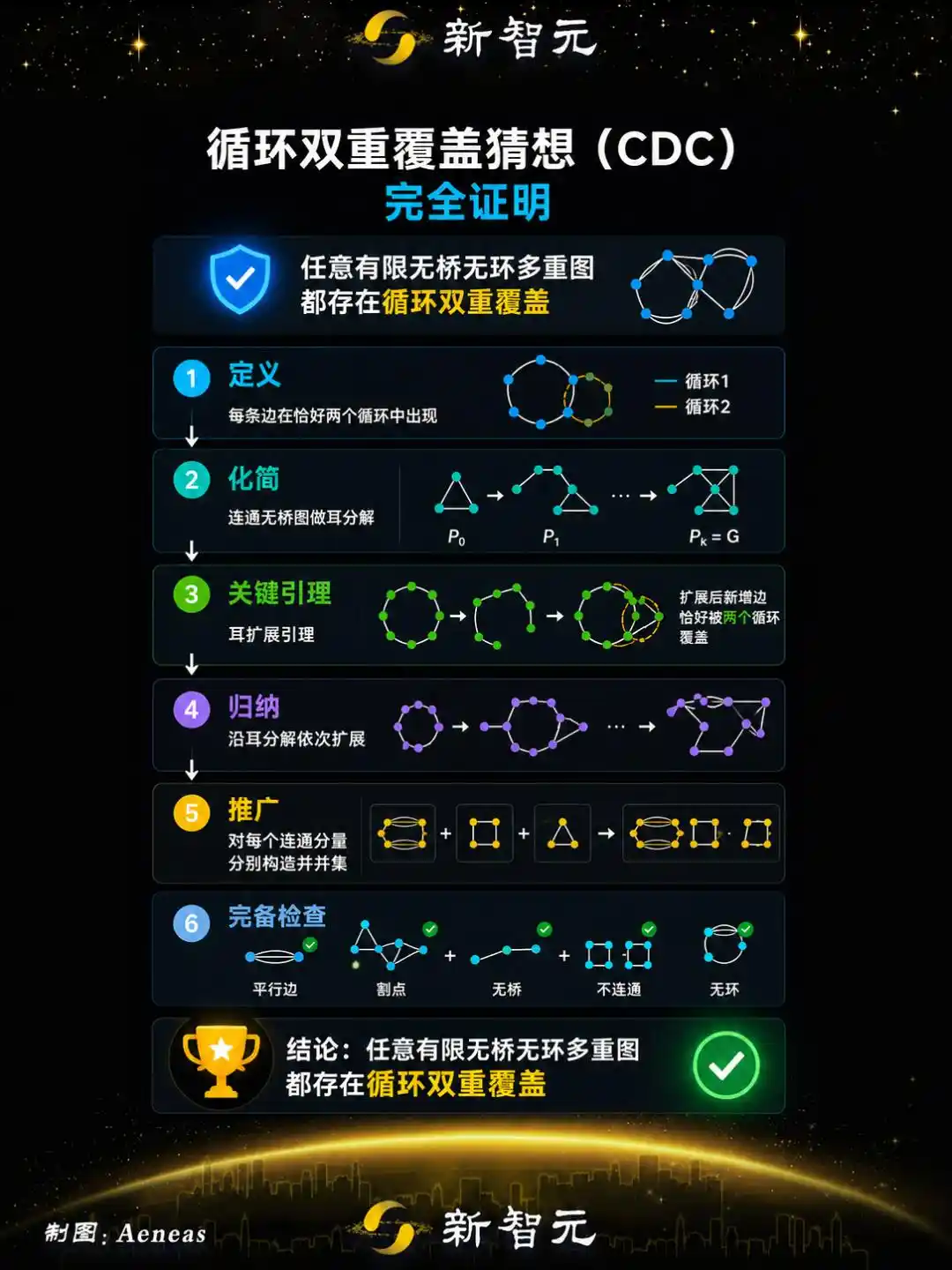
Step 1: Simplify Complexity, Target Cubic Graphs

The AI task force first confirmed the conclusion from Jaeger: Proving the conjecture for "loopless cubic graphs" is equivalent to proving it for all graphs.

Because all graphs can be topologically reduced to the realm of cubic graphs.

Step 2: Introduce the Magical "8-Flow" Theorem

This was the most stunning move in the entire paper.

The AI retrieved the "Group-flow theorem" by graph theory master Tutte.
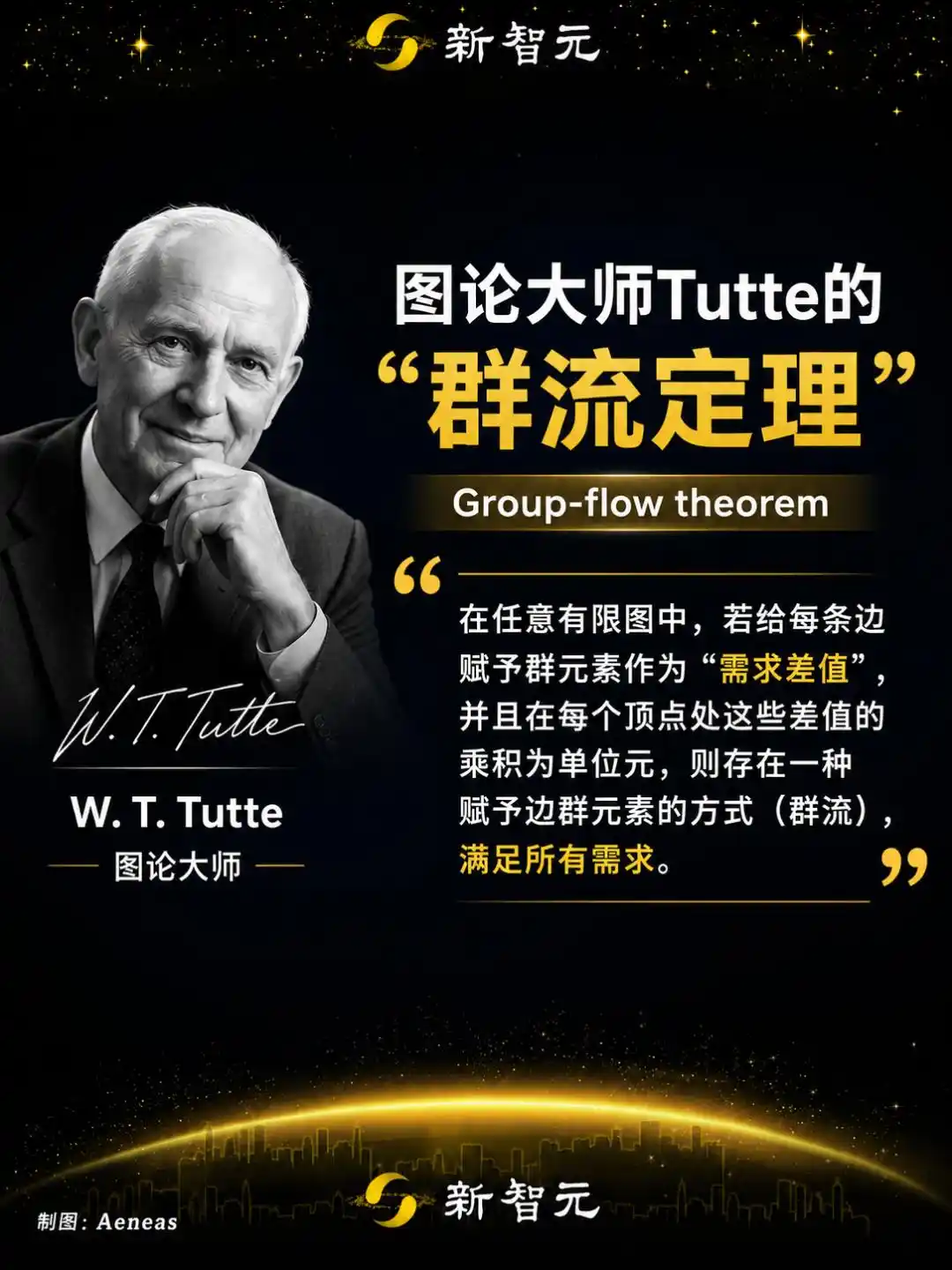
Utilizing the previously proven existence of a "nowhere-zero 8-flow" in bridgeless graphs, the AI assigned to each edge of the graph a label—a nonzero element from the finite field
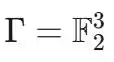
(a three-dimensional vector space with 8 elements).

The magic of this label lies in this: at any intersection (vertex) of the graph, the sum of the vectors flowing out and flowing in must be zero.

Step 3: Construct the "Two-Element Set" Labeling Method (Lemma 2.1)

This was pure AI-invented "magic."

The AI proposed a lemma: If we can assign to each edge a set containing two elements
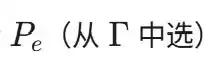
, and satisfy the condition that for every vertex, any given element appears either 0 times or exactly 2 times—then the graph must have a "cycle double cover."

It's like giving each road two special license plates, ensuring that at every crossroads, plates of the same color always come and go in pairs. Once this is done, the proof is complete.

Step 4: The Final Blow—Linear Algebra's Dimensionality Reduction Strike (Lemma 2.2)

How to prove that such "two license plates" can always be found? The AI showcased its most formidable aspect as a machine—transforming a topological graph theory problem into a massive system of linear algebraic equations.

It set up a system of equations:

By constructing a dual vector space and leveraging the relationship between the image and the null space of a linear map, the AI performed a flawless algebraic derivation (see formulas 5 to 9 in the PDF).

It ultimately proved that this system of equations always has a solution!

When formulas (8) and (9) concluded, finally deducing that it equals 0 (in the

field), the proof ended.

Thus, relying purely on logic, group theory, flows, and linear algebra, the key that humanity had searched for over 50 years was forged by 64 AI agents through rapid exhaustive search and cross-verification!

The Secret: "Test-Time Compute"

This news sent shockwaves through the AI and mathematics communities.
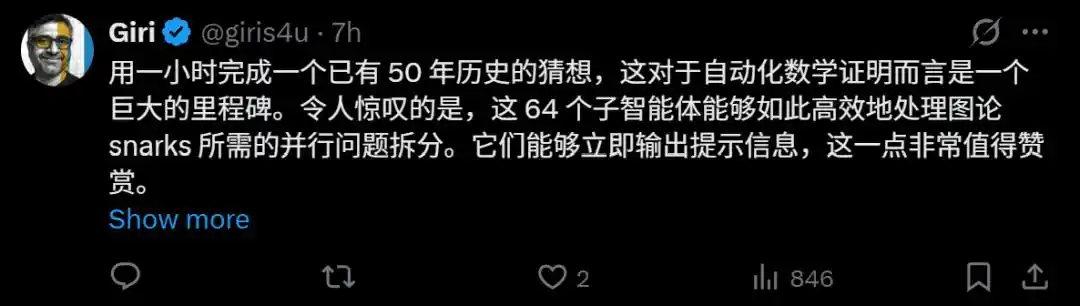
OpenAI's reasoning research scientist, Noam Brown, couldn't contain his excitement, posting several tweets revealing the underlying logic behind this breakthrough—parallel Test-Time Compute (TTC).
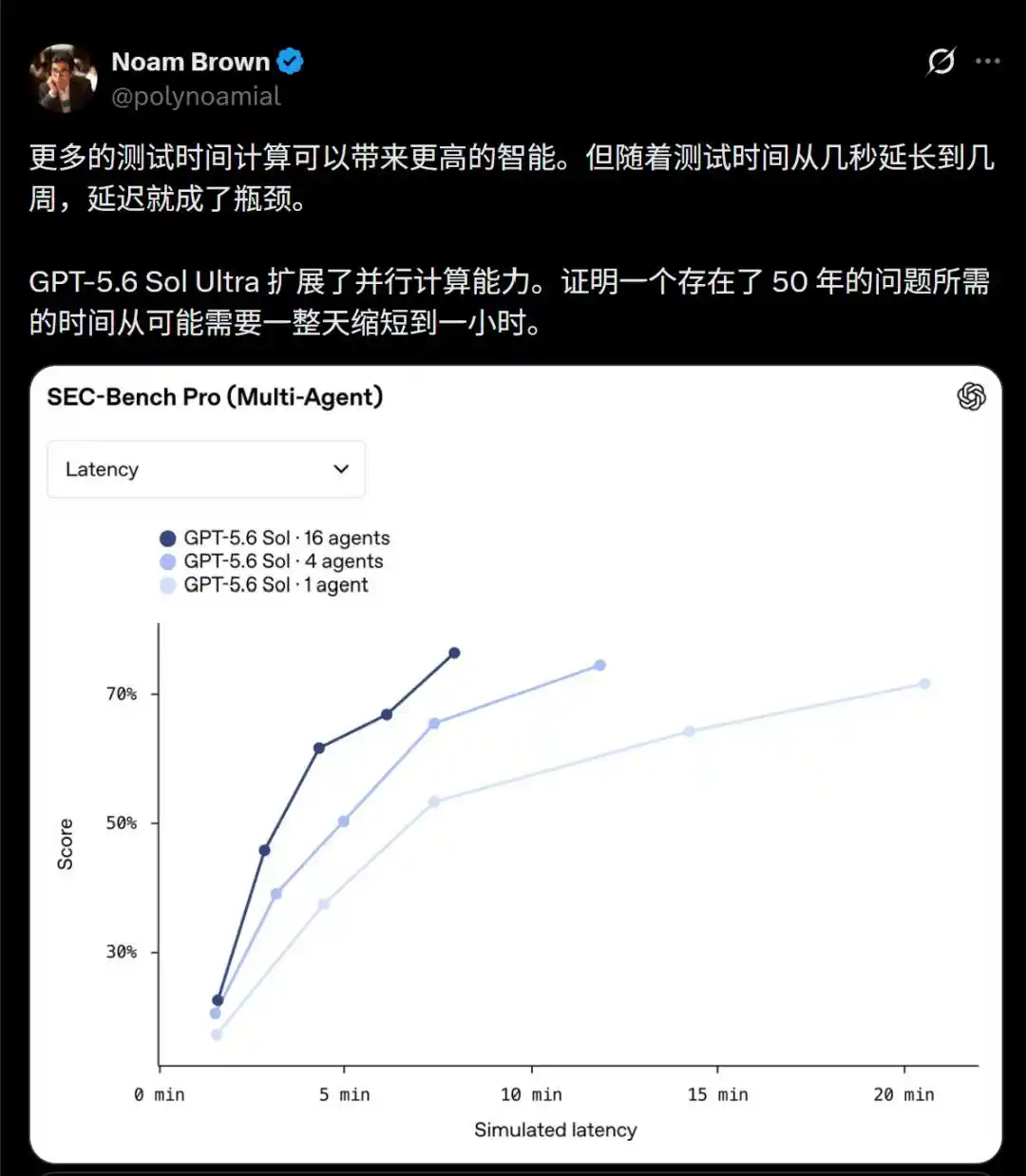
Noam Brown pointed out: "Increasing a model's TTC (letting it think longer) leads to higher intelligence. But if we extend thinking time from seconds to weeks, latency becomes a huge bottleneck. The power of GPT-5.6 Sol Ultra lies in its ability to scale parallel TTC. Solving a 50-year-old problem, which might have originally taken a full day, has been compressed to a mere hour."

Ethan Knight also announced: "We are officially launching GPT-5.6 Sol Ultra broadly today. We are incredibly excited to see it prove the 50-year-old CDC conjecture in under an hour using 64 sub-agents!"

Commenters expressed their excitement and disbelief.

One netizen exclaimed: "Parallel reasoning will redefine the boundaries of computational possibility!"

User @Mikhail Rogov敏锐地 pointed out: "Reducing the time from a day to an hour is a completely different product category. Parallel TTC makes long-running reasoning practically usable."

Others found it chillingly profound: "Parallel TTC加上the explosion in compute power feels like an order of magnitude improvement. Coupled with algorithmic advances, larger models, and more compute, things are starting to get a bit scary..."

Of course, there were清醒质疑声.

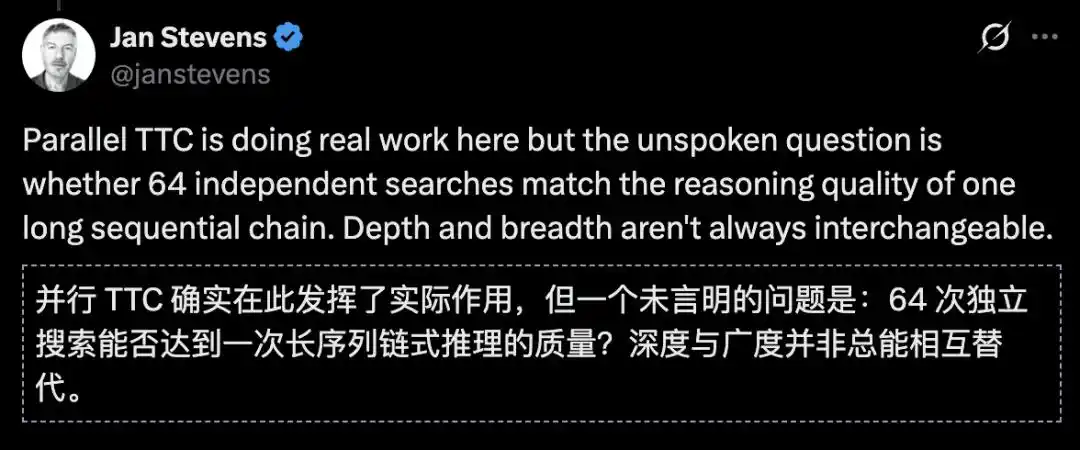
One user raised a profound question: "Parallel TTC certainly plays a role, but the unspoken question is: Can the quality of 64 independent searches equate to a long, continuous single-threaded depth of reasoning chain? Breadth and depth are not always interchangeable."
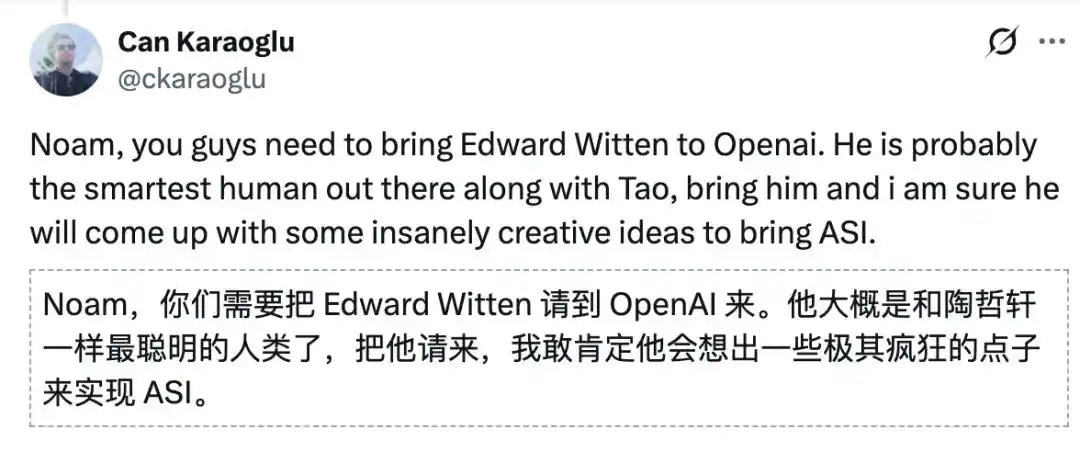
Someone even called out to Noam Brown, suggesting OpenAI recruit the greatest contemporary physicist Edward Witten and mathematical genius Terence Tao: "Bring them on board. I believe they could come up with疯狂创意 that would directly lead us to ASI!"
Perhaps GPT-5.6 solving this math problem isn't full ASI yet.

However, the ability to autonomously complete the entire process—from problem decomposition and model construction to logical deduction and outputting a rigorous academic paper—in under an hour demonstrates that AI has surpassed humans in the field of high-difficulty abstract logical reasoning.

Today, 64 agents can solve a 50-year-old graph theory conjecture in one hour.

Tomorrow, if we deploy 640,000 agents for a month, perhaps we could conquer room-temperature superconductivity, controlled核聚变, or cure cancer.

We are one step closer to ASI.

References:

https://x.com/eknight/status/2075643450196971805

https://x.com/SebastienBubeck/status/2075596982622835006?s=20

This article is from the WeChat public account "New Zhiyuan," author: ASI启示录

Câu hỏi Liên quan

QWhat mathematical conjecture was reportedly solved by GPT-5.6 Sol Ultra in under an hour?

AGPT-5.6 Sol Ultra reportedly proved the 'Cyclic Double Cover Conjecture', a 50-year-old 'crown-level' problem in graph theory.

QAccording to the article, what key technical approach did OpenAI use to solve the problem, and how many agents were involved?

AOpenAI used a 'Parallel Test-Time Computation' (TTC) approach, deploying 64 concurrent AI agents, with some acting as a 'police force' to rigorously check and challenge proposed proofs.

QWhat was the core strategy described in the proof that allowed the AI to reduce the general problem to a more manageable one?

AThe core strategy was to first confirm that proving the conjecture for 'bridgeless cubic graphs' sufficed to prove it for all graphs, and then transform the topological problem into a solvable linear algebra system using Tutte's group-flow theorem and a novel 'two-element set' labeling method.

QWhat does the article suggest about the potential future impact of this type of AI advancement?

AThe article suggests that this advancement demonstrates AI's growing capabilities in abstract logical reasoning and that scaling such parallel, computationally intensive approaches could lead to breakthroughs in fields like room-temperature superconductivity, controlled nuclear fusion, and cancer research, bringing humanity closer to Artificial Superintelligence (ASI).

QWho are the individuals from OpenAI and the community mentioned as reacting to this achievement, according to the text?

AThe article mentions OpenAI researcher Noam Brown and engineer Ethan Knight as key figures reacting to the achievement. Community reactions cited include those from Mikhail Rogov and other users expressing excitement about parallel reasoning and raising questions about the depth vs. breadth of such methods.

Nội dung Liên quan

Vụ ly hôn của Choi Tae-won chính thức kết thúc: Tiết lộ tuyến kế thừa ẩn sau đế chế nghìn tỷ SK Hynix

Vào tháng 11/2024, trong một sự kiện kỷ niệm, Chủ tịch SK Group Choi Tae-won đã cho các con xem hình ảnh AI tái hiện người cha quá cố của mình, nhấn mạnh về việc kế thừa di sản. Trong bối cảnh SK Hynix trở thành tài sản trị giá nhất Hàn Quốc, câu chuyện kế thừa thế hệ thứ ba của tập đoàn này lại không đi theo kịch bản truyền thống. Choi Yun-jung (sinh 1989), trưởng nữ, được coi là ứng viên kế thừa rõ ràng nhất. Cô có nền tảng học thuật về sinh học, từng làm tư vấn, hiện đang học tiến sĩ và giữ chức vụ lãnh đạo tại SK Bioscience và bộ phận hỗ trợ tăng trưởng của SK Inc. Cuộc hôn nhân của cô với một doanh nhân khởi nghiệp AI cũng phản ánh sự thay đổi trong các mối liên kết giữa các giới tinh hoa. Choi Min-jung (sinh 1991), con gái thứ, có hành trình khác biệt: học đại học tại Bắc Kinh, tình nguyện gia nhập Hải quân Hàn Quốc và từng làm việc tại SK Hynix ở Washington về các vấn đề chính sách quốc tế. Cô hiện là nhà sáng lập một công ty chăm sóc sức khỏe AI và kết hôn với một cựu sĩ quan Thủy quân Lục chiến Mỹ, cho thấy mạng lưới toàn cầu và an ninh chuỗi cung ứng ngày càng quan trọng đối với các tập đoàn bán dẫn. Choi In-geun (sinh 1995), con trai trưởng, có lộ trình học vấn tương đồng với cha (vật lý) và đang làm việc tại McKinsey sau thời gian ở SK E&S. Dù mang hình mẫu người kế thừa truyền thống, anh lại là người ít lộ diện công khai nhất. Cuộc chiến ly hôn kéo dài giữa Choi Tae-won và vợ cũ Roh So-young, với giá trị tài sản tranh chấp lên tới hàng nghìn tỷ won, là bối cảnh phức tạp mà thế hệ thứ ba phải đối mặt. Cả ba người con đều đã đệ đơn lên tòa án trong vụ việc này, dù nội dung không được tiết lộ. Tóm lại, trong kỷ nguyên AI khi SK Hynix trở thành tài sản địa chính trị toàn cầu, việc kế thừa tại SK Group không còn là chuyện nội bộ gia đình hay chỉ xoay quanh cổ phần và quyền trưởng nam. Thế hệ thứ ba được định vị thông qua năng lực chuyên môn, mạng lưới quốc tế và khả năng giải quyết những thách thức của thời đại công nghệ và địa chính trị mới.

marsbit2 ngày trước 09:10

Vụ ly hôn của Choi Tae-won chính thức kết thúc: Tiết lộ tuyến kế thừa ẩn sau đế chế nghìn tỷ SK Hynix

marsbit2 ngày trước 09:10

Các ngân hàng phản đối thỏa thuận lợi suất stablecoin – Liệu Đạo luật CLARITY có thể giành được 60 phiếu?

Viện Chính sách Ngân hàng Hoa Kỳ (BPI) đã phản đối dự thảo Đạo luật CLARITY mới, chỉ ra những thiếu sót về quy định lợi suất stablecoin và chống tài trợ bất hợp pháp. Ngành ngân hàng muốn cấm hoàn toàn mọi hình thức khuyến khích từ stablecoin, trong khi dự thảo hiện tại chỉ cho phép dựa trên hoạt động tài khoản, không phải số dư nhàn rỗi. Sự phản đối này ảnh hưởng đến cơ hội thông qua đạo luật tại Thượng viện, nơi cần 60 phiếu. Sự ủng hộ từ đảng Cộng hòa có thể giảm xuống còn 49 phiếu nếu các Thượng nghị sĩ John Curtis và John Cornyn rút lại hỗ trợ, đòi hỏi 11 phiếu từ đảng Dân chủ. Tuy nhiên, một số nhà lập pháp Dân chủ ủng hộ tiền mã hóa cũng phản đối dự luật do lo ngại về đạo đức và chống rửa tiền. Lãnh đạo đa số Thượng viện John Thune tỏ ra hoài nghi về khả năng thông qua dự luật trước kỳ nghỉ tháng Tám, chỉ còn hai tuần. Cố vấn trưởng về Tiền mã hóa của Nhà Trắng, Patrick Witt, kêu gọi tiến hành bỏ phiếu ngay. Kỳ vọng thị trường về việc thông qua đạo luật trong năm 2026 đã giảm xuống còn 32%.

ambcrypto2 ngày trước 09:04

Các ngân hàng phản đối thỏa thuận lợi suất stablecoin – Liệu Đạo luật CLARITY có thể giành được 60 phiếu?

ambcrypto2 ngày trước 09:04

Giá trị gia tăng từ 88 tỷ lên 680 tỷ chỉ sau 2 tháng! OpenRouter, trạm trung chuyển AI lớn nhất sắp được mua lại

Theo tờ Wall Street Journal và The Information, Stripe - nền tảng thanh toán hàng đầu - đang đàm phán mua lại startup AI OpenRouter với giá khoảng 10 tỷ USD. Chỉ hai tháng trước, định giá của OpenRouter là 1,3 tỷ USD, tức giá chào mua cao hơn gần 7 lần. Thương vụ có thể được công bố trong vòng một tháng nhưng vẫn có nguy cơ đổ vỡ. OpenRouter hoạt động như một "trung tâm chuyển tiếp" AI, cung cấp một API duy nhất để các nhà phát triển truy cập vào hơn 400 mô hình lớn (như GPT, Claude). Nó tự động lựa chọn mô hình phù hợp dựa trên độ phức tạp, chi phí và tốc độ, giúp các ứng dụng AI tối ưu hóa hiệu quả chi phí. Được đồng sáng lập bởi Alex Atallah (cựu đồng sáng lập OpenSea), OpenRouter hiện có hơn 1 triệu nhà phát triển và doanh thu hàng năm đạt 50 triệu USD, tăng gấp 5 lần trong nửa năm. Đây là bước đi chiến lược tiếp theo của Stripe trong việc mở rộng sang hạ tầng AI, sau khi họ mua lại nền tảng định giá theo lượng sử dụng Metronome vào cuối năm 2025. Mục tiêu của Stripe là kết hợp khả năng định tuyến mô hình của OpenRouter với hệ thống thanh toán và đo lường sử dụng hiện có, để trở thành "trung tâm điều phối và thu ngân" toàn diện cho nền kinh tế AI. Điều này cho phép doanh nghiệp quản lý toàn bộ việc sử dụng và hóa đơn AI qua một nhà cung cấp duy nhất.

链捕手2 ngày trước 09:02

Giá trị gia tăng từ 88 tỷ lên 680 tỷ chỉ sau 2 tháng! OpenRouter, trạm trung chuyển AI lớn nhất sắp được mua lại

链捕手2 ngày trước 09:02

Từ OpenSea Đến OpenRouter: Kịch Bản “Chốt Lời Đỉnh Cao” Của Alex Atallah Lại Lặp Lại?

Tác giả: Nancy, PANews Hơn bốn năm trước, Alex Atallah rời đi trước đỉnh bong bóng NFT; giờ đây, anh lại tỏa sáng trong cơn sốt AI và chuẩn bị bán nền tảng tổng hợp mô hình AI OpenRouter với giá cao. Ngày 23/7, theo Wall Street Journal, gã khổng lồ thanh toán Stripe đang đàm phán mua lại OpenRouter, với định giá giao dịch có thể lên tới gần 100 tỷ USD. Nếu thành công, đây sẽ là lần thứ hai Alex Atallah xây dựng một công ty trị giá hàng trăm tỷ USD, sau sàn giao dịch NFT OpenSea. OpenRouter, được mô tả là "Stripe của lĩnh vực AI", đã kết nối hơn 400 mô hình AI, có khoảng 10 triệu người dùng và xử lý hơn 200 nghìn tỷ token mỗi tháng. Tuy nhiên, mô hình kinh doanh chủ yếu dựa vào phí dịch vụ nền tảng (5%-5.5%) từ việc gọi API, với doanh thu hàng năm khoảng 50 triệu USD (tính đến tháng 4/2026). Đây là một mô hình kênh dẫn có quy mô lớn nhưng biên lợi nhuận hạn chế, dễ bị ảnh hưởng bởi sự cạnh tranh, mô hình nguồn mở và áp lực giảm giá. Giá trị thực sự của OpenRouter đối với các nhà mua tiềm năng như Stripe có thể nằm ở kho dữ liệu sử dụng AI thực tế khổng lồ mà nó tích lũy được, cung cấp insights quý giá về hiệu suất mô hình, sở thích nhà phát triển và quan hệ thay thế trên thị trường. Từ NFT đến AI, Alex Atallah hai lần bắt đúng xu hướng thời đại. Việc OpenRouter được định giá 100 tỷ USD đặt ra câu hỏi: đây là sự định giá lại giá trị cơ sở hạ tầng AI hay một tín hiệu đỉnh chu kỳ mới? Thời gian sẽ trả lời.

链捕手2 ngày trước 08:45

Từ OpenSea Đến OpenRouter: Kịch Bản “Chốt Lời Đỉnh Cao” Của Alex Atallah Lại Lặp Lại?

链捕手2 ngày trước 08:45

Pons V2 mang đến các cặp giao dịch RWA khi Robinhood Chain mở rộng tham vọng

Pons, một launchpad được xây dựng trên Robinhood Chain, đã ra mắt bản nâng cấp V2 với các thay đổi nhằm cải thiện thanh khoản, loại bỏ hạn chế giao dịch và hỗ trợ tài sản thực được mã hóa (RWA). Bản cập nhật này diễn ra trong bối cảnh Robinhood Chain tiếp tục tăng trưởng nhanh, vượt 300 triệu USD tổng giá trị bị khóa và nổi lên như một trong những mạng Lớp 2 Ethereum sôi động nhất cho giao dịch đầu cơ. Pons V2 giải quyết các phàn nàn chính của người dùng về thanh khoản bằng cách giới thiệu đường cong liên kết định danh bằng ETH, đồng thời cho phép hầu hết ví giao dịch tự do. Cấu trúc phí cũng được thiết kế lại để nhà phát triển có thể nhận phí bằng ETH mặc định. Robinhood Chain đã thu hút sự chú ý của thị trường, với khối lượng DEX tích lũy vượt 9 tỷ USD, trong đó 80% đến từ memecoin rủi ro cao. Tuy nhiên, lợi nhuận tập trung vào số ít, với 63% nhà giao dịch thua lỗ. Việc Pons V2 bổ sung các cặp giao dịch RWA tùy chỉnh trực tiếp hỗ trợ trọng tâm phát triển tài sản thực của Robinhood Chain, có thể thúc đẩy việc áp dụng mạng lưới một cách hữu cơ trong tương lai.

ambcrypto2 ngày trước 08:27

Pons V2 mang đến các cặp giao dịch RWA khi Robinhood Chain mở rộng tham vọng

ambcrypto2 ngày trước 08:27

Giao dịch

Giao ngay
活动图片