Vanguard Group Enters the Arena, Opening a New Crypto Portal for 50 Million Traditional Investors

Foresight NewsXuất bản vào 2026-07-09Cập nhật gần nhất vào 2026-07-09

Tóm tắt

Vanguard Group, the world's second-largest asset manager with $12 trillion in assets under management and over 50 million investors, has signaled a significant strategic shift by posting a job opening for a "Head of Digital Assets, Personal Wealth." The role entails developing a comprehensive digital asset strategy, establishing long-term plans, and overseeing the full integration of digital assets into Vanguard's wealth management platform, covering areas like custody, settlement, asset tokenization, and stablecoins. This move marks a notable reversal from the firm's previous stance. In 2024, Vanguard refused to list spot Bitcoin ETFs and removed Bitcoin futures products. By late 2025, it allowed some third-party crypto ETF trading but reiterated it would not create its own crypto funds. The new hire represents a third step: building an internal team to integrate digital assets into its core infrastructure, moving beyond merely listing products. The initiative focuses on foundational financial infrastructure—how tokenized assets and digital settlement systems can connect to Vanguard's existing platform, which primarily serves long-term, conservative investors. While Vanguard maintains it will not launch proprietary crypto ETFs, it is proactively preparing its systems for a future involving tokenized assets and stablecoins, which Citigroup projects could reach a $5.5 trillion market by 2030. Vanguard's scale means its chosen standards for custody, settlement, and complianc...


Author: Gino Matos

Compiled by: Luffy, Foresight News


On July 6, Vanguard Group released a job posting for the role of Head of Digital Assets, Personal Wealth, with locations spanning four cities: Dallas, Scottsdale, Charlotte, and Malvern. The job announcement required the new head to lead the formulation of a comprehensive digital asset strategy, establish mid-to-long-term development plans, and oversee the full-process implementation within the company's wealth business division.


Two years ago, this asset management giant held a starkly different view towards crypto assets. In January 2024, after the U.S. SEC approved Bitcoin futures ETFs, Vanguard Group not only refused to list Bitcoin spot ETFs but also removed all Bitcoin futures products from its platform.


This shift is happening at the world's second-largest asset management company. As of December 2025, Vanguard Group managed approximately $12 trillion in assets, serving over 50 million investors. For an institution of such immense scale, a job posting that mentions custody, settlement, asset tokenization, and stablecoins carries far greater industry weight than similar announcements from native crypto brokerages.


Interestingly, while overall market expectations for crypto assets are trending towards caution, Vanguard Group is moving in the opposite direction by formally establishing an internal, dedicated digital assets team. This month, Citi lowered its price expectations for crypto assets, reducing its 12-month Bitcoin target price from $112,000 to $82,000 and its Ethereum target from $3,175 to $2,240, while also revising its full-year net inflow expectation for U.S. Bitcoin spot ETFs from $10 billion down to $0.
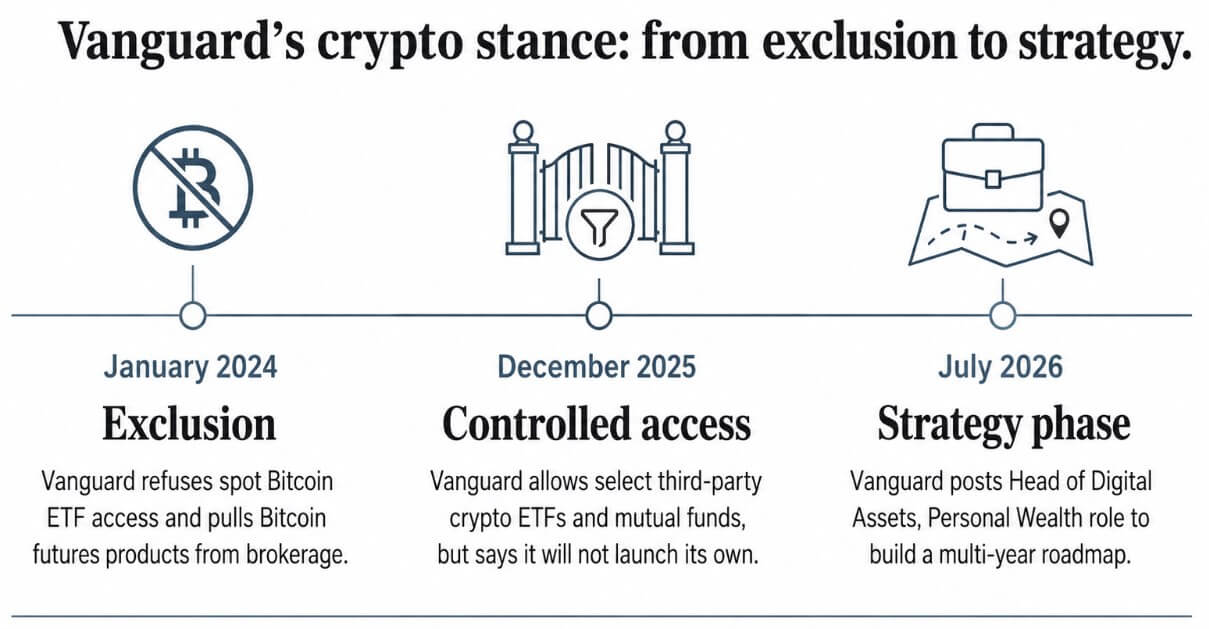

Vanguard's Changing Stance on Cryptocurrency


Core Job Responsibilities


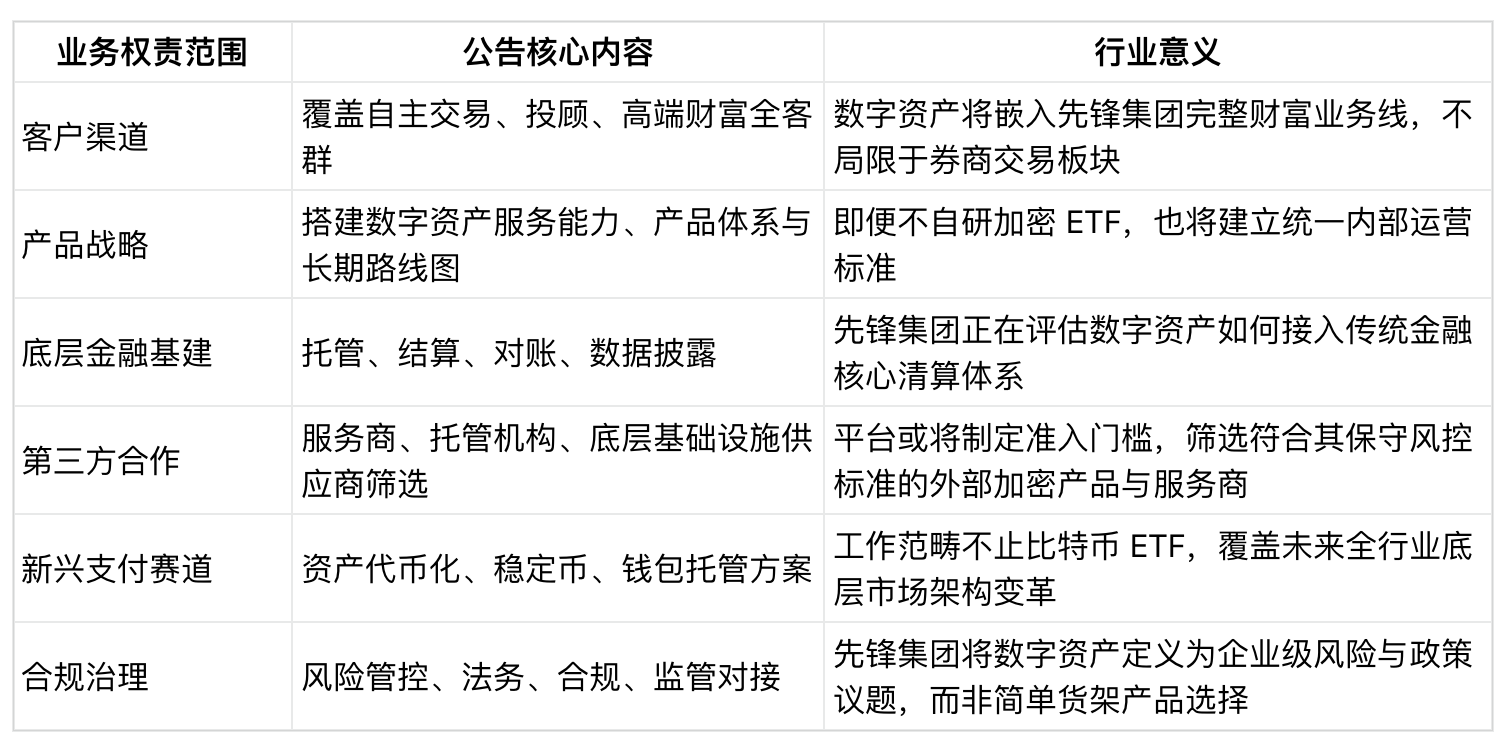
The Vanguard announcement requires the executive to comprehensively assess digital asset service capabilities for self-directed trading clients, advisory service clients, and high-net-worth clients; to design the entire operational system for asset access, custody, settlement, reconciliation, information disclosure, and third-party service provider integration.


The role must continuously monitor five core sectors: asset tokenization, stablecoins, wallet and custody architecture, and blockchain infrastructure, while simultaneously liaising with corresponding regulatory bodies, custody service providers, and technology vendors.


The scope of this role's responsibilities extends beyond the single question of "whether to list Bitcoin ETFs." Vanguard explicitly stated that its stance on self-developing crypto products remains unchanged, with the company having no plans to issue its own cryptocurrency ETFs or mutual funds. It also cautioned that crypto ETFs and crypto funds carry high trading risks and are not suitable for all investors.


The two positions are not contradictory: on one hand, it does not self-issue crypto products; on the other hand, it is establishing an executive role to coordinate how digital assets integrate into the existing financial systems for custody, settlement, and compliance, which currently only serve stocks and bonds.


Vanguard's core business model is providing low-cost, long-term investment products for retirement savers. Before a global regulatory framework is established, building standards for tokenized asset custody and settlement first is a high-stakes move. Once the blueprint is finalized, it would be extremely costly for this $12 trillion AUM giant to make adjustments.


Reviewing the stance changes: In 2024, Vanguard completely blocked Bitcoin spot ETFs; in December 2025, the platform opened access to some third-party crypto ETFs and funds but reiterated it would not self-develop similar products; the July 2026 hiring is the third step, establishing a dedicated internal department to consider how digital assets fit the platform's infrastructure, rather than just considering whether to list financial products.


Building Industry Infrastructure


BlackRock chose ETFs as its entry point. Its iShares Bitcoin Trust (IBIT) reached $46.5 billion in net assets as of July 6, with a product management fee of 0.25% and a 30-day median bid-ask spread of only 0.03%. IBIT's cumulative fund inflows surpassed $60.2 billion; according to Farside Investors data, while other funds like Grayscale's GBTC experienced continued outflows, the net cumulative inflow for all U.S.-listed Bitcoin spot ETFs was approximately $51.4 billion as of July 7.


BlackRock's market logic is very simple: package Bitcoin in the familiar ETF wrapper to enable standardized trading.


In June 2026, Citi's report "Tokenization of Assets 2030" provided a baseline forecast: the current $17 billion tokenized asset market will expand to $5.5 trillion by 2030, with a range of $2.7 trillion to $8.2 trillion. Among this, compliant stablecoins are projected to reach $1.9 trillion by 2030. The report defines tokenized cash as the core foundation for a delivery-versus-payment (DvP) settlement system, which is precisely the settlement sector highlighted in Vanguard's job posting.


The core of Vanguard's current move is to solve a key problem: how can this $12 trillion AUM giant connect its wealth platform to the already scaled ETF products from BlackRock and the trillion-dollar tokenized asset infrastructure predicted by Citi for 2030?


Roadmap Impact Scope


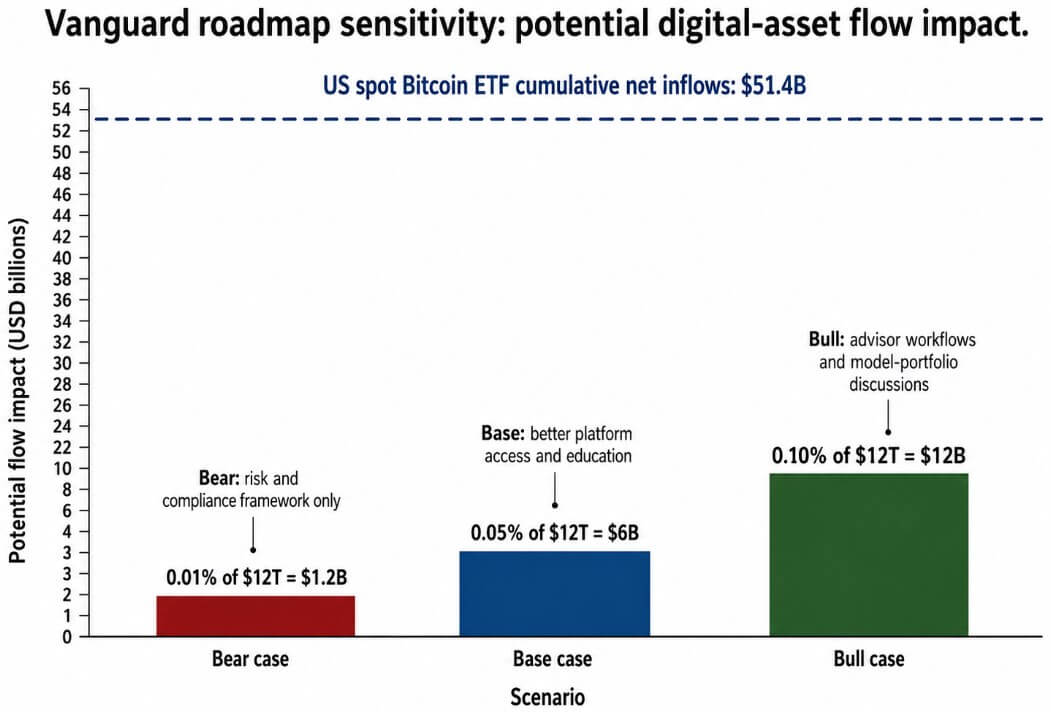
Vanguard's $12 trillion AUM dictates that its digital asset roadmap will have a massive market impact. Using this scale as a base and the $51.4 billion cumulative net inflow into U.S. Bitcoin spot ETFs as a reference, we can estimate the potential fund inflow range:


  • Pessimistic Scenario: The roadmap only establishes a risk and compliance framework, passively opens access to third-party products, and platform distribution channels remain cautious. Assuming only 0.01% of funds are allocated to digital assets, this corresponds to incremental capital of about $12 billion. Even this scale would force the platform to完善 (完善) complete supporting mechanisms like information disclosure, trading permission controls, and risk limits.
  • Baseline Scenario: Moderate capital inflow, corresponding to $6 billion in incremental funds.
  • Optimistic Scenario: Vanguard integrates digital asset trading into advisors' workflows and model portfolio discussions, still implemented through third-party products. Assuming such transactions account for 0.1% of its AUM, approximately $120 billion, this would equate to about 23% of the total cumulative net inflow into all U.S. Bitcoin spot ETFs.


Regulation Not Yet Finalized, Significant Industry Gaps Exist


In June 2026, the Bank for International Settlements (BIS) published a view that stablecoins have the potential to achieve high-speed programmable payments, but existing products exhibit significant flaws in monetary unity, full redemption guarantees, cross-chain interoperability, and resilience against financial crime.


The International Organization of Securities Commissions (IOSCO) also separately warned that asset tokenization suffers from ambiguity of ownership rights, making it difficult for investors to distinguish whether they hold the underlying real asset or merely a claim on the token. Additionally, the efficiency gains from tokenization are unevenly distributed, with vast disparities across different sectors.


Vanguard requires the new executive to continuously monitor the evolving global regulatory frameworks, the technological capabilities of third-party service providers, and the contradictions and shortcomings among various custody solutions. This giant, focused on stable long-term investment, is choosing to build its internal supporting systems in advance, during the current phase of uncertainty where global regulatory rules are not yet finalized.


Vanguard is deciding one thing: whether digital assets can be connected to the existing full-chain infrastructure of custody, settlement, and advisory services—a system currently serving the retirement accounts and index funds of 50 million investors. Once the custody and settlement standards Vanguard sets are adopted by other conservative wealth platforms, the institution that adamantly refused to list Bitcoin ETFs in 2024 could become the arbiter of tokenized asset operational rules for the Wall Street wealth management industry.


This job posting focuses on underlying financial infrastructure, and the influence of infrastructure standards will persist long-term, transcending individual crypto asset bull-bear cycles.

Tiền kỹ thuật số thịnh hành

Câu hỏi Liên quan

QWhat significant shift in strategy has Vanguard Group announced regarding digital assets, and what does this indicate about their long-term approach?

AVanguard Group has announced the hiring of a Head of Digital Assets for their personal wealth business, signaling a major strategic shift. This move, which involves creating a dedicated internal team and planning for digital asset integration into their core infrastructure (like custody and settlement systems), indicates a long-term, infrastructure-focused approach. They are building the foundational systems to support digital assets, moving beyond just the question of whether to list crypto ETFs.

QAccording to the article, what are the five core areas that Vanguard's new digital asset head is required to track?

AThe new Head of Digital Assets at Vanguard is required to continuously track five core areas: asset tokenization, stablecoins, wallet and custody architecture, blockchain underlying infrastructure, and the corresponding regulatory bodies and service providers.

QHow does Vanguard's new strategy for digital assets differ from BlackRock's approach as described in the article?

AVanguard's strategy focuses on building the underlying infrastructure (custody, settlement, compliance) to integrate digital assets into its existing wealth platform. In contrast, BlackRock's approach, as exemplified by its iShares Bitcoin Trust (IBIT), uses the familiar ETF wrapper as a breakthrough to provide standardized access to Bitcoin for investors. Vanguard is building the 'pipes,' while BlackRock created a popular 'product.'

QWhat potential market impact could Vanguard's digital asset roadmap have, based on the article's three scenarios?

ABased on the article's three scenarios, Vanguard's roadmap could attract significant new capital into digital assets: a pessimistic scenario with $1.2 billion (0.01% of AUM), a baseline scenario with $6 billion, and an optimistic scenario with $12 billion (0.1% of AUM). The optimistic inflow would equal roughly 23% of all net inflows into U.S. spot Bitcoin ETFs to date, demonstrating a substantial potential impact.

QWhy is Vanguard's move to establish digital asset standards considered strategically important, despite current regulatory uncertainty?

AVanguard's move is strategically important because, as a conservative giant managing $12 trillion for 50 million investors (often for retirement), the standards it sets for custody, settlement, and compliance for digital assets could become the de facto rules adopted by the broader traditional wealth management industry. By building its infrastructure now, it positions itself to shape the operational rules for tokenized assets on Wall Street, with an influence that will last beyond any single market cycle.

Nội dung Liên quan

Solana đứng trước sức ép: Động thái chuyển 10 triệu đô la SOL của Pump.fun châm ngòi tranh luận về Q3 NÀY

Đối với mạng Layer 1 như Solana, hoạt động giá không chỉ dựa trên kỹ thuật. Câu chuyện tăng trưởng của Solana gắn liền với hiệu suất của các ứng dụng trong hệ sinh thái, thúc đẩy nhu cầu mạng và doanh thu. Gần đây, nền tảng Pump.fun một lần nữa thu hút sự chú ý khi bán thêm 122.498 SOL, trị giá 10,08 triệu USD, nâng tổng lượng SOL đã bán lên 4,6 triệu SOL (794,8 triệu USD). Điều này làm dấy lên cuộc tranh luận về việc Pump.fun có đang "rút giá trị" khỏi hệ sinh thái Solana thay vì tái đầu tư. Một mặt, sự phát triển của Pump.fun cho thấy sức mạnh của mạng Solana, với khối lượng giao dịch spot hàng ngày đạt khoảng 725 triệu USD và hơn 517.000 ví tương tác. Tuy nhiên, áp lực bán từ các đợt bán SOL của Pump.fun, cùng với tâm lý thận trọng trên thị trường, đang thử thách các yếu tố cơ bản của Solana. Dù hoạt động mạng mạnh mẽ, SOL vẫn vật lộn để vượt qua mức kháng cự quan trọng quanh 100 USD, với ngưỡng 80 USD hiện là một trở ngại lớn. Câu hỏi then chốt cho quý III là liệu sự tăng trưởng của mạng và hoạt động on-chain có tạo đủ nhu cầu để đẩy SOL vượt qua các mức kháng cự then chốt hay không. Nếu không, sự suy yếu có thể mở rộng ra ngoài khía cạnh kỹ thuật, tạo nên một bối cảnh đầy thách thức hơn.

ambcrypto2 giờ trước

Solana đứng trước sức ép: Động thái chuyển 10 triệu đô la SOL của Pump.fun châm ngòi tranh luận về Q3 NÀY

ambcrypto2 giờ trước

Swift sẵn sàng cho các thử nghiệm thanh toán token hóa thực tế với sổ cái blockchain cùng 17 ngân hàng toàn cầu

Swift đã chuyển sổ cái dựa trên blockchain từ giai đoạn phát triển sang triển khai thực tế. 17 ngân hàng toàn cầu trên sáu châu lục đang chuẩn bị thí điểm thanh toán xuyên biên giới bằng cách sử dụng tiền gửi được mã hóa (tokenized deposits). Đây là trường hợp sử dụng trực tiếp đầu tiên của Swift cho sổ cái này, cho phép các ngân hàng tham gia cung cấp thanh toán xuyên biên giới 24/7 trong khi vẫn tiếp tục quyết toán giao dịch thông qua cơ sở hạ tầng tài chính hiện có. Sáng kiến này được thiết kế để cải thiện tính linh hoạt thanh toán và quản lý thanh khoản mà không thay đổi các khuôn khổ tuân thủ, quản lý rủi ro và kiểm soát vốn có của hệ thống ngân hàng toàn cầu. Nó đánh dấu xu hướng áp dụng ngày càng tăng của các tổ chức vào công nghệ tài sản kỹ thuật số được quản lý, thay vì các mạng lưới thanh toán blockchain công cộng. Không giống nhiều sáng kiến thanh toán blockchain tập trung vào stablecoin công cộng, nền tảng của Swift được xây dựng xung quanh tiền gửi được mã hóa do ngân hàng phát hành, vẫn nằm trên sổ cái riêng của các ngân hàng tham gia. Sổ cái chung kết nối các hệ thống này, cho phép các tổ chức phối hợp thanh toán xuyên biên giới theo thời gian thực trong khi vẫn dựa trên các đường quyết toán và khuôn khổ quy định hiện có.

ambcrypto3 giờ trước

Swift sẵn sàng cho các thử nghiệm thanh toán token hóa thực tế với sổ cái blockchain cùng 17 ngân hàng toàn cầu

ambcrypto3 giờ trước

Giao dịch

Giao ngay

Bài viết Nổi bật

Làm thế nào để Mua PORTAL

Chào mừng bạn đến với HTX.com! Chúng tôi đã làm cho mua PORTAL (PORTAL) trở nên đơn giản và thuận tiện. Làm theo hướng dẫn từng bước của chúng tôi để bắt đầu hành trình tiền kỹ thuật số của bạn.Bước 1: Tạo Tài khoản HTX của BạnSử dụng email hoặc số điện thoại của bạn để đăng ký tài khoản miễn phí trên HTX. Trải nghiệm hành trình đăng ký không rắc rối và mở khóa tất cả tính năng. Nhận Tài khoản của tôiBước 2: Truy cập Mua Crypto và Chọn Phương thức Thanh toán của BạnThẻ Tín dụng/Ghi nợ: Sử dụng Visa hoặc Mastercard của bạn để mua PORTAL (PORTAL) ngay lập tức.Số dư: Sử dụng tiền từ số dư tài khoản HTX của bạn để giao dịch liền mạch.Bên thứ ba: Chúng tôi đã thêm những phương thức thanh toán phổ biến như Google Pay và Apple Pay để nâng cao sự tiện lợi.P2P: Giao dịch trực tiếp với người dùng khác trên HTX.Thị trường mua bán phi tập trung (OTC): Chúng tôi cung cấp những dịch vụ được thiết kế riêng và tỷ giá hối đoái cạnh tranh cho nhà giao dịch.Bước 3: Lưu trữ PORTAL (PORTAL) của BạnSau khi mua PORTAL (PORTAL), lưu trữ trong tài khoản HTX của bạn. Ngoài ra, bạn có thể gửi đi nơi khác qua chuyển khoản blockchain hoặc sử dụng để giao dịch những tiền kỹ thuật số khác.Bước 4: Giao dịch PORTAL (PORTAL)Giao dịch PORTAL (PORTAL) dễ dàng trên thị trường giao ngay của HTX. Chỉ cần truy cập vào tài khoản của bạn, chọn cặp giao dịch, thực hiện giao dịch và theo dõi trong thời gian thực. Chúng tôi cung cấp trải nghiệm thân thiện với người dùng cho cả người mới bắt đầu và người giao dịch dày dạn kinh nghiệm.

Tổng lượt xem 228Xuất bản vào 2024.12.12Cập nhật vào 2026.06.02

Làm thế nào để Mua PORTAL

Thảo luận

Chào mừng đến với Cộng đồng HTX. Tại đây, bạn có thể được thông báo về những phát triển nền tảng mới nhất và có quyền truy cập vào thông tin chuyên sâu về thị trường. Ý kiến ​​của người dùng về giá của PORTAL (PORTAL) được trình bày dưới đây.

活动图片