World Cup Quarterfinals Are About to Kick Off, Who Did the AIs Vote to Advance?

Odaily星球日报Xuất bản vào 2026-07-09Cập nhật gần nhất vào 2026-07-09

Tóm tắt

The 2026 World Cup quarter-finals are set, with AI models unanimously predicting France, Spain, England, and Argentina to advance to the semi-finals, though they differ on match details. All six AI models (ChatGPT, Claude, Gemini, DeepSeek, Qwen, and Grok) forecast France will defeat Morocco in regulation time, with predicted scores of 2-0 or 2-1. Spain is also favored to beat Belgium, with most AIs predicting a 2-0 or 2-1 win in regular time, though Gemini suggests a possible 1-1 draw leading to a Spanish victory on penalties. The Norway vs. England match is considered the most unpredictable due to Erling Haaland's threat. While all AIs ultimately pick England to advance, predictions range from a 2-1 regulation win to a 2-2 draw requiring extra time. For Argentina vs. Switzerland, AIs predict an Argentine victory, with scores varying from 2-0 to 2-1 in regulation, though Claude and ChatGPT warn the disciplined Swiss could force extra time or a penalty shootout. The core consensus is a final four of France, Spain, England, and Argentina, with the primary disagreements centering on match scores and whether games will require extra time or penalties.

Original | Odaily Planet Daily (@OdailyChina)

Author | Asher (@Asher_ 0210)

With the World Cup quarterfinalists set, the real knockout stage has just begun.

France has maintained a strong team posture, with stable offensive firepower and key players stepping up at crucial moments; Morocco continues its dark horse run, eliminating Canada 3-0 in the round of 16, proving once again they are not a flash in the pan. Spain plays the most steadily, with defensive discipline and possession-based control in place, clinching a last-gasp victory over Portugal in the round of 16 to keep Cristiano Ronaldo out of the quarterfinals; Belgium has reasserted its offensive presence with a resounding 4-1 win over the United States.

On the other side, Norway has become the tournament's biggest surprise, with Erling Haaland leading the team to a 2-1 victory over Brazil, creating the most shocking upset of the knockout stage so far; England, despite a bumpy journey, narrowly defeated Mexico 3-2 thanks to squad depth. Argentina's advancement was the most dramatic, coming back from 0-2 down against Egypt to win 3-2; Switzerland dragged Colombia into a penalty shootout, advancing to the quarterfinals in the most typical "tough nut" fashion.
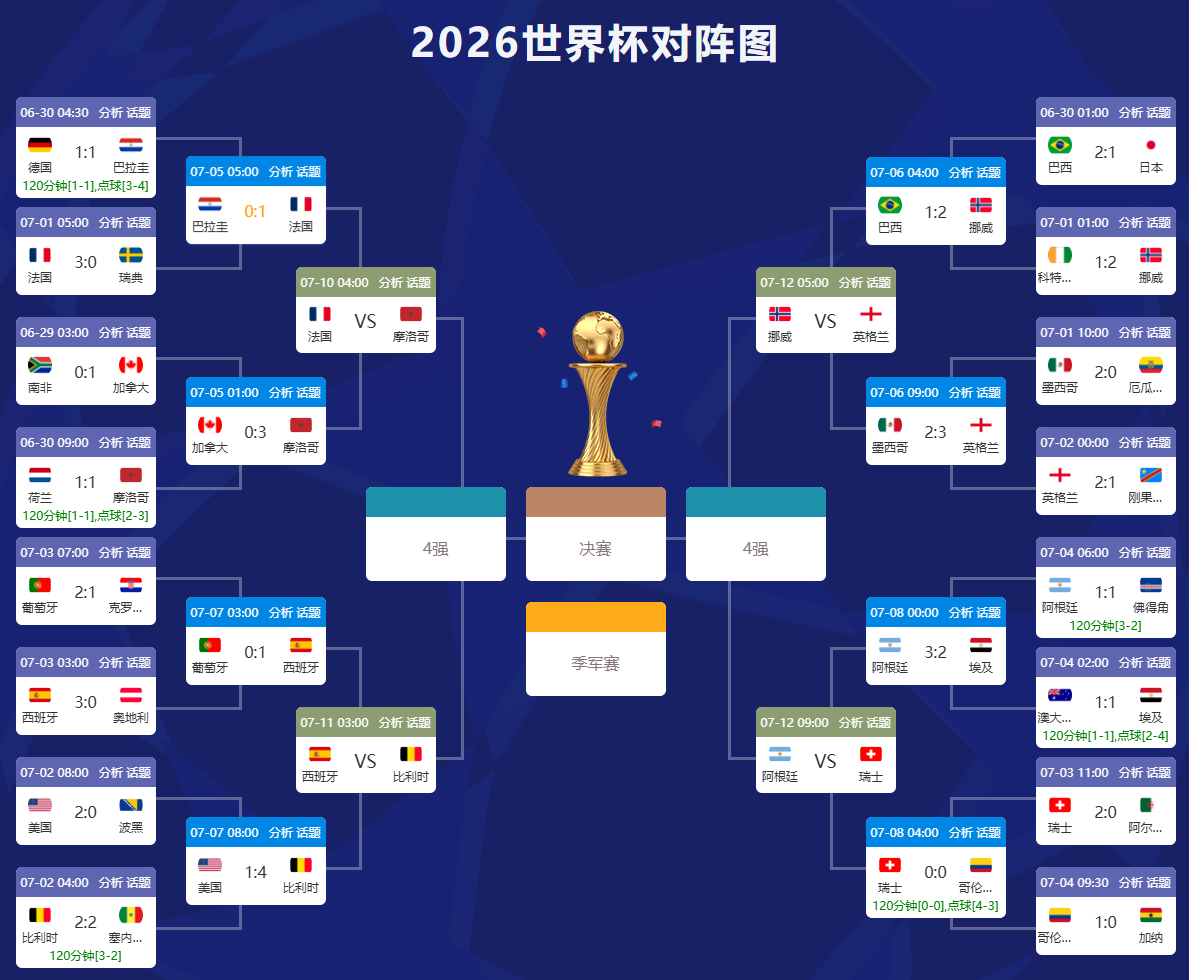
To provide reference for upcoming predictions related to the four quarterfinal matches, I asked ChatGPT, Claude, Gemini, DeepSeek, Qwen, and Grok separately, requesting them to predict the winner, scoreline, and whether each match would go into extra time or penalties for every game.

Looking at the results, the AIs are aligned on the direction of advancement for the four quarterfinal matches, giving the same final four answer: France, Spain, England, and Argentina. The real differences mainly appear in the details such as scores, extra time, and penalties.

AIs All Predict France to Advance, Morocco Unlikely to Repeat Dark Horse Miracle

The first quarterfinal of this World Cup is France vs. Morocco, scheduled for 4:00 AM Beijing Time on July 10th. According to predict.fun data, in regular time, France has a 63% probability of winning; draw probability is 25%; Morocco has a 14% probability of winning. Furthermore, including extra time and penalties, France's advancement probability is 79%, while Morocco's is 22%.
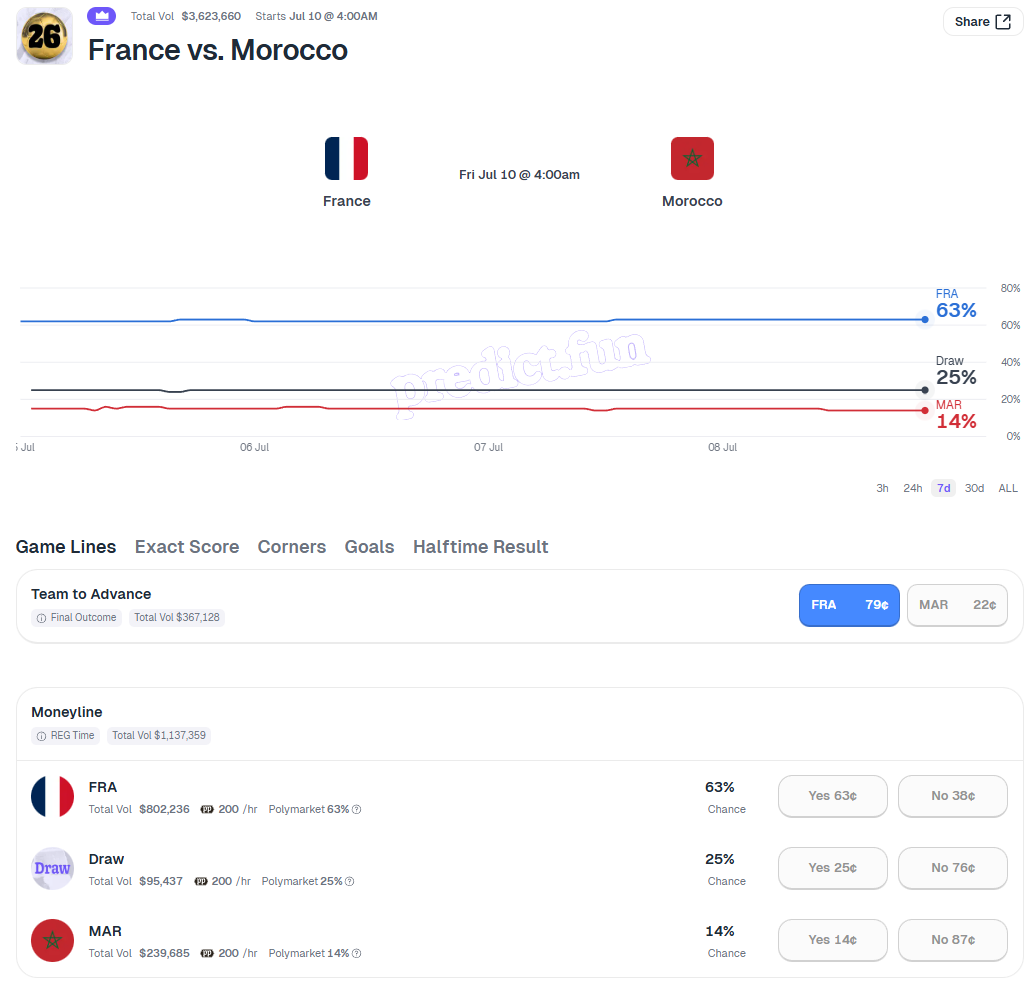
This is also the quarterfinal with the least disagreement among the six AI models. ChatGPT, Claude, Gemini, DeepSeek, Qwen, and Grok all favor France to advance. The only differences lie in whether France will win 2:0 or 2:1, and whether Morocco can score a goal.

Claude and Qwen both predict a 2:0 victory for France. They believe France is the team closest to the championship template this tournament, with forwards like Mbappé, Dembélé, and Olise continuously creating impact, and midfielders like Kanté, Tchouaméni, and Rabiot providing support. France is more complete than Morocco in both offense and defense. While Morocco has proven it's no ordinary dark horse, its squad depth and individual ability are still unlikely to match France head-on.

DeepSeek, Gemini, Grok, and ChatGPT lean more towards a 2:1 win for France. Their judgment is that Morocco won't be easily broken down and still has a chance to create threats through counter-attacks, set pieces, or wing play. However, the issue is that Morocco will find it difficult to consistently contain France's attacking stars for the full 90 minutes. Once the match enters the second half, France's individual quality and bench depth will become increasingly evident.

Overall, the AI models unanimously believe that France will advance within regular time, unlikely to need extra time or penalties.

AIs Place More Trust in Spain, Belgium's Counter-Attack as the Only Variable

The second quarterfinal of this World Cup is Spain vs. Belgium, scheduled for 3:00 AM Beijing Time on July 11th. According to predict.fun data, in regular time, Spain has a 61% probability of winning; draw probability is 25%; Belgium has a 17% probability of winning. Furthermore, including extra time and penalties, Spain's advancement probability is 79%, while Belgium's is 22%.
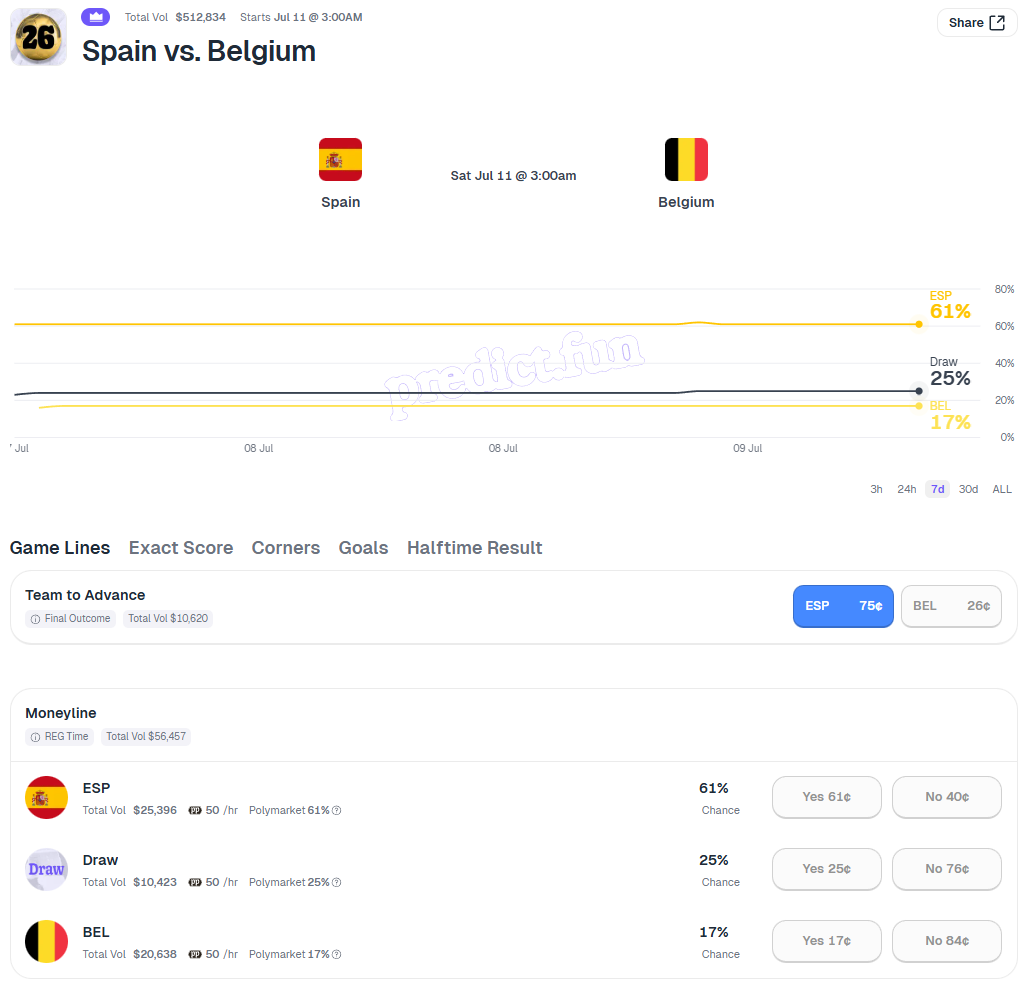
For this match, the six AI models also all favor Spain to advance, but disagreements over the match process are more pronounced than in the France vs. Morocco game.

Claude, Qwen, DeepSeek, and Grok all believe Spain is highly likely to secure victory within regular time, with predicted scores concentrated around 2:0 or 2:1. Their core reasoning is that Spain currently has stronger collective play, with possession, pressing, and defensive discipline all stable, and the match tempo is highly likely to be dictated by Spain.

ChatGPT's prediction is more conservative, favoring a 1:0 win for Spain. It suggests this won't be an open attacking battle but more of a contest between "system stability" and "offensive explosiveness." Spain might not score many goals but is more likely to win the match through possession-based attrition, wing play variations, or a set-piece opportunity.

The only model suggesting extra time and penalties is Gemini. It predicts a 1:1 draw in regular time, with no change in score during extra time, and Spain advancing via a penalty shootout. The key to this prediction is that if Belgium can seize a counter-attack opportunity to score first, Spain could be dragged into a more exhausting, grinding match.

The Match with Greatest AI Disagreement, Haaland Becomes England's Biggest Headache

The third quarterfinal of this World Cup is Norway vs. England, scheduled for 5:00 AM Beijing Time on July 12th. According to predict.fun data, in regular time, Norway has a 23% probability of winning; draw probability is 27%; England has a 53% probability of winning. Furthermore, including extra time and penalties, Norway's advancement probability is 36%, while England's is 66%.
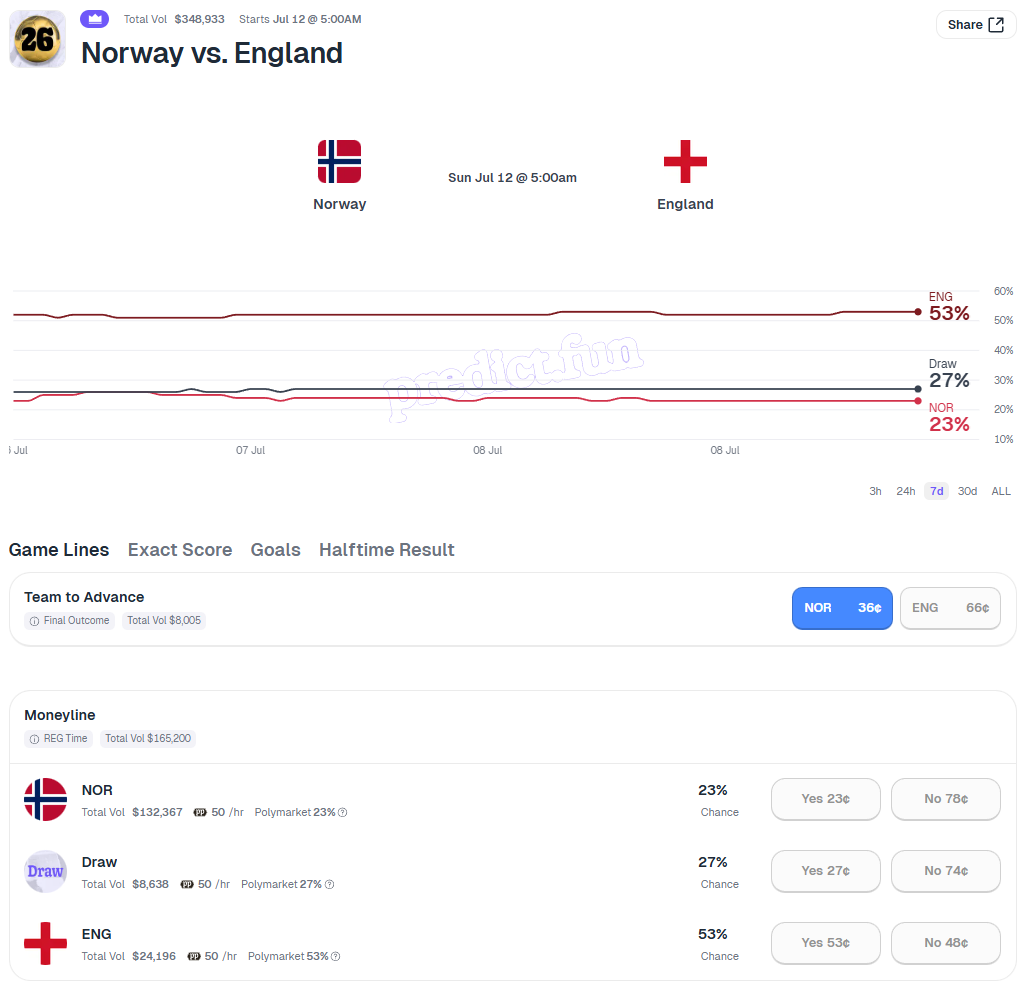
The presence of Haaland makes this knockout match the quarterfinal most likely to produce an upset. Although all six AIs ultimately voted for England to advance, the predictions are noticeably less certain than for the first two matches. Norway's 2:1 victory over Brazil in the previous round is no longer a question of "can they pull off an upset?"—they just did. More importantly, a player like Haaland doesn't need overall dominance; just one opportunity could plunge England into trouble.

Qwen, DeepSeek, and Grok all believe England is highly likely to win 2:1 within regular time. England has better squad depth, with players like Bellingham, Kane, Saka, and Foden all capable of deciding the match. In contrast, Norway's attack relies more heavily on the link-up between Haaland and Ødegaard. Once that connection is cut, Norway's offensive threat will significantly decrease.

However, Claude, Gemini, and ChatGPT are all clearly hedging against the possibility of extra time. Claude thinks England might narrowly win in regular time or be dragged into extra time by Norway; Gemini predicts a 2:2 draw in regular time, with England clinching victory in extra time thanks to bench depth; ChatGPT gives a prediction of 1:1 after 90 minutes, with England advancing 2:1 in extra time.

AIs Favor Argentina to Advance, Switzerland May Drag Match to Penalties

The fourth quarterfinal of this World Cup is Argentina vs. Switzerland, scheduled for 9:00 AM Beijing Time on July 12th. According to predict.fun data, in regular time, Argentina has a 58% probability of winning; draw probability is 28%; Switzerland has a 17% probability of winning. Furthermore, including extra time and penalties, Argentina's advancement probability is 74%, while Switzerland's is 27%.
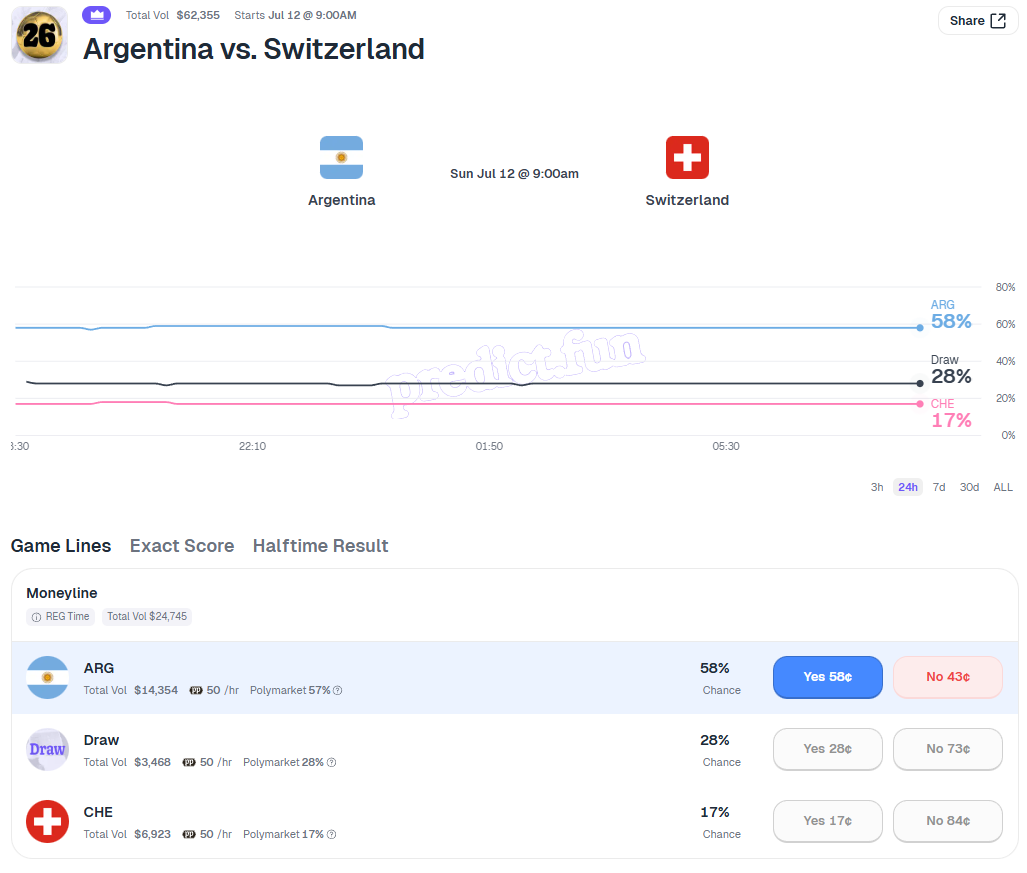
For this match, the AIs unanimously believe Argentina will advance. Unlike the more "dominant favorite" predictions for France and Spain, Argentina vs. Switzerland seems more like a match of patience.

Qwen and Gemini offer the most optimistic predictions, both favoring a 2:0 win for Argentina in regular time. Argentina's comeback from 0:2 down to win 3:2 against Egypt in the previous round has already revitalized the team's form and morale. Facing a team like Switzerland, which isn't particularly prolific in attack, Argentina, as long as they minimize defensive errors, has a chance to settle the match within 90 minutes.

DeepSeek and Grok are more cautious, leaning towards a 2:1 win for Argentina. Switzerland is organized defensively, disciplined, and won't be easily broken down by Argentina. However, the problem lies in Switzerland's lack of sustained offensive pressure. Once Argentina scores first, Switzerland will find it difficult to consistently pull the match back into their preferred rhythm for an extended period.

Those hedging for extra time and penalties are Claude and ChatGPT. Claude believes an opponent like Switzerland could easily force Argentina into a tough battle, possibly leading to a 1:1 draw and extra time, ultimately decided by penalties. ChatGPT directly predicts Argentina advancing via penalties, believing Switzerland has the ability to turn the match into a low-scoring war of attrition, dragging it to the end before relying on goalkeeping and penalty quality.

Related Content

World Cup Kicks Off, Some AI Prediction Models Become Prophets, Others Flop

Predicting World Cup Knockout Matches, Why Such a Big Difference in AI Performance?

Câu hỏi Liên quan

QAccording to the article, which four teams did all the AI models unanimously predict to reach the semi-finals of the World Cup?

AAccording to the article, all the AI models (ChatGPT, Claude, Gemini, DeepSeek, Qwen, and Grok) unanimously predicted France, Spain, England, and Argentina to reach the semi-finals.

QWhich quarter-final match did the AI models have the least disagreement about regarding the outcome?

AThe AI models had the least disagreement about the France vs Morocco quarter-final match. All models predicted France would advance without needing extra time or penalties.

QWhy did the article state that the Norway vs England match was the quarter-final with the greatest potential for an upset?

AThe article stated that the Norway vs England match had the greatest potential for an upset because of Erling Haaland's presence. His ability to decide a game with a single chance, coupled with Norway's recent 2-1 upset over Brazil, made the match highly unpredictable despite most AI models still favoring England.

QFor the Spain vs Belgium match, which AI model provided a prediction that involved a penalty shootout?

AFor the Spain vs Belgium match, the Gemini model provided a prediction that involved a penalty shootout. It predicted a 1-1 draw in regular time, no goals in extra time, and Spain advancing via penalties.

QIn the Argentina vs Switzerland match, which AI models predicted the possibility of the game going to extra time or penalties?

AFor the Argentina vs Switzerland match, Claude and ChatGPT predicted the possibility of the game going to extra time or penalties. Claude suggested a 1-1 draw leading to a penalty shootout, while ChatGPT predicted Argentina would advance via penalties.

Nội dung Liên quan

Vụ ly hôn của Choi Tae-won chính thức kết thúc: Tiết lộ tuyến kế thừa ẩn sau đế chế nghìn tỷ SK Hynix

Vào tháng 11/2024, trong một sự kiện kỷ niệm, Chủ tịch SK Group Choi Tae-won đã cho các con xem hình ảnh AI tái hiện người cha quá cố của mình, nhấn mạnh về việc kế thừa di sản. Trong bối cảnh SK Hynix trở thành tài sản trị giá nhất Hàn Quốc, câu chuyện kế thừa thế hệ thứ ba của tập đoàn này lại không đi theo kịch bản truyền thống. Choi Yun-jung (sinh 1989), trưởng nữ, được coi là ứng viên kế thừa rõ ràng nhất. Cô có nền tảng học thuật về sinh học, từng làm tư vấn, hiện đang học tiến sĩ và giữ chức vụ lãnh đạo tại SK Bioscience và bộ phận hỗ trợ tăng trưởng của SK Inc. Cuộc hôn nhân của cô với một doanh nhân khởi nghiệp AI cũng phản ánh sự thay đổi trong các mối liên kết giữa các giới tinh hoa. Choi Min-jung (sinh 1991), con gái thứ, có hành trình khác biệt: học đại học tại Bắc Kinh, tình nguyện gia nhập Hải quân Hàn Quốc và từng làm việc tại SK Hynix ở Washington về các vấn đề chính sách quốc tế. Cô hiện là nhà sáng lập một công ty chăm sóc sức khỏe AI và kết hôn với một cựu sĩ quan Thủy quân Lục chiến Mỹ, cho thấy mạng lưới toàn cầu và an ninh chuỗi cung ứng ngày càng quan trọng đối với các tập đoàn bán dẫn. Choi In-geun (sinh 1995), con trai trưởng, có lộ trình học vấn tương đồng với cha (vật lý) và đang làm việc tại McKinsey sau thời gian ở SK E&S. Dù mang hình mẫu người kế thừa truyền thống, anh lại là người ít lộ diện công khai nhất. Cuộc chiến ly hôn kéo dài giữa Choi Tae-won và vợ cũ Roh So-young, với giá trị tài sản tranh chấp lên tới hàng nghìn tỷ won, là bối cảnh phức tạp mà thế hệ thứ ba phải đối mặt. Cả ba người con đều đã đệ đơn lên tòa án trong vụ việc này, dù nội dung không được tiết lộ. Tóm lại, trong kỷ nguyên AI khi SK Hynix trở thành tài sản địa chính trị toàn cầu, việc kế thừa tại SK Group không còn là chuyện nội bộ gia đình hay chỉ xoay quanh cổ phần và quyền trưởng nam. Thế hệ thứ ba được định vị thông qua năng lực chuyên môn, mạng lưới quốc tế và khả năng giải quyết những thách thức của thời đại công nghệ và địa chính trị mới.

marsbit2 ngày trước 09:10

Vụ ly hôn của Choi Tae-won chính thức kết thúc: Tiết lộ tuyến kế thừa ẩn sau đế chế nghìn tỷ SK Hynix

marsbit2 ngày trước 09:10

Các ngân hàng phản đối thỏa thuận lợi suất stablecoin – Liệu Đạo luật CLARITY có thể giành được 60 phiếu?

Viện Chính sách Ngân hàng Hoa Kỳ (BPI) đã phản đối dự thảo Đạo luật CLARITY mới, chỉ ra những thiếu sót về quy định lợi suất stablecoin và chống tài trợ bất hợp pháp. Ngành ngân hàng muốn cấm hoàn toàn mọi hình thức khuyến khích từ stablecoin, trong khi dự thảo hiện tại chỉ cho phép dựa trên hoạt động tài khoản, không phải số dư nhàn rỗi. Sự phản đối này ảnh hưởng đến cơ hội thông qua đạo luật tại Thượng viện, nơi cần 60 phiếu. Sự ủng hộ từ đảng Cộng hòa có thể giảm xuống còn 49 phiếu nếu các Thượng nghị sĩ John Curtis và John Cornyn rút lại hỗ trợ, đòi hỏi 11 phiếu từ đảng Dân chủ. Tuy nhiên, một số nhà lập pháp Dân chủ ủng hộ tiền mã hóa cũng phản đối dự luật do lo ngại về đạo đức và chống rửa tiền. Lãnh đạo đa số Thượng viện John Thune tỏ ra hoài nghi về khả năng thông qua dự luật trước kỳ nghỉ tháng Tám, chỉ còn hai tuần. Cố vấn trưởng về Tiền mã hóa của Nhà Trắng, Patrick Witt, kêu gọi tiến hành bỏ phiếu ngay. Kỳ vọng thị trường về việc thông qua đạo luật trong năm 2026 đã giảm xuống còn 32%.

ambcrypto2 ngày trước 09:04

Các ngân hàng phản đối thỏa thuận lợi suất stablecoin – Liệu Đạo luật CLARITY có thể giành được 60 phiếu?

ambcrypto2 ngày trước 09:04

Giá trị gia tăng từ 88 tỷ lên 680 tỷ chỉ sau 2 tháng! OpenRouter, trạm trung chuyển AI lớn nhất sắp được mua lại

Theo tờ Wall Street Journal và The Information, Stripe - nền tảng thanh toán hàng đầu - đang đàm phán mua lại startup AI OpenRouter với giá khoảng 10 tỷ USD. Chỉ hai tháng trước, định giá của OpenRouter là 1,3 tỷ USD, tức giá chào mua cao hơn gần 7 lần. Thương vụ có thể được công bố trong vòng một tháng nhưng vẫn có nguy cơ đổ vỡ. OpenRouter hoạt động như một "trung tâm chuyển tiếp" AI, cung cấp một API duy nhất để các nhà phát triển truy cập vào hơn 400 mô hình lớn (như GPT, Claude). Nó tự động lựa chọn mô hình phù hợp dựa trên độ phức tạp, chi phí và tốc độ, giúp các ứng dụng AI tối ưu hóa hiệu quả chi phí. Được đồng sáng lập bởi Alex Atallah (cựu đồng sáng lập OpenSea), OpenRouter hiện có hơn 1 triệu nhà phát triển và doanh thu hàng năm đạt 50 triệu USD, tăng gấp 5 lần trong nửa năm. Đây là bước đi chiến lược tiếp theo của Stripe trong việc mở rộng sang hạ tầng AI, sau khi họ mua lại nền tảng định giá theo lượng sử dụng Metronome vào cuối năm 2025. Mục tiêu của Stripe là kết hợp khả năng định tuyến mô hình của OpenRouter với hệ thống thanh toán và đo lường sử dụng hiện có, để trở thành "trung tâm điều phối và thu ngân" toàn diện cho nền kinh tế AI. Điều này cho phép doanh nghiệp quản lý toàn bộ việc sử dụng và hóa đơn AI qua một nhà cung cấp duy nhất.

链捕手2 ngày trước 09:02

Giá trị gia tăng từ 88 tỷ lên 680 tỷ chỉ sau 2 tháng! OpenRouter, trạm trung chuyển AI lớn nhất sắp được mua lại

链捕手2 ngày trước 09:02

Từ OpenSea Đến OpenRouter: Kịch Bản “Chốt Lời Đỉnh Cao” Của Alex Atallah Lại Lặp Lại?

Tác giả: Nancy, PANews Hơn bốn năm trước, Alex Atallah rời đi trước đỉnh bong bóng NFT; giờ đây, anh lại tỏa sáng trong cơn sốt AI và chuẩn bị bán nền tảng tổng hợp mô hình AI OpenRouter với giá cao. Ngày 23/7, theo Wall Street Journal, gã khổng lồ thanh toán Stripe đang đàm phán mua lại OpenRouter, với định giá giao dịch có thể lên tới gần 100 tỷ USD. Nếu thành công, đây sẽ là lần thứ hai Alex Atallah xây dựng một công ty trị giá hàng trăm tỷ USD, sau sàn giao dịch NFT OpenSea. OpenRouter, được mô tả là "Stripe của lĩnh vực AI", đã kết nối hơn 400 mô hình AI, có khoảng 10 triệu người dùng và xử lý hơn 200 nghìn tỷ token mỗi tháng. Tuy nhiên, mô hình kinh doanh chủ yếu dựa vào phí dịch vụ nền tảng (5%-5.5%) từ việc gọi API, với doanh thu hàng năm khoảng 50 triệu USD (tính đến tháng 4/2026). Đây là một mô hình kênh dẫn có quy mô lớn nhưng biên lợi nhuận hạn chế, dễ bị ảnh hưởng bởi sự cạnh tranh, mô hình nguồn mở và áp lực giảm giá. Giá trị thực sự của OpenRouter đối với các nhà mua tiềm năng như Stripe có thể nằm ở kho dữ liệu sử dụng AI thực tế khổng lồ mà nó tích lũy được, cung cấp insights quý giá về hiệu suất mô hình, sở thích nhà phát triển và quan hệ thay thế trên thị trường. Từ NFT đến AI, Alex Atallah hai lần bắt đúng xu hướng thời đại. Việc OpenRouter được định giá 100 tỷ USD đặt ra câu hỏi: đây là sự định giá lại giá trị cơ sở hạ tầng AI hay một tín hiệu đỉnh chu kỳ mới? Thời gian sẽ trả lời.

链捕手2 ngày trước 08:45

Từ OpenSea Đến OpenRouter: Kịch Bản “Chốt Lời Đỉnh Cao” Của Alex Atallah Lại Lặp Lại?

链捕手2 ngày trước 08:45

Pons V2 mang đến các cặp giao dịch RWA khi Robinhood Chain mở rộng tham vọng

Pons, một launchpad được xây dựng trên Robinhood Chain, đã ra mắt bản nâng cấp V2 với các thay đổi nhằm cải thiện thanh khoản, loại bỏ hạn chế giao dịch và hỗ trợ tài sản thực được mã hóa (RWA). Bản cập nhật này diễn ra trong bối cảnh Robinhood Chain tiếp tục tăng trưởng nhanh, vượt 300 triệu USD tổng giá trị bị khóa và nổi lên như một trong những mạng Lớp 2 Ethereum sôi động nhất cho giao dịch đầu cơ. Pons V2 giải quyết các phàn nàn chính của người dùng về thanh khoản bằng cách giới thiệu đường cong liên kết định danh bằng ETH, đồng thời cho phép hầu hết ví giao dịch tự do. Cấu trúc phí cũng được thiết kế lại để nhà phát triển có thể nhận phí bằng ETH mặc định. Robinhood Chain đã thu hút sự chú ý của thị trường, với khối lượng DEX tích lũy vượt 9 tỷ USD, trong đó 80% đến từ memecoin rủi ro cao. Tuy nhiên, lợi nhuận tập trung vào số ít, với 63% nhà giao dịch thua lỗ. Việc Pons V2 bổ sung các cặp giao dịch RWA tùy chỉnh trực tiếp hỗ trợ trọng tâm phát triển tài sản thực của Robinhood Chain, có thể thúc đẩy việc áp dụng mạng lưới một cách hữu cơ trong tương lai.

ambcrypto2 ngày trước 08:27

Pons V2 mang đến các cặp giao dịch RWA khi Robinhood Chain mở rộng tham vọng

ambcrypto2 ngày trước 08:27

Giao dịch

Giao ngay
活动图片





