When announcing Microsoft’s $68.7 billion acquisition of Activision Blizzard, Microsoft CEO Satya Nadella made no secret of his desire for the metaverse: “The metaverse is about being able to put people, places, things [in] a physics engine and then having all the people, places, things in the physics engine relate to each other. It is, in essence, creating games”. Technology giants such as NVIDIA and Epic have also shown their interest in the metaverse. Technology giants such as NVIDIA and Epic have also thrown their hat into the ring for the metaverse.
Recently, the Korea Investment Corp (KIC), a $200 billion sovereign wealth fund, has also shared its future investment plans, in which it intends to increase its investment in Silicon Valley startups in the U.S. and seeks to accelerate its expansion in the alternative asset sectors through metaverse and artificial intelligence.
Also, after clothing industry giants like Adidas appeared in some metaverse ecologies in the form of NFT, McDonald’s, the largest fast food restaurant chain in the US, recently filed a trademark application for a virtual restaurant based on metaverse, becoming the latest company in a trademark application for virtual goods and services in the metaverse world. It can be expected that in 2022, the metaverse sector will still include a large number of business giants, funds and capital.
Essentially, the metaverse world is a new Internet application and social form that connects the virtual with the real, through integrating technologies such as network communication, augmented reality, digital twin, blockchain, AI, etc. The metaverse ecology has a complete economic logic, data, content and IP. It is a real-time digital world that is always online and constantly refreshed, allowing each user to produce and edit content. Connecting the physical word with “metaverse” means that production factors are infinitely diversified; productivity is unlimited; the social productivity of human collaboration has been greatly enhanced; and the capacity of users online will be maximized. Although the understanding of metaverse may be for walks of a different life, they share the consensus that metaverse plays a significant role in our future production and life.
The evolution from Web 1.0 to Web 2.0 reveals the future metaverse trends
If you have experienced the early days of the Internet, you must have used a dial-up modem to connect to the Internet, which transmitted data at 56 bits per second and made early Internet products such as Web pages and e-mail possible. But unsurprisingly, such slow speed is intolerable. This speed issue can be attributed to early Internet infrastructure that could not support high data streams. The impact was even inherited to the WEB 1 era and limited users’ deep involvement: users found that they could only participate in the form of “read-only”. Another consequence is that Web 1.0 also became extremely monotonous for the lack of user UGC. It was difficult for users to find useful information that would satisfy their needs from the Internet. In WEB 1, it is beyond users’ imagination that they could publish an article based on an Internet portal. Neither could they transmit video through the Internet at that time.
With the deep development of communication technology, we have gradually entered the Ethereum era, in which bandwidth has been increased by up to 10 megabits/second, making our current bandwidth between 1-10G bits/second (18,000-180,000 times more efficient than dial-up data transfer). In the Ethereum era, the “pipelines” for data transmission and information stream have widened exponentially. High-speed bandwidth opened the possibility for the birth of a range of Internet products that would have been unimaginable under the dial-up modem. The WEB 2 has seen the emergence of multiple high-quality UGC platforms represented by Youtube that maintain the leading position in the industry today for the abundant UGC content published in their ecologies. The massive amount of UGC content also exponentially enriches the information on the Internet, as the majority of online information on the Internet comes from UGC. Although the early UGC platforms unleashed Internet users’ creativity, the proportion of users (usually those with expertise) involved in UGC only made up a small fraction.
As the globe is increasingly connected through Internet, short video platforms represented by Tiktok have greatly lowered the threshold for ordinary users to create UGC content. It is fair to say that we have gradually entered the era in which each individual can produce content, that is UGC of all people. Everyone has the opportunity to become a “15-minute internet celebrity” on UGC platforms that have become the new “emerging giants” in the Web 2.0 era. The advent of the “UGC of all people” era has enabled the Web2.0 Internet ecology to build up sufficient content that gradually covers and reaches all fields, and pushes the Internet to a new height. So, when all users’ creativity is unleashed on UGC platforms, it will be immense. Although the progress of various communication technologies is the root cause of promoting Internet development, UGC is the direct cause.
Although the metaverse does not belong to Web 2, we may still be able to get inspiration from the evolution from Web 1 to Web 2. As the online embodiment of the physical world, the ultimate goal of the metaverse is to move most business scenarios online, so to transform the way human collaborates and produces. Of course, in addition to technical bottlenecks, the metaverse has to have rich enough content and scenarios to become a new human “container”.
The evolution history from Web 1.0 to Web 2.0 is perhaps one of the future trends of the metaverse, i.e. early-stage users gradually became “creators”. Compared to the Web 2 Internet era, the Web 3 based metaverse will embody the blockchain characteristics: the entire metaverse UGC system will be more open, diversified (with a broader definition of content) and able to reach all fields. Each user can become the master in the metaverse and realize self-governance through DAO. This drastically differs from the Web 2 time when tech giants controlled users’ rights and monopoly revenues. UGC in the metaverse will further unleash all users’ creativity of users and motivate participants to enrich the metaverse ecology through self-governance.
At this stage, the metaverse ecosystem is still in the early stage of development. It may be difficult for ordinary users to carry out their ideas in the existing metaverse. Even if it is possible, any “pioneering” behavior may be expensive. Of course, we have to be aware that the metaverse is originally built on the blockchain. As a new field, the metaverse surely faces certain “technical” impediments when building some UGC platforms, for both development teams and ordinary users. At the infancy of metaverse development, MetaBell is expected to solve the above problems.
Meta Bell: a metaverse service provider
MetaBell is a metaverse service provider. It is an independent metaverse ecology built around BellSpace, where users are able to explore the ecosystem and experience various business scenarios. At the same time, MetaBell also includes an engine editor called Bell-XR that allows users to build all kinds of UGC based on this engine system. Bell-XR is of low technical threshold and can be applied to BellSpace and other metaverse ecologies.
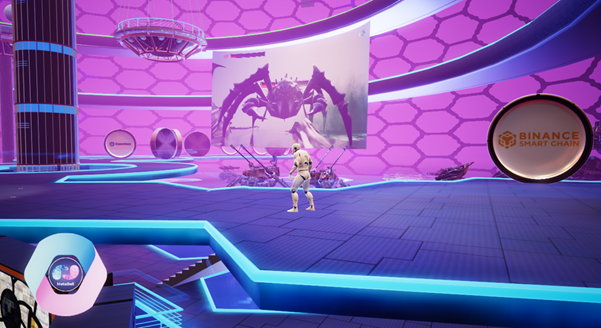
Usually, there is a considerable financial requirement for users to participate in metaverse construction. For example, in some popular metaverse ecosystems, users need to purchase at least one piece of land, which may cost 1 or more ETH. Obviously, MetaBell’s positioning as a “metaverse service provider” encourages users to actively create their own metaverse space. Meta Bell participants do not need to pay high virtual land fees. They only need to hold a small number of BELL to get access and keys to enjoy all the tools, services and rewards in MetaBell, which provides a very important basis for the development of UGC in the ecology.
Some e-commerce merchants, for example, are also able to have their own virtual stores through Bell-XR and build their personal networks in the metaverse. DeFi, GameFi and SocialFi projects are also able to establish their own virtual territory space, which users can reach with one click through BellSpace. Of course, if you are just an ordinary user, then you can also easily build your own home through MetaBell to lay the foundation for your future metaverse life.
In the Web 2.0 ecosystem, user data generated are not in the hands of users themselves but controlled and used by centralized business giants as “assets”. Although various regulations have been introduced for user data privacy, such as the EU’s GDPR, the Web 2.0 world is still dominated by centralization. In comparison, MetaBell, built on blockchain and based on distributed storage, can ensure that users’ data and information are stored in a decentralized form and users have control. For example, some applications built on BellSpace can access user data after receiving authorization from users. Any user who agrees to provide data will also be able to obtain relevant incentives. Therefore, in addition to unleashing the creativity of all users, MetaBell is also expected to further enable users to become the biggest beneficiaries of user data and information. in this way, MetaBell brings us from the Web2 to the Web3 world earlier. Maybe in the near future, you and I will soon meet in the metaverse.
Bell-XR is the “starter” of MetaBell ecology, anyone can use Bell-XR to start the metaverse life.
Bell-XR: the world-building tool in MetaBell
Bell-XRMetaBell provides users with an engine system for building UGC: Bell-XR. Based on this engine, users can easily create UGC of 3D models with dozens of modules for free, such as appearance, size, material, lighting effects, etc., to generate their own exclusive UGC-3D works (e.g., architects, characters, and so on). These UGC works can be saved and shared to any platform for display, or even turned into NFTs by MetaBell. In this way, the works are more digitally scarce, secure and authentic, and they can be displayed and used in MetaBell metaverse. Of course, users are also able to upload some 3D works for secondary editing.
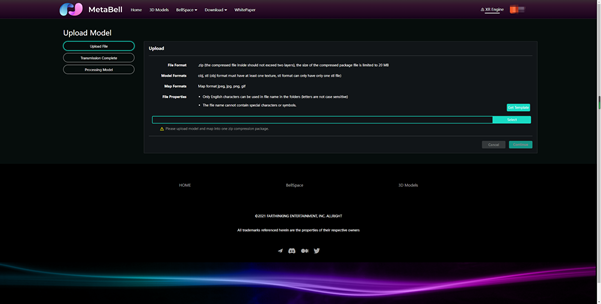
In terms of features, the Web XR technology not only allows users to generate any scene they need, but also supports motion capture, human body capture and face capture.
For 3D works, especially some dynamic 3D works, the ability to capture details can often make them more realistic. For instance, motion capture technology can make animations look more realistic and natural, greatly improving the quality of virtual 3D content. In MetaBell, the human body capture technology combines the advantages and features of single-camera, markerless optical facial expression capture technology and inertial motion capture technology. It uses markerless optical motion capture technology to capture real human facial expressions and inertial motion capture technology to capture real human motion information to build realistic virtual characters. In addition, face capture technology enables it to capture data of real people with fine facial expressions, which can be used to create stunning animations that can be transmitted wirelessly and previewed in real time. With the fine effects and user-friendly operations, the technology is generally used for film and TV effects and AAA game production.
There are approximately 3 million lines of code behind the Web-end program. It is based on modeling technology that provides interactive 3D objects and scenes that can be used not only on the Internet but also on local user systems because the network transmission model files are smaller than video images. WebVR brings virtual reality technology to the Web. It uses JavaScript to implement simultaneously running of VR-related apps through JavaScript. Besides, by incorporating WebXR online display technology, users do not need to download plug-ins.
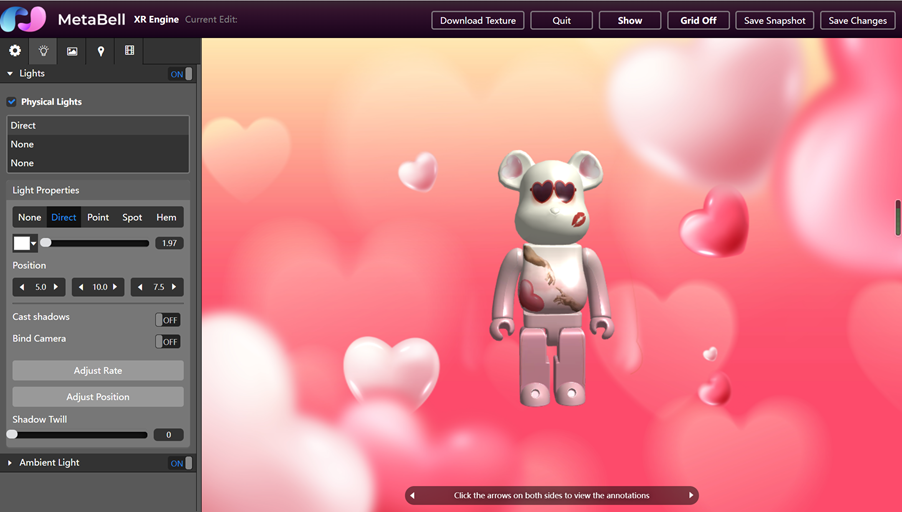
Therefore, in general, Bell-XR boasts many technical advantages, such as higher efficiency, simpler operation, and more convenience when compared to traditional 3D modeling engines. The Web end is direct and convenient, making it free of installation, easy to socialize, and fast to update. It also has diverse functions, such as supporting lighting selection. For example, users can choose the physical light, parallel light, spotlight, hemispheric light, and adjust the setting of spotlight lighting (distance, attenuation, softness, location). ambient light can also be manually set by users. It also has the online editing WebXR model scene functions, such as multi-angle rotation (rotation angle setting can be set to three decimal places), model coordinate change and scale adjustment, wide-angle scaling, environment effect and background image, etc.
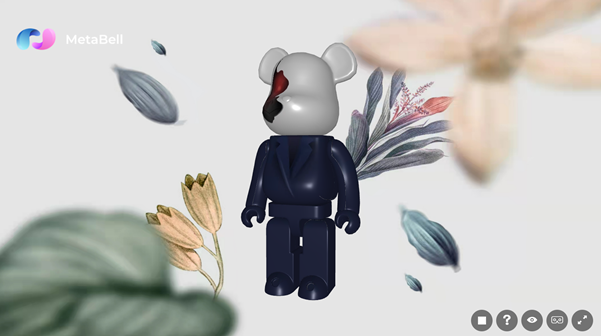
In addition, AR tracking technology, which can take real-world objects or media as reference, fixes AR content at the reference position and changes the position with the movement of the reference to achieve an efficient evaluation of 3D objects. It can be seen that overall, MetaBell’s Bell-XR engine system can provide users with professional 3D modeling functions, which can meet not only the UGC needs of ordinary users but also some professional development teams.
It can be foreseen that when the metaverse UGC ecology makes financial and technical breakthroughs, it will soon usher in a new round of ecological explosion. Through AI, MetaBell can record and learn people’s habits and ways of thinking, and even map them to their behaviors. The Bell-XR technology, MetaBell is able to perfectly replicate the user’s image, and completely represent the user, from image to way of thinking, in the metaverse ecology. This innovation will transform goals of the metaverse and help human beings finally realize the aspiration of “metaverse eternity”.





