Interest Rate Swap Layer: How Does DeFi Use 'Carry Trade' to Solve the Fixed-Rate Challenge?

比推Xuất bản vào 2026-01-09Cập nhật gần nhất vào 2026-01-09

Tóm tắt

The article explores the challenge of fixed-rate lending in DeFi, arguing that while demand exists—primarily from institutional borrowers and recursive yield farmers seeking predictable costs—current solutions struggle to scale because they require lenders to lock funds, sacrificing the flexibility that DeFi users highly value. Instead of matching fixed-rate borrowers directly with fixed-rate lenders, the author proposes building an interest rate swap layer on top of established money markets like Aave. This layer would allow traders to speculate on the spread between fixed and floating rates with high capital efficiency, while preserving the seamless deposit/withdrawal experience for lenders. The piece concludes that such a mechanism is essential for the future expansion of on-chain credit, enabling larger, longer-term institutional and consumer lending with rate certainty.

Author: nico pei

Compiled by: AididiaoJ, Foresight News

Original title: Fixed-Rate Lending, the Key to DeFi's Success in Scaling


The demand for fixed rates primarily comes from institutional borrowers and looping strategy users. While on-chain credit is expected to expand in the future, at this stage, most on-chain participants highly value the flexibility of "being able to withdraw funds at any time." Therefore, instead of forcing lenders to accept "term locking," a better approach is to build an interest rate swap layer on top of existing money markets (like Aave) to meet the demand for fixed-rate lending.

Inspiration from Traditional Finance: The Fixed-Rate Market Begins with Borrower Demand

In the private debt market, fixed rates are the mainstream not because lenders prefer them, but because borrowers need certainty.

  • Borrower Perspective (corporations, private equity funds, real estate developers, etc.): Their primary concern is cash flow predictability. Fixed rates hedge against the risk of rising benchmark rates, simplify budgeting, and reduce refinancing risk. This is especially critical for highly leveraged or long-term projects, where interest rate fluctuations could directly threaten their survival.

  • Lender Perspective: They generally prefer floating rates. Loan pricing is typically structured as "benchmark rate + credit risk premium." A floating structure protects profit margins when rates rise, reduces "duration risk," and allows for additional gains if benchmark rates increase. Lenders only offer fixed rates if they can hedge the interest rate risk or charge a sufficient premium.

Thus, fixed-rate products are created in response to borrower demand, not as the market's default form. A key takeaway for DeFi is: without clear and sustained borrower demand for "interest rate certainty," fixed-rate lending will struggle to gain liquidity, scale, or develop sustainably.

Who Are the Borrowers on Aave / Morpho & Euler? Why Do They Borrow?

A common misconception is: "Traders borrow from money markets to add leverage or open short positions."

In reality, directional leverage operations are almost entirely conducted through perpetual contracts due to higher capital efficiency. Money markets require over-collateralization, making them unsuitable for speculative leverage.

Yet, Aave alone has approximately $8 billion in stablecoin loans outstanding. Who are these borrowers?

They can be broadly categorized into two types:

  1. Long-term Holders / Whales / Project Treasuries: They collateralize their crypto assets (e.g., ETH) to borrow stablecoins for liquidity, while avoiding selling the assets (thus retaining upside potential and avoiding taxable events).

  2. Yield Loopers: They borrow to recursively add leverage to yield-bearing assets (e.g., Liquid Staking Tokens LST/LRT like stETH; or yield-bearing stablecoins like sUSDe). The goal is to achieve a higher net yield, not to speculate on price movements.

So, Is There Actually a Need for Fixed Rates On-Chain?

Yes. The demand mainly comes from two types of users: institutional-grade crypto-collateralized loans and looping strategies.

1. Institutional-Grade Crypto-Collateralized Loans Need Fixed Rates

Take Maple Finance as an example. It lends stablecoins to institutions through over-collateralized loans, with collateral primarily being blue-chip crypto assets like BTC and ETH. Borrowers include high-net-worth individuals, family offices, hedge funds, etc., who seek fixed-rate funding with predictable costs.

  • Interest Rate Comparison: The cost to borrow USDC on Aave is around 3.5% APR, while the fixed-rate loan liquidation yield for similar collateral on Maple ranges from 5.3% to 8%. This means borrowers pay a premium of approximately 180-450 basis points to switch from floating to fixed rates.

  • Market Size: Maple's Syrup pool alone manages about $2.67 billion, comparable to Aave's ~$3.75 billion in outstanding loans on Ethereum mainnet.
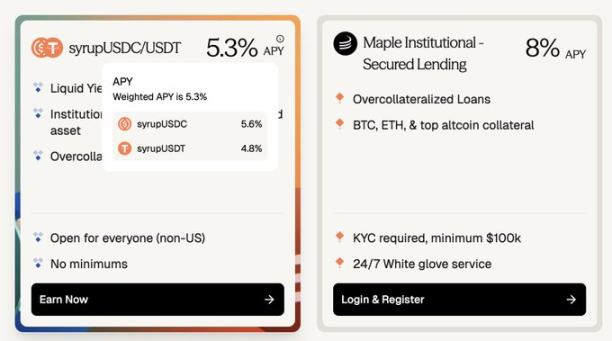
(Aave's ~3.5% vs. Maple's ~8%, paying a ~180-400 basis point premium for fixed-rate crypto loans.)

It's worth noting that some borrowers choose Maple to avoid (early DeFi's) smart contract risk. However, as protocols like Aave have proven their security, transparency, and liquidation mechanisms through testing, this risk perception is diminishing. If reliable fixed-rate options emerge on-chain, the premium for off-chain fixed-rate loans will likely compress.

2. Looping Strategies Need Fixed Rates

Despite generating billions in borrowing demand, looping strategies are often unprofitable due to volatile borrowing rates.

A stablecoin looping/borrowing user stated: "As a looper/borrower, the unpredictability of borrowing rates means rate fluctuations can suddenly wipe out months of accumulated yield, causing positions to become unprofitable."

Historical data also shows that borrowing rates on Aave and Morpho are extremely volatile, with annualized volatility exceeding 20%.

For loopers, they earn fixed income (e.g., via Pendle's PTs) but use floating-rate borrowing to maintain the loop, introducing "interest rate risk." A spike in borrowing rates can devour all profits. If both the borrowing rate and investment yield were fixed, the funding risk would be eliminated. The strategy becomes easier to evaluate, positions can be held with peace of mind, and capital can be deployed more efficiently.

As on-chain infrastructure (like Pendle's PTs) has been security-tested for over five years, demand for on-chain fixed-rate loans is growing rapidly.

Given the demand, why hasn't the market scaled? Look at the supply-side issues.

Flexibility is the 'Priceless Treasure' of On-Chain Participants

Here, flexibility refers to the ability to adjust or exit positions at any time, without lock-up periods—lenders can withdraw anytime, borrowers can repay and redeem collateral anytime, without penalties.

In contrast, holders of Pendle PTs sacrifice some flexibility. Even in the largest pools, Pendle's mechanism cannot allow instantaneous exit of positions exceeding ~$1 million without significant slippage.

So, how much compensation do on-chain lenders get for giving up flexibility? Taking Pendle PTs as an example, compensation is often as high as 10%+ APR, and even over 30%+ during YT points trading frenzies (e.g., usdai on Arbitrum).

Clearly, genuine borrowers (non-speculators) cannot afford a 10% fixed-rate cost. This high rate is essentially a "premium" paid for sacrificing flexibility, unsustainable without speculation on YT points.

Although PTs are riskier than base lending protocols like Aave (adding protocol and underlying asset risk), the core conclusion remains: any fixed-rate market requiring lenders to sacrifice flexibility cannot scale if borrowers cannot afford super-high rates.

Term Finance and TermMax are examples: few lenders are willing to give up flexibility for meager interest, and borrowers absolutely refuse to pay 10% to lock in rates when Aave's rate is 4%.

The Way Out: Don't Match Fixed-Rate Borrowers Directly with Fixed-Rate Lenders

Match fixed-rate borrowers with interest rate traders. Specifically:

Step 1: Protect the Lender Experience

The vast majority of on-chain capital only trusts the security of Aave, Morpho, Euler and enjoys the simple, passive experience of "depositing and earning" on Aave. They are not "sophisticated managers" who would meticulously evaluate every new protocol for a 50-100 basis point premium.

Therefore, for a fixed-rate market to scale, the lender experience must be exactly the same as using Aave now:

  • Deposit anytime

  • Withdraw anytime

  • Almost no additional trust assumptions

  • No lock-up periods

Ideally, fixed-rate protocols should be built directly on top of trusted money markets like Aave, leveraging their security and liquidity.

Step 2: Trade the 'Spread,' Not the 'Principal'

Borrowers seeking fixed rates don't need another full loan with a locked term. What they really need is capital willing to take on the spread risk between the "agreed fixed rate" and the "Aave floating rate"; the principal can still be borrowed from places like Aave.

In other words, traders are trading the expected difference between fixed and floating rates, not the entire loan principal.

An interest rate swap layer can achieve this:

  • Hedgers can exchange fixed payments for floating income perfectly matched to Aave's floating rate.

  • Macro traders can express views on interest rate trends with extremely high capital efficiency.

Capital Efficiency Example: A trader only posts a small amount of margin to take on the interest rate risk exposure, far less than the loan's notional principal. For example, to short the Aave borrowing rate for $10 million over 1-month term, assuming a fixed rate of 4% APR, a trader might only need to put up about $33,300 in margin—this implies ~300x capital efficiency.

Considering Aave rates often fluctuate between 3.5% and 6.5%, this implied leverage allows traders to treat the interest rate itself as a highly volatile "token" to trade (from $3.5 to $6.5), with amplitude far exceeding major cryptocurrencies, strongly correlated with overall market liquidity and prices, while avoiding the liquidation risks of explicit leverage (e.g., 40x on BTC).

Go long on rates to profit from "peaks," go short to profit from "troughs."

Long-Term Outlook: Fixed Rates are Essential for On-Chain Credit Expansion

I foresee that as on-chain credit grows, demand for fixed-rate loans will also expand. Borrowers will increasingly need predictable funding costs to support larger, longer-term positions and productive capital allocation.

  • Institutional Credit Expansion: Projects like Cap Protocol are pushing on-chain institutional credit. They help restaking protocols insure institutional-grade stablecoin loans. Currently, rates are determined by utilization curves suited for short-term liquidity, but institutional borrowers value rate certainty. In the future, a dedicated interest rate swap layer will be crucial for supporting "term pricing" and risk transfer.

  • On-Chain Consumer Credit: Projects like 3Jane focus on on-chain consumer credit. This field is almost entirely fixed-rate loans because consumers need certainty.

In the future, borrowers might enter different segmented rate markets based on credit grade or collateral asset type. Unlike traditional finance, on-chain rate markets could allow borrower groups to directly face market-driven rates, rather than being locked into rates set by a single lender.


Twitter:https://twitter.com/BitpushNewsCN

Bitpush TG Community:https://t.me/BitPushCommunity

Bitpush TG Subscription: https://t.me/bitpush

Original link:https://www.bitpush.news/articles/7601399

Tiền kỹ thuật số thịnh hành

Câu hỏi Liên quan

QWhat are the two main types of users who demand fixed-rate loans in DeFi according to the article?

AThe two main types of users demanding fixed-rate loans are institutional crypto-backed loans and looping strategy users.

QWhy do traditional finance borrowers prefer fixed-rate loans?

ABorrowers in traditional finance prefer fixed-rate loans because they need certainty for cash flow predictability, to hedge against the risk of benchmark rate increases, simplify budgeting, and reduce refinancing risk, which is especially critical for highly leveraged or long-term projects.

QWhat is the core problem with asking lenders to lock up their capital to provide fixed-rate loans in DeFi?

AThe core problem is that flexibility (the ability to withdraw funds at any time) is extremely valuable to most on-chain participants. Lenders demand a very high premium (e.g., 10%+ APY) to give up this flexibility, a rate that most real borrowers cannot afford to pay, making such markets unable to scale.

QWhat is the proposed solution, or 'way out', for creating a scalable fixed-rate market in DeFi?

AThe proposed solution is to build an interest rate swap layer on top of trusted money markets like Aave. Instead of matching fixed-rate borrowers with locked-up lenders, it matches them with interest rate traders who take on the spread risk between a fixed rate and the Aave floating rate, allowing lenders to maintain their flexible experience.

QHow does the article describe the capital efficiency for a trader in the proposed interest rate swap layer?

AThe capital efficiency is described as extremely high. For example, a trader taking a short position on a $10 million, 1-month Aave borrowing rate at a 4% fixed rate might only need to post around $33,300 in margin, implying roughly 300x capital efficiency, allowing them to trade interest rate volatility like a high-volatility token.

Nội dung Liên quan

Sam Bankman-Fried Muốn Một Token Mới Để Bồi Thường Nạn Nhân FTX, Nhưng Liệu Điều Đó Có Thể Xảy Ra?

Sam Bankman-Fried (SBF) một lần nữa xuất hiện trên các tiêu đề sau khi được cho là bày tỏ hy vọng về một dự án token mới có thể bồi thường cho các nạn nhân của FTX. Tuy nhiên, tuyên bố này cần được hiểu là một mong muốn cá nhân, hoàn toàn tách biệt với thực tế pháp lý khắc nghiệt mà ông đang đối mặt. Điều quan trọng cần nhấn mạnh là vào ngày 12 tháng 6 năm 2026, một tòa phúc thẩm Mỹ đã giữ nguyên bản án 25 năm tù dành cho SBF. Với tư cách là một phạm nhân, ông phải đối mặt với hàng loạt rào cản pháp lý hiển nhiên trong việc điều hành công ty, huy động vốn hay phát hành token. Hiện không hề có bất kỳ dự án token nào đã được xác minh là khả thi về mặt pháp lý. Lý do khiến thông tin này thu hút sự chú ý nằm ở quy mô và ảnh hưởng của vụ sụp đổ FTX trong lịch sử crypto. Bất kỳ đề cập nào về việc bồi thường nạn nhân đều khơi gợi ký ức về thiệt hại khổng lồ và sự tổn hại niềm tin trong cộng đồng. Tuy nhiên, góc độ an toàn và chính xác để đưa tin không phải là việc SBF đang phát hành token, mà là sự tương phản giữa hy vọng cá nhân của ông về một con đường dựa trên token và nghịch lý pháp lý hiện tại. Quá trình bồi thường thực tế cho các chủ nợ của FTX vẫn sẽ phải tuân theo các thủ tục pháp lý, cơ cấu phá sản và cơ chế thu hồi tài sản chính thức, chứ không phải từ một ý tưởng token xuất phát từ trong tù.

bitcoinist5 giờ trước

Sam Bankman-Fried Muốn Một Token Mới Để Bồi Thường Nạn Nhân FTX, Nhưng Liệu Điều Đó Có Thể Xảy Ra?

bitcoinist5 giờ trước

BlackRock Ra Mắt Quỹ ETF Bitcoin Covered-Call Với Mã Chứng Khoán BITA

BlackRock đã ra mắt iShares Bitcoin Premium Income ETF (BITA), một quỹ ETF bitcoin mới sử dụng chiến lược covered-call để tạo thu nhập. Không giống như các quỹ spot bitcoin thông thường, BITA bán quyền chọn mua (call options) dựa trên danh mục nắm giữ bitcoin, nhằm thu phí bảo hiểm và phân phối thu nhập hàng tháng cho nhà đầu tư. Sản phẩm này phù hợp với những nhà đầu tư tin tưởng vào triển vọng bitcoin nhưng muốn có một công cụ tạo thu nhập ổn định hơn trong danh mục truyền thống, thay vì chỉ dựa vào việc tăng giá. Tuy nhiên, có sự đánh đổi: trong thị trường đi ngang hoặc biến động, chiến lược này có thể hấp dẫn, nhưng nó sẽ hạn chế phần lợi nhuận nếu giá bitcoin tăng mạnh vượt quá mức giá thực hiện của quyền chọn đã bán. Việc ra mắt BITA cho thấy thị trường ETF bitcoin đang phát triển vượt ra ngoài các sản phẩm spot đơn giản, hướng tới các chiến lược phức tạp hơn như tạo thu nhập, phòng ngừa rủi ro và tích hợp vào danh mục. Điều này giúp bitcoin dần được coi như một thành phần thị trường có thể kết hợp trong cấu trúc quỹ rộng hơn, thu hút thêm các nhà đầu tư tổ chức.

bitcoinist7 giờ trước

BlackRock Ra Mắt Quỹ ETF Bitcoin Covered-Call Với Mã Chứng Khoán BITA

bitcoinist7 giờ trước

Nhật Bản tăng lãi suất, tại sao cả thế giới đều lo lắng?

Vào tháng 6/2026, Ngân hàng Trung ương Nhật Bản (BoJ) nâng lãi suất chính sách lên 1%, mức cao nhất kể từ năm 1995. Dù mức này vẫn thấp hơn nhiều so với Mỹ hay châu Âu, nó lại khiến thị trường toàn cầu chú ý. Lý do nằm ở vai trò đặc biệt của Nhật Bản trong nhiều thập kỷ: là trung tâm cung cấp vốn vay chi phí cực thấp cho thế giới. Suốt hơn 20 năm, Nhật Bản duy trì lãi suất gần 0% hoặc âm, tạo điều kiện cho các nhà đầu tư quốc tế thực hiện "giao dịch carry trade" bằng đồng Yên. Họ vay Yên rẻ, đổi sang các đồng tiền khác để đầu tư vào tài sản có lợi suất cao hơn như cổ phiếu Mỹ, trái phiếu mới nổi. Dòng vốn Yên giá rẻ này trở thành một nguồn thanh khoản quan trọng, góp phần đẩy giá nhiều loại tài sản toàn cầu. Việc BoJ bắt đầu chu kỳ tăng lãi suất, dù nhỏ, đang làm lung lay kỳ vọng rằng Nhật Bản sẽ mãi mãi là nguồn vốn rẻ. Điều này buộc các nhà đầu tư phải tính toán lại chi phí vay và điều chỉnh các chiến lược đầu tư dựa trên đòn bẩy. Nguy cơ là nhiều quỹ có thể đồng loạt giảm đòn bẩy (deleverage), dẫn đến thu hồi vốn từ các thị trường tài sản rủi ro trên thế giới, gây biến động. Động thái của Nhật Bản phản ánh sự thay đổi cơ bản trong nền kinh tế nội địa: lạm phát đã vượt mục tiêu 2%, và quan trọng hơn là tiền lương tăng trưởng liên tục (trên 5% trong "shunto" - đàm phán lao động mùa xuân), tạo ra vòng xoáy tích cực "lương - lạm phát" mà nước này long đợi từ lâu. Áp lực từ đồng Yên yếu (từng gần chạm 160 Yên/USD) cũng góp phần thúc đẩy việc thắt chặt chính sách. Tuy nhiên, hướng đi cuối cùng của dòng vốn toàn cầu vẫn phụ thuộc lớn vào Cục Dự trữ Liên bang Mỹ (Fed). Chênh lệch lãi suất Mỹ-Nhật vẫn rộng. Chỉ khi Fed bắt đầu chu kỳ cắt giảm lãi suất trong khi BoJ tiếp tục tăng, chênh lệch này mới thu hẹp đáng kể, và khi đó tác động mạnh mẽ hơn đến dòng vốn và tỷ giá hối đoái mới thực sự rõ rệt. Tóm lại, thị trường lo ngại không phải vì mức lãi suất 1%, mà vì sự thay đổi trong một xu hướng đã tồn tại suốt 30 năm. Sự kết thúc của kỷ nguyên vốn vay cực rẻ từ Nhật Bản có thể định nghĩa lại logic định giá tài sản và dòng chảy vốn toàn cầu trong tương lai.

marsbit9 giờ trước

Nhật Bản tăng lãi suất, tại sao cả thế giới đều lo lắng?

marsbit9 giờ trước

Quốc Hội Thông Qua Lệnh Cấm CBDC Cho Đến Năm 2030 Thông Qua Dự Luật Cải Cách Nhà Ở Lớn

Các nhà lập pháp Hoa Kỳ đã thông qua một dự luật cải cách nhà ở lớn, trong đó có điều khoản cấm tạm thời Cục Dự trữ Liên bang (Fed) phát hành tiền kỹ thuật số của ngân hàng trung ương (CBDC) cho đến ngày 31 tháng 12 năm 2030. Điều khoản này, nằm trong Đạo luật Con đường Nhà ở Thế kỷ 21, phân loại CBDC là tài sản kỹ thuật số được định giá bằng đô la, là nghĩa vụ trực tiếp của Fed và phải có thể tiếp cận được với mọi công dân Mỹ. Những người ủng hộ lệnh cấm cho rằng nó cung cấp thêm thời gian để đánh giá tác động tiềm năng của đồng đô la kỹ thuật số, đồng thời phản ánh mối quan ngại về quyền riêng tư, giám sát tài chính và sự can thiệp của chính phủ. Lệnh cấu áp dụng cho mọi nỗ lực phát hành CBDC bán lẻ, dù trực tiếp hay thông qua trung gian, nhưng không hạn chế các mạng lưới blockchain không cần cấp phép. Mặc dù trọng tâm của dự luật là giải quyết thách thức về nguồn cung nhà ở, nhưng ngôn ngữ liên quan đến CBDC lại thu hút sự chú ý đáng kể từ cộng đồng tiền mã hóa, vì nó sẽ ảnh hưởng đến tương lai của các hệ thống thanh toán kỹ thuật số. Các bước tiếp theo trong quy trình lập pháp sẽ quyết định số phận của lệnh cấm này trong thập kỷ tới.

TheNewsCrypto10 giờ trước

Quốc Hội Thông Qua Lệnh Cấm CBDC Cho Đến Năm 2030 Thông Qua Dự Luật Cải Cách Nhà Ở Lớn

TheNewsCrypto10 giờ trước

Giao dịch

Giao ngay
Hợp đồng Tương lai

Bài viết Nổi bật

Làm thế nào để Mua SWAP

Chào mừng bạn đến với HTX.com! Chúng tôi đã làm cho mua TrustSwap (SWAP) trở nên đơn giản và thuận tiện. Làm theo hướng dẫn từng bước của chúng tôi để bắt đầu hành trình tiền kỹ thuật số của bạn.Bước 1: Tạo Tài khoản HTX của BạnSử dụng email hoặc số điện thoại của bạn để đăng ký tài khoản miễn phí trên HTX. Trải nghiệm hành trình đăng ký không rắc rối và mở khóa tất cả tính năng. Nhận Tài khoản của tôiBước 2: Truy cập Mua Crypto và Chọn Phương thức Thanh toán của BạnThẻ Tín dụng/Ghi nợ: Sử dụng Visa hoặc Mastercard của bạn để mua TrustSwap (SWAP) ngay lập tức.Số dư: Sử dụng tiền từ số dư tài khoản HTX của bạn để giao dịch liền mạch.Bên thứ ba: Chúng tôi đã thêm những phương thức thanh toán phổ biến như Google Pay và Apple Pay để nâng cao sự tiện lợi.P2P: Giao dịch trực tiếp với người dùng khác trên HTX.Thị trường mua bán phi tập trung (OTC): Chúng tôi cung cấp những dịch vụ được thiết kế riêng và tỷ giá hối đoái cạnh tranh cho nhà giao dịch.Bước 3: Lưu trữ TrustSwap (SWAP) của BạnSau khi mua TrustSwap (SWAP), lưu trữ trong tài khoản HTX của bạn. Ngoài ra, bạn có thể gửi đi nơi khác qua chuyển khoản blockchain hoặc sử dụng để giao dịch những tiền kỹ thuật số khác.Bước 4: Giao dịch TrustSwap (SWAP)Giao dịch TrustSwap (SWAP) dễ dàng trên thị trường giao ngay của HTX. Chỉ cần truy cập vào tài khoản của bạn, chọn cặp giao dịch, thực hiện giao dịch và theo dõi trong thời gian thực. Chúng tôi cung cấp trải nghiệm thân thiện với người dùng cho cả người mới bắt đầu và người giao dịch dày dạn kinh nghiệm.

Tổng lượt xem 237Xuất bản vào 2024.12.10Cập nhật vào 2026.06.02

Làm thế nào để Mua SWAP

Thảo luận

Chào mừng đến với Cộng đồng HTX. Tại đây, bạn có thể được thông báo về những phát triển nền tảng mới nhất và có quyền truy cập vào thông tin chuyên sâu về thị trường. Ý kiến ​​của người dùng về giá của SWAP (SWAP) được trình bày dưới đây.

活动图片