2025 Airdrop Survival Rules: From Gold Rush to Holding These Two Aces

marsbitXuất bản vào 2025-12-12Cập nhật gần nhất vào 2025-12-12

Tóm tắt

In 2025, the airdrop farming landscape shifted dramatically, moving from a "gold rush" to a challenging environment with significantly reduced returns. The absence of an "altcoin season" and Bitcoin's market dominance led to lower valuations for airdropped tokens, with many projects launching at lower fully diluted valuations (FDVs) and experiencing immediate sell-offs. This resulted in smaller airdrops, often not even covering gas fees, causing many farming studios to shut down or pivot to other ventures. Despite the downturn, new farming methods emerged. "InfoFi" or "talk-to-earn" platforms like Kaito, Cookie Snaps, and Galxe’s Starboard allowed users to earn tokens by creating quality content and analysis on social media, lowering entry barriers and offering faster returns compared to traditional on-chain interactions. Binance Alpha also became a key income source for many, though its rewards diminished over time due to increased competition and lower token values. The two most reliable strategies for sustaining profits were: 1) Participating in high-profile token launches (e.g., on BuidlPad, Kaito, or Legion), focusing on projects with strong community hype and oversubscribed sales, which often provided quick, substantial gains at TGE. 2) Stablecoin farming through platforms like Binance’s Web3 Wallet, which offered low-risk, high-yield opportunities (e.g., Plasma’s collaboration with Binance offered over 70% APY for USDT depositors). These methods provided steady r...

Author: Asher, Odaily Planet Daily

As 2025 draws to a close, being the Odaily Planet Daily author who "loves talking about airdrops and writing interaction guides the most" (I wrote the vast majority of the interaction tutorial section articles this year), it's time for an annual summary on airdrop hunting.

After liquidating my holdings in on-chain AI Agent sector Meme coins at the beginning of the year, I devoted most of my time to interacting with various popular projects. I tried almost all the hot airdrop projects, and of course, I didn't miss out on the pitfalls either. As the year-end approaches, I've had many conversations with friends who are also passionate about airdrop hunting, summarizing the changes in the landscape this year.Because of this, I deeply feel that airdrop hunting in 2025 has quietly shifted from a "gold rush for all" to a "collective retreat."

Plummeting Airdrop Returns, Studios Exit En Masse

Looking back at 2025, the airdrop hunting sector rapidly fell from "get-rich-quick myths" into a "winter of intense competition." Big airdrops disappeared, small airdrops shrank, and "getting rekt by the airdrop" became the norm. The most common phrase among "airdrop hunters" this year most直观地揭示了这一变化: "Small airdrops are only $5 to $10, and the Gas fee to claim them is more expensive than the tokens; past airdrop rewards of over 10% with no lock-up have now dropped to 2-3%, and are released in batches."

The sharp drop in returns directly triggered a mass exodus of studios."From the days when any interaction made money, to now not even covering the basic team wages. It's not that we didn't try hard, it's that the era quietly closed its door." Odaily Planet Daily learned from interviews that large numbers of teams have either shut down directly or shifted to more controllable businesses like cross-border e-commerce; the few teams that remain are barely surviving, almost entirely relying on Binance Alpha's daily 'certain airdrop claims' to scrape by. However, with the significant drop in the value of airdropped tokens on Binance Alpha throughout November, studios will likely face a second wave of concentrated exits in the short term.

More absurdly, the biggest profit source for many studios this year wasn't token airdrops, but hoarding hardware. A studio friend joked self-deprecatingly: "Didn't make much from airdrop hunting this year, but the RAM sticks I hoarded in February rose from 55 yuan to 240 yuan, a pants-load of RAM sticks became the most profitable investment of the year."
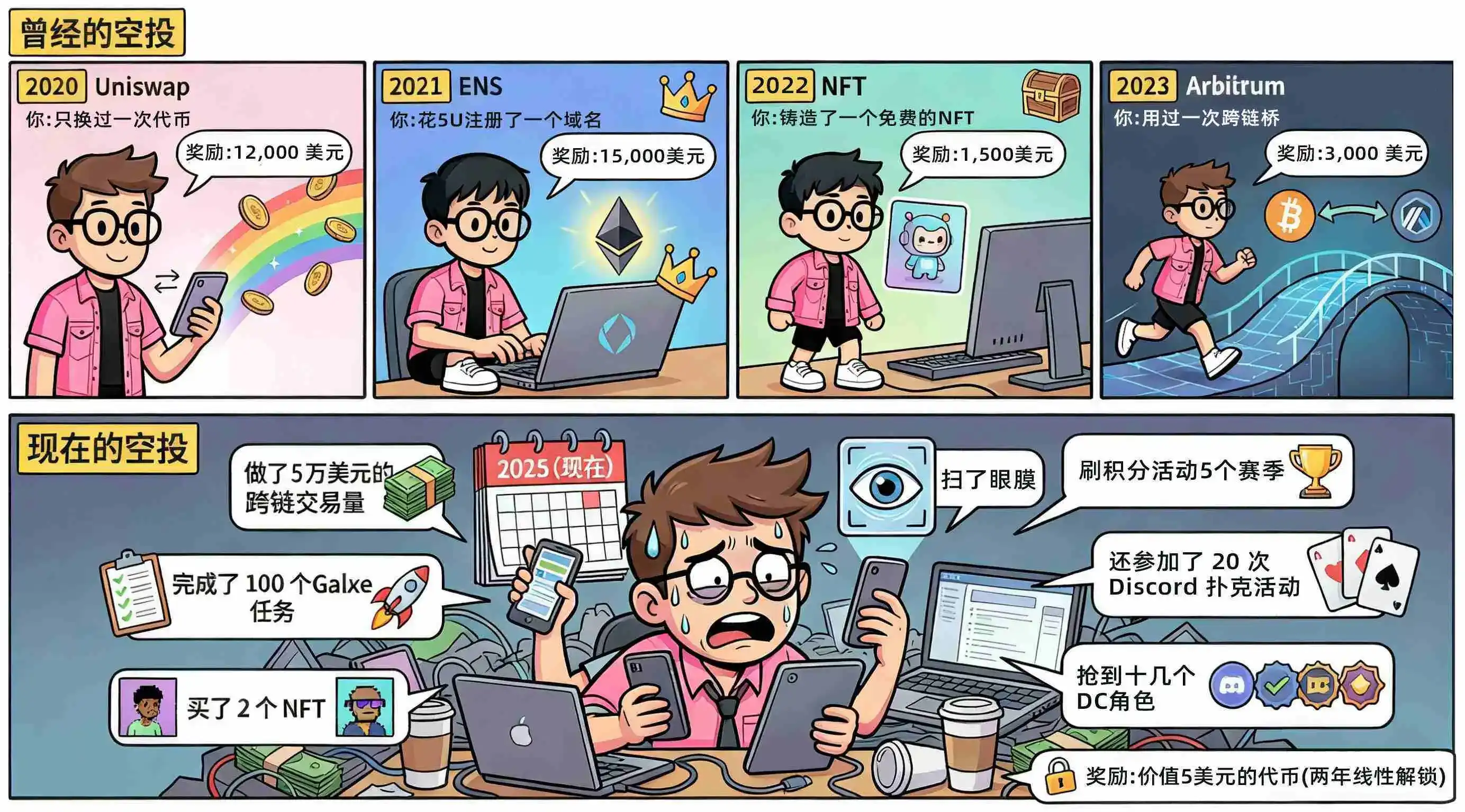
The airdrop hunting sector moves from "get-rich-quick myths" to "winter of intense competition"

No Altcoin Season is the Root Cause of Declining Airdrop Returns

Airdrop returns本质上依赖于空投代币的后续表现, which in turn often rely on the tailwind of "altseason"—that golden window when altcoins collectively rotate and surge hundredfold. However, throughout 2025, the crypto market was stuck in a prolonged BTC-dominant pattern, with altcoins generally depressed. According to on-chain data, BTC's market dominance continued to rise, hitting a high of 63% at one point this year. BTC dominance meansliquidity doesn't spill over, altcoins don't rotate, and new projects struggle to gain traction—without this price amplifier, airdrop values can't rise, and airdrop hunting returns are注定走弱.
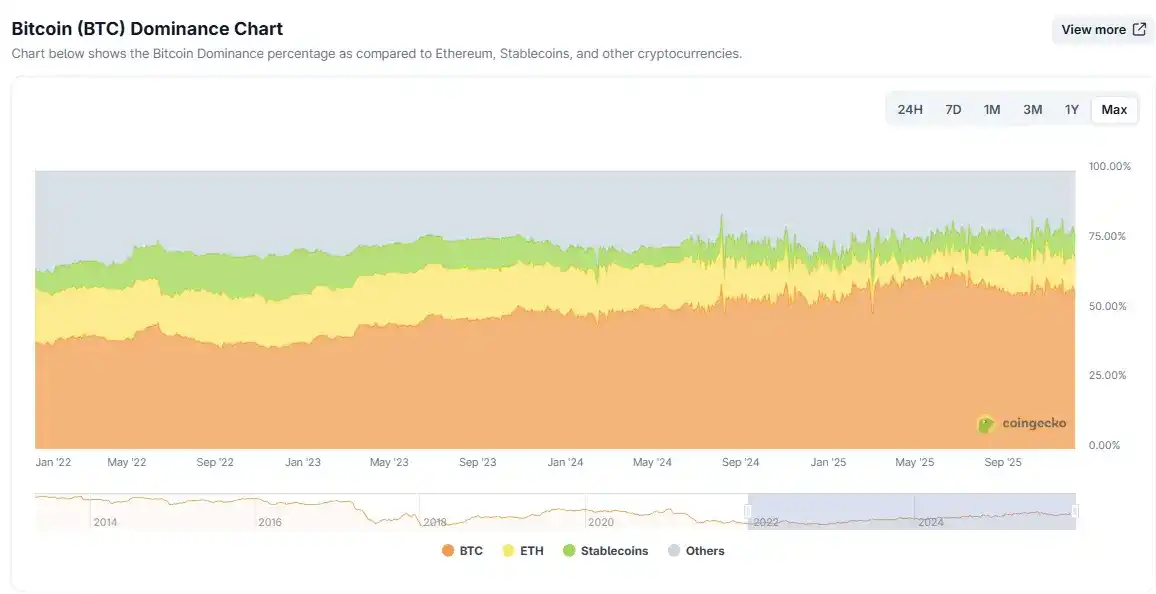
BTC Market Dominance

This "no altseason" situation directly hits the core pain point of airdrop hunting—the upfront investment in Gas fees, time, and resources often results in tokens that open low and go lower, or even go to zero. Per-account returns have shrunk from tens or even hundreds of dollars in the past to just a few dollars, often not even covering the Gas fees.

Further analysis shows that, on one hand, the opening market caps of newly launched projects this year were generally lower, with valuation systems collapsing across the board. From the heyday of ARB and STARK airdrops opening with FDVs动不动就 10-20 billion USD, to many projects now starting with only a few hundred million or even tens of millions in FDV, there's little room for imagination, and the airdrops are already worthless at launch.(Let's be honest, the former sky-high valuations of star projects were also partly due to airdrop hunters who frantically刷数据, had no loyalty, and abandoned projects after the drop.)

On the other hand, even if the opening valuation is low, expecting a "catch-up rally" is difficult. Many projects have "rat warehouse" insiders entering early, who dump mercilessly on the market upon launch, or even rug pull directly, with花样崩盘层出不穷: 50% drops in a day, crashes over 80%, pump at open followed by a slow bleed, airdrops being集中抛售, etc. Many veteran hunters sigh that "sell immediately upon receipt" should be an iron rule, because 90% of altcoins are注定归零, and the risk of heavy betting far outweighs the potential reward.

Therefore, the immediate returns from airdrops are extremely limited, and if one chooses to hold through the market, being a "diamond hands," they often not only miss the rebound but end up with even lower final returns.

Despite the significant drop in airdrop returns in 2025, the sector has not completely stalled. Odaily Planet Daily observes thatthe methods of airdrop hunting are quietly diversifying, no longer just单纯每日参与测试网交互、刷主网交易量 to gamble on token airdrops, but gradually forming multiple细分方向.

Diversification of Airdrop Hunting

From Traditional Hunting to "Skill-Based Hunting"

The biggest innovation in the airdrop hunting sector in 2025 is undoubtedly the "talk-to-earn economy." InfoFi (Information Finance,信息金融化) uses token incentives to directly reward high-quality information creators, while also alleviating the issues of information fragmentation and lack of trust in the crypto world.

Since Kaito launched its "Yap-to-Earn" mechanism, it's been easy to see a flood of "Upcoming TGE Project Analysis" posts while scrolling through X. Subsequently, Cookie launched Cookie Snaps, highlighting "analyzing crypto projects and KOLs to get rewards for quality CT content", and Galxe used Starboard in a data-driven way to help projects screen and incentivize key contributors. The launch of these mechanisms triggered KOLs to compete in posting project analysis threads, vying for token airdrops, and also made "talk-to-earn" a popular concept within the circle—earning project airdrops simply by posting and writing reviews.

Traditional airdrop hunting may have reached a turning point. The hard work of "running multiple accounts with scripts, grinding interactions" often ends with being slashed by the sybil system—not only wasted effort, but not even a single airdrop received. Having followed projects for years, full of expectation, only to be met with the outcome of "getting rekt" is utterly disheartening.

With the arrival of the "talk-to-earn" era, platforms like Kaito and Cookie use content points and influence rewards, lowering the participation barrier, offering faster returns, lower costs, and greater potential. In the new landscape, a high-quality post on X, with images and opinions, can generate even more value than a week of on-chain interactions.

Now, "talk-to-earn" on X is essentially creating a refined airdrop hunting account in a different form. Going with the flow and actively adapting to the new model of airdrop hunting is the way to earn more token airdrops.

Binance Alpha: The Main Source of Survival for Studios

Since its launch in May 2025, Binance Alpha was once hailed as the "wealth engine" of the airdrop hunting world, reaching its peak during the "golden month" of September. Since May, Binance Alpha and Binance Booster(For more related content, read: Don't Just Grind Points for Airdrops, Binance Alpha's Booster Activity is Also Worth Participating In) provided studios with "stable startup capital," earning $500 to $2000 per month, allowing studios to move from "survival" to "expansion." Many hunters joked, "Binance is疯狂撒钱, making it seem like money grows on trees."

<p style="text-align: justify; font-size: 16px; font-weight: inherit; word-break: break-all;极速赛车开奖结果查询 官网 168 飞艇开奖直播 开奖记录 历史结果 体彩 福彩 双色球 大乐透 排列三 排列五 七星彩 快乐8 3D 七乐彩 胜负彩 任选九 半全场 进球彩 北京单场 竞彩足球 竞彩篮球</p> </body></html>


Câu hỏi Liên quan

QWhat are the two main strategies mentioned in the article for surviving the airdrop hunting landscape in 2025?

AThe two main strategies are participating in new token launches (打新) and engaging in stablecoin yield farming (稳定币理财).

QAccording to the article, what is the fundamental reason for the sharp decline in airdrop profits in 2025?

AThe fundamental reason is the lack of an 'altcoin season' or a bull market for山寨币. The market was dominated by Bitcoin (BTC独大), which meant liquidity did not flow into altcoins, preventing them from rising in value and thus devaluing airdropped tokens.

QWhat new airdrop hunting method, dubbed 'Yap-to-Earn' or '嘴撸', became popular in 2025?

AThe new method is 'InfoFi' or 'Information Finance', where users earn token rewards by creating high-quality content, such as project analysis posts on platforms like X (Twitter), through mechanisms introduced by platforms like Kaito and Cookie.

QWhy did Binance Alpha's airdrop rewards decrease significantly after its initial success?

AThe rewards decreased due to two main factors: a massive influx of new users and studios (increased competition, or '僧多') and a more severe drop in the actual value of the airdropped tokens themselves, with many crashing immediately after launch ('肉少').

QWhat is presented as the long-term, stable foundation for a sustainable airdrop hunting strategy?

AStablecoin yield farming (稳定币理财) is presented as the long-term foundation. It offers a low-risk way to earn steady returns and sometimes substantial airdrops (like with Plasma), which helps preserve capital and provide a reliable income stream during bear markets.

Nội dung Liên quan

Vụ ly hôn của Choi Tae-won chính thức kết thúc: Tiết lộ tuyến kế thừa ẩn sau đế chế nghìn tỷ SK Hynix

Vào tháng 11/2024, trong một sự kiện kỷ niệm, Chủ tịch SK Group Choi Tae-won đã cho các con xem hình ảnh AI tái hiện người cha quá cố của mình, nhấn mạnh về việc kế thừa di sản. Trong bối cảnh SK Hynix trở thành tài sản trị giá nhất Hàn Quốc, câu chuyện kế thừa thế hệ thứ ba của tập đoàn này lại không đi theo kịch bản truyền thống. Choi Yun-jung (sinh 1989), trưởng nữ, được coi là ứng viên kế thừa rõ ràng nhất. Cô có nền tảng học thuật về sinh học, từng làm tư vấn, hiện đang học tiến sĩ và giữ chức vụ lãnh đạo tại SK Bioscience và bộ phận hỗ trợ tăng trưởng của SK Inc. Cuộc hôn nhân của cô với một doanh nhân khởi nghiệp AI cũng phản ánh sự thay đổi trong các mối liên kết giữa các giới tinh hoa. Choi Min-jung (sinh 1991), con gái thứ, có hành trình khác biệt: học đại học tại Bắc Kinh, tình nguyện gia nhập Hải quân Hàn Quốc và từng làm việc tại SK Hynix ở Washington về các vấn đề chính sách quốc tế. Cô hiện là nhà sáng lập một công ty chăm sóc sức khỏe AI và kết hôn với một cựu sĩ quan Thủy quân Lục chiến Mỹ, cho thấy mạng lưới toàn cầu và an ninh chuỗi cung ứng ngày càng quan trọng đối với các tập đoàn bán dẫn. Choi In-geun (sinh 1995), con trai trưởng, có lộ trình học vấn tương đồng với cha (vật lý) và đang làm việc tại McKinsey sau thời gian ở SK E&S. Dù mang hình mẫu người kế thừa truyền thống, anh lại là người ít lộ diện công khai nhất. Cuộc chiến ly hôn kéo dài giữa Choi Tae-won và vợ cũ Roh So-young, với giá trị tài sản tranh chấp lên tới hàng nghìn tỷ won, là bối cảnh phức tạp mà thế hệ thứ ba phải đối mặt. Cả ba người con đều đã đệ đơn lên tòa án trong vụ việc này, dù nội dung không được tiết lộ. Tóm lại, trong kỷ nguyên AI khi SK Hynix trở thành tài sản địa chính trị toàn cầu, việc kế thừa tại SK Group không còn là chuyện nội bộ gia đình hay chỉ xoay quanh cổ phần và quyền trưởng nam. Thế hệ thứ ba được định vị thông qua năng lực chuyên môn, mạng lưới quốc tế và khả năng giải quyết những thách thức của thời đại công nghệ và địa chính trị mới.

marsbit20 giờ trước

Vụ ly hôn của Choi Tae-won chính thức kết thúc: Tiết lộ tuyến kế thừa ẩn sau đế chế nghìn tỷ SK Hynix

marsbit20 giờ trước

Các ngân hàng phản đối thỏa thuận lợi suất stablecoin – Liệu Đạo luật CLARITY có thể giành được 60 phiếu?

Viện Chính sách Ngân hàng Hoa Kỳ (BPI) đã phản đối dự thảo Đạo luật CLARITY mới, chỉ ra những thiếu sót về quy định lợi suất stablecoin và chống tài trợ bất hợp pháp. Ngành ngân hàng muốn cấm hoàn toàn mọi hình thức khuyến khích từ stablecoin, trong khi dự thảo hiện tại chỉ cho phép dựa trên hoạt động tài khoản, không phải số dư nhàn rỗi. Sự phản đối này ảnh hưởng đến cơ hội thông qua đạo luật tại Thượng viện, nơi cần 60 phiếu. Sự ủng hộ từ đảng Cộng hòa có thể giảm xuống còn 49 phiếu nếu các Thượng nghị sĩ John Curtis và John Cornyn rút lại hỗ trợ, đòi hỏi 11 phiếu từ đảng Dân chủ. Tuy nhiên, một số nhà lập pháp Dân chủ ủng hộ tiền mã hóa cũng phản đối dự luật do lo ngại về đạo đức và chống rửa tiền. Lãnh đạo đa số Thượng viện John Thune tỏ ra hoài nghi về khả năng thông qua dự luật trước kỳ nghỉ tháng Tám, chỉ còn hai tuần. Cố vấn trưởng về Tiền mã hóa của Nhà Trắng, Patrick Witt, kêu gọi tiến hành bỏ phiếu ngay. Kỳ vọng thị trường về việc thông qua đạo luật trong năm 2026 đã giảm xuống còn 32%.

ambcrypto20 giờ trước

Các ngân hàng phản đối thỏa thuận lợi suất stablecoin – Liệu Đạo luật CLARITY có thể giành được 60 phiếu?

ambcrypto20 giờ trước

Giá trị gia tăng từ 88 tỷ lên 680 tỷ chỉ sau 2 tháng! OpenRouter, trạm trung chuyển AI lớn nhất sắp được mua lại

Theo tờ Wall Street Journal và The Information, Stripe - nền tảng thanh toán hàng đầu - đang đàm phán mua lại startup AI OpenRouter với giá khoảng 10 tỷ USD. Chỉ hai tháng trước, định giá của OpenRouter là 1,3 tỷ USD, tức giá chào mua cao hơn gần 7 lần. Thương vụ có thể được công bố trong vòng một tháng nhưng vẫn có nguy cơ đổ vỡ. OpenRouter hoạt động như một "trung tâm chuyển tiếp" AI, cung cấp một API duy nhất để các nhà phát triển truy cập vào hơn 400 mô hình lớn (như GPT, Claude). Nó tự động lựa chọn mô hình phù hợp dựa trên độ phức tạp, chi phí và tốc độ, giúp các ứng dụng AI tối ưu hóa hiệu quả chi phí. Được đồng sáng lập bởi Alex Atallah (cựu đồng sáng lập OpenSea), OpenRouter hiện có hơn 1 triệu nhà phát triển và doanh thu hàng năm đạt 50 triệu USD, tăng gấp 5 lần trong nửa năm. Đây là bước đi chiến lược tiếp theo của Stripe trong việc mở rộng sang hạ tầng AI, sau khi họ mua lại nền tảng định giá theo lượng sử dụng Metronome vào cuối năm 2025. Mục tiêu của Stripe là kết hợp khả năng định tuyến mô hình của OpenRouter với hệ thống thanh toán và đo lường sử dụng hiện có, để trở thành "trung tâm điều phối và thu ngân" toàn diện cho nền kinh tế AI. Điều này cho phép doanh nghiệp quản lý toàn bộ việc sử dụng và hóa đơn AI qua một nhà cung cấp duy nhất.

链捕手20 giờ trước

Giá trị gia tăng từ 88 tỷ lên 680 tỷ chỉ sau 2 tháng! OpenRouter, trạm trung chuyển AI lớn nhất sắp được mua lại

链捕手20 giờ trước

Từ OpenSea Đến OpenRouter: Kịch Bản “Chốt Lời Đỉnh Cao” Của Alex Atallah Lại Lặp Lại?

Tác giả: Nancy, PANews Hơn bốn năm trước, Alex Atallah rời đi trước đỉnh bong bóng NFT; giờ đây, anh lại tỏa sáng trong cơn sốt AI và chuẩn bị bán nền tảng tổng hợp mô hình AI OpenRouter với giá cao. Ngày 23/7, theo Wall Street Journal, gã khổng lồ thanh toán Stripe đang đàm phán mua lại OpenRouter, với định giá giao dịch có thể lên tới gần 100 tỷ USD. Nếu thành công, đây sẽ là lần thứ hai Alex Atallah xây dựng một công ty trị giá hàng trăm tỷ USD, sau sàn giao dịch NFT OpenSea. OpenRouter, được mô tả là "Stripe của lĩnh vực AI", đã kết nối hơn 400 mô hình AI, có khoảng 10 triệu người dùng và xử lý hơn 200 nghìn tỷ token mỗi tháng. Tuy nhiên, mô hình kinh doanh chủ yếu dựa vào phí dịch vụ nền tảng (5%-5.5%) từ việc gọi API, với doanh thu hàng năm khoảng 50 triệu USD (tính đến tháng 4/2026). Đây là một mô hình kênh dẫn có quy mô lớn nhưng biên lợi nhuận hạn chế, dễ bị ảnh hưởng bởi sự cạnh tranh, mô hình nguồn mở và áp lực giảm giá. Giá trị thực sự của OpenRouter đối với các nhà mua tiềm năng như Stripe có thể nằm ở kho dữ liệu sử dụng AI thực tế khổng lồ mà nó tích lũy được, cung cấp insights quý giá về hiệu suất mô hình, sở thích nhà phát triển và quan hệ thay thế trên thị trường. Từ NFT đến AI, Alex Atallah hai lần bắt đúng xu hướng thời đại. Việc OpenRouter được định giá 100 tỷ USD đặt ra câu hỏi: đây là sự định giá lại giá trị cơ sở hạ tầng AI hay một tín hiệu đỉnh chu kỳ mới? Thời gian sẽ trả lời.

链捕手20 giờ trước

Từ OpenSea Đến OpenRouter: Kịch Bản “Chốt Lời Đỉnh Cao” Của Alex Atallah Lại Lặp Lại?

链捕手20 giờ trước

Pons V2 mang đến các cặp giao dịch RWA khi Robinhood Chain mở rộng tham vọng

Pons, một launchpad được xây dựng trên Robinhood Chain, đã ra mắt bản nâng cấp V2 với các thay đổi nhằm cải thiện thanh khoản, loại bỏ hạn chế giao dịch và hỗ trợ tài sản thực được mã hóa (RWA). Bản cập nhật này diễn ra trong bối cảnh Robinhood Chain tiếp tục tăng trưởng nhanh, vượt 300 triệu USD tổng giá trị bị khóa và nổi lên như một trong những mạng Lớp 2 Ethereum sôi động nhất cho giao dịch đầu cơ. Pons V2 giải quyết các phàn nàn chính của người dùng về thanh khoản bằng cách giới thiệu đường cong liên kết định danh bằng ETH, đồng thời cho phép hầu hết ví giao dịch tự do. Cấu trúc phí cũng được thiết kế lại để nhà phát triển có thể nhận phí bằng ETH mặc định. Robinhood Chain đã thu hút sự chú ý của thị trường, với khối lượng DEX tích lũy vượt 9 tỷ USD, trong đó 80% đến từ memecoin rủi ro cao. Tuy nhiên, lợi nhuận tập trung vào số ít, với 63% nhà giao dịch thua lỗ. Việc Pons V2 bổ sung các cặp giao dịch RWA tùy chỉnh trực tiếp hỗ trợ trọng tâm phát triển tài sản thực của Robinhood Chain, có thể thúc đẩy việc áp dụng mạng lưới một cách hữu cơ trong tương lai.

ambcrypto21 giờ trước

Pons V2 mang đến các cặp giao dịch RWA khi Robinhood Chain mở rộng tham vọng

ambcrypto21 giờ trước

Giao dịch

Giao ngay
活动图片



