Earnings Beat Expectations and Cloud Business Soars, So Why Is Google Still Falling?

链捕手Publicado a 2026-07-24Actualizado a 2026-07-24

Resumen

Despite reporting better-than-expected Q2 earnings and explosive growth in its cloud business, Alphabet's stock price fell. Key results included total net revenue of $103.6B, beating estimates, and Google Cloud revenue surging 82% year-over-year to $24.8B. However, the market reacted negatively to a significant increase in the company's 2026 capital expenditure guidance, now projected between $195B and $205B, up approximately $15B. This elevated spending is expected to result in negative free cash flow for 2026 and 2027. Other concerns include the lack of share buybacks in Q2 and a planned $40B at-the-market equity offering, which could dilute shares. While search and YouTube revenues met or slightly exceeded expectations, they showed some moderation compared to prior quarters. Bank of America maintains a "Buy" rating with a $430 price target, arguing that the increased capital investment is directly linked to strong cloud demand, as evidenced by a massive $514B backlog. At current levels, the stock's valuation is seen as attractive relative to its growth prospects.

Author: Zhui Feng Trading Desk

Alphabet, Google's parent company, delivered a stellar second-quarter report card, with cloud business growth far exceeding expectations, and overall revenue and earnings per share significantly beating Wall Street estimates. However, the stock still plunged, reflecting market concerns over deeper underlying issues such as a sharp spike in capital expenditures, negative free cash flow, and equity dilution.

According to a Bank of America Securities research report, Alphabet's Q2 net revenue reached $103.6 billion, higher than the market expectation of $101.1 billion. Google Cloud revenue grew 82% year-over-year, far surpassing the market expectation of 65%, with the acceleration being particularly notable.

Simultaneously, the company raised its fiscal year 2026 capital expenditure guidance by $15 billion to a range of $195 billion to $205 billion, a significant increase from the previous guidance of $180 billion to $190 billion. This news became the core variable suppressing the stock price.

Bank of America Securities analyst Justin Post maintained a "Buy" rating on Alphabet with a price target of $430 in the report. He pointed out that despite the negative market reaction to the raised capex guidance, the backlog of cloud business, customer overconsumption, and the continued expansion of cloud profit margins all indicate that incremental investments are directly translating into revenue growth.

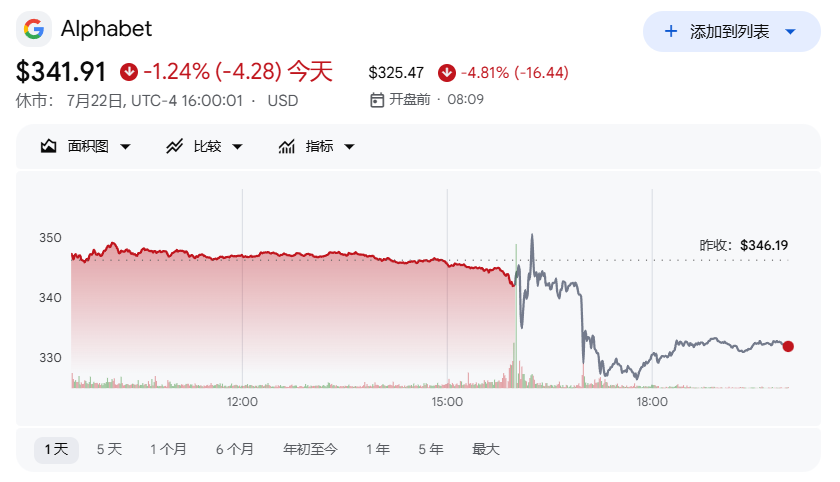
In pre-market trading, Google's decline widened to nearly 5%.
Explosive Growth in Cloud Business, the Biggest Highlight of the Quarter

Google's cloud business achieved impressive accelerated growth this quarter.

Second-quarter cloud revenue reached $24.8 billion, an 82% year-over-year increase, not only significantly exceeding the market expectation of 65% but also accelerating by 19 percentage points compared to Q1's 63% growth. The cloud business operating margin rose to 35.6%, also higher than the market expectation of 31.3%, up 270 basis points from the previous quarter and nearly 15 percentage points from a year ago.

The Bank of America Securities report points out that behind the cloud business's strong performance, multiple data points support its sustainability: Cloud business backlog grew 11% sequentially and approximately 375% year-over-year in Q2, reaching $514 billion; actual customer spending exceeded contractual commitments by over 50%, higher than Q1's 45%; the rate of new customer acquisition is more than double that of the same period last year.

Furthermore, this quarter included new revenue from selling TPU chips to external customers. Management stated that even excluding TPU sales, cloud business growth would still be "significantly accelerating."

Google's model APIs currently process about 22 billion tokens per minute, a significant increase from last quarter's 16 billion; the weekly active users of the AI agent development platform AntiGravity have exceeded 2.4 million. Bank of America Securities expects Google Cloud revenue growth to further accelerate to 93% in Q3.

Search and Overall Performance: Exceeding Expectations but Highlights Uneven

Overall, Alphabet's Q2 GAAP earnings per share were $9.11, significantly beating the market expectation of $2.90. However, note that this included about $98 billion in other income, primarily from revaluation gains on Anthropic, whereas the market had previously expected this item to be only $0.8 billion. Excluding this one-time factor, the core business performance is more genuine.

Search revenue was $63.3 billion, a 17% year-over-year increase, roughly in line with market expectations but slightly weaker than the previous quarter's strong beat, seen by the market as a temporary "cooling" signal for the recent AI uptrend narrative.

Management also indicated that search business will face higher year-over-year comparables in Q3.

YouTube ad revenue was $11.1 billion, up 13% year-over-year, exceeding the market expectation of $10.8 billion, partially benefiting from brand advertising demand driven by the FIFA World Cup. Regarding operating margin, the Q2 GAAP operating margin was 39.3%, below the market expectation of 40.3%, mainly dragged down by G&A expense overruns—actual G&A spending was $6.46 billion, far above the market expectation of $5.1 billion. Management attributed this to several legal and other matters but did not provide detailed disclosure.

Soaring Capital Expenditures and Negative Free Cash Flow, the Market's Biggest Worry

The negative market reaction to this quarter's earnings stems from the core conflict surrounding the significant increase in capital expenditures and its impact on cash flow.

Alphabet raised its fiscal year 2026 capital expenditure guidance to $195 billion to $205 billion, an increase of about 8% from previous guidance and significantly higher than the market expectation of $187 billion. Bank of America Securities expects full-year 2026 free cash flow to be negative $16 billion, also negative in 2027.

Meanwhile, Alphabet did not conduct any share repurchases in Q2, and free cash flow was negative $5.9 billion. After completing a $45 billion hybrid capital financing in June this year, the company plans to launch a $40 billion at-the-market (ATM) equity offering in Q3. Bank of America Securities expects this will lead to an approximate 1% sequential increase in diluted shares outstanding in the second half of the year.

Bank of America Securities analyst Justin Post noted that while the above factors create short-term pressure, the increase in capital expenditures is directly linked to the rapid growth of the cloud business backlog—the $514 billion backlog size far exceeds the $15 billion incremental capital expenditure, meaning the logic of "more capacity equals more sales" still holds. He maintains his forecast for ~$200 billion in 2026 capital expenditures and raises his 2027 capital expenditure forecast to ~$300 billion, a ~51% year-over-year increase.

Valuation and Rating: Current Price Still Attractive

Bank of America Securities maintains its "Buy" rating on Alphabet and its $430 price target, based on a 27x P/E multiple applied to its 2027 adjusted GAAP EPS of $15.55, plus $11 per share in cash.

The report raises its 2026 net revenue forecast by 2% to $433.6 billion and EPS by 4% to $20.58; raises its 2027 net revenue forecast by 3% to $552.8 billion and EPS by 2% to $15.01.

At the after-hours price level of around $332, Alphabet trades at about 22x its 2027 GAAP EPS, in line with the company's 10-year historical average. However, Bank of America Securities expects 2027 revenue growth to be 27%, far above the average of 14% from 2023-2025.

From a sum-of-the-parts valuation perspective, after excluding assets like YouTube, the cloud business, Waymo, and cash, the implied valuation for Google's core ads and Play business is only 13x expected 2026 earnings, below the S&P 500's 20x.


Criptos en tendencia

Preguntas relacionadas

QWhy did Alphabet's stock fall despite exceeding earnings expectations and strong cloud growth?

AThe stock fell primarily due to concerns over significantly increased capital expenditure guidance, negative free cash flow, and upcoming equity dilution. The company raised its FY2026 capex guidance by $150 billion to $195-205 billion, leading to expected negative free cash flow for both 2026 and 2027. Additionally, no share buybacks were executed in Q2, and a $40 billion at-the-market (ATM) equity offering is planned for Q3, which will dilute existing shareholders.

QWhat were the key highlights of Alphabet's cloud business performance in Q2?

AGoogle Cloud revenue was $24.8 billion, up 82% year-over-year, significantly beating expectations of 65% growth. Cloud operating margins improved to 35.6%. Key supporting metrics include a 11% sequential increase in cloud backlog to $514 billion, customer consumption exceeding commitments by over 50%, and new customer acquisition being double the rate of a year ago. Revenue also included initial sales of TPU chips to external customers.

QWhat are the main concerns for investors regarding Alphabet's future financials?

AThe main concerns are the surge in capital expenditures, leading to projected negative free cash flow (-$16 billion for 2026, also negative for 2027), and expected shareholder dilution. The company plans a $40 billion ATM equity offering in Q3, which analysts estimate will increase diluted shares outstanding by approximately 1% in the second half of the year.

QHow did Alphabet's core advertising businesses perform in Q2?

ASearch revenue was $63.3 billion, up 17% year-over-year, essentially in line with market expectations but seen as a slight disappointment compared to prior outperformance. YouTube advertising revenue was $11.1 billion, up 13%, slightly beating expectations of $10.8 billion, partly benefiting from FIFA World Cup-related brand advertising. Overall GAAP operating margin was 39.3%, missing expectations due to higher-than-expected General & Administrative (G&A) expenses.

QWhat is Bank of America's investment rating and price target for Alphabet, and what is the valuation rationale?

ABank of America maintains a 'Buy' rating on Alphabet with a $430 price target. The target is based on a 27x P/E multiple applied to their 2027 adjusted GAAP EPS estimate of $15.55, plus $11 per share in cash. They view the current stock price (around $332) as attractive, trading at about 22x their 2027 GAAP EPS estimate, which is in line with its 10-year historical average, despite forecasted revenue growth of 27% in 2027, significantly higher than the 14% average from 2023-2025.

Lecturas Relacionadas

Argentine Banking Groups Quietly Develop Peso-Pegged Stablecoins for the Institutional Market

Argentine banking groups are quietly developing peso-pegged stablecoins for the institutional market. While US dollar-linked stablecoins like USDC and USDT are popular in Argentina, fintech companies are now focusing on local alternatives. Two major initiatives are underway. The BIND Group, through its virtual asset service provider BEN, is developing a peso stablecoin and has partnered with Circle to offer institutional clients payment and treasury use cases. Separately, the Petersen Group is developing a stablecoin called DIPE via a subsidiary, supported by crypto-as-a-service company Lirium. Both projects are being advanced by entities backed by banking conglomerates, not the banks themselves, due to a Central Bank of Argentina ban from May 2022 prohibiting private banks from offering crypto services to clients. The primary target is the institutional sector, which could benefit from the programmable features of a digital peso for treasury management, event-triggered blockchain payments, and collateralized lending management. These initiatives could expand to private banks in the future if the central bank lifts its crypto ban. This development comes as regulators scrutinize existing crypto offerings; in March, the national securities regulator highlighted that the "argt peso" stablecoin was being offered as a security without proper compliance.

cryptonews.ruHace 5 min(s)

Argentine Banking Groups Quietly Develop Peso-Pegged Stablecoins for the Institutional Market

cryptonews.ruHace 5 min(s)

Pi Network Price Forecast: Can a $12 Million Robotics Bet Save PI From a New All-Time Low?

Pi Network (PI) price faces intense pressure, dropping to $0.07286 on July 28th (-5.60%). It is testing key technical support at the lower Bollinger Band ($0.07003), just above its all-time low. A close below this level would signal a likely plunge into uncharted territory with no established historical support underneath. The sell-off is fueled by viral market criticism regarding unclear tokenomics. An analysis by Mahidhar Crypto highlighted unanswered questions about Pi's total supply of 100 billion tokens, with only 16.8% currently minted/mainnet. This lack of clarity on the remaining ~83.2B tokens and the absence of a burn mechanism have created uncertainty, pressuring marginal holders to sell. Amidst the bearish sentiment, Pi Network Ventures participated in a $12M seed round for physical AI robotics startup Axis Robotics. While this signals ecosystem expansion beyond crypto, its direct impact on the PI token price is considered indirect at best against the dominant supply-side concerns. **Price Forecast Scenarios:** * **Bull Case:** PI holds above $0.07003, and the Pi Core Team addresses tokenomics concerns, shifting narrative to ecosystem growth. A recovery toward the Bollinger Band middle line at $0.08614 is possible. * **Bear Case:** PI breaks below $0.07003 support. Continued silence from the core team allows supply fears to persist, accelerating selling into price discovery with no floor below.

cryptonews.ruHace 9 min(s)

Pi Network Price Forecast: Can a $12 Million Robotics Bet Save PI From a New All-Time Low?

cryptonews.ruHace 9 min(s)

Trump's AI Plan Could Replace 50 State AI Laws With One Set of Rules

The Trump administration is reportedly close to establishing a national framework for regulating artificial intelligence. According to The Information, this initiative aims to replace the patchwork of approximately 50 differing state-level AI laws with a single, federal standard. The core proposal, outlined in the White House's National AI Policy Framework, would centralize AI policymaking in Washington, D.C., offering developers more consistent and transparent rules on issues like child safety, AI-generated deepfakes, and the use of regulatory sandboxes. This move addresses growing concerns that the current fragmented regulatory landscape, with states like Colorado, Texas, and California enacting their own rules, creates a compliance burden for AI companies. A unified federal system is intended to streamline regulations, allowing businesses to spend less time adapting to state laws and more time on innovation. The administration's strategy also includes an executive order signed by President Trump in June 2026, which focuses on enhancing cybersecurity for advanced AI systems. A major unresolved question in the proposal, however, is how to regulate open-source AI models. The framework does not clearly define an approach, despite expert warnings that such models pose unique governance challenges due to their free modification and distribution. While the fate of the legislative proposal in Congress remains uncertain, its existence signals Washington's intent to become the primary authority governing AI technology, a move that would have significant global implications given the dominance of U.S. firms in the AI sector.

cryptonews.ruHace 10 min(s)

Trump's AI Plan Could Replace 50 State AI Laws With One Set of Rules

cryptonews.ruHace 10 min(s)

Trading

Spot

Artículos destacados

Cómo comprar BEAT

¡Bienvenido a HTX.com! Hemos hecho que comprar Audiera (BEAT) sea simple y conveniente. Sigue nuestra guía paso a paso para iniciar tu viaje de criptos.Paso 1: crea tu cuenta HTXUtiliza tu correo electrónico o número de teléfono para registrarte y obtener una cuenta gratuita en HTX. Experimenta un proceso de registro sin complicaciones y desbloquea todas las funciones.Obtener mi cuentaPaso 2: ve a Comprar cripto y elige tu método de pagoTarjeta de crédito/débito: usa tu Visa o Mastercard para comprar Audiera (BEAT) al instante.Saldo: utiliza fondos del saldo de tu cuenta HTX para tradear sin problemas.Terceros: hemos agregado métodos de pago populares como Google Pay y Apple Pay para mejorar la comodidad.P2P: tradear directamente con otros usuarios en HTX.Over-the-Counter (OTC): ofrecemos servicios personalizados y tipos de cambio competitivos para los traders.Paso 3: guarda tu Audiera (BEAT)Después de comprar tu Audiera (BEAT), guárdalo en tu cuenta HTX. Alternativamente, puedes enviarlo a otro lugar mediante transferencia blockchain o utilizarlo para tradear otras criptomonedas.Paso 4: tradear Audiera (BEAT)Tradear fácilmente con Audiera (BEAT) en HTX's mercado spot. Simplemente accede a tu cuenta, selecciona tu par de trading, ejecuta tus trades y monitorea en tiempo real. Ofrecemos una experiencia fácil de usar tanto para principiantes como para traders experimentados.

593 Vistas totalesPublicado en 2026.01.22Actualizado en 2026.06.02

Cómo comprar BEAT

Discusiones

Bienvenido a la comunidad de HTX. Aquí puedes mantenerte informado sobre los últimos desarrollos de la plataforma y acceder a análisis profesionales del mercado. A continuación se presentan las opiniones de los usuarios sobre el precio de BEAT (BEAT).

活动图片