The live price of Raydium (RAY) is $0.62 USD and its current market capitalization is $-- USD.
Get real-time RAY/USD updates on HTX. Stay informed with the latest data and market trends to make smart trading decisions. HTX, your trusted source for accurate cryptocurrency price information.
Track Raydium price movements with chart views spanning 1 day, 30 days, 60 days, 90 days, 1 year, and the period since it was listed on HTX.View more data for the Raydium prices
Time
Change
Change%
Highest Price
Lowest Price
No data
RAY Market Information
Get the latest Raydium price details on HTX: 24-hour high and low, all-time high (ATH), and daily price change percentage.
24h Low
$0
24h High
$0
All-Time High
$0
Market Cap
$0.00
24h Volume (USD)
$--
Circulating Supply
--
What is RAY?
Raydium is an automated market maker (AMM) and liquidity provider built on the Solana blockchain for the Serum decentralized exchange (DEX). Unlike any other AMMs, Raydium provides on-chain liquidity to a central limit orderbook meaning that funds deposited into Raydium are converted into limit orders which sit on Serum’s orderbooks. This gives Raydium LPs access to all of Serum’s order flow as well as their existing liquidity.
It's super easy to buy RAY on HTX. Simply click here to view a complete guide to buying Raydium with ease.
Real-Time RAY Markets
View real-time Raydium prices on HTX's spot markets. Switch between spot and futures markets to instantly compare live prices and 24-hour price changes.
Based on the historical performance of Raydium, our prediction tool estimates that the price of Raydium (RAY) could reach -- by --.
Predicted RAY Price in --
Our most recent forecast indicates the price of Raydium (RAY) will increase to -- by --, with a price change of --% and a cumulative ROI of approximately --%.
Buy your first RAY on HTXSign Up
RAY FAQs
QWhat is the Raydium (RAY) price today?
AThe current price of Raydium (RAY) is $0.62 USD.
QWhat is the Raydium (RAY) market cap?
AThe current market capitalization of Raydium (RAY) is $0.00 USD, calculated by multiplying its circulating supply by its current price.
QWhat is the Raydium (RAY) circulating supply?
AThe current circulating supply of Raydium (RAY) is -- RAY.
QWhat is the Raydium (RAY) all-time high?
AAs of 2026-06-29, the all-time high of Raydium (RAY) is $0 USD.
QWhat is the Raydium (RAY) 24h trading volume?
AThe 24-hour trading volume of Raydium (RAY) is -- USD on HTX.
QCan I buy Raydium (RAY) on HTX?
AYes, HTX offers industry-leading trading fees and deep liquidity, ensuring a smooth and secure Raydium (RAY) purchase experience.
In his latest notes, Ray Dalio addresses a critical question for investors amid the AI-driven stock market surge: how should one allocate assets during a transformative technological revolution? Dalio emphasizes that technological advancement does not automatically make related stocks attractive. Historical tech cycles—marked by excitement, crowding, volatility, and eventual shakeouts—show that even long-term winners like Microsoft and Apple experienced severe drawdowns. Today's AI sector faces similar uncertainties: overinvestment, intensifying competition, geopolitical tensions (e.g., Taiwan's chip supply), tax policy shifts, anti-AI sentiment, and potential disruption from future technologies like quantum computing.
Dalio's core argument focuses on the highly concentrated market structure, where a few tech giants dominate major indices. He warns investors against unknowingly holding concentrated, correlated exposures. Instead of chasing a handful of AI leaders, he advocates for a robust, diversified portfolio of 15 or more high-quality, uncorrelated investments, risk-balanced to match an investor's volatility tolerance. Mathematically, such diversification significantly improves the risk-return ratio—for example, holding 15 uncorrelated assets can boost the ratio by over four times compared to a single concentrated bet.
Dalio cautions that future equity returns appear low, with his bubble indicator suggesting real returns could be negative over the next 5-10 years. He stresses that knowing what you don't know is as important as knowing what you do. In an environment of high uncertainty and concentration, avoiding large, concentrated bets on AI stocks is prudent. The optimal strategy is disciplined diversification—the "holy grail" of investing—to navigate this technologically driven cycle with lower risk and comparable or better returns.
As the era of channel-driven growth ends, major tech giants like Coinbase, Stripe, and Kraken are vertically integrating by acquiring or building core infrastructure, capturing profits from underlying protocols. For instance, Coinbase leverages its Base blockchain to earn sequencing fees from protocols like Morpho, while Stripe acquired Bridge to internalize stablecoin yields, and Kraken bought NinjaTrader for derivatives licenses.
This trend creates a power imbalance: entities controlling distribution channels can extract value from open-source DeFi protocols. However, protocols are developing a defense through multi-chain expansion. Examples like Morpho (with significant TVL on Ethereum and Base) and Uniswap (dominant across many chains) show that by deploying across multiple blockchains, protocols reduce dependency on any single chain operator, making them costly and risky to replace.
The article argues that the future landscape will be shaped by the race between institutional vertical integration and protocol horizontal, multi-chain scaling. Protocols that embed themselves deeply across ecosystems and become indispensable due to high switching costs are most likely to survive and thrive amidst this consolidation.
The article discusses how major tech companies like Coinbase, Stripe, and Kraken are increasingly acquiring or building their own underlying infrastructure to capture profits, moving away from relying on external DeFi protocols. It uses the example of Coinbase's Base blockchain, which generates sequencing fees for Coinbase from protocols like Morpho that deploy on it. Similarly, Stripe acquired Bridge to capture stablecoin yield instead of paying it to Circle, and Kraken bought NinjaTrader for its derivatives licenses.
The core argument is that when channel-based advantages (like user traffic) fade, control over the profit-generating infrastructure becomes critical. While this could lead to a future dominated by a few integrated giants, the article suggests a more balanced outcome is possible. Protocols that have already achieved deep, multi-chain integration and embedded themselves into corporate backends create high switching costs, making them difficult to replace. Examples include Morpho (despite reliance on Base, it's widely deployed) and Uniswap. The piece concludes that the race between institutional expansion and open-source protocol proliferation will ultimately shape the industry's structure.
Bridgewater founder Ray Dalio links declining U.S. credibility and rising Chinese influence to a modern "tribute system" – a hierarchical order based on power differentials, economic interests, and diplomatic pressure rather than direct control. This shift, he argues, makes U.S. commitments appear negotiable, prompting Asian nations to reassess security and economic alignments. A key market vulnerability is the advanced semiconductor supply chain concentrated in East Asia, which produces the majority of the world's most advanced chips. Dalio suggests that even without direct conflict, uncertainties over commitments, shipping, or supply chain reshoring can trigger asset price volatility in tech stocks, Asian markets, and RMB-denominated assets. While not predicting immediate extreme events, he warns that policy swings, miscalculations, and non-military pressure could reshape regional order, with market reactions preceding any outright confrontation.
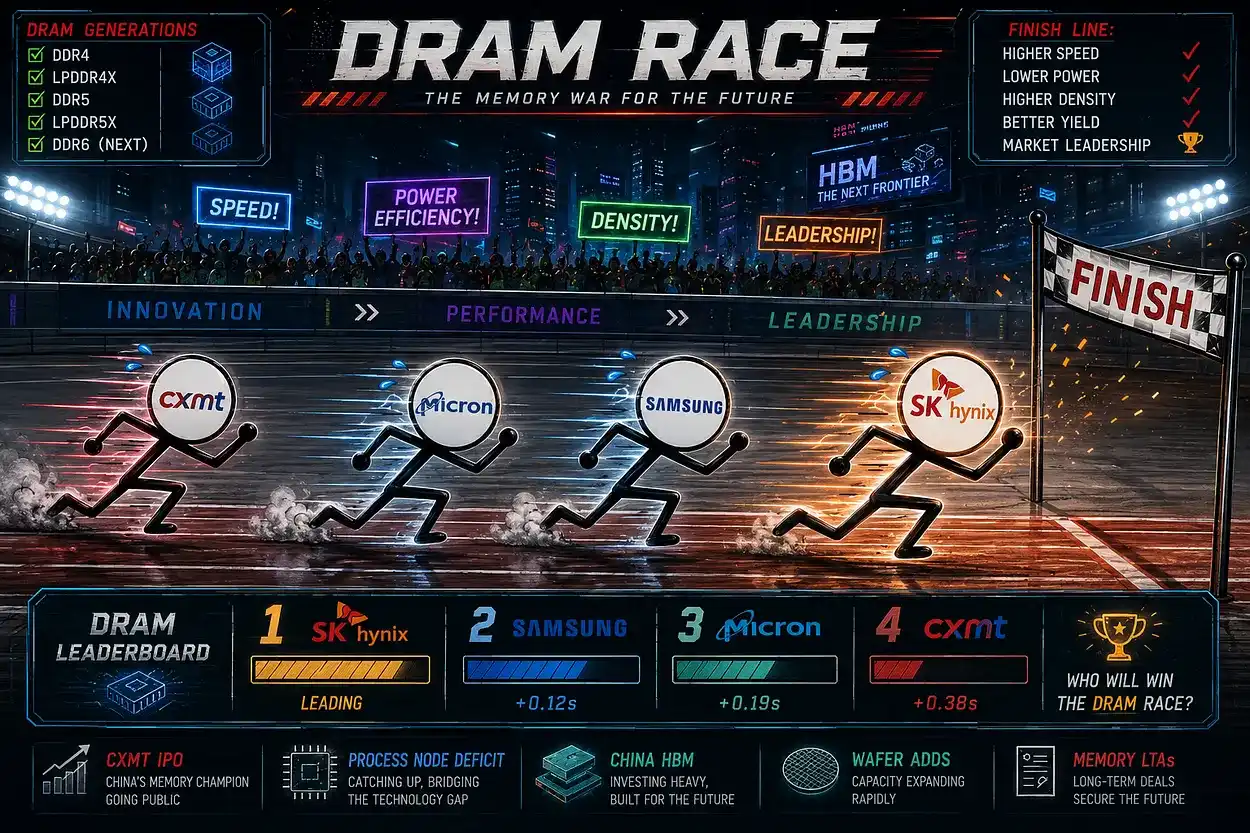
SemiAnalysis' in-depth report on ChangXin Memory Technologies (CXMT) details its rapid rise as China's largest upcoming semiconductor IPO. Founded in 2016 by Zhu Yiming, CXMT built its DRAM foundation on acquired patents and talent from the bankrupt German firm Qimonda. It achieved its first annual profit in 2025 after nearly a decade of significant capital support, primarily from patient Hefei municipal investors who fostered a local supply chain.
The company is now capitalizing on a strong DRAM supercycle. Its revenue soared from ~$3.3B in 2024 to ~$8.6B in 2025, with Q1 2026 alone reaching ~$7.3B. SemiAnalysis projects full-year 2026 revenue could exceed $50B, driven by soaring ASPs rather than massive market share gains. While CXMT is closing the capacity gap with Micron, its product mix remains heavily focused on commodity DDR/LPDDR, which currently offers higher margins than its nascent HBM business.
CXMT faces significant challenges in HBM, struggling with yield and stability for HBM3 8-Hi stacks while lagging behind the big three (Samsung, SK Hynix, Micron) in advanced nodes. However, strategic national priorities for AI self-sufficiency may push it to accelerate HBM capacity. Its complex IPO structure reveals heavy state-backed ownership and voting control over its fabs, with Alibaba appearing as both a key cloud customer and a minority shareholder. The IPO aims to raise ~$4.1B, primarily to strengthen its core DRAM manufacturing base.
marsbit5天前
Threads
Welcome to the HTX Community. Here, you can stay informed about the latest platform developments and gain access to professional market insights. Users' opinions on the price of Raydium (RAY) are presented below.
Related Questions
Welcome to the Crypto FAQ. Users' questions and answers on Raydium (RAY) are presented below.