The live price of DAO Maker (DAO) is $0.02 USD and its current market capitalization is $-- USD.
Get real-time DAO/USD updates on HTX. Stay informed with the latest data and market trends to make smart trading decisions. HTX, your trusted source for accurate cryptocurrency price information.
Track DAO Maker price movements with chart views spanning 1 day, 30 days, 60 days, 90 days, 1 year, and the period since it was listed on HTX.View more data for the DAO Maker prices
Time
Change
Change%
Highest Price
Lowest Price
No data
DAO Market Information
Get the latest DAO Maker price details on HTX: 24-hour high and low, all-time high (ATH), and daily price change percentage.
24h Low
$0
24h High
$0
All-Time High
$0
Market Cap
$0.00
24h Volume (USD)
$--
Circulating Supply
--
What is DAO?
DAO Maker is a platform that aims to redefine venture capital for the masses, by providing scalable technologies and funding support to tokenized startups. This venture capital fund was first conceptualized in 2017. It has since evolved to create low turnout frameworks, which has enabled many retail investors and individuals to become active in venture capital. When funding through DAO Maker, the risks for both parties – the investors and the startups – are significantly reduced.
It's super easy to buy DAO on HTX. Simply click here to view a complete guide to buying DAO Maker with ease.
Real-Time DAO Markets
View real-time DAO Maker prices on HTX's spot markets. Switch between spot and futures markets to instantly compare live prices and 24-hour price changes.
Based on the historical performance of DAO Maker, our prediction tool estimates that the price of DAO Maker (DAO) could reach -- by --.
Predicted DAO Price in --
Our most recent forecast indicates the price of DAO Maker (DAO) will increase to -- by --, with a price change of --% and a cumulative ROI of approximately --%.
Buy your first DAO on HTXSign Up
DAO FAQs
QWhat is the DAO Maker (DAO) price today?
AThe current price of DAO Maker (DAO) is $0.02 USD.
QWhat is the DAO Maker (DAO) market cap?
AThe current market capitalization of DAO Maker (DAO) is $0.00 USD, calculated by multiplying its circulating supply by its current price.
QWhat is the DAO Maker (DAO) circulating supply?
AThe current circulating supply of DAO Maker (DAO) is -- DAO.
QWhat is the DAO Maker (DAO) all-time high?
AAs of 2026-07-06, the all-time high of DAO Maker (DAO) is $0 USD.
QWhat is the DAO Maker (DAO) 24h trading volume?
AThe 24-hour trading volume of DAO Maker (DAO) is -- USD on HTX.
QCan I buy DAO Maker (DAO) on HTX?
AYes, HTX offers industry-leading trading fees and deep liquidity, ensuring a smooth and secure DAO Maker (DAO) purchase experience.
A group of activist investors, often labeled as "treasury raiders," have submitted proposal GIP-150 to Gnosis DAO, calling for a one-time, voluntary, and proportional treasury redemption. The proposal would allow participating GNO holders to claim a share of the over $220 million in DAO reserves. Proponents argue this addresses the persistent and widening discount of GNO's market price relative to the treasury's net asset value. Despite recent DAO funding to Gnosis Ltd., the discount has increased.
The current vote, closing May 12th, shows 65% opposition among early votes. The redemption would value each eligible token around $170, a ~30% premium to the current $131 market price. GNO held by Gnosis Ltd. is excluded.
DeFi community reactions are mixed. Some commentators acknowledge the "risk-free value" (RFV) arbitrage logic but criticize the proposal as a short-term cash grab lacking legitimacy, as Gnosis never promised treasury backing for the token price. Others oppose it due to Gnosis's contributions to ecosystem infrastructure (Safe, CoW Swap, etc.). Founder Sebastian Bürgel lamented the targeting of respected builders. Aragon's team, previously targeted in similar RFV campaigns, called for better mechanisms to align incentives.
This follows a pattern of 2023 RFV-style actions against projects like Rook and Aragon. Recently, Beefy Finance implemented a buyback to preempt such pressure. The proposal's author, Wismerhill, expressed past admiration for Gnosis but now sees this vote as a test of whether holders prioritize short-term arbitrage or long-term ecosystem value.
On May 26th, Kelp DAO successfully transferred its final batch of rsETH, completing the 37-day process of fully backing rsETH 1:1 after a security incident. However, the resolution came at a significant cost to Aave. The protocol's TVL plummeted by over $12 billion in the following month. Furthermore, a separate legal battle over 30,766 frozen ETH continues in court, posing ongoing reputational risk.
The recovery was enabled by an unprecedented, one-time coalition dubbed "DeFi United," involving major contributions from Aave's founder, treasury, Consensys, Mantle, and others. Despite this, the event triggered a major outflow of funds, with whales like Justin Sun moving capital to competitors like Spark.
Aave's path to regaining its position relies heavily on the successful execution of its multi-pronged strategy. Its new V4 protocol, designed for open, heterogeneous asset markets, faces delays due to internal governance disputes. Meanwhile, the V3 version remains the core revenue generator, and the permissioned Horizon fork is targeting institutional RWA (Real-World Assets) growth—a segment less impacted by the rsETH incident but dependent on traditional finance adoption timelines.
The key takeaway is that while the immediate bad debt was covered, Aave paid a steep price in lost trust and capital. Recovering market share depends on accelerating V4's rollout and advancing its institutional RWA offerings, both of which face external and internal hurdles. The "DeFi United" safety net is unlikely to be replicable for future crises.
Title: Kelp DAO Exploit Triggers $15 Billion Exodus, Exposing a Clash Between Two DeFi Lending Models.
In April 2026, a hacker exploited a LayerZero bridge vulnerability in the Kelp DAO project, minting $292 million in fake rsETH tokens. These were deposited into Aave as collateral to borrow real Ethereum, draining the protocol's liquidity. Within three and a half days, Aave saw $15 billion in deposits flee, forcing a costly $160 million bailout. The root cause was identified as Aave's governance, which had previously voted to set rsETH's loan-to-value ratio to a risky 93%, leaving minimal safety margin.
This incident starkly contrasts with the experience of Morpho, the second-largest DeFi lending protocol. Some fake rsETH also flowed into Morpho, but the exposure was limited to $1 million across isolated, pre-configured markets, preventing systemic contagion.
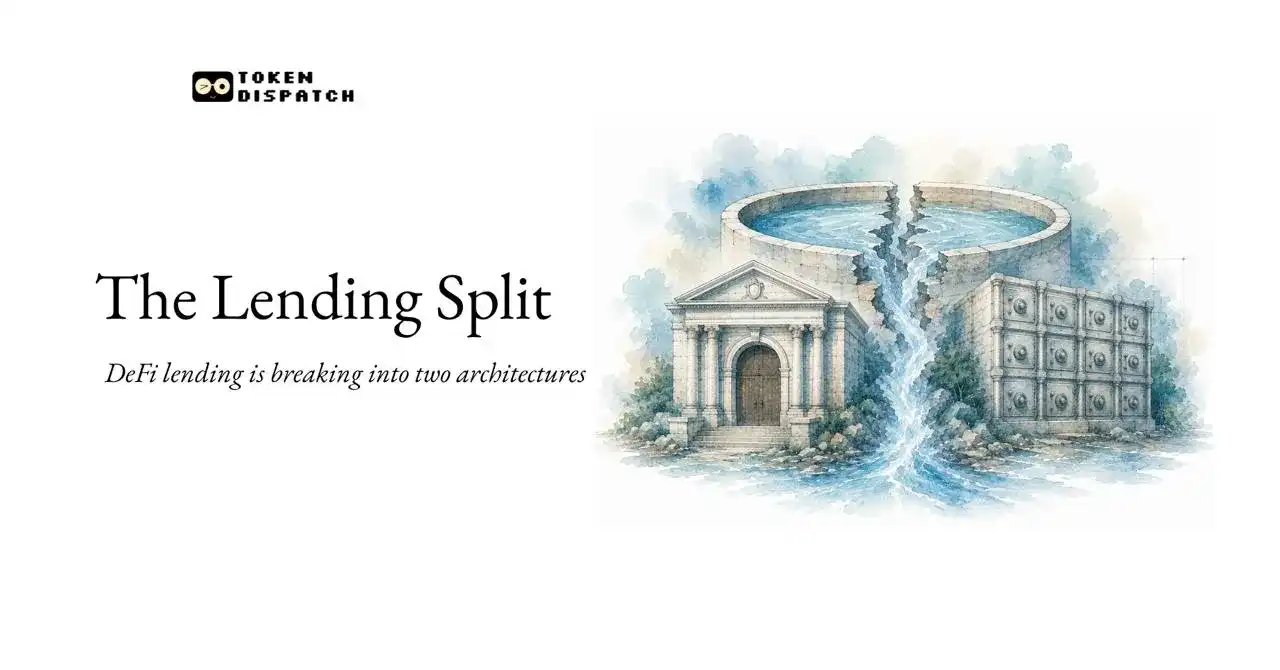
The event highlights a fundamental divergence in DeFi lending architectures. Aave employs a shared liquidity pool model, where all deposits back all approved collateral assets, governed by DAO vote. This creates systemic risk, as seen when even users who never interacted with rsETH faced frozen funds. Furthermore, Aave's governance, influenced by leveraged borrowers, prioritized their interests during the crisis, even lowering borrowing rates for frozen markets at the expense of safer depositors. Its supplemental insurance mechanism, Umbrella, also failed as providers withdrew capital when needed.
Morpho operates on an isolated market model. Anyone can create a separate lending market with fixed parameters (collateral, loan asset, oracle, rates). Independent risk managers (curators) allocate capital to these markets, bearing losses within their own vaults if they occur. This structure prevents risk from spreading and removes governance conflicts, as curators' decisions are not subject to community override.
Beyond crisis management, the shared pool model carries a hidden cost: idle capital. In Aave's core markets, the spread between borrowing and deposit rates represents unusable funds, costing an estimated $52 million annually in lost value. Morpho's model targets a higher utilization rate (90% vs. Aave's 60-80%) because it eliminates rehypothecation risk, dynamically adjusting rates to balance supply and demand without governance delays. Consequently, Morpho often offers higher net yields to depositors.
Institutional adoption underscores this difference. Major players like Coinbase (powering its lending for over 100M users), Apollo Global Management, Anchorage Digital, and SG-FORGE (Societe Generale) have chosen to build on Morpho. They require compliant, self-controlled risk parameters that Aave's community-governed model cannot provide. This trend is amplified by regulations like the proposed US GENIUS Act, which will push stablecoin issuers to seek neutral, controllable infrastructure like Morpho to manage trillions in reserve assets.
Investigations into the 2026 exploits of Kelp DAO and Humanity Protocol have revealed that stolen funds from both attacks were recently commingled, suggesting a connection between the attackers. Blockchain analyst ZachXBT identified the activity, where 15,403 ETH ($23.6 million) from the Humanity Protocol hack was moved to a new Ethereum address and then to the Bitcoin network, merging with proceeds from the Kelp DAO exploit. Over $8 million of these funds has been laundered using methods associated with groups like the Lazarus Group. The Kelp DAO attack drained about $292 million in April 2026, while Humanity Protocol lost around $32 million in June due to a compromised developer device. This commingling points to a shared external threat actor and highlights ongoing security risks in DeFi.
On June 29th, the ENS community entered the on-chain voting phase for a proposal to renew the ENS DAO Security Council's veto power for two more years. Shortly after voting began, ENS founder Nick Johnson used his substantial ENS holdings to cast over 3.55 million votes against the proposal, swinging the outcome despite initial strong support.
The Security Council was established in July 2024 with a 4/8 multisig veto power to protect the DAO's treasury (valued over $350 million) from malicious proposals during a period of low voter participation. Its powers were limited to vetoing only harmful proposals, not normal ones.
Nick Johnson's opposition stems from broader concerns about ENS DAO's governance. In late 2025, he and others expressed frustration that the DAO had become mired in political gamesmanship, with capable contributors leaving and leadership falling to less experienced or misaligned parties. This context set the stage for a major restructuring proposal by ENS COO Katherine Wu on June 19th, titled "Next Era of ENS DAO: Empowering the ENS Foundation."
The controversial proposal aims to transfer daily operations, treasury management, and long-term strategy to a restructured ENS Foundation with a professional board, while the DAO would retain core protocol governance powers. Critics, including original ENS constitution author Brantly Millegan, argue this effectively transfers treasury control from token holders to ENS Labs (the core development team), undermining the DAO's original decentralized design.
Nick's massive "no" vote on the Security Council renewal is seen as the first move in this power struggle. He explained his vote was due to concerns about insufficient checks on the Council's power and the potential for its veto to be used politically. In response, Katherine Wu submitted a revised proposal with higher execution thresholds (5/8 instead of 4/8) and stricter limits.
The push for change comes as ENS's annual revenue has declined significantly, from over $10 million in 2023 to under $2 million in 2025, increasing pressure to manage the treasury more effectively. Nick Johnson now faces the challenge of proving that a more structured foundation can steer ENS better than the current DAO model.
Foresight News4天前
Threads
Welcome to the HTX Community. Here, you can stay informed about the latest platform developments and gain access to professional market insights. Users' opinions on the price of DAO Maker (DAO) are presented below.
Related Questions
Welcome to the Crypto FAQ. Users' questions and answers on DAO Maker (DAO) are presented below.