The live price of Quickswap (QUICK) is $0.0075 USD and its current market capitalization is $-- USD.
Get real-time QUICK/USD updates on HTX. Stay informed with the latest data and market trends to make smart trading decisions. HTX, your trusted source for accurate cryptocurrency price information.
Track Quickswap price movements with chart views spanning 1 day, 30 days, 60 days, 90 days, 1 year, and the period since it was listed on HTX.View more data for the Quickswap prices
Time
Change
Change%
Highest Price
Lowest Price
No data
QUICK Market Information
Get the latest Quickswap price details on HTX: 24-hour high and low, all-time high (ATH), and daily price change percentage.
24h Low
$0
24h High
$0
All-Time High
$0
Market Cap
$0.00
24h Volume (USD)
$--
Circulating Supply
--
What is QUICK?
Quickswap is a decentralized exchange (DEX) on the Polygon Network. It is a based on the Uniswap V2 AMM protocol and allows users on Polygon to trade tokens through a liquidity pool.
It's super easy to buy QUICK on HTX. Simply click here to view a complete guide to buying Quickswap with ease.
Real-Time QUICK Markets
View real-time Quickswap prices on HTX's spot markets. Switch between spot and futures markets to instantly compare live prices and 24-hour price changes.
Based on the historical performance of Quickswap, our prediction tool estimates that the price of Quickswap (QUICK) could reach -- by --.
Predicted QUICK Price in --
Our most recent forecast indicates the price of Quickswap (QUICK) will increase to -- by --, with a price change of --% and a cumulative ROI of approximately --%.
Buy your first QUICK on HTXSign Up
QUICK FAQs
QWhat is the Quickswap (QUICK) price today?
AThe current price of Quickswap (QUICK) is $0.0075 USD.
QWhat is the Quickswap (QUICK) market cap?
AThe current market capitalization of Quickswap (QUICK) is $0.00 USD, calculated by multiplying its circulating supply by its current price.
QWhat is the Quickswap (QUICK) circulating supply?
AThe current circulating supply of Quickswap (QUICK) is -- QUICK.
QWhat is the Quickswap (QUICK) all-time high?
AAs of 2026-07-09, the all-time high of Quickswap (QUICK) is $0 USD.
QWhat is the Quickswap (QUICK) 24h trading volume?
AThe 24-hour trading volume of Quickswap (QUICK) is -- USD on HTX.
QCan I buy Quickswap (QUICK) on HTX?
AYes, HTX offers industry-leading trading fees and deep liquidity, ensuring a smooth and secure Quickswap (QUICK) purchase experience.
Snowball, a new meme token launched on pump.fun on December 18, gained significant traction in the English-speaking crypto community by introducing an automated market-making mechanism designed to create a self-sustaining "snowball effect." Unlike typical meme coins where creators take a fee (usually 0.5%-1%) from each transaction, Snowball redirects 100% of this fee to an on-chain bot. This bot uses accumulated funds to buy back tokens, add liquidity to the pool, and burn a small portion of tokens periodically. The goal is to create continuous buy pressure and improve trading depth, theoretically allowing the token to grow organically through increased trading activity.
Within four days, Snowball reached a $10 million market cap with over 7,000 holders and relatively decentralized ownership. However, the mechanism relies heavily on sustained trading volume to fuel the buyback bot. In a cold market with low on-chain activity, this "flywheel" could reverse if new buyers diminish. While the structure reduces developer exit risk, it doesn’t eliminate other meme coin dangers like large holder dumps or narrative fatigue. Similar projects like FIREBALL are emerging, indicating interest in "mechanism-driven memes," but past examples like OlympusDAO and Safemoon show that mechanisms alone don’t guarantee long-term value. Snowball remains primarily a meme experiment—interesting, but high-risk.
The meme token Snowball" launched on pump.fun on December 18 and gained significant traction in the English-speaking crypto community, reaching a $10 million market cap within four days while largely flying under the radar in Chinese crypto circles.
Its core innovation is an automated market-making mechanism: instead of the typical "creator fee" (usually 0.5%–1% per transaction) going to the developer’s wallet—a common setup that often leads to rug pulls—Snowball directs 100% of this fee to an on-chain bot. This bot periodically:
1. Buys back tokens to create buy pressure,
2. Adds the purchased tokens and corresponding SOL to the liquidity pool to improve depth,
3. Burns 0.1% of tokens to induce deflation.
The fee rate also adjusts dynamically based on market cap (0.05%–0.95%) to balance accumulation and transaction friction. The idea is a "snowball effect": trading generates fees → fees fuel buybacks → buybacks may push price up → higher prices attract more trading.
On-chain data shows 7,270 holders, with the top 10 holding ~20% of supply. Trading volume has been relatively balanced between buys and sells. However, the token remains highly speculative. While the structure reduces dev exit risk, it doesn’t eliminate other meme coin risks like low liquidity, narrative fatigue, or large holder dumps.
Similar projects like FIREBALL are emerging, suggesting a trend toward "mechanism-driven memes." But as past examples like OlympusDAO and Safemoon show, complex tokenomics alone don’t guarantee sustainability—external demand and market conditions remain critical.
In short: Snowball is a meme first and an experiment second. Its mechanism is interesting, but it doesn’t change the high-risk, speculative nature of meme coins.
Coinbase has significantly expanded its ecosystem in 2025 through a series of strategic acquisitions, aiming to build an "Everything Exchange." Key acquisitions include:
- **Roam** (on-chain browser/search engine)
- **Spindl** (on-chain advertising platform)
- **Iron Fish** team (privacy layer, team-only acquisition)
- **Deribit** ($2.9B, major derivatives platform)
- **Liquifi** (token management)
- **Opyn** team (DeFi options, talent acquisition)
- **Sensible** founders (yield platform, later shut down)
- **Echo** ($375M, launchpad platform by Cobie)
- **Vector.fun** (Solana DEX, to enhance cross-chain trading)
- **The Clearing Company** (prediction markets)
Most deals were undisclosed talent/team acquisitions, focusing on integrating expertise rather than tokens or legacy systems. The strategy emphasizes consolidating services—spanning spot, derivatives, DeFi, privacy, and prediction markets—into a unified platform. This aligns with CEO Brian Armstrong's vision of a one-stop "Exchange Everything" model, strengthening Coinbase's competitive position against rivals like Binance and OKX.
**Summary: A History of Web3 Airdrop "Rug Pulls" – 12 Iconic Cases**
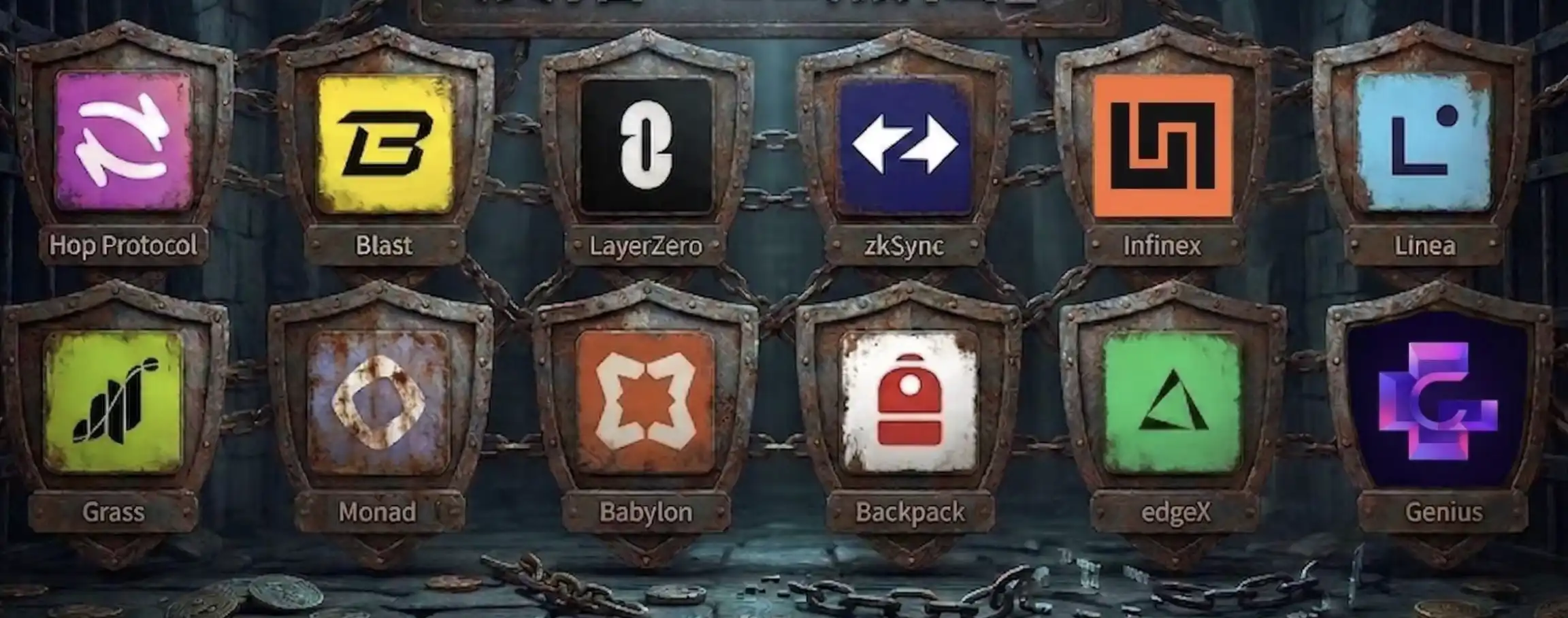
The era of Web3 airdrops has shifted from a golden age of mutual benefit between early users and projects to a landscape dominated by systematic exploitation. This article reviews 12 infamous "anti-airdrop" projects that eroded user trust:
1. **Hop Protocol (HOP):** Pioneered a "community witch-hunt" model, encouraging users to report Sybil addresses to claim their rewards, fostering a toxic environment of mutual harm.
2. **Blast:** Introduced the exploitative "points system," locking user funds for meager returns that often underperformed risk-free yields, turning airdrop hunting into a rigged casino.
3. **LayerZero (ZRO):** After 18 months of user-funded gas fees, it implemented a harsh "guilty until proven innocent" Sybil filter, forcing users to "self-confess" or face zero rewards, destroying multi-chain interaction narratives.
4. **zkSync (ZK):** Prioritized "funds held at a specific time" over long-term activity, betraying early contributors who spent significant gas and rewarding insiders, crushing L2 airdrop expectations.
5. **Infinex:** Lured users with NFT and point systems, only to announce a high FDV, a mandatory 1-year lockup, and chaotic rules at its public sale, betraying its community.
6. **Linea:** Perfected user exploitation with endless, grueling Galxe Odyssey tasks and KYC requirements, reducing airdrop hunting to a low-wage, full-time job.
7. **Grass:** Exploited users' physical resources (bandwidth/IP) for DePIN data, rewarding them with tokens worth less than the electricity and proxy costs incurred.
8. **Monad:** Allocated a mere ~3.3% of its airdrop to the community after extensive testnet participation, favoring KOLs and insiders and dampening enthusiasm for new L1s.
9. **Babylon:** Forced Ethereum-style staking onto Bitcoin, causing users massive losses from failed transactions due to high fees and network congestion, damaging trust in L2s.
10. **Backpack:** Encouraged massive trading volume for points, then applied strict KYC and Sybil rules last minute, resulting in massive losses for users and cementing a negative stereotype for projects with Chinese founders.
11. **EdgeX:** Perpetual DEX users lost significant fees for minimal rewards, while "insider" addresses received enormous allocations, exposing blatant corruption and killing the Perp DEX airdrop narrative.
12. **Genius:** The final straw: users were forced to choose between immediately claiming only 30% of their airdrop, locking tokens for a year for 100%, or a 100% burn for a gas fee refund, shattering trust in "elite-backed" narratives.
**Conclusion** marks the painful end of the airdrop era. This collective "rug pull" was a co-created disaster of speculation and greed. The collapse, while brutal, forces a return to fundamentals: sustainable products with real product-market fit are paramount. This is not just the end of airdrops but a potential rebirth for Web3, weeding out exploitative projects and rewarding those that build genuine community value.
In a significant U.S. federal case, 22-year-old Saif Faiq of Missouri pleaded guilty to conspiracy to commit Hobbs Act robbery, related to an attempted Bitcoin theft and the kidnapping of two individuals in Danbury, Connecticut. Prosecutors state the 2024 plot targeted the parents of a person involved in a separate large-scale Bitcoin theft, intending to use them as hostages to coerce the transfer of crypto assets. Faiq's role involved recruiting accomplices and surveillance. This case, involving a Lamborghini Urus carjacking, exemplifies the growing threat of "wrench attacks"—physical violence and coercion to steal cryptocurrency—where a holder's family, vehicles, and visible wealth become targets.
The guilty plea, alongside that of co-conspirator Adam Iza, marks the formal entry of such crypto-related violent crimes into the U.S. federal judiciary. It highlights that while blockchain technology itself is secure, the human endpoint is vulnerable. Attackers leverage personal connections and luxury items as indicators of crypto wealth to plan kidnappings and extortion.
Though this case occurred in the U.S., Europe remains the epicenter for such attacks. CertiK's 2026 report notes 34 confirmed wrench attacks in the first four months of 2026, with 82% occurring in Europe, primarily France, causing an estimated $101 million in losses. The Danbury case serves as a stark warning for crypto holders globally: operational security must now extend beyond digital threats to include physical safety, privacy of personal information, and protection of family members from becoming leverage in extortion schemes. Faiq's sentencing on August 28 will be a key indicator of the judicial response to this emerging crime pattern.
marsbit29天前
Threads
Welcome to the HTX Community. Here, you can stay informed about the latest platform developments and gain access to professional market insights. Users' opinions on the price of Quickswap (QUICK) are presented below.
Related Questions
Welcome to the Crypto FAQ. Users' questions and answers on Quickswap (QUICK) are presented below.