Zora Launches Solana-Based Attention Markets to Revolutionize Trend Trading

TheNewsCryptoОпубліковано о 2026-02-18Востаннє оновлено о 2026-02-18

Анотація

On February 17, Zora launched "attention markets" on the Solana blockchain, marking a significant shift from its previous Ethereum and Base-based operations. This new product enables users to trade tokens based on internet trends and social media topics, allowing them to buy or sell based on whether they believe a trend will grow or fade. Anyone can create a new market by paying a 1 SOL fee. Initial trading activity was limited, with tokens like bitcoin, cats, and dogs among the first trends. The main token reached a market value of around $70,000. The crypto community had mixed reactions, with some supporting the move to Solana and others questioning the departure from Ethereum. While experts warn of high risk due to low liquidity and potential volatility, supporters see it as an innovative way to measure public interest by blending social media trends with on-chain trading.

On February 17, Zora launched a new product called “attention markets” on the Solana blockchain, and the launch was announced by both Zora and Solana. This move from Zora marked a major shift from NFTs and Ethereum-based tools to Solana, which is known for its faster transactions and lower fees.

What is the attention market?

Attention markets basically allow users to trade based on internet trends. Instead of betting on the financial markets, users can now bet on the topics or memes that they believe will become popular on social media and can buy the token of it. If they think it will fade, then they can sell it. Anyone can create a new market trend by paying a 1 SOL fee. Once they are created, users can trade in the market and close the positions at any time.
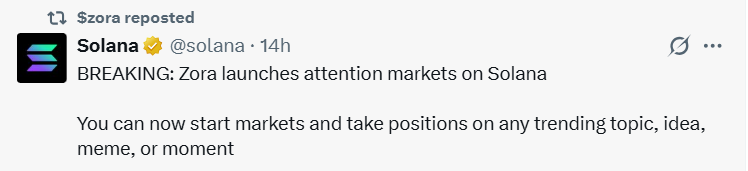
Image Source: https://x.com/solana/status/2023799108545503709

Once after the launch, the initial trading activity has been limited. Some of the feisty trending markets included bitcoin, cats, dogs, and attention markets. The main attention market’s token reached the market value of around $70,000 with a trading volume of $200,000 after the launch. Analysts noted that some of the tokens showed sharp gains, and the liquidity remained limited.

Mixed reactions to this Launch

This launch received mixed comments from the crypto community. Some users have supported Zora’s move to Solana, but others questioned the shift from Ethereum and Base, where Zora originally built its ecosystem. Following this launch, Zora’s native token rose more than 5% and is trading near $0.022.

Right now, Zora is entering the competitive market, and experts describe attention markets as high risk when trading volume is low because the low liquidity can lead to sharp price swings and volatility. However, supporters believe this model could be a new way to measure the public interest. This move from Zora aims to blend the social media interest with in-chain trading.

Highlighted Crypto News:

‌World Liberty Financial (WLFI) Posts 18% Surge: Are Buyers Taking the Driver’s Seat?

TagsSolanaZora

Пов'язані питання

QWhat is the main purpose of Zora's newly launched 'attention markets' on Solana?

AAttention markets allow users to trade based on internet trends, enabling them to buy tokens representing topics or memes they believe will gain popularity on social media or sell them if they think they will fade.

QWhy did Zora's move to launch on Solana attract mixed reactions from the crypto community?

ASome users supported the shift to Solana for its faster transactions and lower fees, while others questioned Zora's departure from Ethereum and Base, where it originally built its ecosystem.

QWhat was the initial trading activity and market performance like for attention markets after launch?

AInitial trading activity was limited. The main attention market's token reached a market value of around $70,000 with a trading volume of $200,000, with some tokens showing sharp gains but liquidity remained low.

QWhat is the risk associated with trading on these attention markets according to experts?

AExperts describe attention markets as high risk when trading volume is low because the low liquidity can lead to sharp price swings and high volatility.

QHow can a user create a new market trend on Zora's attention markets platform?

AAnyone can create a new market trend by paying a fee of 1 SOL.

Пов'язані матеріали

Splashing Out 27 Billion Yuan, OpenAI Establishes New Company to Accelerate AI Deployment

On May 11th, OpenAI announced the formation of a new company, "OpenAI Deployment Company," with an initial investment of over $4 billion (approximately 27.2 billion RMB). This venture aims to help businesses build and deploy AI solutions. OpenAI is also acquiring the AI consulting firm Toromo to rapidly scale the deployment company's capabilities. This new entity, majority-owned by OpenAI, brings together 19 investment, consulting, and system integration partners, led by TPG with co-lead founding partners including Advent International, Bain Capital, and Brookfield. OpenAI's Chief Revenue Officer, Denise Dresser, stated that while AI is becoming increasingly capable, the current challenge lies in integrating these systems into core business infrastructure and workflows. The deployment company is designed to bridge this gap and translate AI capabilities into operational impact. This move comes as OpenAI emphasizes the next competitive phase will depend on the efficiency of deploying AI in real business scenarios. The company reports over 1 million businesses already use its products and APIs. OpenAI is significantly increasing its investments in computing power, with co-founder Greg Brockman stating the company expects to spend $50 billion on compute this year, a dramatic increase from $3 million in 2017. The announcement follows OpenAI's recent completion of a record $122 billion funding round in late March, led by Amazon, Nvidia, and SoftBank, valuing the company at $852 billion post-money. Major strategic investors committed $110 billion as a base for this round. Concurrently, OpenAI is advancing its core model development. It has shifted focus from its Sora video generator to developing advanced robotics and AI models that interact with the physical world. It has also begun allowing select users access to a new model specialized in identifying software vulnerabilities and is reportedly preparing to launch an enhanced image generation model in the coming weeks. According to reports citing founder Sam Altman, OpenAI is considering an IPO as early as 2027, with a potential valuation around $1 trillion.

marsbit6 хв тому

Splashing Out 27 Billion Yuan, OpenAI Establishes New Company to Accelerate AI Deployment

marsbit6 хв тому

The Essence of AI Layoffs: Why More AI Adoption Leads to More Corporate Anxiety?

The author, awaiting potential inclusion on an 8000-person layoff list, analyzes the true nature of recent "AI-driven" layoffs. They argue that while AI use, particularly tools like Claude for code generation, has skyrocketed and boosted developer output (e.g., 2-5x more code commits), this has not translated into proportional business growth or revenue. The core issue is a misalignment between increased "Input" (code) and tangible "Outcomes" (user value, revenue). AI acts as a costly B2B SaaS, inflating operational expenses without guaranteed returns. Two key problems emerge: 1) The friction that once filtered out bad ideas is gone, as AI allows cheap pursuit of even weak concepts. 2) Organizational "alignment tax"—the difficulty of coordinating across teams—becomes crippling when development velocity outpaces consensus-building. Thus, layoffs serve two immediate purposes: 1) To offset ballooning AI costs (Token consumption) and maintain cash flow, as rising input costs without outcome growth destroys unit economics. 2) To reduce organizational bloat and alignment friction by simply removing teams, thereby speeding up execution in the short term. Therefore, these layoffs are fundamentally caused by AI, even if AI doesn't directly replace roles. They represent a painful correction until companies learn to convert AI-driven productivity into real business outcomes and streamline organizational coordination to match the new pace of work. The cycle will continue until this learning curve is mastered.

marsbit1 год тому

The Essence of AI Layoffs: Why More AI Adoption Leads to More Corporate Anxiety?

marsbit1 год тому

Торгівля

Спот
Ф'ючерси
活动图片