Zhou Hang: How Much is SpaceX Really Worth?

marsbitОпубліковано о 2026-06-02Востаннє оновлено о 2026-06-02

Анотація

Summary: Author Zhou Hang argues that while SpaceX is arguably one of the greatest industrial companies of the past 50 years, its anticipated IPO valuation of approximately $1.75 trillion is likely overvalued by about $1.25 trillion. The analysis acknowledges SpaceX's monumental success in slashing launch costs, achieving near-monopoly in commercial launches, and building the Starlink satellite internet constellation. However, using a projected 2030 revenue of $50-80 billion and applying a generous tech company valuation multiple yields a "reasonable" valuation range of only $500 billion to $1.2 trillion. The $1.25 trillion gap stems from premiums for its long-term vision (e.g., Starship, space-based computing), its status as a U.S. strategic national asset, and retail investor enthusiasm driven by the Elon Musk narrative. The article outlines three post-IPO scenarios: valuation solidification (25% probability), sideways consolidation (50%), or a correction to fundamental value (25%). The probability-weighted expected valuation is $1.3-1.5 trillion, suggesting negative expected returns for buyers at the IPO price. The conclusion cautions investors to separate the company's undeniable greatness from the stock's price, advising against chasing the IPO and to wait for key milestones or a lower entry point.

Author: Zhou Hang

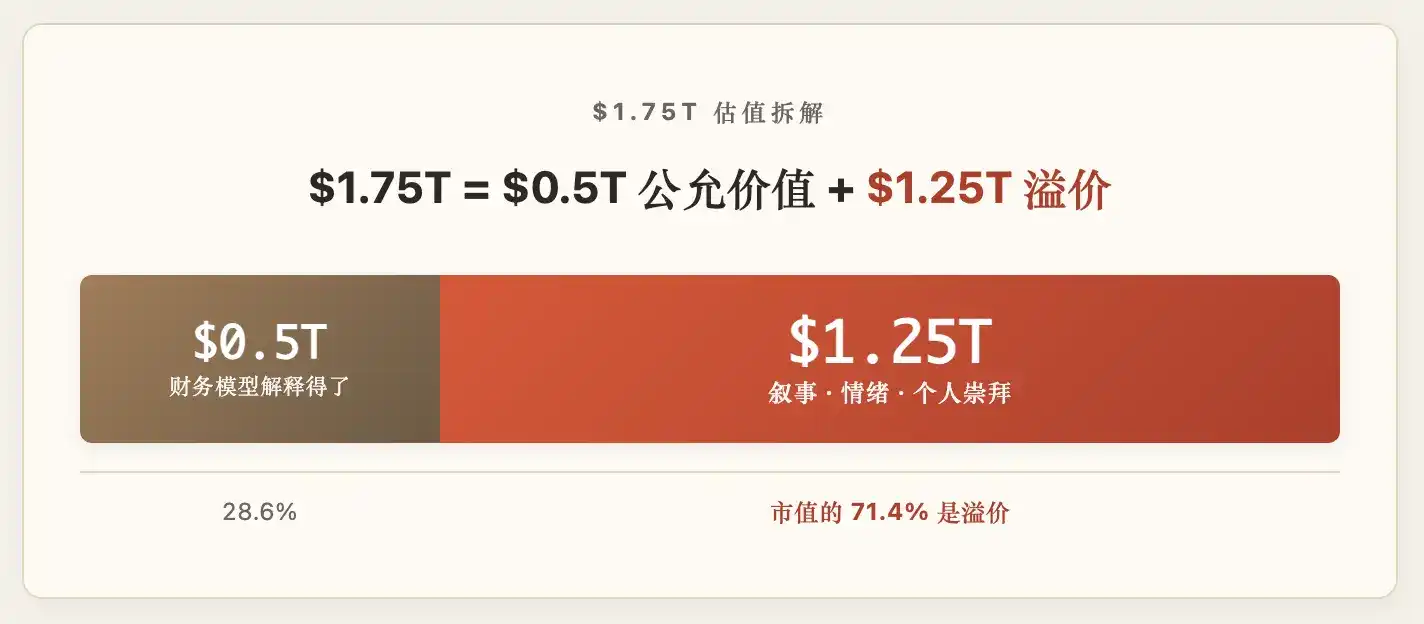
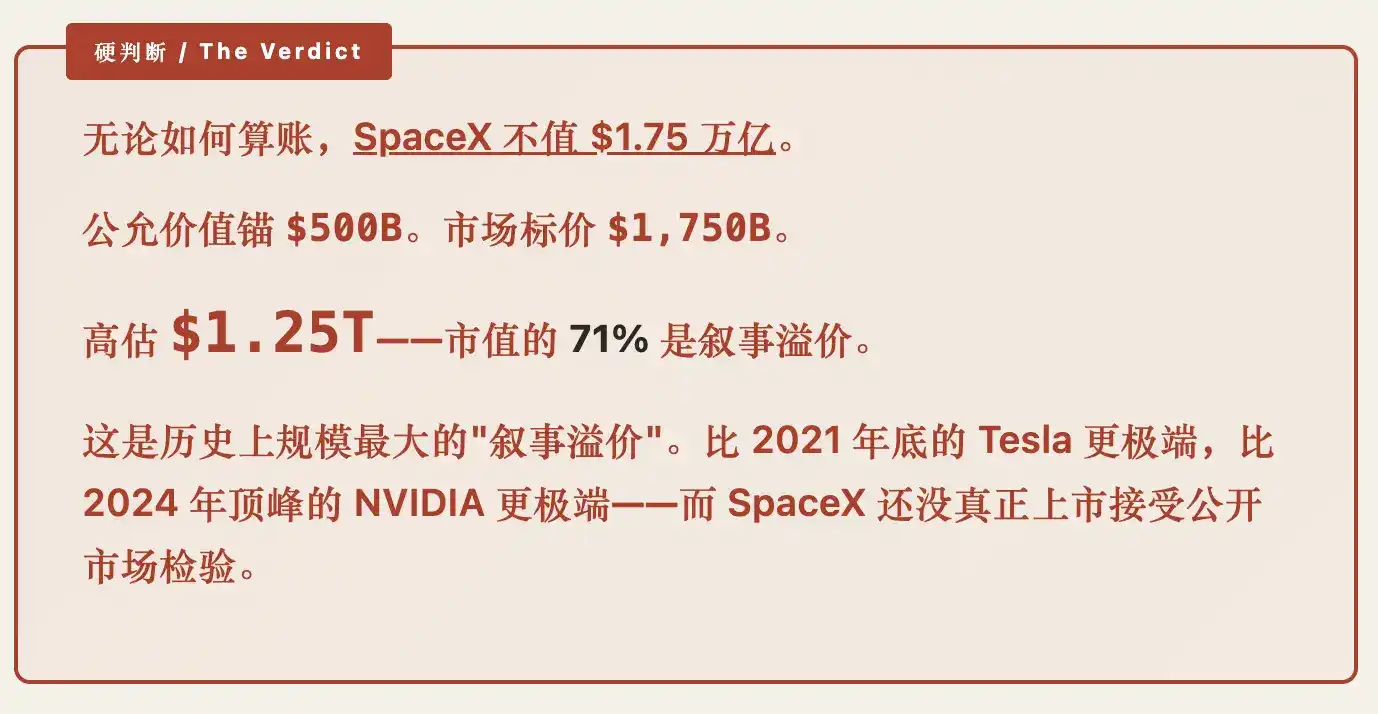
SpaceX may be overvalued by $1.25 trillion around its IPO.

This is not to deny SpaceX's greatness. On the contrary, anyone seriously discussing SpaceX must first acknowledge: it is likely one of the greatest industrial companies of the past 50 years.

But the greatness of a company and whether a stock is worth buying at any price are two completely different things.

SpaceX can simultaneously be "the greatest industrial entity of the 21st century" and also a "severely overvalued investment target." These two things are not mutually exclusive.
First, Acknowledge Its True Greatness

Any honest discussion about SpaceX's valuation must start with this statement: It is the most successful industrial company of the past 25 years, bar none—even more successful than Tesla. This is not mere praise; it is a fact of engineering economics.

Tesla disrupted a 150-year-old mature industry—automobiles. Its rivals are Mercedes-Benz, Ford, Toyota. These opponents are certainly not weak, but they are commercial companies, not backed by national interests, lacking political barriers; competition is essentially about product, brand, supply chain.

SpaceX disrupted a 60-year-old state-monopolized industry—space. Its rivals are NASA, Roscosmos, ESA, CNSA. This is an entirely different level of difficulty: higher engineering barriers, greater capital density, more complex regulation, deeper entanglement with national interests. When Musk founded SpaceX in 2002, the entire space industry was essentially an extension of national missions; commercial companies were not believed capable of building rockets, let alone rockets cheaper than national ones.

Over 20 years later, SpaceX slashed launch costs from $54,500/kg in the Space Shuttle era to $1,500/kg—a 36-fold reduction. It now launches 165 times a year, one company exceeding the total launch count of all other nations and all commercial players combined. It built humanity's first truly reusable rocket, a single Falcon 9 first stage flying 32 times, with a success rate exceeding 99%. It established the world's first global satellite internet—covering over a billion users, becoming a decisive strategic asset on the first day of the Ukraine war.

Tesla in 2025 still faces fierce competition from Chinese EVs; SpaceX's share in the global commercial launch market, is nearing monopoly.

SpaceX is a great company, perhaps the greatest industrial company on Earth in the past 50 years. Any critique of its valuation must first acknowledge this fact.

What Does $1.75 Trillion Mean?

Let's understand through a set of comparisons:
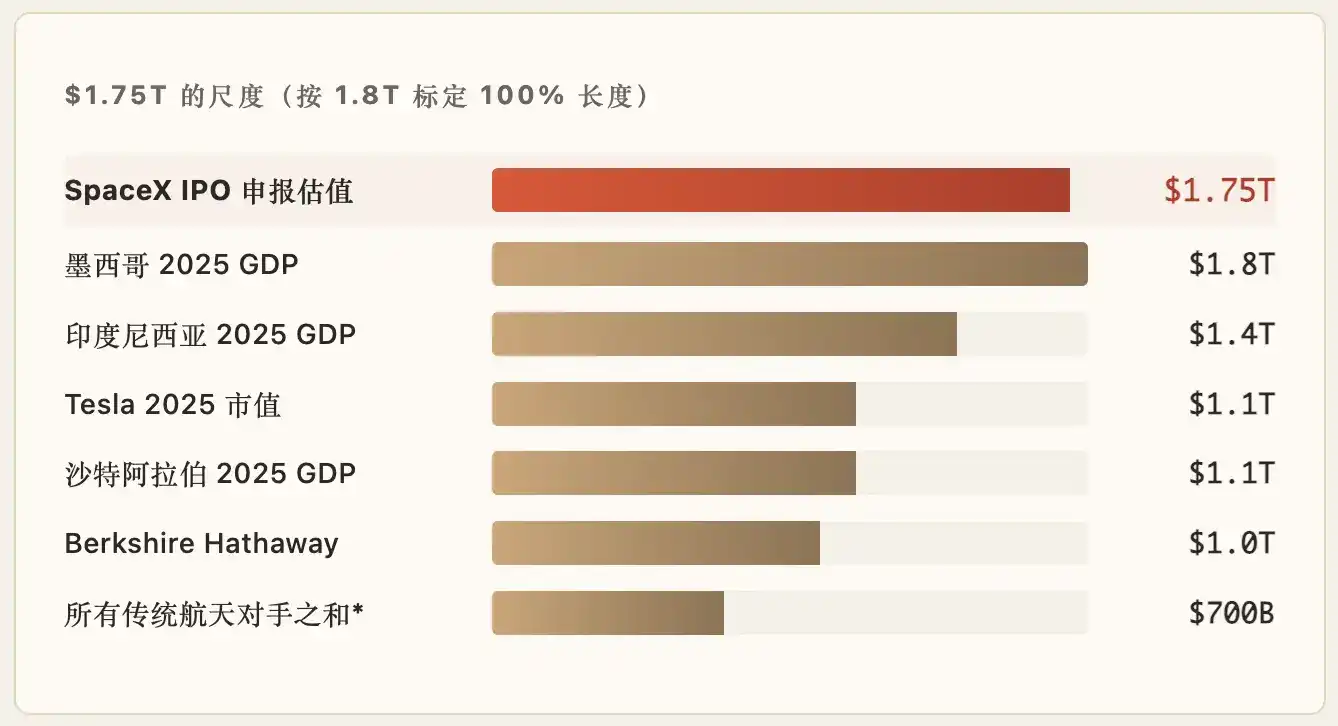
* Combined market cap of Boeing + Lockheed + Northrop + RTX + GD. SpaceX alone is valued at 2.5 times the sum of these 5.

In other words, the valuation of SpaceX alone will exceed Mexico's annual GDP, exceed either Tesla or Berkshire, and is 2.5 times the total market cap of all traditional space rivals.

This itself is not the issue—great companies deserve great valuations. But the 2.5x ratio means the market is not pricing it as a "space company," nor as an "industrial company." The market is pricing it using a hybrid paradigm closer to "sovereign asset + AI-era infrastructure + narrative premium."

Is this pricing reasonable?

List SpaceX's current businesses and seriously calculate how much revenue it can generate by 2030, assuming a reasonably optimistic scenario for each line:
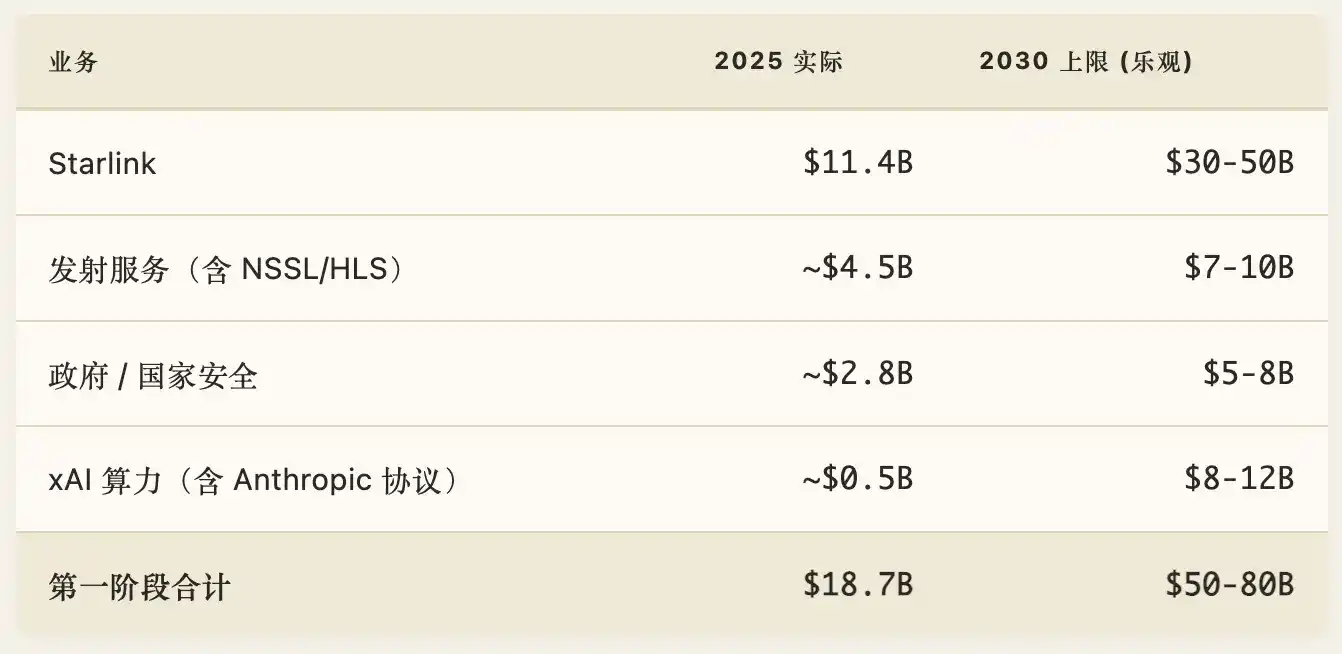
If SpaceX achieves revenue of $50-80B in 2030, corresponding EBITDA (Earnings Before Interest, Taxes, Depreciation, and Amortization, roughly understood as the operating cash profitability of the company's main business) would be approximately $20-35B (assuming a 40% margin, already a very optimistic estimate).

Using the standard SaaS/diversified EV/EBITDA multiple of 25-35x—which is already a premium valuation for tech companies—SpaceX's "reasonable valuation" range in 2030 is between $500B and $1.2T.

Take the conservative anchor point of $500B (i.e., valuing all 2030 businesses reasonably, not wildly) versus the market price of $1.75T.

Difference: $1.25T.

This difference cannot be explained by any standard financial model. It is not the result of DCF (Discounted Cash Flow), not derived from P/S multiples, nor from comparable company analysis—none of these methods yield $1.75T.
This difference does not appear out of thin air. It has three real sources:

First Source: Long-Term Vision Premium. If Starship operates stably in 2027-2030, launch costs could drop to $200/kg or lower. Capacity increases 30-fold—enough to support new businesses (in-orbit data centers, lunar commerce, deep-space robotics). Anthropic has publicly expressed interest in "being willing to pay for GW-scale space computing." If this narrative materializes, SpaceX plus new businesses could address a total market of $200-500B/year by 2040. This upper limit is indeed massive—so it's rational for the market to leave room for "vision premium."

Second Source: Sovereign Asset + Strategic Position Premium. SpaceX is no longer just a commercial company; it is a U.S. national strategic asset. $22B in government contracts, HLS lunar lander, NRO reconnaissance constellation, Golden Dome missile tracking—these integrate SpaceX into the U.S. national security system. With international communication order fracturing (China bloc / U.S. bloc / third parties), Starlink automatically gains "soft sovereignty" in all markets it can serve. The monetization of this status may take 10+ years to fully manifest, but the premium is real.

Third Source: Retail Investors' Desire for Heroic Narratives + Musk Personal Cult. This is the hardest to quantify, but anyone familiar with capital markets knows its power. Musk has 200 million followers on platform X; his persona is a valuation variable. SpaceX's story—a private company sending humans to Mars, building a global internet, making humanity multi-planetary—is the most heroic commercial story of the past 50 years.

Retail investors are not buying EBITDA; they are buying a ticket to participate in history.

The first two premiums are "real, but slow"; the third premium is "large, but fragile." The current $1.75T valuation bets that all three will hold true and encounter no problems. This is a difficult combination to sustain.

What Happens After IPO?

Assuming SpaceX completes its IPO in the second half of 2026, the next 3-5 years will likely look like this:

Scenario A: Valuation Solidifies (Probability ~25%). Starship V3 successfully launches in 2027, enters stable operation in 2028, the first GW-scale space computing contract lands in 2028. Lunar commerce progresses per NASA schedule. While Starlink growth slows, the Aviation + Maritime + D2C segments offset residential market deceleration. In this scenario, $1.75T "starts to look cheap"—the market would revalue it to $2-3T.

Scenario B: Flat Volatile Valuation (Probability ~50%). Starship materializes slower than expected—5/25 = 20% flight test success in 2025. If this realization rate continues in 2026-2027, V3 may not mature until 2029-2030. Starlink growth slows to +20%/year, the xAI-Anthropic agreement brings real cash flow but no major follow-up contracts. The market realizes "narrative is ahead of reality," and valuation oscillates between $1.2T - $1.8T for 3-5 years. This is the most probable scenario.

Scenario C: Valuation Reckoning (Probability ~25%). Persistent Starship delays, xAI falling significantly behind in AI competition, a Musk personal risk event (health, reputation, politics) triggers. Sentiment premium rapidly contracts. The market reprices using financial models—valuation falls back to the $800B-$1.2T range, equivalent to "the reasonable valuation an excellent industrial company deserves." This scenario is actually good for long-term holders—but means a 30-50% paper loss for retail investors who buy post-IPO.
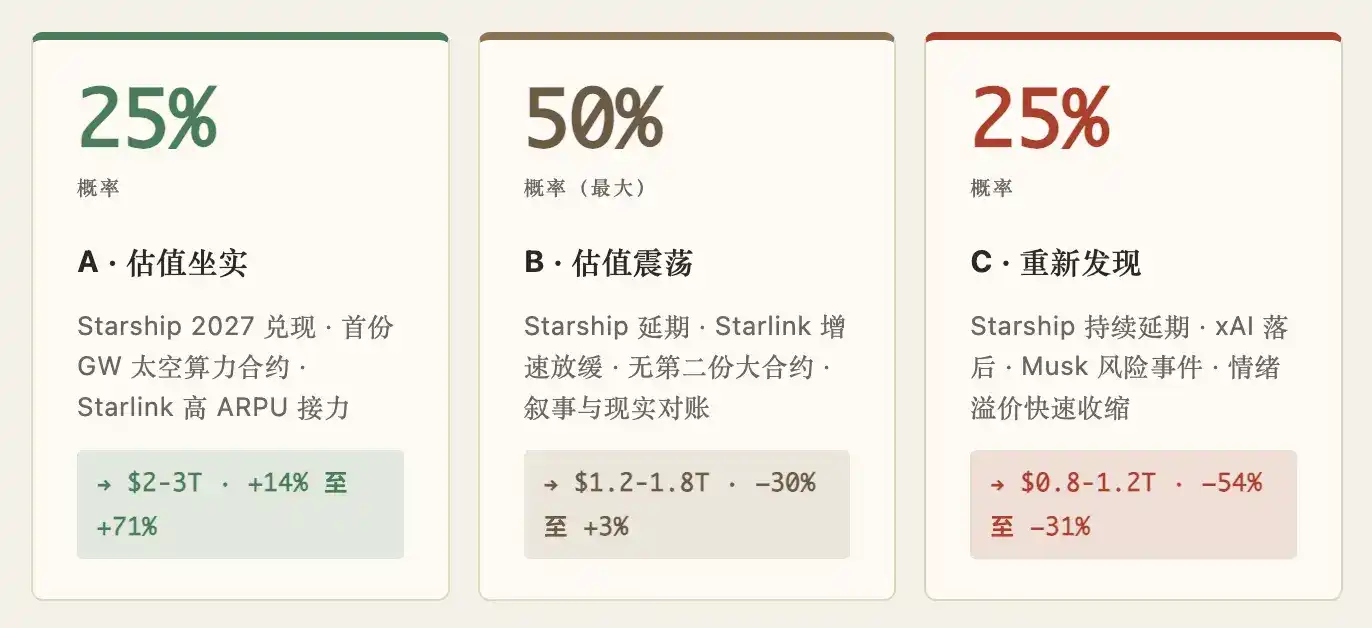
Probability-weighted = 0.25 × Upside + 0.50 × Flat + 0.25 × Downside ≈ Expected Value $1.3-1.5T, lower than the IPO filing price of $1.75T.

Weighting the three probabilities, the expected central range for SpaceX's valuation over the next 3-5 years is approximately $1.3-1.5T—lower than the current IPO filing price.

In plain language: buying at $1.75T on IPO day yields negative expected returns over 5 years. This is the inevitable conclusion after weighting the three scenarios by probability: you get no return in the highest-probability scenario; you lose 30-50% in the worst scenario; only in 1/4 of cases do you make money.

As Charlie Munger would say: this is not a bet with favorable odds.

To Those Planning to Buy on IPO Day

SpaceX is a great company, but a great company does not equal a stock you should buy at any price. These are two different things.

Tesla at the end of 2021 was also considered by many as "should buy at any price"—its market cap was $1.2T then. Over the next two years, Tesla fell 70%, from $1.2T to $400B. Not because Tesla became a bad company—it remains an excellent EV company. It's because price got too far ahead of fundamentals.

SpaceX's current situation is highly similar to Tesla's at the end of 2021—possibly more dangerous, because SpaceX's "vision premium" is a larger component, the story is grander, and retail participation may be deeper.

If you truly believe in SpaceX's long-term vision and are willing to hold for over 10 years without selling, then buying at the IPO price may be fine—the company will likely be worth more in 10 years. But if you expect to "double your money in 1-3 years after buying," the math is not on your side.

A more rational strategy is:

  • Do not chase the high on IPO day.
    Premium is typically highest on the first day of any mega IPO.
  • Wait for at least one of three things to happen.
    Starship V3 stable operation, the first GW-scale space computing contract, or the stock price falling below $1T.
  • If you must buy now, limit your position.
    Don't treat it as a "sure bet"—it is not. It is a "meaningful long-term +/- 30% uncertainty."

A Great Company Can Also Be an Expensive Stock

A company's greatness is fact; whether a stock's price is reasonable is math. Facts don't change, math changes daily. In SpaceX's current valuation structure, financial models can only explain half; the other half is market sentiment + sovereign status + personal cult—this part is not non-existent, but it is fragile.

After IPO, one thing will happen: retail investors start measuring the company with quarterly earnings. The first quarterly report, the second, the third—each will force the market to reconcile "story" with "reality." This reconciliation process is typically unfriendly to short-term valuation.

If you're buying the company—the great industrial entity, the post-Starship human infrastructure, the sovereign asset—then the IPO price is just a point in a 20-year marathon, no need to obsess.

If you're buying the story—participating in history, following a hero, contributing to us becoming a multi-planetary species—then admit this is consumption, not investment. Consumption can be expensive, but you need to know what you're doing.

The company can be world-class, the stock can simultaneously be overvalued by $1.25 trillion. Both are facts, but they must be viewed separately. Distinguish whether you're buying the company, or the story.


Пов'язані питання

QWhat is the core argument of the article regarding SpaceX's $1.75 trillion valuation?

AThe article argues that SpaceX's projected $1.75 trillion IPO valuation is likely overvalued by approximately $1.25 trillion. While acknowledging SpaceX as an exceptionally great industrial company, it contends that at this price, the valuation has priced in significant premiums for long-term vision, sovereign/strategic status, and narrative/Musk-centric enthusiasm that are not fully supported by near-to-mid-term financial projections based on its core businesses.

QAccording to the author's analysis, what would be a more reasonable valuation range for SpaceX by 2030 based on standard financial metrics?

ABased on the author's analysis of SpaceX's potential 2030 revenues ($50-80B) and EBITDA ($20-35B), and applying a premium tech company valuation multiple (25-35x EV/EBITDA), a more reasonable valuation range for SpaceX in 2030 would be $500 billion to $1.2 trillion. This is significantly lower than the speculated $1.75 trillion IPO price.

QWhat are the three main sources of the '$1.25 trillion' valuation gap identified in the article?

AThe three main sources of the $1.25 trillion valuation gap are: 1) **Long-term vision premium**: For future Starship-enabled businesses like in-orbit data centers and lunar commerce. 2) **Sovereign asset & strategic status premium**: Due to its role as a U.S. national strategic asset with major government contracts and Starlink's geopolitical importance. 3) **Retail enthusiasm for the heroic narrative & Musk's personal cult**: Where investors buy the 'story' and participation in history rather than just financial metrics.

QWhat are the three probable scenarios for SpaceX's post-IPO valuation trajectory, and what is the most likely outcome according to the article?

AThe three scenarios are: A) **Valuation is validated** (~25% probability): Starship succeeds quickly, new contracts materialize, valuation rises. B) **Valuation trades sideways/volatile** (~50% probability - *most likely*): Execution is slower than the narrative, leading to a prolonged period of valuation churn. C) **Valuation is rediscovered (downwards)** (~25% probability): Significant delays or Musk-related risks trigger a contraction of narrative premiums, reverting to a valuation based more on financials. The weighted expectation centers around $1.3-1.5T, below the $1.75T IPO price.

QWhat practical advice does the author give to potential retail investors considering buying SpaceX stock at its IPO?

AThe author advises potential retail investors to: 1) **Avoid buying at the IPO peak** on day one, as溢价 is typically highest then. 2) **Wait for key catalysts** like Starship V3 stable operation, a major GW-scale space compute contract, or a significant price drop (e.g., below $1T). 3) **If buying immediately, limit position size** and recognize it as a long-term, uncertain bet rather than a sure thing. The core message is to separate the admiration for the company from the investment math of the stock price.

Пов'язані матеріали

AI PC Battle: Bet on the Toll Booth, Not the Camp

**Title:** The AI PC Battle: Don't Bet on Sides, Bet on the Tollbooth **Summary:** The AI PC competition is moving beyond simple "x86 vs. Arm" narratives. The core investment thesis should focus on identifying which players can sustain margins, cash flow, and pricing power throughout the upgrade cycle, rather than backing a particular architecture. The opportunity is analyzed in three layers: 1. **The Advanced Foundry Tollbooth:** TSMC is positioned to collect "tolls" regardless of which chip designer wins, due to its dominant ~70% share in advanced semiconductor manufacturing, which is essential for high-end AI PC chips. 2. **Compute & Platform Spillover:** AMD represents an offensive in the x86 CPU+GPU space, while NVIDIA leverages its GPU and CUDA software stack dominance. Both benefit from the demand for increased local AI compute. 3. **Architecture Diffusion & Turnaround Plays:** ARM and Intel offer potential for significant upside (elasticity), but investments here require stricter discipline due to higher execution risks and competitive challenges. The industry is transitioning from concept to shipment validation. While short-term forecasts for AI PC adoption have been revised down slightly due to tariffs and procurement delays, the long-term trend towards AI becoming a standard PC feature remains intact. The key driver for upgrade cycles will be whether compelling enterprise applications (e.g., privacy-sensitive computing, low-latency inference) emerge beyond consumer-focused features like meeting summarization. Investment strategy should prioritize companies with platform-level advantages and recurring revenue streams. TSMC offers high certainty as the foundational tollbooth. AMD presents a strong offensive play within the established ecosystem. ARM and Intel are higher-risk, higher-potential-reward turnaround bets. The report cautions against chasing short-term hype and emphasizes a disciplined, long-term approach focused on buying ecosystem strength and cash-flow certainty after market enthusiasm subsides. **Key Risks:** Underwhelming AI PC applications slowing upgrade cycles; slow improvement in Windows on Arm compatibility; macro/tariff impacts on PC demand; potential advanced node supply-demand mismatches affecting TSMC; high overall AI sector valuations making stocks vulnerable to a risk-off shift in markets.

marsbit4 хв тому

AI PC Battle: Bet on the Toll Booth, Not the Camp

marsbit4 хв тому

Ten-Thousand-Word Analysis: From $10 to $290, MRVL Wins the Entire AI Era by 'Not Making GPUs'

Marvell Technology's stock price surged from under $10 in 2016 to a record $290 in June 2026, fueled not by making GPUs, but by dominating AI infrastructure connectivity. This analysis argues the market misvalues MRVL as merely a smaller Broadcom in custom AI chips, overlooking its true, unique position. Marvell's core strength lies in enabling high-speed data flow for AI clusters through three interconnected businesses. First, it holds a commanding ~70% market share in high-speed optical DSPs (essential for data center light modules), a deep-moat business with accelerating growth. Second, its custom AI chip design business serves hyperscalers like AWS, Microsoft, and Google, with a significant revenue pipeline despite lower margins. Third, stable cash flows come from Ethernet switch chips and enterprise storage controllers. Together, they form a full-stack "AI data movement" platform. CEO Matt Murphy's transformative leadership since 2016, involving strategic divestments, key acquisitions (like Inphi for optical DSPs), and securing long-term agreements with major cloud providers, repositioned the company. A pivotal $2 billion strategic investment from NVIDIA in 2026 underscored Marvell's critical role in the AI ecosystem, particularly through collaborations like NVLink Fusion. While Marvell faces risks—including client concentration (losing the Amazon Trainium3 design), lower-margin business mix, competitive threats, insider selling, and complex supply chains—its fundamentals remain strong. The optical interconnect moat is widening with the acquisition of Celestial AI (photonics fabric), and financial metrics show accelerating revenue growth and operating leverage. With a PEG ratio suggesting undervaluation relative to its growth, the thesis is that the market undervalues Marvell's monopolistic position in AI "plumbing" while overemphasizing its competitive custom chip segment. The story transcends investing, symbolizing how in any complex system—from the internet to AI—the value of "connection" ultimately surpasses that of individual "nodes."

marsbit33 хв тому

Ten-Thousand-Word Analysis: From $10 to $290, MRVL Wins the Entire AI Era by 'Not Making GPUs'

marsbit33 хв тому

AI Relay Stations Spark Heated Debate on Zhihu: Behind Cheap Tokens, What Are Users Really Worried About?

A discussion on Zhihu about "AI relay stations" shifted the niche developer topic of "cheap tokens" into broader user awareness. Users moved beyond simply questioning the legitimacy of these services to focus on practical concerns: Where do cheap tokens truly come from? Is the model being accessed the real one? Can relay stations see prompts, code, and API keys? For occasional users, are the risks worth it? The core debate centered less on price and more on trust. A primary worry is model authenticity—the risk of "model swapping," where users paying for a premium model might be routed to a cheaper one, creating an information asymmetry. Others argued that cost comparisons matter; while cheaper than official pay-as-you-go APIs, relay stations may not be the lowest-cost option versus subscriptions, domestic models, or free tiers, making user needs assessment crucial. Speculation about token sources ranged from legitimate bulk discounts to gray-area methods like account sharing or exploiting regional pricing. This opacity makes risk assessment difficult for users. Data security emerged as a critical concern, especially for enterprise use. When processing sensitive information like code, contracts, or client data, the inability to verify a relay station's data handling, retention, or access policies poses significant compliance and confidentiality risks. The evolving consensus suggests relay stations can be used cautiously for low-sensitivity, disposable tasks (e.g., summarizing public info, simple translation). However, they should not be the default for sensitive, professional, or production workflows involving proprietary data, Agents, or automated systems. Recommendations include avoiding large prepayments, not relying on a single service, using test prompts to monitor quality, anonymizing data where possible, and keeping official channels as backups. Ultimately, the discussion framed tokens not just as a billing unit but as a measure of real cost encompassing price, model integrity, data security, and service stability. The popularity of relay stations highlights user demand for affordable access, but the debate underscores a key trade-off: the savings from cheap tokens may come at the price of trust, transparency, and control over one's data and AI experience.

marsbit1 год тому

AI Relay Stations Spark Heated Debate on Zhihu: Behind Cheap Tokens, What Are Users Really Worried About?

marsbit1 год тому

In-Depth Research Report on TradFi: The Convergence Wave of Crypto and Traditional Finance

In 2026, the crypto industry is undergoing a profound infrastructure-level transformation—TradFi assets are migrating on-chain at an unprecedented pace. According to CoinGecko's Q1 2026 report, the total value locked (TVL) of tokenized real-world assets (RWA) has surpassed $31 billion, a nearly 4x increase from $7.8 billion at the beginning of 2025, with the sector’s aggregate market capitalization reaching $19.3 billion. Among these, the market cap of tokenized stocks surged from $2 million to $486 million, with Q1 spot trading volume reaching $15.1 billion—a single quarter already surpassing the entire second half of 2025. RWA perpetual contract Q1 trading volume reached a staggering $524.8 billion, far exceeding the $313 billion for all of 2025. Meanwhile, BlackRock's BUIDL fund has reached $2.3 billion in scale and has filed for two new tokenized funds, signaling that the world's largest asset manager's tokenization strategy is evolving from pilot to product suite expansion. HTX, as a core participant in the crypto exchange sector, officially launched TradFi perpetual futures products including NVDA, AAPL, MSFT, META, and SPY in 2026, enabling crypto users to gain 24/7 trading access to core U.S. equities. Boston Consulting Group predicts that global tokenized asset scale could reach $16 trillion by 2030, while McKinsey offers a conservative estimate of approximately $2 trillion. The on-chain migration of TradFi assets is no longer a "future narrative" but a structural transformation unfolding in real time, as crypto exchanges evolve from single crypto asset trading platforms toward "multi-asset-class trading infrastructure."

HTX Learn1 год тому

In-Depth Research Report on TradFi: The Convergence Wave of Crypto and Traditional Finance

HTX Learn1 год тому

Торгівля

Спот
Ф'ючерси

Популярні статті

Як купити T

Ласкаво просимо до HTX.com! Ми зробили покупку Threshold Network Token (T) простою та зручною. Дотримуйтесь нашої покрокової інструкції, щоб розпочати свою криптовалютну подорож.Крок 1: Створіть обліковий запис на HTXВикористовуйте свою електронну пошту або номер телефону, щоб зареєструвати обліковий запис на HTX безплатно. Пройдіть безпроблемну реєстрацію й отримайте доступ до всіх функцій.ЗареєструватисьКрок 2: Перейдіть до розділу Купити крипту і виберіть спосіб оплатиКредитна/дебетова картка: використовуйте вашу картку Visa або Mastercard, щоб миттєво купити Threshold Network Token (T).Баланс: використовуйте кошти з балансу вашого рахунку HTX для безперешкодної торгівлі.Треті особи: ми додали популярні способи оплати, такі як Google Pay та Apple Pay, щоб підвищити зручність.P2P: Торгуйте безпосередньо з іншими користувачами на HTX.Позабіржова торгівля (OTC): ми пропонуємо індивідуальні послуги та конкурентні обмінні курси для трейдерів.Крок 3: Зберігайте свої Threshold Network Token (T)Після придбання Threshold Network Token (T) збережіть його у своєму обліковому записі на HTX. Крім того, ви можете відправити його в інше місце за допомогою блокчейн-переказу або використовувати його для торгівлі іншими криптовалютами.Крок 4: Торгівля Threshold Network Token (T)Легко торгуйте Threshold Network Token (T) на спотовому ринку HTX. Просто увійдіть до свого облікового запису, виберіть торгову пару, укладайте угоди та спостерігайте за ними в режимі реального часу. Ми пропонуємо зручний досвід як для початківців, так і для досвідчених трейдерів.

450 переглядів усьогоОпубліковано 2024.12.10Оновлено 2026.06.02

Як купити T

Обговорення

Ласкаво просимо до спільноти HTX. Тут ви можете бути в курсі останніх подій розвитку платформи та отримати доступ до професійної ринкової інформації. Нижче представлені думки користувачів щодо ціни T (T).

活动图片