Zhou Hang: How Much is SpaceX Really Worth?

marsbitОпубліковано о 2026-06-02Востаннє оновлено о 2026-06-02

Анотація

Summary: Author Zhou Hang argues that while SpaceX is arguably one of the greatest industrial companies of the past 50 years, its anticipated IPO valuation of approximately $1.75 trillion is likely overvalued by about $1.25 trillion. The analysis acknowledges SpaceX's monumental success in slashing launch costs, achieving near-monopoly in commercial launches, and building the Starlink satellite internet constellation. However, using a projected 2030 revenue of $50-80 billion and applying a generous tech company valuation multiple yields a "reasonable" valuation range of only $500 billion to $1.2 trillion. The $1.25 trillion gap stems from premiums for its long-term vision (e.g., Starship, space-based computing), its status as a U.S. strategic national asset, and retail investor enthusiasm driven by the Elon Musk narrative. The article outlines three post-IPO scenarios: valuation solidification (25% probability), sideways consolidation (50%), or a correction to fundamental value (25%). The probability-weighted expected valuation is $1.3-1.5 trillion, suggesting negative expected returns for buyers at the IPO price. The conclusion cautions investors to separate the company's undeniable greatness from the stock's price, advising against chasing the IPO and to wait for key milestones or a lower entry point.

Author: Zhou Hang

SpaceX may be overvalued by $1.25 trillion around its IPO.

This is not to deny SpaceX's greatness. On the contrary, anyone seriously discussing SpaceX must first acknowledge: it is likely one of the greatest industrial companies of the past 50 years.

But the greatness of a company and whether a stock is worth buying at any price are two completely different things.

SpaceX can simultaneously be "the greatest industrial entity of the 21st century" and also a "severely overvalued investment target." These two things are not mutually exclusive.
First, Acknowledge Its True Greatness

Any honest discussion about SpaceX's valuation must start with this statement: It is the most successful industrial company of the past 25 years, bar none—even more successful than Tesla. This is not mere praise; it is a fact of engineering economics.

Tesla disrupted a 150-year-old mature industry—automobiles. Its rivals are Mercedes-Benz, Ford, Toyota. These opponents are certainly not weak, but they are commercial companies, not backed by national interests, lacking political barriers; competition is essentially about product, brand, supply chain.

SpaceX disrupted a 60-year-old state-monopolized industry—space. Its rivals are NASA, Roscosmos, ESA, CNSA. This is an entirely different level of difficulty: higher engineering barriers, greater capital density, more complex regulation, deeper entanglement with national interests. When Musk founded SpaceX in 2002, the entire space industry was essentially an extension of national missions; commercial companies were not believed capable of building rockets, let alone rockets cheaper than national ones.

Over 20 years later, SpaceX slashed launch costs from $54,500/kg in the Space Shuttle era to $1,500/kg—a 36-fold reduction. It now launches 165 times a year, one company exceeding the total launch count of all other nations and all commercial players combined. It built humanity's first truly reusable rocket, a single Falcon 9 first stage flying 32 times, with a success rate exceeding 99%. It established the world's first global satellite internet—covering over a billion users, becoming a decisive strategic asset on the first day of the Ukraine war.

Tesla in 2025 still faces fierce competition from Chinese EVs; SpaceX's share in the global commercial launch market, is nearing monopoly.

SpaceX is a great company, perhaps the greatest industrial company on Earth in the past 50 years. Any critique of its valuation must first acknowledge this fact.

What Does $1.75 Trillion Mean?

Let's understand through a set of comparisons:
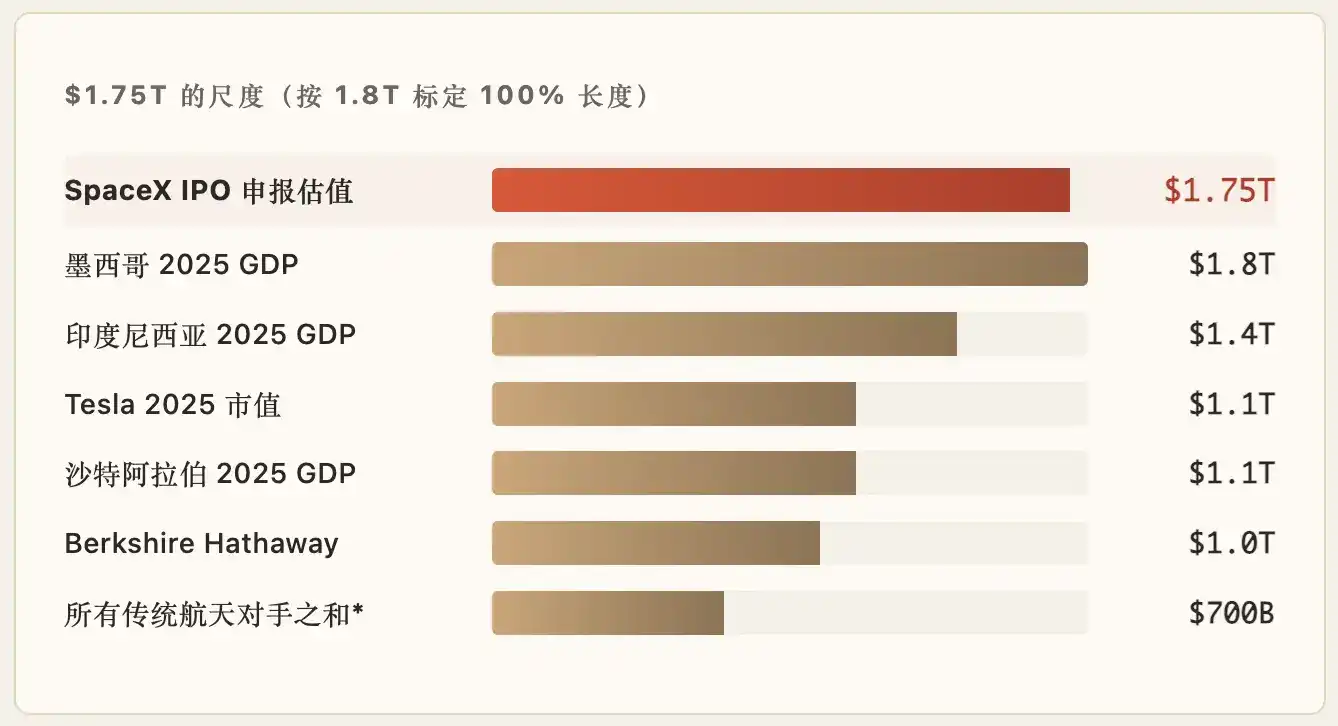
* Combined market cap of Boeing + Lockheed + Northrop + RTX + GD. SpaceX alone is valued at 2.5 times the sum of these 5.

In other words, the valuation of SpaceX alone will exceed Mexico's annual GDP, exceed either Tesla or Berkshire, and is 2.5 times the total market cap of all traditional space rivals.

This itself is not the issue—great companies deserve great valuations. But the 2.5x ratio means the market is not pricing it as a "space company," nor as an "industrial company." The market is pricing it using a hybrid paradigm closer to "sovereign asset + AI-era infrastructure + narrative premium."

Is this pricing reasonable?

List SpaceX's current businesses and seriously calculate how much revenue it can generate by 2030, assuming a reasonably optimistic scenario for each line:
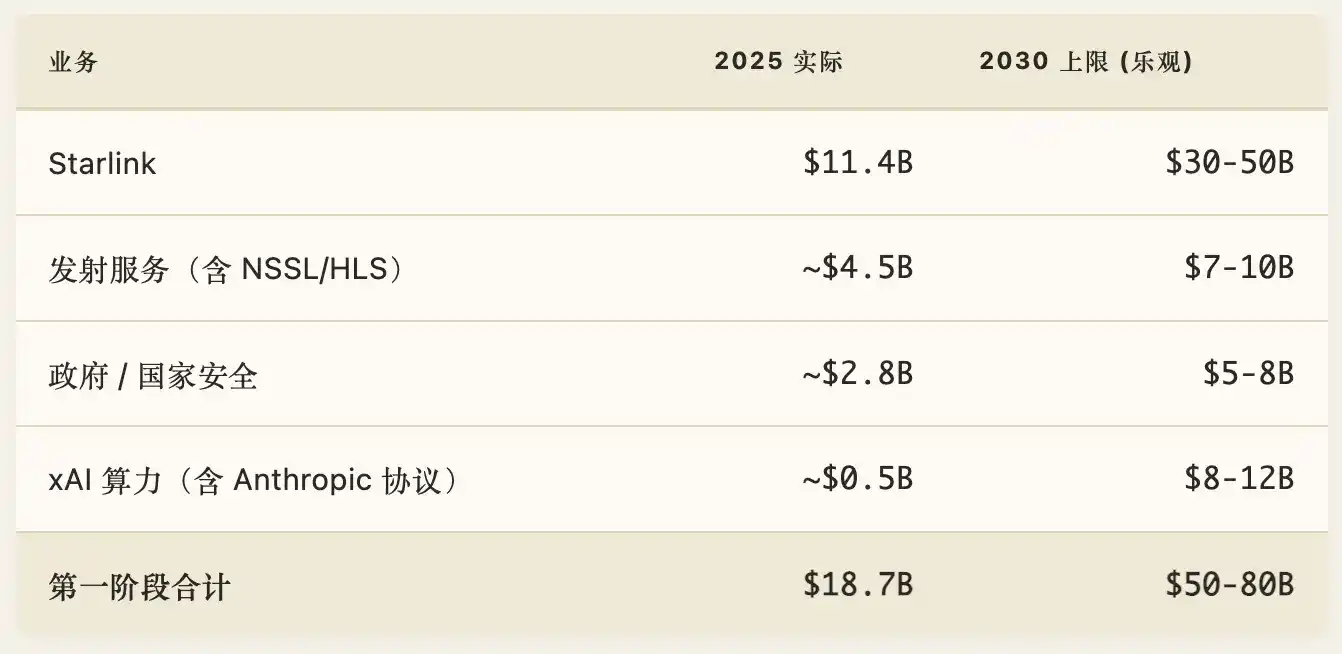
If SpaceX achieves revenue of $50-80B in 2030, corresponding EBITDA (Earnings Before Interest, Taxes, Depreciation, and Amortization, roughly understood as the operating cash profitability of the company's main business) would be approximately $20-35B (assuming a 40% margin, already a very optimistic estimate).

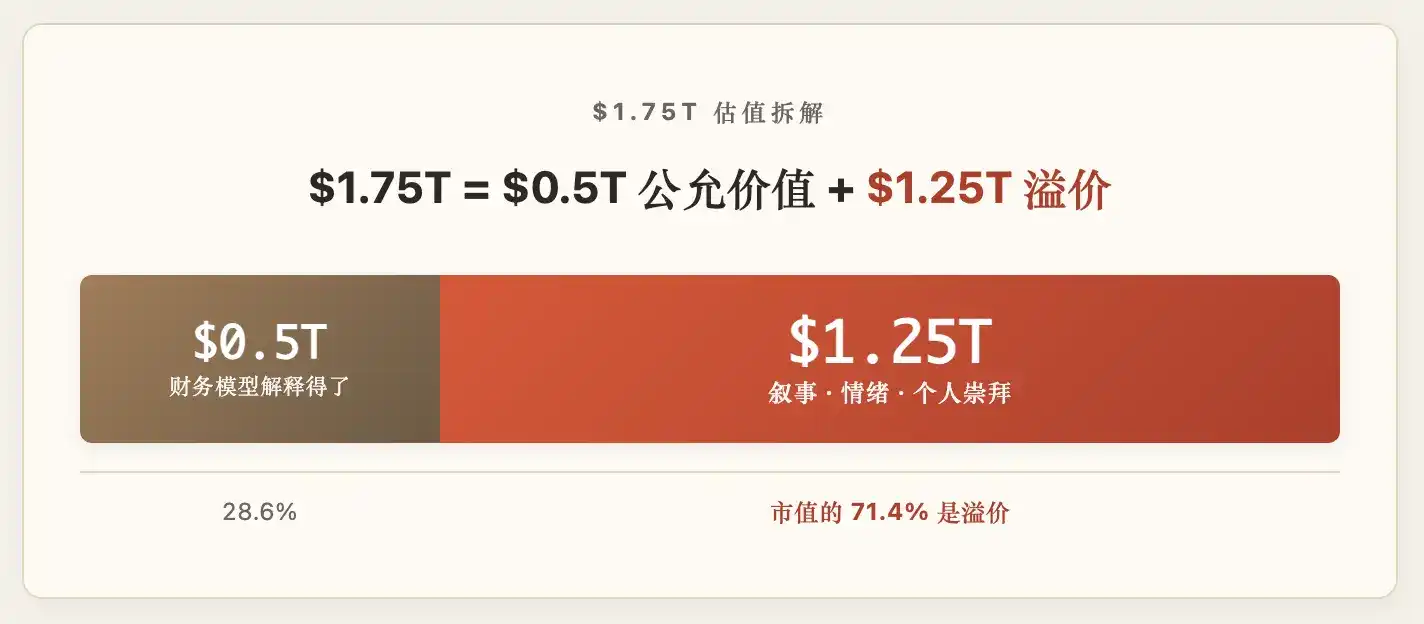
Using the standard SaaS/diversified EV/EBITDA multiple of 25-35x—which is already a premium valuation for tech companies—SpaceX's "reasonable valuation" range in 2030 is between $500B and $1.2T.

Take the conservative anchor point of $500B (i.e., valuing all 2030 businesses reasonably, not wildly) versus the market price of $1.75T.

Difference: $1.25T.

This difference cannot be explained by any standard financial model. It is not the result of DCF (Discounted Cash Flow), not derived from P/S multiples, nor from comparable company analysis—none of these methods yield $1.75T.
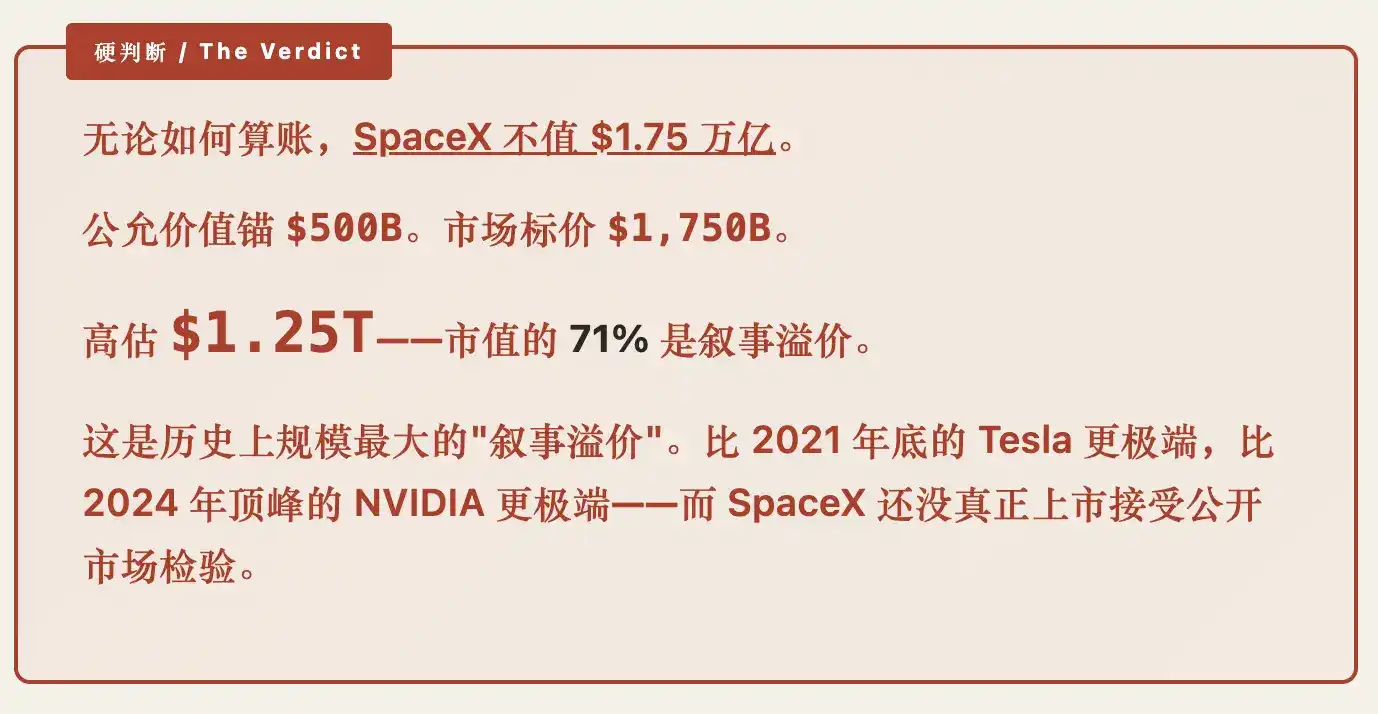
This difference does not appear out of thin air. It has three real sources:

First Source: Long-Term Vision Premium. If Starship operates stably in 2027-2030, launch costs could drop to $200/kg or lower. Capacity increases 30-fold—enough to support new businesses (in-orbit data centers, lunar commerce, deep-space robotics). Anthropic has publicly expressed interest in "being willing to pay for GW-scale space computing." If this narrative materializes, SpaceX plus new businesses could address a total market of $200-500B/year by 2040. This upper limit is indeed massive—so it's rational for the market to leave room for "vision premium."

Second Source: Sovereign Asset + Strategic Position Premium. SpaceX is no longer just a commercial company; it is a U.S. national strategic asset. $22B in government contracts, HLS lunar lander, NRO reconnaissance constellation, Golden Dome missile tracking—these integrate SpaceX into the U.S. national security system. With international communication order fracturing (China bloc / U.S. bloc / third parties), Starlink automatically gains "soft sovereignty" in all markets it can serve. The monetization of this status may take 10+ years to fully manifest, but the premium is real.

Third Source: Retail Investors' Desire for Heroic Narratives + Musk Personal Cult. This is the hardest to quantify, but anyone familiar with capital markets knows its power. Musk has 200 million followers on platform X; his persona is a valuation variable. SpaceX's story—a private company sending humans to Mars, building a global internet, making humanity multi-planetary—is the most heroic commercial story of the past 50 years.

Retail investors are not buying EBITDA; they are buying a ticket to participate in history.

The first two premiums are "real, but slow"; the third premium is "large, but fragile." The current $1.75T valuation bets that all three will hold true and encounter no problems. This is a difficult combination to sustain.

What Happens After IPO?

Assuming SpaceX completes its IPO in the second half of 2026, the next 3-5 years will likely look like this:

Scenario A: Valuation Solidifies (Probability ~25%). Starship V3 successfully launches in 2027, enters stable operation in 2028, the first GW-scale space computing contract lands in 2028. Lunar commerce progresses per NASA schedule. While Starlink growth slows, the Aviation + Maritime + D2C segments offset residential market deceleration. In this scenario, $1.75T "starts to look cheap"—the market would revalue it to $2-3T.

Scenario B: Flat Volatile Valuation (Probability ~50%). Starship materializes slower than expected—5/25 = 20% flight test success in 2025. If this realization rate continues in 2026-2027, V3 may not mature until 2029-2030. Starlink growth slows to +20%/year, the xAI-Anthropic agreement brings real cash flow but no major follow-up contracts. The market realizes "narrative is ahead of reality," and valuation oscillates between $1.2T - $1.8T for 3-5 years. This is the most probable scenario.

Scenario C: Valuation Reckoning (Probability ~25%). Persistent Starship delays, xAI falling significantly behind in AI competition, a Musk personal risk event (health, reputation, politics) triggers. Sentiment premium rapidly contracts. The market reprices using financial models—valuation falls back to the $800B-$1.2T range, equivalent to "the reasonable valuation an excellent industrial company deserves." This scenario is actually good for long-term holders—but means a 30-50% paper loss for retail investors who buy post-IPO.
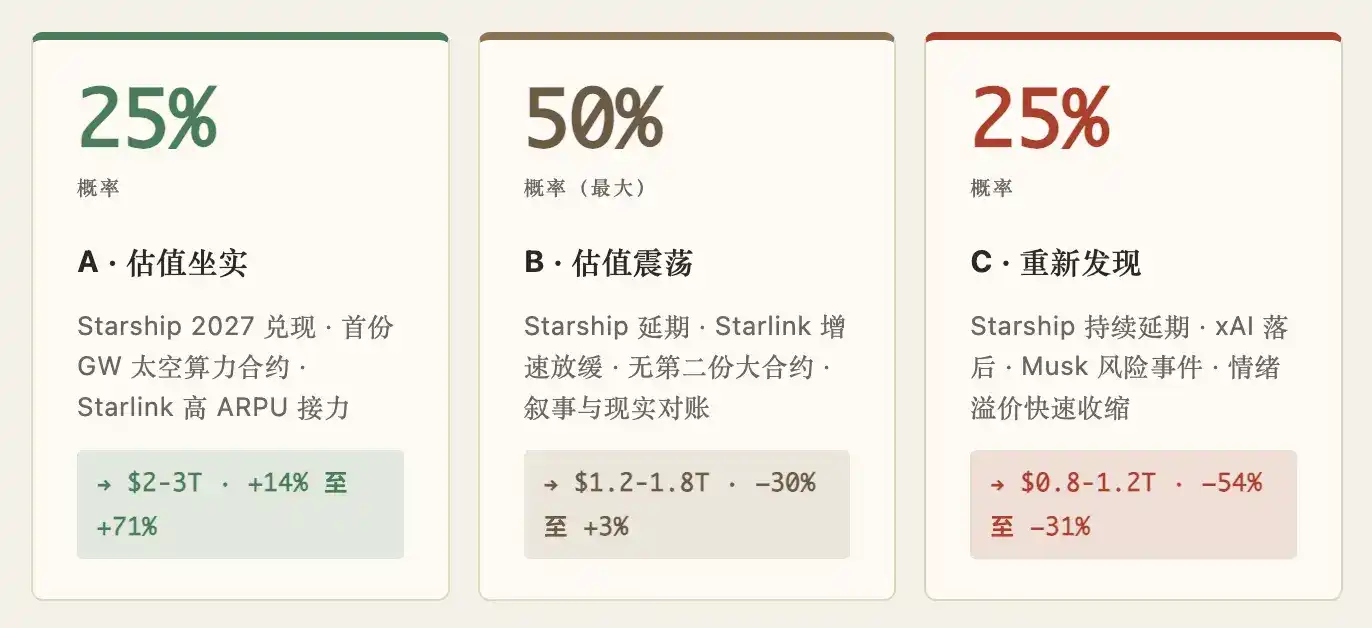
Probability-weighted = 0.25 × Upside + 0.50 × Flat + 0.25 × Downside ≈ Expected Value $1.3-1.5T, lower than the IPO filing price of $1.75T.

Weighting the three probabilities, the expected central range for SpaceX's valuation over the next 3-5 years is approximately $1.3-1.5T—lower than the current IPO filing price.

In plain language: buying at $1.75T on IPO day yields negative expected returns over 5 years. This is the inevitable conclusion after weighting the three scenarios by probability: you get no return in the highest-probability scenario; you lose 30-50% in the worst scenario; only in 1/4 of cases do you make money.

As Charlie Munger would say: this is not a bet with favorable odds.

To Those Planning to Buy on IPO Day

SpaceX is a great company, but a great company does not equal a stock you should buy at any price. These are two different things.

Tesla at the end of 2021 was also considered by many as "should buy at any price"—its market cap was $1.2T then. Over the next two years, Tesla fell 70%, from $1.2T to $400B. Not because Tesla became a bad company—it remains an excellent EV company. It's because price got too far ahead of fundamentals.

SpaceX's current situation is highly similar to Tesla's at the end of 2021—possibly more dangerous, because SpaceX's "vision premium" is a larger component, the story is grander, and retail participation may be deeper.

If you truly believe in SpaceX's long-term vision and are willing to hold for over 10 years without selling, then buying at the IPO price may be fine—the company will likely be worth more in 10 years. But if you expect to "double your money in 1-3 years after buying," the math is not on your side.

A more rational strategy is:

  • Do not chase the high on IPO day.
    Premium is typically highest on the first day of any mega IPO.
  • Wait for at least one of three things to happen.
    Starship V3 stable operation, the first GW-scale space computing contract, or the stock price falling below $1T.
  • If you must buy now, limit your position.
    Don't treat it as a "sure bet"—it is not. It is a "meaningful long-term +/- 30% uncertainty."

A Great Company Can Also Be an Expensive Stock

A company's greatness is fact; whether a stock's price is reasonable is math. Facts don't change, math changes daily. In SpaceX's current valuation structure, financial models can only explain half; the other half is market sentiment + sovereign status + personal cult—this part is not non-existent, but it is fragile.

After IPO, one thing will happen: retail investors start measuring the company with quarterly earnings. The first quarterly report, the second, the third—each will force the market to reconcile "story" with "reality." This reconciliation process is typically unfriendly to short-term valuation.

If you're buying the company—the great industrial entity, the post-Starship human infrastructure, the sovereign asset—then the IPO price is just a point in a 20-year marathon, no need to obsess.

If you're buying the story—participating in history, following a hero, contributing to us becoming a multi-planetary species—then admit this is consumption, not investment. Consumption can be expensive, but you need to know what you're doing.

The company can be world-class, the stock can simultaneously be overvalued by $1.25 trillion. Both are facts, but they must be viewed separately. Distinguish whether you're buying the company, or the story.


Трендові криптовалюти

Пов'язані питання

QWhat is the core argument of the article regarding SpaceX's $1.75 trillion valuation?

AThe article argues that SpaceX's projected $1.75 trillion IPO valuation is likely overvalued by approximately $1.25 trillion. While acknowledging SpaceX as an exceptionally great industrial company, it contends that at this price, the valuation has priced in significant premiums for long-term vision, sovereign/strategic status, and narrative/Musk-centric enthusiasm that are not fully supported by near-to-mid-term financial projections based on its core businesses.

QAccording to the author's analysis, what would be a more reasonable valuation range for SpaceX by 2030 based on standard financial metrics?

ABased on the author's analysis of SpaceX's potential 2030 revenues ($50-80B) and EBITDA ($20-35B), and applying a premium tech company valuation multiple (25-35x EV/EBITDA), a more reasonable valuation range for SpaceX in 2030 would be $500 billion to $1.2 trillion. This is significantly lower than the speculated $1.75 trillion IPO price.

QWhat are the three main sources of the '$1.25 trillion' valuation gap identified in the article?

AThe three main sources of the $1.25 trillion valuation gap are: 1) **Long-term vision premium**: For future Starship-enabled businesses like in-orbit data centers and lunar commerce. 2) **Sovereign asset & strategic status premium**: Due to its role as a U.S. national strategic asset with major government contracts and Starlink's geopolitical importance. 3) **Retail enthusiasm for the heroic narrative & Musk's personal cult**: Where investors buy the 'story' and participation in history rather than just financial metrics.

QWhat are the three probable scenarios for SpaceX's post-IPO valuation trajectory, and what is the most likely outcome according to the article?

AThe three scenarios are: A) **Valuation is validated** (~25% probability): Starship succeeds quickly, new contracts materialize, valuation rises. B) **Valuation trades sideways/volatile** (~50% probability - *most likely*): Execution is slower than the narrative, leading to a prolonged period of valuation churn. C) **Valuation is rediscovered (downwards)** (~25% probability): Significant delays or Musk-related risks trigger a contraction of narrative premiums, reverting to a valuation based more on financials. The weighted expectation centers around $1.3-1.5T, below the $1.75T IPO price.

QWhat practical advice does the author give to potential retail investors considering buying SpaceX stock at its IPO?

AThe author advises potential retail investors to: 1) **Avoid buying at the IPO peak** on day one, as溢价 is typically highest then. 2) **Wait for key catalysts** like Starship V3 stable operation, a major GW-scale space compute contract, or a significant price drop (e.g., below $1T). 3) **If buying immediately, limit position size** and recognize it as a long-term, uncertain bet rather than a sure thing. The core message is to separate the admiration for the company from the investment math of the stock price.

Пов'язані матеріали

After Three Consecutive Quarters of Decline, Can the Crypto Market Find a Window for Stabilization in Q3?

The cryptocurrency market has just concluded its worst-performing quarter since 2022, with total capitalization dropping 12.6% to $2.1 trillion. All core metrics indicate capital is leaving the sector, not just rotating within it. Bitcoin fell 14.2% and Ethereum dropped 25.4% in Q2, breaking their previous correlation with US tech stocks. A key driver is the reversal in US spot Bitcoin ETF flows, which saw a net outflow of approximately $4.67 billion in Q2, including a record monthly outflow near $4.5 billion in June. While recent data suggests long-term holders are accumulating again, sustained ETF outflows mean continued selling pressure. Market focus is now singularly on the Federal Reserve. The upcoming July FOMC meeting is seen as the most critical event for Q3. A dovish signal could support Bitcoin reclaiming a $68,000-$84,000 range, while a hawkish stance might establish a new trading band around $50,000-$56,000. Additionally, regulatory uncertainty persists, with the progress of the crucial *CLARITY Act* stalling in the Senate, reducing its perceived 2026 passage probability to 40-45%. Despite the broad downturn, a few sectors showed growth. Prediction markets saw nominal volume surge 48.7% year-over-year to $113.8 billion, and tokenized collectibles transaction volume rose 143% quarterly to $1.4 billion. The Real-World Asset (RWA) tokenization sector also continued steady growth, now representing ~$28.1 billion in on-chain value. The market's foundation for an extreme crash appears limited, with Bitcoin price hovering near its 200-week moving average. However, the trading paradigm has shifted from narrative-driven speculation to decisions based on price action, policy developments, and interest rate expectations, making a broad sentiment-driven rally unlikely in the near term.

marsbit14 год тому

After Three Consecutive Quarters of Decline, Can the Crypto Market Find a Window for Stabilization in Q3?

marsbit14 год тому

BIT Trading Moment: BTC Still Suppressed by Weekly 200 EMA, Rejection May Restart Decline; Storage and Semiconductors that Surged Last Night Begin Falling in Evening Trading

**Crypto & Stock Market Wrap: Bitcoin Tests Resistance, Stocks Retreat After AI Surge** Bitcoin consolidates around $66,000, facing key resistance near $68,000—an area seen as a major psychological and technical hurdle where previous rallies have failed. Analysts note the cryptocurrency is caught between its 200-week moving average (~$63,333) and 200-week EMA (~$68,328). A clear break above $68k is needed to signal a stronger bullish trend, while a rejection could lead to a retest of $63k support. Market sentiment remains cautious, with low futures open interest pointing to a low-liquidity rebound rather than a full bull market. Bitcoin spot ETFs saw another $203 million inflow. US stock futures pointed lower after a strong Tuesday session led by a massive rebound in semiconductors and memory stocks. The rally was fueled by renewed optimism about AI-driven hardware demand, with Micron, SanDisk, and SK Hynix surging. However, those gains reversed in pre-market trading. Super Micro Computer (SMCI) soared over 20% after hours on strong guidance and a record backlog. Other standouts included Rocket Lab and nuclear energy plays Oklo and X-Energy. Rising oil prices (Brent above $91) and climbing Treasury yields (10-year near 4.64%), however, are reigniting inflation concerns and acting as a headwind for equities. In Asia, markets were mixed. South Korea's KOSPI pared early gains to close slightly higher as semiconductor stocks like SK Hynix gave back initial surges. Japan's Nikkei edged lower as the yen hit a fresh 38-year low against the dollar, raising fears of potential market intervention. Key events to watch include the Samsung Galaxy launch, AMD's AI event, and a slew of major tech earnings from Alphabet, Tesla, and IBM after the close on Wednesday, followed by the ECB meeting and Intel's earnings on Thursday.

marsbit14 год тому

BIT Trading Moment: BTC Still Suppressed by Weekly 200 EMA, Rejection May Restart Decline; Storage and Semiconductors that Surged Last Night Begin Falling in Evening Trading

marsbit14 год тому

Former CFTC Chairman, Circle President Tarbert: Preaching Long-Termism While Cashing Out $30 Million Himself

Former CFTC Chairman and Circle President Heath Tarbert has consistently advocated for a long-term vision in public, urging patience from investors as Circle’s stock price has fallen significantly from its peak. However, it has been revealed that since Circle’s IPO, Tarbert has continuously sold his CRCL shares through pre-arranged trading plans, cashing out approximately $30 million, without making any public market purchases. This contrast between his public messaging and personal actions has drawn criticism. Tarbert joined Circle in July 2023 as Chief Legal Officer, leveraging his regulatory experience to help guide the company through its IPO and expansion. Despite promoting stablecoins as long-term infrastructure, he established a 10b5-1 trading plan just before Circle went public, leading to substantial stock sales over the following year. In March 2026, he initiated another plan to sell more shares. His career trajectory highlights a pattern of moving between high-level regulatory roles and influential positions in the financial sector. After resigning as CFTC Chairman in early 2021, he joined Citadel Securities as Chief Legal Officer just 27 days later, during a period of intense regulatory scrutiny for the firm. He later joined Circle, aiding its efforts to navigate regulatory challenges for its public listing. While Tarbert's expertise in policy and compliance is valuable to companies like Circle, his actions—advocating long-term confidence while personally divesting—raise questions about the alignment between his public statements and his private financial decisions, leaving investors who followed his advice to bear the market risks.

marsbit14 год тому

Former CFTC Chairman, Circle President Tarbert: Preaching Long-Termism While Cashing Out $30 Million Himself

marsbit14 год тому

Gate Research Institute: The 'Wall Street-ization' Wave of Crypto Financial Products – Competition or Integration?

The article titled "Gate Research Institute: Are Crypto Financial Products Sparking a 'Wall Street' Wave—Competition or Convergence?" explores the evolving relationship between the crypto ecosystem and traditional finance (TradFi). The piece begins by reflecting on Bitcoin's original 2009 vision of decentralization, disintermediation, and moving away from banks. It then contrasts this with the 2024 landscape, where key crypto assets like Bitcoin are increasingly held through Wall Street products like ETFs issued by giants like BlackRock. The article questions whether this signifies that TradFi is systematically taking over the rights to issue, price, custody, and distribute crypto financial assets. The core argument is that this is not a zero-sum takeover but rather a bidirectional convergence where each side addresses the other's weaknesses. Crypto offers 24/7 global markets, programmable settlement, and open access but lacks compliant channels, institutional-grade custody, deep fiat liquidity, and mainstream distribution. TradFi possesses these but is constrained by legacy systems, limited operating hours, and slow settlement. Two primary convergence paths are highlighted: * **Path A (CEX to TradFi):** Exemplified by Gate, which has progressed from offering tokenized stocks and CFDs to providing direct, real stock trading (US, Hong Kong, South Korea) within its platform, using USDT. * **Path B (TradFi to Crypto):** Exemplified by Robinhood, which has integrated crypto trading, acquired exchanges like Bitstamp, and is moving traditional assets like stocks onto the blockchain via tokenization and its own Layer 2. Both paths are ultimately competing to become the next-generation, unified financial account—a "super account" where users can seamlessly trade cryptocurrencies, stocks, ETFs, RWA (Real World Assets), and tokenized treasury products in one interface. The growth of RWA and tokenized treasuries (e.g., BlackRock's BUIDL) is presented as the asset-layer fusion, providing stable, yield-bearing assets on-chain and acting as a bridge between the two worlds. In conclusion, the "Wall Street-ization" of crypto is framed as a mutual transformation. Decentralized ideals persist in the protocol layer, while at the application layer, a more efficient, global, and accessible unified capital market is emerging from this convergence. The future competition lies not between crypto exchanges and stockbrokers, but between platforms vying to offer the most comprehensive asset coverage, liquidity, and user experience within a single account.

marsbit14 год тому

Gate Research Institute: The 'Wall Street-ization' Wave of Crypto Financial Products – Competition or Integration?

marsbit14 год тому

Торгівля

Спот

Популярні статті

Як купити T

Ласкаво просимо до HTX.com! Ми зробили покупку Threshold Network Token (T) простою та зручною. Дотримуйтесь нашої покрокової інструкції, щоб розпочати свою криптовалютну подорож.Крок 1: Створіть обліковий запис на HTXВикористовуйте свою електронну пошту або номер телефону, щоб зареєструвати обліковий запис на HTX безплатно. Пройдіть безпроблемну реєстрацію й отримайте доступ до всіх функцій.ЗареєструватисьКрок 2: Перейдіть до розділу Купити крипту і виберіть спосіб оплатиКредитна/дебетова картка: використовуйте вашу картку Visa або Mastercard, щоб миттєво купити Threshold Network Token (T).Баланс: використовуйте кошти з балансу вашого рахунку HTX для безперешкодної торгівлі.Треті особи: ми додали популярні способи оплати, такі як Google Pay та Apple Pay, щоб підвищити зручність.P2P: Торгуйте безпосередньо з іншими користувачами на HTX.Позабіржова торгівля (OTC): ми пропонуємо індивідуальні послуги та конкурентні обмінні курси для трейдерів.Крок 3: Зберігайте свої Threshold Network Token (T)Після придбання Threshold Network Token (T) збережіть його у своєму обліковому записі на HTX. Крім того, ви можете відправити його в інше місце за допомогою блокчейн-переказу або використовувати його для торгівлі іншими криптовалютами.Крок 4: Торгівля Threshold Network Token (T)Легко торгуйте Threshold Network Token (T) на спотовому ринку HTX. Просто увійдіть до свого облікового запису, виберіть торгову пару, укладайте угоди та спостерігайте за ними в режимі реального часу. Ми пропонуємо зручний досвід як для початківців, так і для досвідчених трейдерів.

487 переглядів усьогоОпубліковано 2024.12.10Оновлено 2026.06.02

Як купити T

Обговорення

Ласкаво просимо до спільноти HTX. Тут ви можете бути в курсі останніх подій розвитку платформи та отримати доступ до професійної ринкової інформації. Нижче представлені думки користувачів щодо ціни T (T).

活动图片












