Zhejiang University Research Team Proposes New Approach: Teaching AI How the Human Brain Understands the World

marsbitОпубліковано о 2026-04-05Востаннє оновлено о 2026-04-05

Анотація

A research team from Zhejiang University published a paper in *Nature Communications* challenging the prevailing notion that larger AI models inherently think more like humans. They found that while model performance on recognizing concrete concepts improved as parameters increased (from 74.94% to 85.87%), performance on abstract concept tasks slightly declined (from 54.37% to 52.82%) in models like SimCLR, CLIP, and DINOv2. The key difference lies in how concepts are organized. Humans naturally form hierarchical categories (e.g., grouping a swan and an owl into "birds"), enabling them to apply past knowledge to new situations. Models, however, rely heavily on statistical patterns in data and struggle to form stable, abstract categories. The team proposed a novel solution: using human brain signals (recorded when viewing images) to supervise and guide the model's internal organization of concepts. This method, termed transferring "human conceptual structures," helped the model learn a brain-like categorical system. In experiments, the model showed improved few-shot learning and generalization, with a 20.5% average improvement on a task requiring abstract categorization like distinguishing living vs. non-living things, even outperforming much larger models. This research shifts the focus from simply scaling model size ("bigger is better") to designing smarter internal structures ("structured is smarter"). It highlights a new pathway for developing AI that possesses more hum...

Large models have been growing in size, with the mainstream view being that the more parameters a model has, the closer it gets to human-like thinking. However, a paper published by a Zhejiang University team on April 1 in Nature Communications presents a different perspective (original article link: https://www.nature.com/articles/s41467-026-71267-5). They found that as model size (primarily SimCLR, CLIP, DINOv2) increases, the ability to recognize specific objects does continue to improve, but the ability to understand abstract concepts not only fails to improve but can even decline. When parameters increased from 22.06 million to 304.37 million, performance on concrete concept tasks rose from 74.94% to 85.87%, while performance on abstract concept tasks dropped from 54.37% to 52.82%.

Differences Between Human and Model Thinking

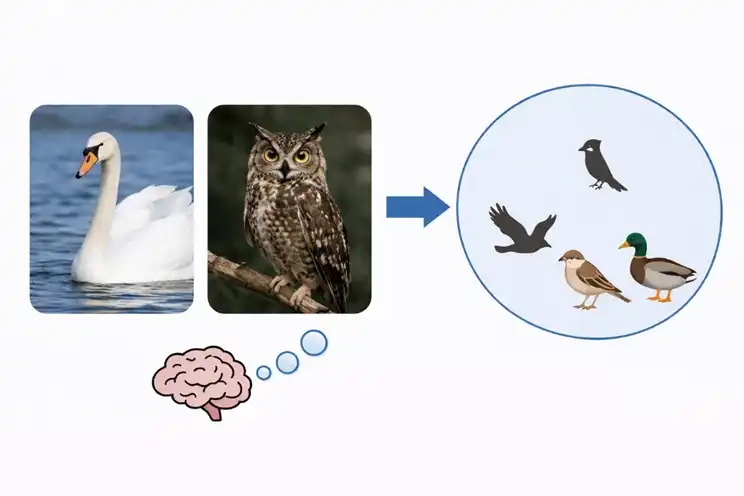
When the human brain processes concepts, it first forms a system of categorical relationships. Swans and owls look different, but humans still classify them both as birds. Moving up, birds and horses can be further grouped into the animal category. When humans encounter something new, they often first consider what it resembles from past experience and which category it might belong to. Humans continuously learn new concepts, then organize this experience, using this relational system to recognize new things and adapt to new situations.
Models also classify, but they form these classifications differently. They rely primarily on patterns that repeatedly appear in large-scale data. The more frequently a specific object appears, the easier it is for the model to recognize it. When it comes to larger categories, models struggle more. They need to capture the commonalities between multiple objects and then group these commonalities into the same category. Existing models still have significant shortcomings here. As parameters continue to increase, performance on concrete concept tasks improves, while performance on abstract concept tasks sometimes even decreases.
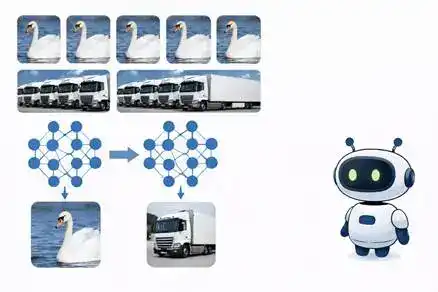
A commonality between the human brain and models is that both internally form a system of categorical relationships. However, their emphases differ. The higher-order visual regions of the human brain naturally distinguish broad categories like living and non-living things. Models can separate specific objects but find it difficult to stably form these larger categories. This difference means the human brain more easily applies past experience to new objects, allowing for rapid categorization of unseen things. Models, conversely, rely more on existing knowledge, so when encountering new objects, they tend to focus on superficial features. The method proposed in the paper addresses this characteristic, using brain signals to constrain the model's internal structure, making it closer to the human brain's categorization method.

The Solution from the Zhejiang University Team

The team's proposed solution is also unique: instead of simply adding more parameters, they use a small amount of brain signal data for supervision. These brain signals come from recordings of brain activity while humans view images. The original paper states the goal as transferring 'human conceptual structures' to DNNs. This means teaching the model, as much as possible, how the human brain classifies, generalizes, and groups similar concepts together.
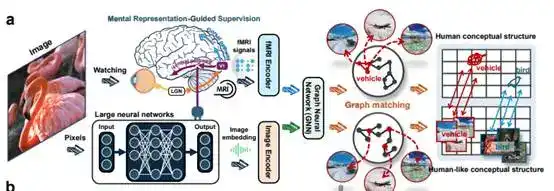
The team conducted experiments using 150 known training categories and 50 unseen test categories. The results showed that as this training progressed, the distance between the model's representations and the brain representations continuously narrowed. This change occurred for both categories, indicating that the model was learning not just individual samples but truly beginning to learn a conceptual organization method more akin to the human brain.

After this process, the model demonstrated stronger few-shot learning capabilities and performed better in novel situations. In a task requiring the model to distinguish abstract concepts like living vs. non-living things with very few examples, the model improved by an average of 20.5%, even surpassing much larger control models. The team also conducted 31 additional specialized tests, where several types of models showed improvements of nearly ten percent.

Over the past few years, the familiar path in the modeling industry has been larger model scale. The Zhejiang University team has chosen a different direction: moving from 'bigger is better' to 'structured is smarter'. Scaling up is indeed useful, but it primarily improves performance on familiar tasks. Abstract understanding and transfer capabilities, inherent to humans, are equally crucial for AI. This requires future AI thinking structures to more closely resemble the human brain. The value of this direction lies in redirecting the industry's attention from pure size expansion back to the cognitive structure itself.

Neosoul and the Future

This points to a larger possibility: AI evolution may not only occur during the model training phase. Model training can determine how AI organizes concepts and forms higher-quality judgment structures. Then, after entering the real world, another layer of AI evolution just begins: how an AI agent's judgments are recorded, tested, and how they continuously grow and evolve through real-world competition, learning and evolving on their own, much like humans. This is precisely what Neosoul is doing now. Neosoul doesn't just have AI agents produce answers; it places AI agents into a system of continuous prediction, verification, settlement, and selection, allowing them to continuously optimize themselves based on predictions and outcomes, preserving better structures and淘汰ing worse ones. What the Zhejiang University team and Neosoul jointly point towards is actually the same goal: enabling AI to not just solve problems, but to possess comprehensive thinking abilities and continuously evolve.


Пов'язані питання

QWhat was the key finding of the Zhejiang University team's research published in Nature Communications regarding model scaling?

AThey found that as model parameters increased (from 22.06 million to 304.37 million), performance on recognizing concrete concepts improved (74.94% to 85.87%), but performance on understanding abstract concepts not only failed to improve but actually decreased (54.37% to 52.82%).

QWhat is the fundamental difference between how the human brain and AI models form conceptual categories?

AThe human brain naturally forms a hierarchical classification system (e.g., grouping specific birds into the 'bird' category, then 'birds' and 'horses' into 'animals'). AI models primarily rely on statistical patterns from large-scale data, excelling at recognizing specific, frequently appearing objects but struggling to form stable, larger abstract categories.

QWhat was the unique solution proposed by the Zhejiang University team to improve AI's abstract reasoning?

AInstead of scaling model size, they used a small amount of brain signal data (recordings of human brain activity when viewing images) as supervision to transfer human conceptual structures to the deep neural networks (DNNs), teaching them how to classify and generalize concepts more like the human brain.

QWhat improvements were observed in the model after being trained with the brain signal supervision method?

AThe distance between the model's representations and brain representations decreased. The model showed stronger few-shot learning capabilities and performed better in novel situations. In a task requiring abstract concept discrimination with very few examples, performance improved by an average of 20.5%, even surpassing much larger control models.

QWhat broader shift in AI development philosophy does the research and Neosoul project represent, according to the article?

AIt represents a shift from the 'bigger is better' paradigm focused on scaling parameters to a 'structured is smarter' approach. The focus is on improving the AI's cognitive structure to be more human-like, enabling abstract understanding and transfer capabilities, and creating systems for continuous learning and evolution through real-world prediction, verification, and competition.

Пов'язані матеріали

From South Korea to the United States: Blue-Collar Jobs Are Becoming Increasingly Popular, Thanks to AI

AI is reshaping the labor market's value proposition. The traditional four-year college degree is losing its appeal as a guaranteed career path, while skilled blue-collar trades like electricians, welders, and plumbers are experiencing historic demand and wage premiums. This shift is driven by dual pressures: AI's displacement of certain white-collar roles and a booming need for physical infrastructure and data center construction. Data confirms the trend. In the U.S., vocational school revenue surged, and a significant portion of recent layoffs are AI-related. Surveys show a majority of Gen Z adults plan to pursue blue-collar work, citing better job security against AI automation. Vocational education interest has exploded recently. Experts cite a psychological shift as younger generations seek tangible, AI-resistant careers and avoid high student debt. In many cases, salaries for skilled trades now match or exceed those requiring a bachelor's degree. In South Korea, semiconductor vocational high schools boast near-total employment, with graduates securing high-paying roles at companies like Samsung. The shortage is structural, exacerbated by a retiring baby boomer workforce and massive infrastructure projects. Companies like JPMorgan Chase, Meta, and Lowe's are investing heavily in training programs. However, overcoming historical stigma and a "perception gap" around trade careers remains a key challenge to closing the talent gap.

marsbit59 хв тому

From South Korea to the United States: Blue-Collar Jobs Are Becoming Increasingly Popular, Thanks to AI

marsbit59 хв тому

Qualcomm: AI Hype Subsides, When Will Smartphones Emerge from the Gloom?

Qualcomm reported its Q3 FY2026 results (ending June 2026), with revenue of $9.95B, down 4% YoY but above expectations. Gross margin declined to 53.1%, pressured by rising costs across manufacturing and memory. Key business segments showed mixed performance: Handset revenue fell 19.6% YoY to $5.09B, dragged by an 11% decline in non-Apple Android shipments and weaker high-end mix. Conversely, Automotive revenue surged 61% to $1.59B, and IoT grew 9% to $1.83B. Core operating profit dropped 41% YoY due to margin compression and higher expenses. Management's Q4 FY2026 guidance projects revenue of $9.7B-$10.5B, in line with consensus, but Non-GAAP EPS guidance of $2.05-$2.25 fell short of expectations. Amidst persistent weakness in its core handset market, Qualcomm is pursuing growth in AI, focusing on Edge AI (smartphones, PCs, automotive) and Data Center AI. Its data center strategy includes four pillars: AI accelerators (e.g., AI200), commercial CPUs (Dragonfly C1000), custom silicon, and connectivity solutions. While these initiatives initially boosted its stock, concerns over AI capital expenditure sustainability have since erased those gains. The company targets $5B in data center revenue for FY2027 and $15B for FY2029. The report concludes that with the traditional handset business still under pressure, the data center opportunity is currently viewed as a longer-term option, and a more conservative valuation based on core operations may be warranted until AI contributions materialize.

marsbit1 год тому

Qualcomm: AI Hype Subsides, When Will Smartphones Emerge from the Gloom?

marsbit1 год тому

From TPU to Self-Evolving Agents: How Jeff Dean Predicts the Next Step in AI

At the 2026 YC Startup School, Jeff Dean outlined his vision for AI's next phase, shifting focus from simply scaling models to building intelligent, autonomous systems. He believes AI's progress is no longer just about creating smarter models, but about integrating them into systems capable of long-term, iterative work, automated experimentation, and continuous learning. This evolution moves the competition from "who has the bigger model" to "who can best organize intelligence." Dean suggests AI capabilities are now comparable to a junior engineer, enabling the automation of complex workflows. However, the true challenge and opportunity lie in managing these AI "workers" at scale. He emphasizes the importance of **context engineering**—structuring tools, memory, and feedback loops—over raw model power. For startups, this means building deep expertise in niche domains where general models currently fail (near 0-1% success rates), leveraging proprietary data, specialized tools, and domain-specific evaluators. A recurring theme is re-examining fundamental constraints. Dean's past work, like moving Google's search index to memory or creating the TPU, stemmed from questioning outdated assumptions about hardware and cost. He sees similar inflection points today, particularly in **specialized inference hardware** to drastically reduce latency and energy consumption for real-time Agent operation. Notably, he points out that in modern AI systems, the dominant cost is often not computation but **data movement**. Reliable, long-running Agents require robust system design, borrowing concepts from distributed computing like checkpointing, state management, and parallel exploration to handle failures and maintain progress over days or weeks. As AI automates execution, the scarcest human skills will shift to **defining clear specifications**, **judging what problems are worth solving** (taste), and designing effective feedback loops. Ultimately, Dean's framework prioritizes understanding the problem deeply, identifying the true bottlenecks, and systematically building closed-loop systems where AI can not only perform tasks but also improve AI itself.

marsbit1 год тому

From TPU to Self-Evolving Agents: How Jeff Dean Predicts the Next Step in AI

marsbit1 год тому

Торгівля

Спот
活动图片




