ZCash reclaims $400, but here’s why the recovery could be short-lived

ambcryptoОпубліковано о 2026-07-03Востаннє оновлено о 2026-07-03

Анотація

ZCash (ZEC) has seen a 5.28% price increase, reclaiming the $400 level amid a broader, albeit cautious, crypto market recovery at the start of July. However, analysis suggests this rebound may be short-lived. Despite a whale opening an $8.1 million long position, the lack of significant growth in Open Interest indicates weak speculative interest. The price structure remains bearish, with key resistance at the $480-$540 zone. Failure to overcome this supply area, coupled with a potential loss of the local $360-$380 support, could see ZEC retreat toward $300, especially if Bitcoin's own recovery falters.

The crypto market has started July off on a positive note. Though June forced sizeable losses across the market, a positive start to the new month has given many altcoins a new lease of life.

Bitcoin [BTC] has gained 6.26% from the low of $57,800 made on July 1, and the altcoin market cap, including Ethereum, has expanded by 4.05%.
Source: Axel Adler Jr. on X

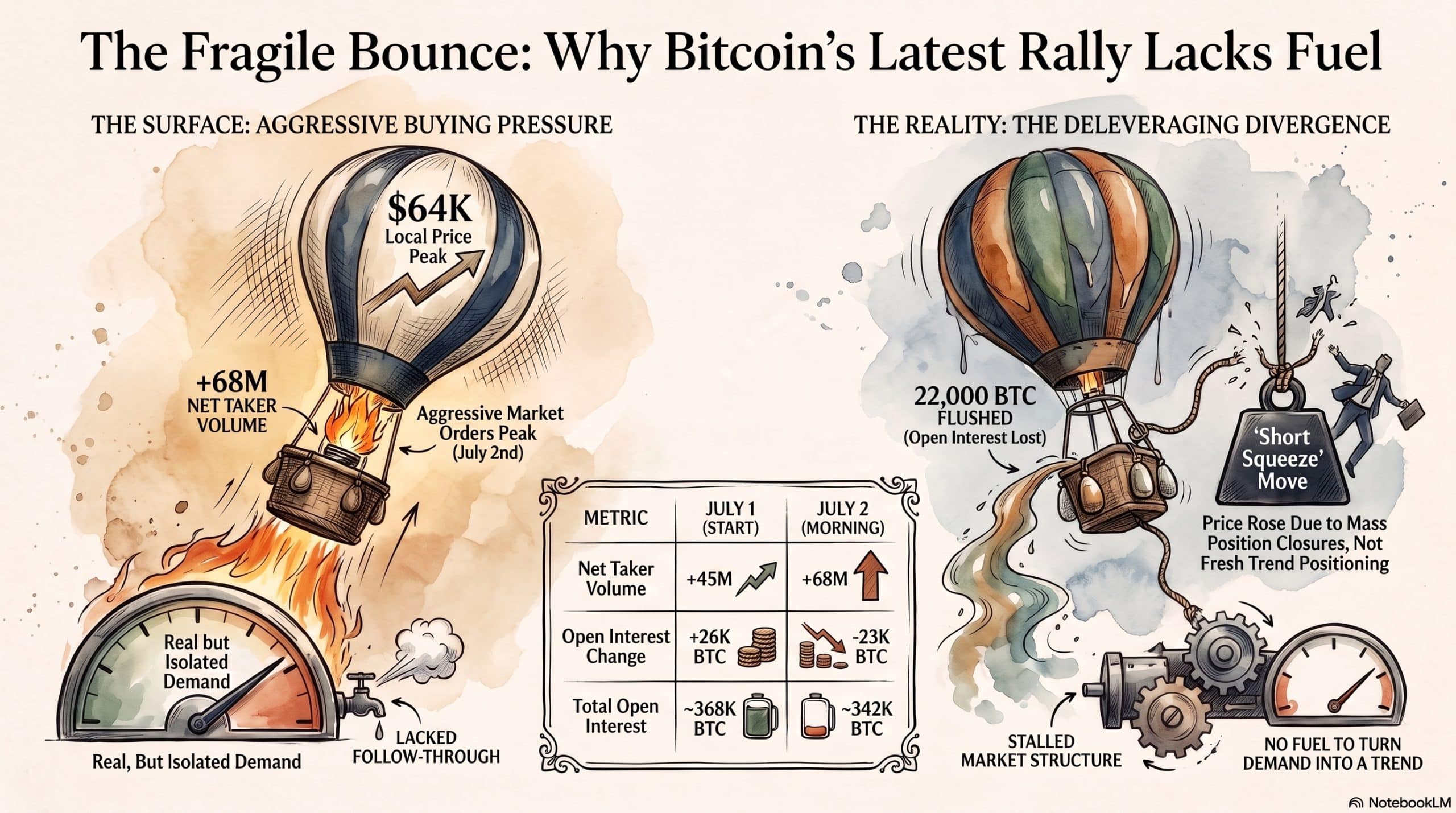
In a post on X, crypto analyst Axel Adler Jr. explained that the Bitcoin Open Interest fell by 23k BTC, though net taker buy volume was $68 million. The lack of growth in OI, despite aggressive buying in the perpetual markets, suggested a lack of fuel to sustain the upward move.

A lack of bullish follow-through can negatively impact altcoins, including ZCash [ZEC]. The token was up 5.28% in 24 hours, but its OI has grown by only 1.33%, indicative of a lack of speculative interest.

AMBCrypto reported that a ZEC whale had opened a $8.1 million long position, but that the price structure remained bearish. Here’s what ZEC bulls need to see before they can bet on a sustained uptrend.

The former range above $500 is pivotal for revival
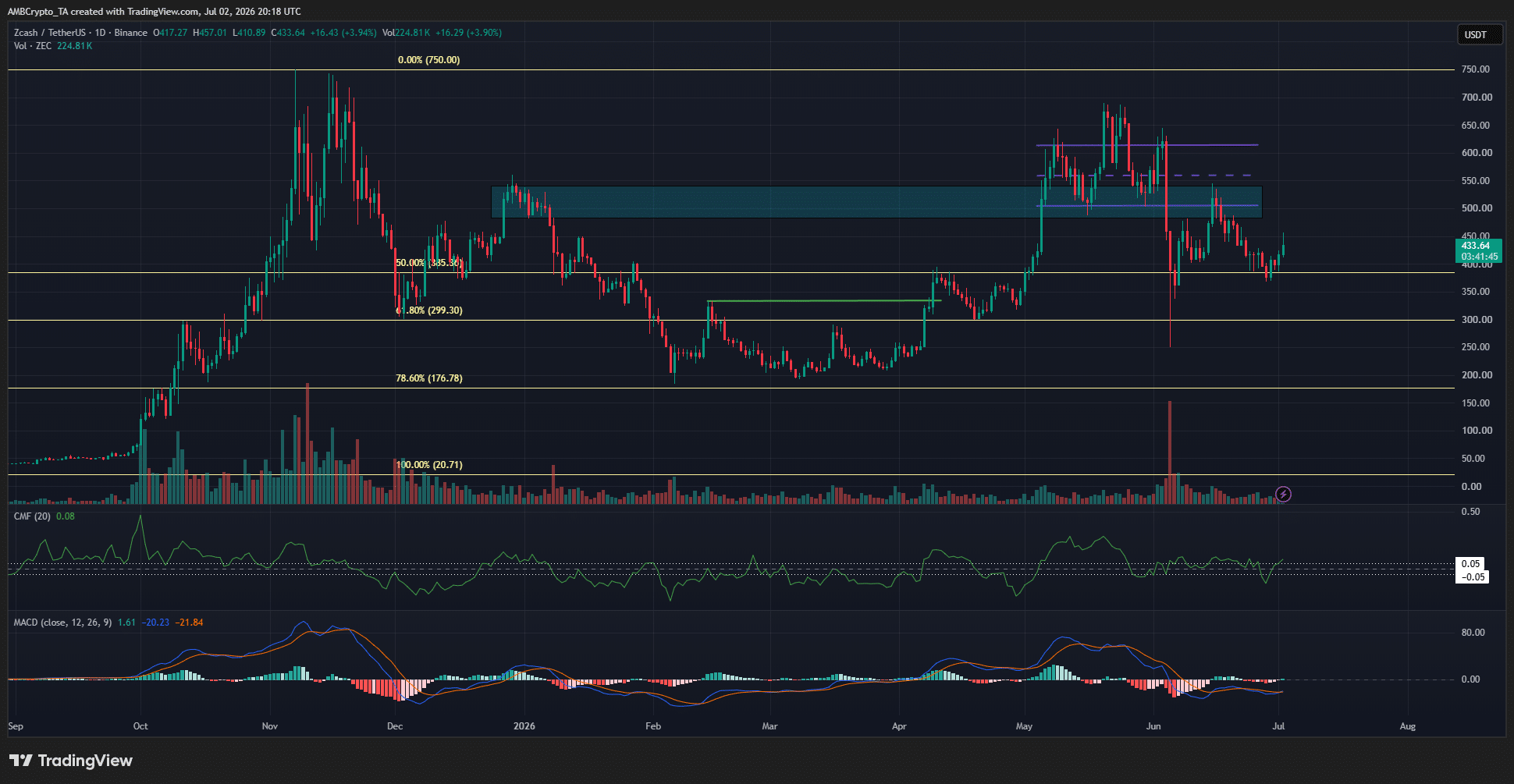
Source: ZEC/USDT on TradingView

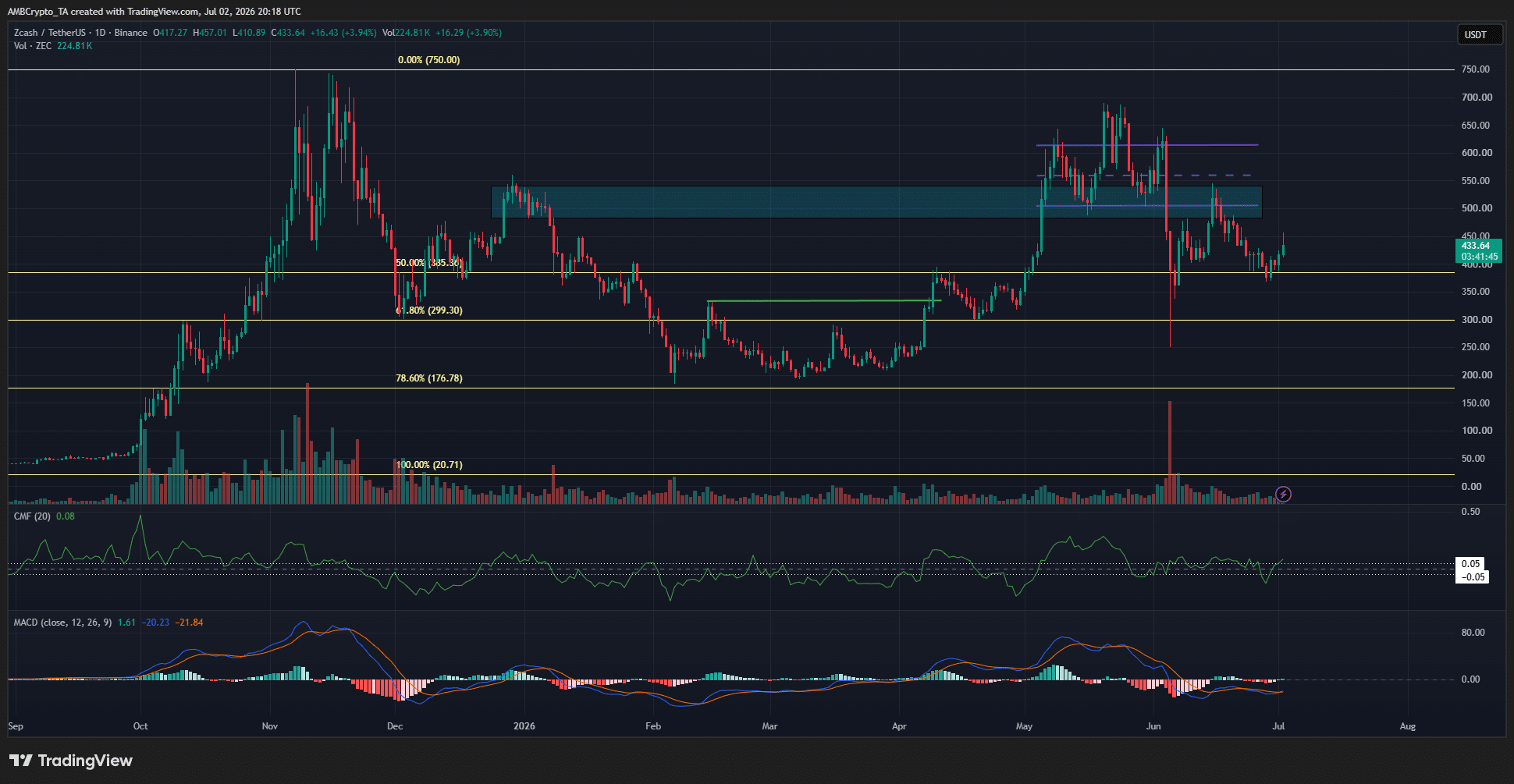
The 1-day chart showed a bearish internal market structure. The $486.61 low made in mid-May fell below the local range’s low, but the buyers were not able to defend this demand zone for long.

The subsequent waves of selling forced a price drop below $400 on two occasions in the weeks since this bearish breakdown.

At the time of writing, the CMF was at +0.08 to show significant buying pressure. The recovery from $176 earlier this year was part of a longer-term uptrend, but as things stand, the $480-$540 supply zone must be overcome to revive the idea of a bullish recovery.

If, instead, ZEC falls below the $360-$380 local support zone once again, swing traders and investors can expect the move to continue toward the next support level at $300.


Final Summary

  • The $360-$380 local support zone and $480-$540 resistance zone were the key battlegrounds ZEC swing traders must watch.
  • If the short-term Bitcoin bounce fails to gain traction, a momentum reversal could hurt ZEC and push it back below $400.

Пов'язані питання

QAccording to the article, why might ZCash's recovery be short-lived?

AThe recovery might be short-lived due to a lack of growth in Bitcoin's Open Interest (OI) despite buying, suggesting insufficient fuel for a sustained upward move, and ZCash's own OI growth of only 1.33%, indicating a lack of speculative interest.

QWhat are the key price zones for ZEC (ZCash) according to the technical analysis in the article?

AThe key zones are the local support zone at $360-$380 and the crucial supply/resistance zone at $480-$540. The price must overcome the $480-$540 zone to revive a bullish recovery idea.

QWhat potential downside target is mentioned if ZEC breaks below its $360-$380 support?

AIf ZEC falls below the $360-$380 local support zone, the move could continue toward the next support level at $300.

QWhat did the article report about a ZEC whale's activity?

AThe article reported that a ZEC whale had opened an $8.1 million long position.

QWhat broader market condition could negatively impact ZEC and other altcoins?

AA lack of bullish follow-through in Bitcoin's price movement could negatively impact altcoins like ZEC. If Bitcoin's short-term bounce fails to gain traction, a momentum reversal could hurt ZEC.

Пов'язані матеріали

Building USDC by Its Own Hands, Why Does Coinbase Turn to Support Competitor OUSD?

Coinbase, a key distributor of the dominant stablecoin USDC, has joined over 140 major companies—including Visa, Mastercard, and BlackRock—as a founding member of the Open USD (OUSD) alliance, a move that directly challenges the current stablecoin economic model. The new project aims to upend the established profit structure by offering zero minting and redemption fees and allocating the majority of reserve interest earnings to distribution partners, rather than the issuer. This shift highlights a growing power struggle in the $320+ billion stablecoin market, where platforms with massive user bases are demanding a larger share of the revenue generated from the underlying reserves. Circle, the issuer of USDC, saw its stock plummet 16% on the day of the OUSD announcement, reflecting investor concern over the potential strain on its crucial partnership with Coinbase. While Coinbase earned over $900 million from its USDC partnership in 2024, its support for a competing model gives it significant leverage as its revenue-sharing agreement with Circle nears expiration in August 2026. Circle CEO Jeremy Allaire defended the USDC model, emphasizing its decade-long development, deep liquidity, and extensive ecosystem integration, which he argues cannot be easily replicated by a large, potentially slow-moving consortium. He also questioned the sustainability of a zero-fee model and warned that diverting all reserve interest would leave issuers without funds for critical compliance and operational infrastructure. Analysts remain skeptical of OUSD's prospects, citing the "cold start" problem of building liquidity, potential governance challenges within a large alliance, and heightened regulatory scrutiny. The emergence of OUSD signals a broader industry bifurcation, where stablecoins are increasingly viewed as backend settlement tools. The core competition is shifting from technology to a direct negotiation over how profits from the network are distributed between issuers and the powerful distribution channels.

Foresight News1 год тому

Building USDC by Its Own Hands, Why Does Coinbase Turn to Support Competitor OUSD?

Foresight News1 год тому

Торгівля

Спот
活动图片