Zcash Bug Could Have Minted Unlimited ZEC Undetected

bitcoinistОпубліковано о 2026-06-05Востаннє оновлено о 2026-06-05

Анотація

A critical vulnerability in Zcash's Orchard shielded pool, discovered by researcher Taylor Hornby on May 29, 2026, could have allowed an attacker to create an unlimited amount of undetectable counterfeit ZEC. The flaw, involving an under-constrained element in the Orchard circuit, existed from the pool's 2022 activation until an emergency fix was deployed by June 2, 2026. Hornby identified the bug using AI-assisted auditing tools and confirmed its exploitability in a test environment. Due to Orchard's privacy features, which hide transaction amounts and history, there is no cryptographic way to prove whether the vulnerability was exploited before the fix. While Shielded Labs assesses prior exploitation as unlikely, this uncertainty has sparked a debate on proving supply integrity in privacy-preserving systems. In response, Shielded Labs and other developers are exploring a network upgrade, potentially involving a new shielded pool and formal verification of the circuit rules to prevent future vulnerabilities and allow verification of the ZEC supply's integrity. ZEC's price fell nearly 45% following the disclosure.

A critical vulnerability in Zcash’s Orchard shielded pool could have allowed an attacker to create an unlimited amount of counterfeit ZEC without detection, according to a new disclosure from Zooko Wilcox, Jason McGee and security researcher Taylor Hornby. The flaw was discovered on May 29, remediated through an emergency ecosystem response completed by June 2, and has now triggered a broader debate over how Zcash can prove supply integrity in a privacy-preserving system.

Orchard Flaw Puts Zcash Supply Integrity Under Scrutiny

The vulnerability was found by Hornby, an experienced security engineer hired by Shielded Labs in April 2026 to conduct ongoing security research on the Zcash protocol. According to the disclosure, the mandate was straightforward: find protocol-level weaknesses before adversaries did. Hornby began reviewing Zcash with a combination of traditional security research and newer AI-assisted auditing methods.

The timing was unusually compressed. Shortly after Anthropic released its Opus 4.8 model on May 28, Hornby used it in a targeted review of the Orchard circuit. One day later, he found a critical counterfeiting flaw and disclosed it to Zcash Open Development Lab, or ZODL, whose engineers coordinated the emergency response with other ecosystem participants.

“The vulnerability could have been exploited to undetectably create an unlimited amount of counterfeit ZEC within Orchard,” the Shielded Labs post said. “Because of the privacy properties of Orchard, there is no way to cryptographically prove whether the vulnerability was exploited before it was remediated. However, a network upgrade can be deployed to protect users and prove the integrity of the Zcash supply.”

The disclosure states that the bug was “real and exploitable.” Hornby, with the help of Opus 4.8, wrote a complete exploit and tested it in a local regtest environment, where it generated unlimited counterfeit ZEC that could not be detected. The authors said that had the same tool been run on mainnet, it would have generated unlimited, undetectable counterfeit ZEC in Hornby’s mainnet wallet.

Technically, the issue involved an under-constrained element of the Orchard circuit. That made it possible to feed arbitrary false inputs into an elliptic curve multiplication while still passing the multiplication check. The vulnerability existed from Orchard’s activation in May 2022 until the emergency fix was deployed on June 1, 2026.

That timeline is central to the concern. In a transparent ledger, supply irregularities can generally be audited by inspecting public balances and transaction values. Orchard is different by design: it hides amounts and transaction history. That privacy model means the system depends heavily on the correctness of the circuit rules that define valid shielded transactions.

Josh Swihart, founder and CEO of Zcash Open Development Lab, the team behind the creation and launch of Zcash and builder of the Zodl wallet, framed the issue in those terms in a separate post. “A shielded Zcash transaction includes a proof that it followed the protocol’s rules, as defined in the rulebook (the circuit) that defines what constitutes a valid transaction. The Orchard vulnerability was in one of the rules, written loosely enough that it would accept false information and still pass. As a result, the engine could be convinced that a fake transaction was valid.”

Swihart added that the flaw was not in Zcash’s underlying cryptography or the proof engine itself, but in the handwritten rules. In his words, “This was a flaw in the handwritten rules, not in the underlying cryptography or the engine that creates proofs.”

Shielded Labs said prior exploitation appears unlikely, while emphasizing that users should not be asked to rely on that assessment alone. The authors pointed to several reasons for their view: the flaw had evaded years of scrutiny by leading cryptographers, Hornby was specifically hired to find such vulnerabilities, and the response window after discovery was sharply narrowed by the speed of ZODL and the broader Zcash ecosystem.

“The discovery was not accidental—it was the result of a deliberate effort to identify vulnerabilities of this kind before malicious actors could,” the post said. “Taylor is one of the most skilled people in the world at this. He used the most recent AI tools, available only to white-hat security researchers, along with a sophisticated custom-built AI harness and prompts, and worked hard to outrace the attackers. We think he probably succeeded.”

Still, the authors acknowledged the unresolved cryptographic uncertainty. Because of Orchard’s privacy properties and the nature of the bug, they said there is no definitive way to prove solely through cryptography whether the vulnerability was exploited before the fix.

Shielded Labs Eyes New Pool And Formal Verification

To address that, Shielded Labs is exploring a proposed network upgrade with other Zcash developers. The plan would deploy a new shielded pool and enforce turnstile accounting on coins moving from the existing Orchard pool, with the goal of allowing anyone to verify the integrity of the Zcash supply and prove the non-existence of counterfeit ZEC in Orchard. A follow-up post is expected next week with more details, including tradeoffs and implementation mechanics. Any major upgrade would still need community support and the standard governance process before activation.

Swihart said a second Orchard pool could, in principle, be targeted for NU7 at the end of July, though he did not take a fixed position on whether that path should be pursued. He argued that the larger issue is preventing this class of failure from recurring, with formal verification as the strongest answer.

“Formal verification fixes this,” Swihart wrote. “A mathematical proof can be constructed to reduce the parts humans must review to a concise, readable statement of the rules. A computer then checks the entire rulebook to ensure it matches. AI tools can now do the work of writing these proofs.”

Shielded Labs said it is already accelerating proactive security work with Hornby and Anthropic, initiating a project to formally verify the Orchard circuit, and opening searches for a Head of Security and a Cryptographer. The episode leaves Zcash with a difficult but clear path: repair the trust assumptions around Orchard, prove supply integrity where possible, and move future shielded design closer to machine-checked guarantees rather than human-reviewed complexity.

Over the past 24 hours, ZEC has fallen nearly 45% amid the uncertainty. At press time, it was trading at $337.
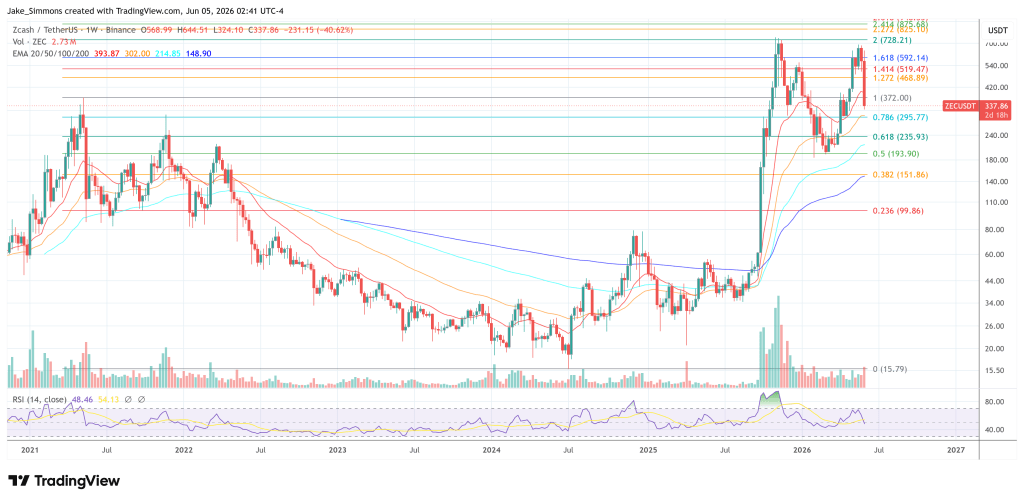
ZEC trades below the 1.618 Fib again, 1-week chart | Source: ZECUSDT on TradingView.com

Пов'язані питання

QWhat was the nature of the critical vulnerability discovered in Zcash's Orchard shielded pool?

AThe vulnerability was a critical counterfeiting flaw. An under-constrained element in the Orchard circuit allowed an attacker to feed arbitrary false inputs into an elliptic curve multiplication while still passing the multiplication check, potentially enabling the creation of an unlimited amount of counterfeit ZEC that could not be detected.

QWho discovered the vulnerability, and what tools aided in its discovery?

AThe vulnerability was discovered by security researcher Taylor Hornby, who was hired by Shielded Labs. He used a combination of traditional security research and newer AI-assisted auditing methods, specifically employing Anthropic's Opus 4.8 model released on May 28 in a targeted review of the Orchard circuit, which led to the discovery the next day.

QWhy is it impossible to cryptographically prove whether the Orchard vulnerability was exploited before it was fixed?

ADue to the privacy properties of the Orchard shielded pool, which hides transaction amounts and history by design. This means supply irregularities cannot be audited by inspecting public data, unlike transparent ledgers. The system relies on the correctness of the circuit rules, and the bug's nature leaves no definitive cryptographic trace of prior exploitation.

QWhat proposed solution is Shielded Labs exploring to address the supply integrity concerns raised by the Orchard bug?

AShielded Labs is exploring a proposed network upgrade to deploy a new shielded pool. This plan would enforce turnstile accounting on coins moving from the existing Orchard pool, with the goal of allowing anyone to verify the integrity of the Zcash supply and prove the non-existence of counterfeit ZEC in Orchard.

QAccording to Josh Swihart, what is the strongest long-term solution to prevent this class of failure from recurring?

AJosh Swihart identified formal verification as the strongest answer. This involves constructing a mathematical proof to reduce the human-reviewed parts to a concise statement of the rules, and then using a computer to check that the entire rulebook matches those rules, with AI tools now capable of writing these proofs.

Пов'язані матеріали

US Stock Market Trend (June 16): SpaceX Rises 42% in Two Days, New Fed Chairman Takes Office Today

**U.S. Stocks Trend (June 16): SpaceX Soars 42% in Two Days, New Fed Chair Takes Office Today** Markets surged on Monday following former President Trump's social media announcement of a completed U.S.-Iran deal to reopen the Strait of Hormuz, pending a June 19 signing. The news triggered a broad risk-on rally: oil prices crashed, tech stocks soared, bond yields fell, and defensive sectors lagged. **Market Performance:** The Nasdaq jumped 3.07%, led by semiconductor stocks like Micron (+9.2%). The S&P 500 gained 1.65%, and the Dow rose 0.92% to a record high. However, the Russell 2000 small-cap index underperformed (+0.72%). SpaceX continued its hot streak, rising another 5% pre-market after disclosures of large buys by an Australian billionaire and Cathie Wood's ARK. Boeing also rallied on the transportation optimism. Conversely, energy stocks like Chevron fell over 3% on the oil price plunge, with other defensive sectors also selling off. The day's action showed a clear rotation of funds from energy/defensive plays into AI and tech narratives. **Macro & Outlook:** The VIX fear index fell 8.37%. Treasury yields declined, and WTI crude dropped over 5%. Attention now shifts to a packed schedule: the Bank of Japan is widely expected to hike rates to 1.0% on Tuesday. The Fed's June meeting concludes Wednesday, marking new Chair Wash's debut. While rates are expected to hold, his tone on stubborn inflation and the "dot plot" will be crucial for gauging the 2024 rate path. The formal Iran deal signing is set for Friday. **Trend Perspective:** While the peace deal is a genuine positive, Monday's explosive rally may have gotten ahead of itself, pricing in a swift resolution to inflation concerns. The shortened trading week faces a triple test: BoJ tightening, the Fed's policy stance, and deal implementation details. Tech and semiconductors, which led the surge, remain vulnerable to any disappointment from these key events. The real price discovery begins with the central banks' communications this week.

marsbit25 хв тому

US Stock Market Trend (June 16): SpaceX Rises 42% in Two Days, New Fed Chairman Takes Office Today

marsbit25 хв тому

Xiaohongshu's Second Great Voyage, This Time Sailing Towards AI

Xiaohongshu's Second Voyage: Navigating Towards AI Since ChatGPT's emergence, Xiaohongshu's founder Mao Wenchao has been acutely aware of AI's potential threat, recognizing that the life advice people seek from chatbots overlaps directly with his platform's core business. Founded in 2013 as a PDF shopping guide for Chinese tourists, Xiaohongshu evolved into a massive community where millions share authentic, personal experiences—from product reviews to travel tips. This vast repository of "I've tried this" human judgment became its most valuable asset. However, the rise of AI, which delivers instant answers, challenges the very need for users to sift through numerous personal notes. Fearing its treasure trove of lived experience could become mere training data for others, Xiaohongshu is proactively adapting. In 2026, it established a dedicated AI division (Dots), launched RED Skill to turn user experiences into usable AI tools, and acquired the AI search product "Diandian." Its investments now extend to AI firms like MiniMax and hardware startups, moving upstream to address needs before they even become search queries. The platform's commercialization strategy is also evolving. With a newly acquired payment license and tools like the AIPS model to track consumer decision journeys, Xiaohongshu aims to seamlessly integrate recommendations with transactions, embedding commerce within AI-generated answers. Yet, a critical tension remains. While building smarter machines to organize and leverage its human experiences, Xiaohongshu must prevent AI from drowning out the authentic, flawed, and trustworthy "I've tried this" voices that built its community. Its core challenge is to harness AI's power without letting the map—the machine's perfect, synthesized answer—replace the territory of genuine human experience. This balance between technological advancement and preserving human trust defines its current journey and its future.

marsbit57 хв тому

Xiaohongshu's Second Great Voyage, This Time Sailing Towards AI

marsbit57 хв тому

SharpLink CEO: How to Understand Ethereum Developers Just Exceeded 1 Million?

SharpLink CEO reflects on the milestone of Ethereum surpassing 1 million historical developers, emphasizing that this figure represents the largest pool of technical talent ever assembled around an open, permissionless blockchain network. While approximately 232,000 developers remain active, the key question for the crypto industry is not which chain is fastest, but where the best builders choose to build long-term. Ethereum's advantage lies in a decade-long accumulation of infrastructure, standards, tools, liquidity, and a cohesive culture, making it the default operating system for programmable finance. This developer base is tackling complex challenges: the Glamsterdam upgrade aims to enhance scalability while preserving core principles; synchronous composability seeks to unify Rollup ecosystems; and significant efforts are underway for post-quantum security. Ethereum's deeper network effects stem from composability and shared standards (like the EVM and Solidity), creating a flywheel of more developers, tools, and liquidity. Three reinforcing strengths cement Ethereum's lead: credible neutrality (secured by ~900k validators), a modular architecture with interconnected Rollups, and a culture that attracts top researchers. The ecosystem is consolidating as the trusted coordination layer for internet-native finance, favored by large institutions valuing security and liquidity. The future of Ethereum is being built by this global community of founders and architects.

链捕手1 год тому

SharpLink CEO: How to Understand Ethereum Developers Just Exceeded 1 Million?

链捕手1 год тому

Торгівля

Спот
Ф'ючерси

Популярні статті

Як купити ZEC

Ласкаво просимо до HTX.com! Ми зробили покупку Zcash (ZEC) простою та зручною. Дотримуйтесь нашої покрокової інструкції, щоб розпочати свою криптовалютну подорож.Крок 1: Створіть обліковий запис на HTXВикористовуйте свою електронну пошту або номер телефону, щоб зареєструвати обліковий запис на HTX безплатно. Пройдіть безпроблемну реєстрацію й отримайте доступ до всіх функцій.ЗареєструватисьКрок 2: Перейдіть до розділу Купити крипту і виберіть спосіб оплатиКредитна/дебетова картка: використовуйте вашу картку Visa або Mastercard, щоб миттєво купити Zcash (ZEC).Баланс: використовуйте кошти з балансу вашого рахунку HTX для безперешкодної торгівлі.Треті особи: ми додали популярні способи оплати, такі як Google Pay та Apple Pay, щоб підвищити зручність.P2P: Торгуйте безпосередньо з іншими користувачами на HTX.Позабіржова торгівля (OTC): ми пропонуємо індивідуальні послуги та конкурентні обмінні курси для трейдерів.Крок 3: Зберігайте свої Zcash (ZEC)Після придбання Zcash (ZEC) збережіть його у своєму обліковому записі на HTX. Крім того, ви можете відправити його в інше місце за допомогою блокчейн-переказу або використовувати його для торгівлі іншими криптовалютами.Крок 4: Торгівля Zcash (ZEC)Легко торгуйте Zcash (ZEC) на спотовому ринку HTX. Просто увійдіть до свого облікового запису, виберіть торгову пару, укладайте угоди та спостерігайте за ними в режимі реального часу. Ми пропонуємо зручний досвід як для початківців, так і для досвідчених трейдерів.

558 переглядів усьогоОпубліковано 2024.12.12Оновлено 2026.06.02

Як купити ZEC

Обговорення

Ласкаво просимо до спільноти HTX. Тут ви можете бути в курсі останніх подій розвитку платформи та отримати доступ до професійної ринкової інформації. Нижче представлені думки користувачів щодо ціни ZEC (ZEC).

活动图片