Zashi Becomes Zodl: Zcash Wallet Rebrands Following Internal Split

bitcoinistОпубліковано о 2026-02-17Востаннє оновлено о 2026-02-17

Анотація

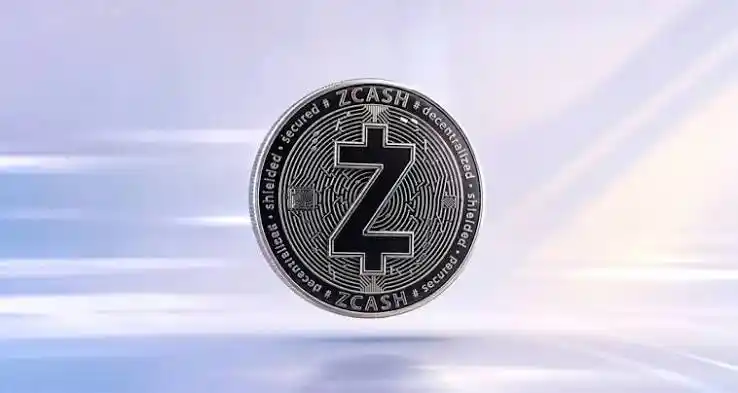
Zashi, the flagship mobile wallet for Zcash, has been rebranded to "Zodl" following a formal split from the Electric Coin Company (ECC), its original developer. The rebrand signals continuity in the product and team, but under a new corporate entity called the Zcash Open Development Lab (ZODL). Users are not required to take any action, as the update will not impact the wallet's functionality. The change comes after a governance rupture in January 2025, when the entire ECC team left due to a dispute with Bootstrap, the nonprofit governing ECC. The conflict centered around a proposal to move Zashi into a for-profit structure and attract external investment, which Bootstrap argued required careful handling due to nonprofit fiduciary duties. Despite the corporate restructuring, the team's mission remains focused on privacy-first payments and financial sovereignty. The wallet will continue operating as Zcash's flagship product, now independently developed and funded outside the Zcash development fund.

Zashi, the flagship mobile wallet built by Zcash’s original engineering team, is rebranding to “Zodl” as its developers formally operate outside the Electric Coin Company (ECC) structure. The change matters less as a cosmetic refresh than as a signal: the same builders are continuing product work, but under a new corporate banner after a governance rupture that spilled into public view in early January.

Zcash Wallet Zashi Renamed Zodl

In a post on X dated Feb. 16, the wallet team said the next app update will rename Zashi to Zodl “without impacting the user experience,” stressing there is “no action required” from users. “It’s a new brand for a new chapter, but everything else stays the same: the wallet, the team behind it, and our commitment to Zcash,” the announcement read. “We’re moving forward with clarity and purpose, and this change reflects the building momentum.”

The post also tied the rebrand to a broader organizational reset. “In January of this year, the entire Electric Coin Company (ECC) team, the original creators of Zcash and Zashi, left ECC and formed a new company,” it said, naming the new entity Zcash Open Development Lab (ZODL) and positioning Zodl as the “Zcash flagship wallet.” The team framed the move as a way to pursue growth “without reliance on the Zcash development fund,” while keeping continuity on shipping and support.

On mission, the wallet team used language that will be familiar to long-time Zcash followers, explicitly anchoring the product roadmap to privacy-first payments. “We envision a world without mass financial surveillance. A world where law-abiding people can transact freely and privately, without fear that their data will be exploited or weaponized,” the post said. “There is no sovereignty without privacy. Our banner has changed, but our mission has not.”

The immediate practical effect for users is limited: the same app is expected to update in place, with branding changes rolling out across channels, including the Discord support presence. The more consequential change is governance and ownership context: the wallet is now explicitly presented as a product of ZODL rather than ECC, after weeks of public dispute about who could control, finance, and potentially commercialize consumer-facing efforts around Zashi.

The Background Story

The break traces back to a late-2025 clash between ECC leadership and Bootstrap, the 501(c)(3) nonprofit that governs ECC. In early January, former ECC CEO Josh Swihart said board actions left the team no viable path inside the existing structure. “Unfortunately, decisions made by four of Bootstrap’s board members forced every person at ECC to exit the company, very quickly,” Swihart wrote on the Zcash Community Forum on Jan. 9. “I wish we hadn’t been forced to move so quickly. But we had no choice. This is a serious matter. It is not a game. And as you see, the consequences, severe.”

Bootstrap, for its part, has argued the flashpoint was a proposed transaction to move Zashi into a for-profit structure and attract outside capital, which it says had to be handled as a related-party deal involving nonprofit-controlled assets.

In a public statement and accompanying timeline, Bootstrap described talks around external investment and “alternative structures to privatize Zashi” intensifying in late October 2025, then accelerating in December amid rushed deadlines, incomplete documentation, and legal constraints tied to nonprofit fiduciary duties. The timeline states that matters “rapidly escalated” around Dec. 20 when the board was presented with a Jan. 1 deadline to approve a deal, followed by leadership departures in early January and the broader team exit shortly after.

At press time, Zcash traded at $284.34.
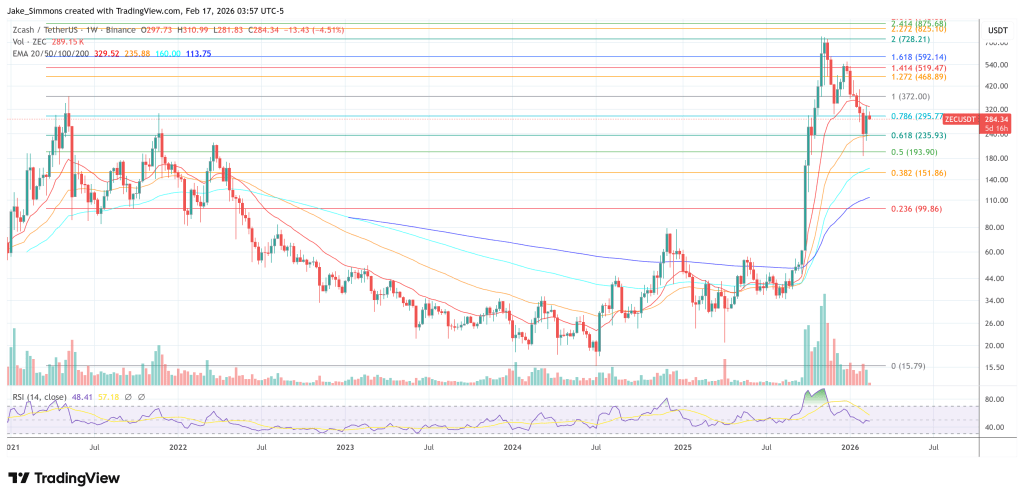
ZEC price remains below the 0.786 Fib, 1-week chart | Source: ZECUSDT on TradingView.com

Пов'язані матеріали

Dalio's Latest Warning: Don't Get Carried Away by AI, Real Returns on US Stocks in the Next 5-10 Years Could Be -5% to -10%

Ray Dalio, founder of Bridgewater Associates, warns investors against excessive concentration in AI stocks. He argues the current market, dominated by a few AI giants, mirrors historical patterns where revolutionary new technologies lead to high risk, volatility, and uncertainty. While acknowledging AI's transformative potential, Dalio emphasizes that most investors fail at this stage of the cycle by over-concentrating in a handful of leading companies. He cites inherent risks: companies cannot accurately forecast investment needs or external shocks (e.g., monetary policy, geopolitics, taxes), face potential disruption from future technologies and international competition (notably from China), and experience significant price swings. Dalio's core advice is diversification, calling it his "Holy Grail of Investing." He presents a mathematical case that a well-diversified portfolio of 15-20 uncorrelated, good bets offers a superior risk-adjusted return compared to a concentrated position. Dalio also offers a cautious outlook, suggesting U.S. stocks may deliver real returns of -5% to -10% over the next 5-10 years based on valuation and bubble indicators. He concludes that in the face of high uncertainty, the prudent strategy is not to avoid betting entirely, but to avoid large, concentrated bets where one lacks sufficient informational edge. Instead, investors should build a strategically balanced, diversified portfolio.

marsbit48 хв тому

Dalio's Latest Warning: Don't Get Carried Away by AI, Real Returns on US Stocks in the Next 5-10 Years Could Be -5% to -10%

marsbit48 хв тому

Rain Valuation Approaches $20 Billion: The Battle for U-Cards Extends to Rewards Systems

Rain, a stablecoin payments infrastructure company, is shifting the competitive focus for U Cards from simple issuance to user retention and repeated usage. On June 15, Rain launched "Rain Rewards," an embedded loyalty program capability within its card-issuing infrastructure. This allows partner businesses—like fintech platforms and neobanks—to configure branded loyalty points, earning rules, redemptions, and merchant promotions directly within their card products. The system, built from the 2025 acquisition of Uptop, ensures points are only issued upon final transaction settlement, preventing liabilities from refunds. Trials, such as with Avalanche Card, reportedly boosted spending by 25% among enrolled users. Founded by Farooq Malik and Charles Yoo-Naut, Rain evolved from a tool for managing Web3 company expenses into a full-stack enterprise platform. It is a Principal Member of Visa and Mastercard, enabling partners to issue stablecoin-backed cards and wallets while leveraging traditional payment networks. Notably, the popular U Card Plasma One is issued by Rain under Visa's authority. Rain also integrates with Visa's stablecoin settlement pilot, using USDC for network settlement. Rain's rapid funding reflects growing institutional interest in stablecoin payment infrastructure. It raised a $245 million Series A in March 2025, a $58 million Series B in August 2025, and a $250 million Series C in January of this year, reaching a $19.5 billion valuation. Annualized transaction volume exceeds $3 billion, serving over 200 partners including Western Union and Nuvei. Beyond cards, Rain is expanding into programmable payments. Its June 2026 "Agent Control Layer" allows businesses to set spending rules—like merchant categories, amounts, and frequency—for AI agents before transactions occur. This positions Rain not as a single product but as an operating system for stablecoin payments, handling everything from card issuance and wallet management to rewards, on/off-ramps, and automated compliance. The goal is to enable seamless, often invisible, real-world spending of on-chain assets.

Foresight News52 хв тому

Rain Valuation Approaches $20 Billion: The Battle for U-Cards Extends to Rewards Systems

Foresight News52 хв тому

Google TPU Shipments Revised Up by 50%

Recent industry research indicates a significant upward revision in the shipments of Google's TPU (Tensor Processing Unit) chips. Previous expectations for 2027 were set at around 10 million units, but new estimates now point to 15 million units, a 50% increase. This substantial boost directly translates to higher demand across the entire supporting supply chain. Google's TPU clusters utilize a standardized all-optical interconnect architecture. Consequently, key hardware components are deeply integrated and scaled in fixed ratios with the chips. The 15 million TPU target will drive corresponding demand increases for NPO optical engines (roughly a 1:1 match), 1.6T optical modules, OCS optical switches, high-end server power supplies, fiber optics & MPO connectors, and liquid cooling solutions. Among these, liquid cooling is highlighted as the sector experiencing the most significant transformation and offering the most stable potential for excess returns. As next-generation TPU chips reach power levels where traditional air cooling is insufficient, liquid cooling becomes essential. 2026 is forecasted as the first year of substantial adoption for Google's liquid cooling solutions. This shift, coupled with delivery and capacity bottlenecks faced by incumbent overseas manufacturers, is creating a prime window for domestic Chinese suppliers to enter and secure Google's core supply chain. The market size for Google-specific liquid cooling is projected to potentially triple from a baseline of hundreds of billions to around 300 billion units by 2028. The logic for the fiber optic sector is also being rewritten. Once considered a cyclical commodity tied to telecom operator procurement, fiber is now a strategic and scarce resource for AI Data Centers (AIDC). A severe supply-demand imbalance, driven by the long lead time for preform production (18-24 months) and surging demand from cloud giants, is supporting strong performance. Chinese fiber manufacturers are well-positioned to capture a significant share of global AIDC demand, with exports potentially reaching 200-300 million core kilometers in 2026. Overall, the investment focus within the AI computing industry is shifting from pure "chip performance speculation" towards the more certain incremental growth in computing infrastructure and its supporting ecosystem. The upward revision in Google TPU shipments, along with the potential for further doubling by 2028, is seen as solidifying performance visibility for the entire supporting supply chain over the next two years.

marsbit2 год тому

Google TPU Shipments Revised Up by 50%

marsbit2 год тому

Торгівля

Спот
Ф'ючерси
活动图片