XRP, Solana Holders Deeper In The Red Compared To Bitcoin, Data shows

bitcoinistОпубліковано о 2026-04-16Востаннє оновлено о 2026-04-16

Анотація

According to on-chain data from Glassnode, altcoins like XRP and Solana are experiencing significantly higher levels of investor losses relative to their market capitalizations compared to Bitcoin. The "Relative Unrealized Loss" metric, which calculates the total unrealized losses as a percentage of market cap, shows Bitcoin and Ethereum at 11.9% and 16.6%, respectively. In contrast, XRP and Solana are facing much steeper losses at 31.8% and 54.8%. This indicates that a larger portion of their supply is held by investors who bought near cycle highs. Despite the elevated loss levels, they remain below those seen during the 2022 bear market lows. At the time of writing, XRP is trading around $1.35, down 2% over the past week.

On-chain data shows altcoins like XRP and Solana are observing a higher amount of investor loss relative to their market caps than Bitcoin.

XRP & Solana Are Observing A High Value On The Relative Unrealized Loss

In a new post on X, on-chain analytics firm Glassnode has talked about how the Relative Unrealized Loss compares between the various top coins in the cryptocurrency sector. The “Unrealized Loss” is an indicator that keeps track of the total amount of loss that’s held by investors as a whole on a given digital asset network.

The metric works by going through the transaction history of each coin on the blockchain to determine the last price at which it was involved in a move. If this previous transfer value was more than the current spot price for any token, then that particular token is considered to be held at an unrealized loss right now.

The exact amount of loss held by the coin is naturally equal to the difference between the two prices. The Relative Unrealized Loss, which is the version of the metric that’s of relevance here, sums up this difference for all loss tokens and finds what percentage of the market cap that it makes up for.

A counterpart metric called the Relative Unrealized Profit finds the same for the profit portion of the supply. That is, the tokens that have a cost basis lower than the current spot price. Now, here is the chart shared by Glassnode that shows the trend in the Relative Unrealized Loss for the four top cryptocurrencies: Bitcoin, Ethereum, XRP, and Solana.
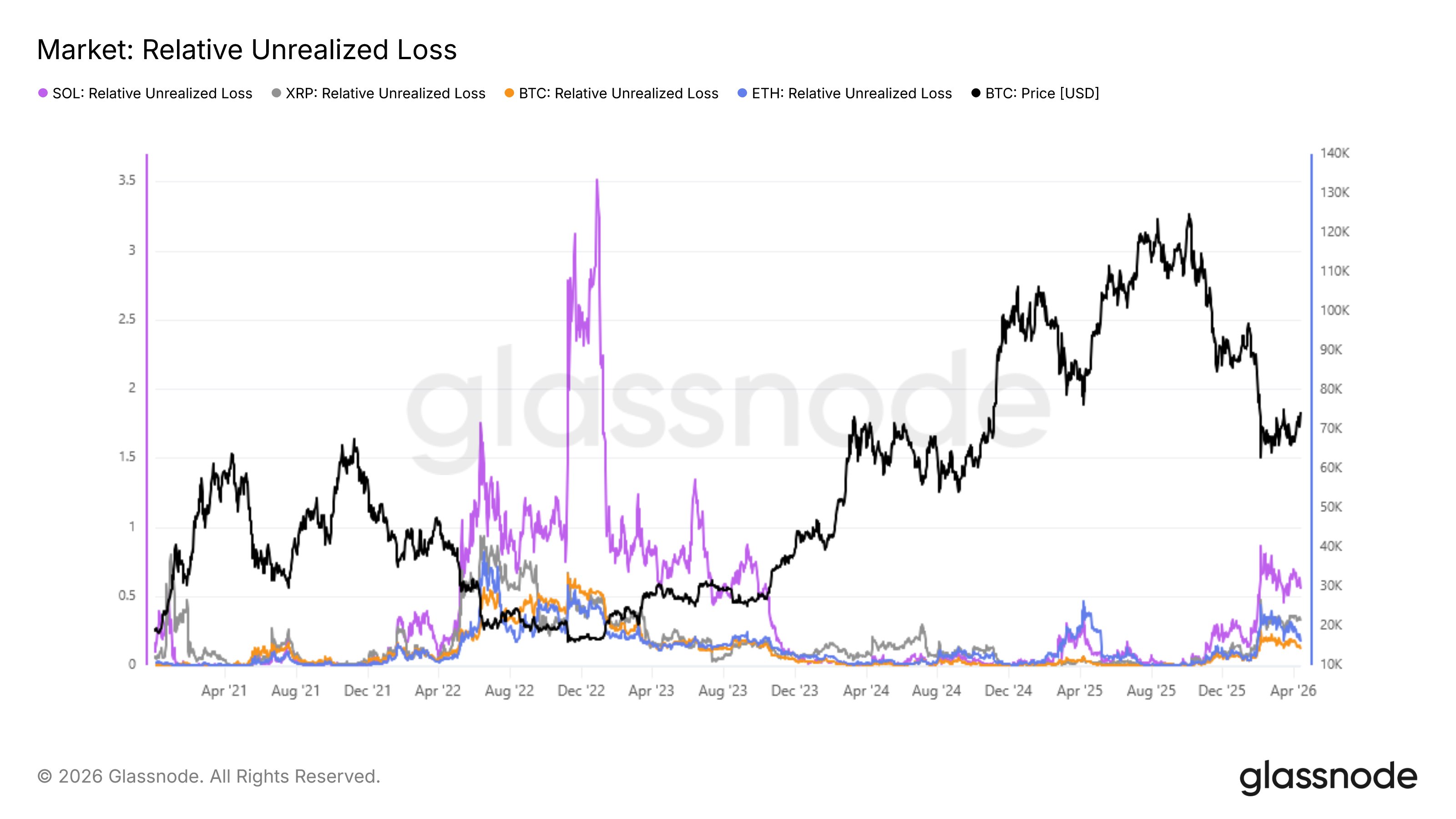
Looks like the indicator has gone up for all of these assets in recent months | Source: Glassnode on X

As is visible in the above graph, the Relative Unrealized Loss has witnessed a rise across the sector during the last few months. This increase is a natural consequence of the bearish price action that the various assets have seen in this window.

While the trend has been more-or-less uniform, the indicator’s value has differed in scale for the coins. Bitcoin and Ethereum, the two cryptocurrencies largest by market cap, have the metric sitting at relatively modest levels of 11.9% and 16.6%, respectively. Meanwhile, XRP and Solana have faced much heavier losses, with the Relative Unrealized Loss at 31.8% and 54.8%, respectively.

“The elevated loss levels in altcoins reflect how heavy the top is in these markets, where supply is more concentrated among buyers who entered near cycle highs,” explained the analytics firm. While the altcoins are facing high levels of losses, they are still lower than those observed at the lows of the 2022 bear market. XRP isn’t too far off, but Solana’s losses remain magnitudes lower.

XRP Price

At the time of writing, XRP is floating around $1.35, down 2% in the last seven days.

The price of the coin has retraced from Tuesday's high | Source: XRPUSDT on TradingView


Трендові криптовалюти

Пов'язані питання

QWhat does the Relative Unrealized Loss metric measure for a cryptocurrency?

AThe Relative Unrealized Loss metric tracks the total amount of loss held by all investors in a cryptocurrency. It calculates the difference between the current spot price and the price at which each coin was last moved for all tokens currently held at a loss, and expresses this total as a percentage of the asset's market capitalization.

QAccording to the data, which two cryptocurrencies have the highest Relative Unrealized Loss?

AAccording to the data, XRP and Solana have the highest Relative Unrealized Loss, with values of 31.8% and 54.8% of their market caps, respectively.

QHow do Bitcoin and Ethereum's Relative Unrealized Loss levels compare to those of XRP and Solana?

ABitcoin and Ethereum have significantly lower Relative Unrealized Loss levels, at 11.9% and 16.6% respectively, compared to the much higher levels of XRP (31.8%) and Solana (54.8%).

QWhat reason does Glassnode give for the elevated loss levels in altcoins like XRP and Solana?

AGlassnode explains that the elevated loss levels in altcoins reflect how heavy the top is in these markets, meaning that the supply is more concentrated among buyers who entered near the cycle highs.

QWhat was the price of XRP at the time of writing, and how had it performed over the previous week?

AAt the time of writing, XRP was trading around $1.35, which was down 2% over the last seven days.

Пов'язані матеріали

After Three Consecutive Quarters of Decline, Can the Crypto Market Find a Window for Stabilization in Q3?

The cryptocurrency market has just concluded its worst-performing quarter since 2022, with total capitalization dropping 12.6% to $2.1 trillion. All core metrics indicate capital is leaving the sector, not just rotating within it. Bitcoin fell 14.2% and Ethereum dropped 25.4% in Q2, breaking their previous correlation with US tech stocks. A key driver is the reversal in US spot Bitcoin ETF flows, which saw a net outflow of approximately $4.67 billion in Q2, including a record monthly outflow near $4.5 billion in June. While recent data suggests long-term holders are accumulating again, sustained ETF outflows mean continued selling pressure. Market focus is now singularly on the Federal Reserve. The upcoming July FOMC meeting is seen as the most critical event for Q3. A dovish signal could support Bitcoin reclaiming a $68,000-$84,000 range, while a hawkish stance might establish a new trading band around $50,000-$56,000. Additionally, regulatory uncertainty persists, with the progress of the crucial *CLARITY Act* stalling in the Senate, reducing its perceived 2026 passage probability to 40-45%. Despite the broad downturn, a few sectors showed growth. Prediction markets saw nominal volume surge 48.7% year-over-year to $113.8 billion, and tokenized collectibles transaction volume rose 143% quarterly to $1.4 billion. The Real-World Asset (RWA) tokenization sector also continued steady growth, now representing ~$28.1 billion in on-chain value. The market's foundation for an extreme crash appears limited, with Bitcoin price hovering near its 200-week moving average. However, the trading paradigm has shifted from narrative-driven speculation to decisions based on price action, policy developments, and interest rate expectations, making a broad sentiment-driven rally unlikely in the near term.

marsbit2 год тому

After Three Consecutive Quarters of Decline, Can the Crypto Market Find a Window for Stabilization in Q3?

marsbit2 год тому

BIT Trading Moment: BTC Still Suppressed by Weekly 200 EMA, Rejection May Restart Decline; Storage and Semiconductors that Surged Last Night Begin Falling in Evening Trading

**Crypto & Stock Market Wrap: Bitcoin Tests Resistance, Stocks Retreat After AI Surge** Bitcoin consolidates around $66,000, facing key resistance near $68,000—an area seen as a major psychological and technical hurdle where previous rallies have failed. Analysts note the cryptocurrency is caught between its 200-week moving average (~$63,333) and 200-week EMA (~$68,328). A clear break above $68k is needed to signal a stronger bullish trend, while a rejection could lead to a retest of $63k support. Market sentiment remains cautious, with low futures open interest pointing to a low-liquidity rebound rather than a full bull market. Bitcoin spot ETFs saw another $203 million inflow. US stock futures pointed lower after a strong Tuesday session led by a massive rebound in semiconductors and memory stocks. The rally was fueled by renewed optimism about AI-driven hardware demand, with Micron, SanDisk, and SK Hynix surging. However, those gains reversed in pre-market trading. Super Micro Computer (SMCI) soared over 20% after hours on strong guidance and a record backlog. Other standouts included Rocket Lab and nuclear energy plays Oklo and X-Energy. Rising oil prices (Brent above $91) and climbing Treasury yields (10-year near 4.64%), however, are reigniting inflation concerns and acting as a headwind for equities. In Asia, markets were mixed. South Korea's KOSPI pared early gains to close slightly higher as semiconductor stocks like SK Hynix gave back initial surges. Japan's Nikkei edged lower as the yen hit a fresh 38-year low against the dollar, raising fears of potential market intervention. Key events to watch include the Samsung Galaxy launch, AMD's AI event, and a slew of major tech earnings from Alphabet, Tesla, and IBM after the close on Wednesday, followed by the ECB meeting and Intel's earnings on Thursday.

marsbit2 год тому

BIT Trading Moment: BTC Still Suppressed by Weekly 200 EMA, Rejection May Restart Decline; Storage and Semiconductors that Surged Last Night Begin Falling in Evening Trading

marsbit2 год тому

Former CFTC Chairman, Circle President Tarbert: Preaching Long-Termism While Cashing Out $30 Million Himself

Former CFTC Chairman and Circle President Heath Tarbert has consistently advocated for a long-term vision in public, urging patience from investors as Circle’s stock price has fallen significantly from its peak. However, it has been revealed that since Circle’s IPO, Tarbert has continuously sold his CRCL shares through pre-arranged trading plans, cashing out approximately $30 million, without making any public market purchases. This contrast between his public messaging and personal actions has drawn criticism. Tarbert joined Circle in July 2023 as Chief Legal Officer, leveraging his regulatory experience to help guide the company through its IPO and expansion. Despite promoting stablecoins as long-term infrastructure, he established a 10b5-1 trading plan just before Circle went public, leading to substantial stock sales over the following year. In March 2026, he initiated another plan to sell more shares. His career trajectory highlights a pattern of moving between high-level regulatory roles and influential positions in the financial sector. After resigning as CFTC Chairman in early 2021, he joined Citadel Securities as Chief Legal Officer just 27 days later, during a period of intense regulatory scrutiny for the firm. He later joined Circle, aiding its efforts to navigate regulatory challenges for its public listing. While Tarbert's expertise in policy and compliance is valuable to companies like Circle, his actions—advocating long-term confidence while personally divesting—raise questions about the alignment between his public statements and his private financial decisions, leaving investors who followed his advice to bear the market risks.

marsbit2 год тому

Former CFTC Chairman, Circle President Tarbert: Preaching Long-Termism While Cashing Out $30 Million Himself

marsbit2 год тому

Gate Research Institute: The 'Wall Street-ization' Wave of Crypto Financial Products – Competition or Integration?

The article titled "Gate Research Institute: Are Crypto Financial Products Sparking a 'Wall Street' Wave—Competition or Convergence?" explores the evolving relationship between the crypto ecosystem and traditional finance (TradFi). The piece begins by reflecting on Bitcoin's original 2009 vision of decentralization, disintermediation, and moving away from banks. It then contrasts this with the 2024 landscape, where key crypto assets like Bitcoin are increasingly held through Wall Street products like ETFs issued by giants like BlackRock. The article questions whether this signifies that TradFi is systematically taking over the rights to issue, price, custody, and distribute crypto financial assets. The core argument is that this is not a zero-sum takeover but rather a bidirectional convergence where each side addresses the other's weaknesses. Crypto offers 24/7 global markets, programmable settlement, and open access but lacks compliant channels, institutional-grade custody, deep fiat liquidity, and mainstream distribution. TradFi possesses these but is constrained by legacy systems, limited operating hours, and slow settlement. Two primary convergence paths are highlighted: * **Path A (CEX to TradFi):** Exemplified by Gate, which has progressed from offering tokenized stocks and CFDs to providing direct, real stock trading (US, Hong Kong, South Korea) within its platform, using USDT. * **Path B (TradFi to Crypto):** Exemplified by Robinhood, which has integrated crypto trading, acquired exchanges like Bitstamp, and is moving traditional assets like stocks onto the blockchain via tokenization and its own Layer 2. Both paths are ultimately competing to become the next-generation, unified financial account—a "super account" where users can seamlessly trade cryptocurrencies, stocks, ETFs, RWA (Real World Assets), and tokenized treasury products in one interface. The growth of RWA and tokenized treasuries (e.g., BlackRock's BUIDL) is presented as the asset-layer fusion, providing stable, yield-bearing assets on-chain and acting as a bridge between the two worlds. In conclusion, the "Wall Street-ization" of crypto is framed as a mutual transformation. Decentralized ideals persist in the protocol layer, while at the application layer, a more efficient, global, and accessible unified capital market is emerging from this convergence. The future competition lies not between crypto exchanges and stockbrokers, but between platforms vying to offer the most comprehensive asset coverage, liquidity, and user experience within a single account.

marsbit2 год тому

Gate Research Institute: The 'Wall Street-ization' Wave of Crypto Financial Products – Competition or Integration?

marsbit2 год тому

Торгівля

Спот

Популярні статті

Що таке XRP 2.0

XRP 2.0: Нова межа в світі криптовалют Вступ до XRP 2.0 У постійно змінюючомуся світі криптовалют нові проекти постійно з'являються, змагаючись за увагу та прийняття. Однією з таких обіцяючих ініціатив є XRP 2.0, новий криптовалютний проект, що має на меті використання сучасних технологій блокчейн та надійних методів шифрування. Хоча назва нагадує про XRP від Ripple, важливо зазначити, що XRP 2.0 функціонує автономно, концентруючи увагу на підвищенні безпеки транзакцій, конфіденційності та масштабованості. Оскільки цифровий фінансовий ландшафт все більше приймає децентралізовані рішення, XRP 2.0 прагне значно сприяти веб3 та загальному розширенню крипто проектів. Що таке XRP 2.0? У своїй основі XRP 2.0 є криптовалютним проектом, що має на меті створення безпечної та децентралізованої екосистеми цифрової валюти. Його фундаментальна технологія інтегрує складні принципи блокчейну з передовими техніками шифрування. Загальною метою XRP 2.0 є встановлення себе як надійної та ефективної платформи, що дозволяє швидко виконувати транзакції, при цьому надаючи пріоритет підвищеним захистам конфіденційності для своїх користувачів. Проект позиціонується як рішення багатьох обмежень, з якими стикаються існуючі криптовалюти, пропонуючи систему, яка може обробляти вищий обсяг транзакцій з покращеною швидкістю та конфіденційністю. Ця універсальність позиціонує XRP 2.0 як значного гравця на ринку, наповненому різними цифровими валютами. Хто творець XRP 2.0? Особистість творця XRP 2.0 була позначена як «Вілбур». Проте, вичерпні деталі про Вілбура або пов'язану з ним організацію залишаються недоступними. Анонімність багатьох творців криптовалют не є незвичним явищем в індустрії, часто запроваджена для збереження певного рівня конфіденційності та безпеки. Хто інвестори XRP 2.0? На даний момент конкретна інформація про інвестиційні фонди або організації, що підтримують XRP 2.0, не є публічно доступною. У секторі криптовалют підтримка від визнаних інвесторів може значно вплинути на кредитоспроможність і успіх проекту, але прозорість щодо фінансових підтримувачів XRP 2.0 не була встановлена. Як працює XRP 2.0? XRP 2.0 вирізняється використанням комбінації технології блокчейн та просунутих алгоритмів шифрування, що забезпечують безпечні та децентралізовані транзакції. Його інноваційна структура включає унікальні функції, спрямовані на залучення користувачів та розширення функціональності за межами традиційних транзакцій криптовалюти. Серед цих функцій, XRP 2.0 включає можливості на базі ШІ, такі як текст в зображення та текст в мову. Ці нововведення розроблені для покращення інтерактивного досвіду для користувачів, сприяючи ширшій застосовності в різних секторах. Завдяки поєднанню технологічних досягнень з орієнтованим на користувача дизайном, XRP 2.0 прагне привернути увагу різноманітних осіб і підприємств, які шукають способи інтеграції рішень криптовалют у свої операційні структури. Хронологія XRP 2.0 Розуміння XRP 2.0 вимагає вивчення основних етапів, які визначили його подорож до теперішнього часу: 23 липня 2023 року: XRP 2.0 представлено як новий криптовалютний проект, що має на меті революціонізувати безпечні та децентралізовані можливості транзакцій у галузі блокчейн. 8 вересня 2023 року: Запускається інший проект, XRP20, що відзначає виникнення токена ERC-20 на блокчейні Ethereum, який не пов'язаний з XRP 2.0. 13 листопада 2023 року: XRP Ledger зазнає значного оновлення з виходом програмного забезпечення rippled server версії 2.0.0. Важливо зазначити, що цей розвиток не пов'язаний з криптовалютним проектом XRP 2.0. Ключові моменти про XRP 2.0 Щоб узагальнити суть XRP 2.0, кілька критично важливих факторів emerge: Унікальні функції: Включення функцій, таких як текст в зображення і текст в мову на базі ШІ, ще більше розширює потенційні застосування XRP 2.0. Технологія блокчейн: Архітектура використовує сучасні механізми блокчейн і протоколи шифрування, забезпечуючи безпечне та децентралізоване середовище для транзакцій. Масштабованість і конфіденційність: XRP 2.0 надає пріоритет підвищеним захистам конфіденційності в процесах транзакцій і масштабованості, необхідній для задоволення зростаючої бази користувачів. Відсутність зв'язку з Ripple: Важливо, що, незважаючи на свою назву, XRP 2.0 не має жодної прив'язки чи співпраці з XRP від Ripple, що відрізняє його операційну структуру та цілі в рамках криптовалютної екосистеми. Висновок XRP 2.0 представляє амбітну ініціативу у світі криптовалют, прагнучи запропонувати поєднання безпеки, конфіденційності та ефективності у цифрових транзакціях. Інтегруючи складні технології та дружні до користувача функції, проект ставить за мету розширити горизонти того, що криптовалюта може досягти в сучасній цифровій економіці. Хоча анонімність його творця та відсутність розкритих інвесторів можуть викликати запитання у деяких, фокус XRP 2.0 на передових функціональностях і децентралізації підвищує його привабливість на дедалі більшому ринку криптовалют. Оскільки ландшафт криптовалют продовжує еволюціонувати, XRP 2.0 може ще стати важливим гравцем у розширенні безпечних і масштабованих рішень блокчейн.

199 переглядів усьогоОпубліковано 2024.04.05Оновлено 2024.12.03

Що таке XRP 2.0

Як купити XRP

Ласкаво просимо до HTX.com! Ми зробили покупку XRP (XRP) простою та зручною. Дотримуйтесь нашої покрокової інструкції, щоб розпочати свою криптовалютну подорож.Крок 1: Створіть обліковий запис на HTXВикористовуйте свою електронну пошту або номер телефону, щоб зареєструвати обліковий запис на HTX безплатно. Пройдіть безпроблемну реєстрацію й отримайте доступ до всіх функцій.ЗареєструватисьКрок 2: Перейдіть до розділу Купити крипту і виберіть спосіб оплатиКредитна/дебетова картка: використовуйте вашу картку Visa або Mastercard, щоб миттєво купити XRP (XRP).Баланс: використовуйте кошти з балансу вашого рахунку HTX для безперешкодної торгівлі.Треті особи: ми додали популярні способи оплати, такі як Google Pay та Apple Pay, щоб підвищити зручність.P2P: Торгуйте безпосередньо з іншими користувачами на HTX.Позабіржова торгівля (OTC): ми пропонуємо індивідуальні послуги та конкурентні обмінні курси для трейдерів.Крок 3: Зберігайте свої XRP (XRP)Після придбання XRP (XRP) збережіть його у своєму обліковому записі на HTX. Крім того, ви можете відправити його в інше місце за допомогою блокчейн-переказу або використовувати його для торгівлі іншими криптовалютами.Крок 4: Торгівля XRP (XRP)Легко торгуйте XRP (XRP) на спотовому ринку HTX. Просто увійдіть до свого облікового запису, виберіть торгову пару, укладайте угоди та спостерігайте за ними в режимі реального часу. Ми пропонуємо зручний досвід як для початківців, так і для досвідчених трейдерів.

1.6k переглядів усьогоОпубліковано 2024.12.10Оновлено 2026.06.02

Як купити XRP

Обговорення

Ласкаво просимо до спільноти HTX. Тут ви можете бути в курсі останніх подій розвитку платформи та отримати доступ до професійної ринкової інформації. Нижче представлені думки користувачів щодо ціни XRP (XRP).

活动图片













