XRP sinks below $2 despite $1B in ETF inflows: How low can price go?

cointelegraphОпубліковано о 2025-12-15Востаннє оновлено о 2025-12-15

Анотація

Spot XRP ETFs have attracted nearly $1 billion in inflows over 20 consecutive days, signaling strong institutional interest. Despite this, XRP’s price fell below the key $2 support level, declining over 11% in 10 days. Technical analysis indicates limited support around $1.93, with the next major support at $1.78. A break below that could push prices toward $1.61 or even the 200-week EMA near $1.40. The RSI has hit its lowest since July 2024, suggesting increasing downward momentum.

Spot XRP (XRP) exchange-traded funds have continued to attract investor interest, drawing in almost $1 billion in inflows since their launch. Unfortunately, this didn’t help the bulls hold the price above the psychological $2 support level.

Key takeaways:

  • Spot XRP ETFs saw inflows for 20 consecutive days, totalling $1.2 billion.

  • XRP price extended its downtrend, slipping below a key moving support level.

Spot XRP ETFs add $1 billion in 3 weeks of inflows

US-based spot XRP ETFs have recorded inflows for twenty consecutive days, underscoring institutional demand for the network’s native asset.

According to data from SoSoValue, XRP ETFs added $20.2 million on Friday, bringing cumulative inflows to $990.9 million and total assets to over $1.2 billion. The Franklin XRP ETF (XRPZ) led with $8.7 million in inflows on Friday, bringing its net assets to $175 million.

Related: XRP buy signal flashes as funding rate turns deeply negative: Will bulls step in?

Bitwise XRP ETF (XRP) and Canary XRP ETF (XRPC) were the only other products that recorded inflows on Dec. 12, while Grayscale XRP Trust ETF (GXRP) and 21shares XRP ETF (TOXR) did not see any flows.
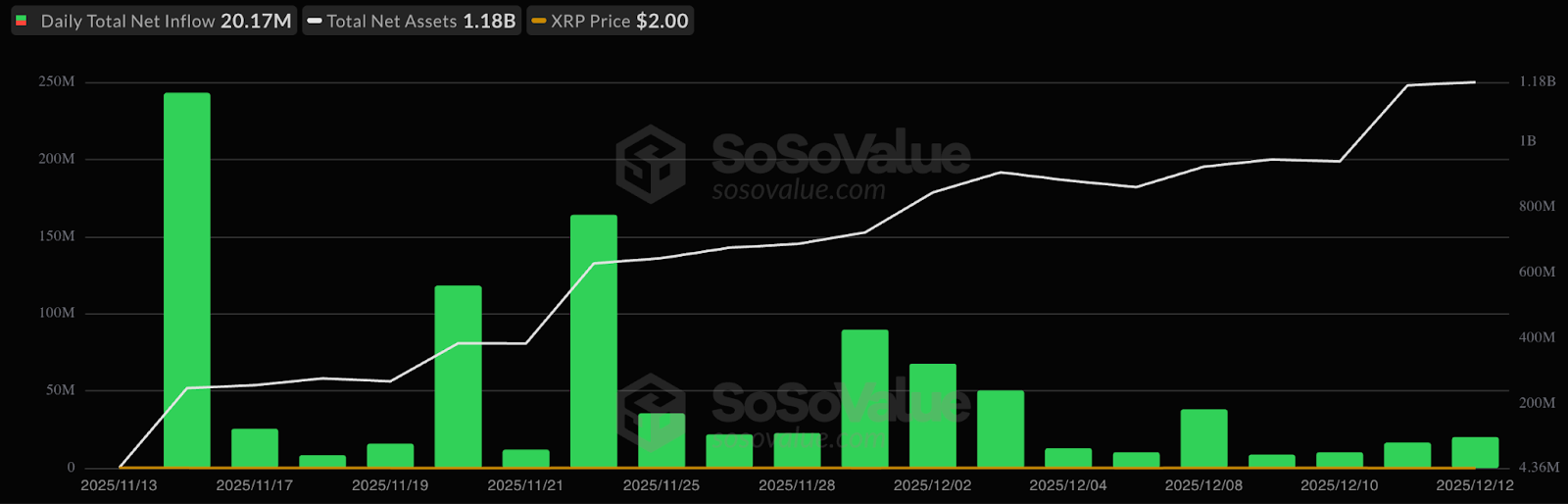
XRP ETFs inflows. Source: SoSoValue

Such a strong start for XRP ETFs reflected confidence among institutional investors. By comparison, spot Bitcoin (BTC) ETFs saw $49 million in inflows on the same day.

Spot Ether (ETH) ETFs posted $19.4 million in outflows, reducing their cumulative inflows to $13.1 billion. The funds also shed $42.3 million on Thursday.

“US spot $XRP ETFs have now recorded 20 straight days of inflows since launch, even as $BTC and $ETH ETFs continue to struggle with outflows,” said analyst Bitcoinsensus in a Monday post on X, adding:

“Institutional demand for XRP is heating up fast.”

As Cointelegraph reported, XRP ETF demand backs the bullish case for the altcoin with a rally to $10 still in the cards for 2026.

XRP price loses key support levels

The persistent demand for XRP ETFs has, however, failed to hold its price above $2, with the technical setup indicating a potential for a deeper correction.

XRP’s price extended its bearish trajectory on Monday, falling over 11% over the last 10 days and dropping below $2 for the second time since Nov. 21.

The XRP/USDT pair is currently testing a daily order block around $1.93, a level with limited support, according to data from Glassnode.

Glassnode's UTXO realized price distribution (URPD) — a metric that shows the average prices at which SOL holders bought their coins — reveals smaller clusters of these buy levels below $1.90. This means that fewer holders are likely to defend the price there.

The next significant support sits at $1.78, where approximately 1.85 billion XRP were previously acquired.
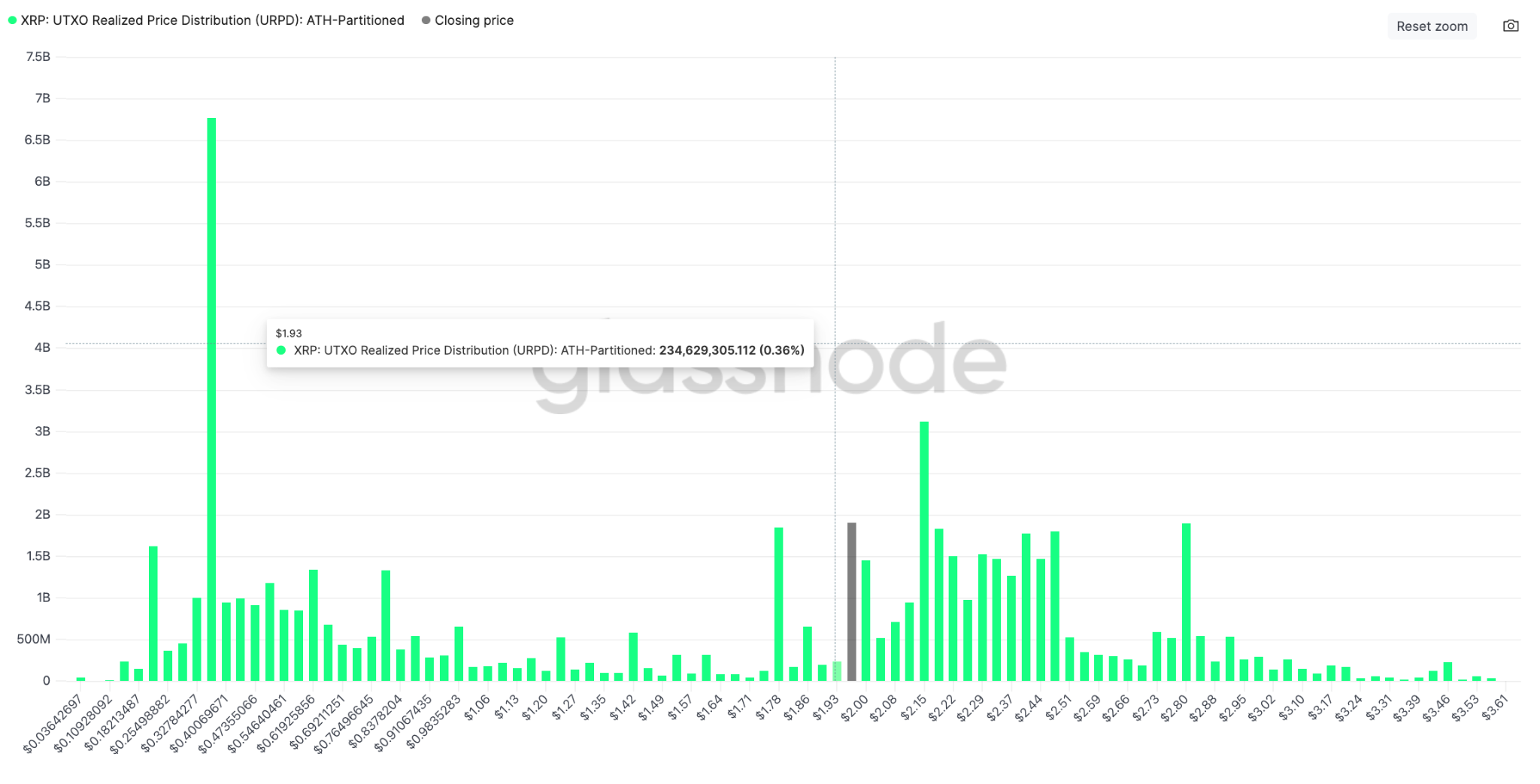
XRP: UTXO realized price distribution (URPD). Source: Glassnode

If the price breaks below this level, it could drop toward the green zone shown below, supported by the $1.61 local low and the 200-week EMA, which is around $1.40 and represents the last line of defense for the XRP price.
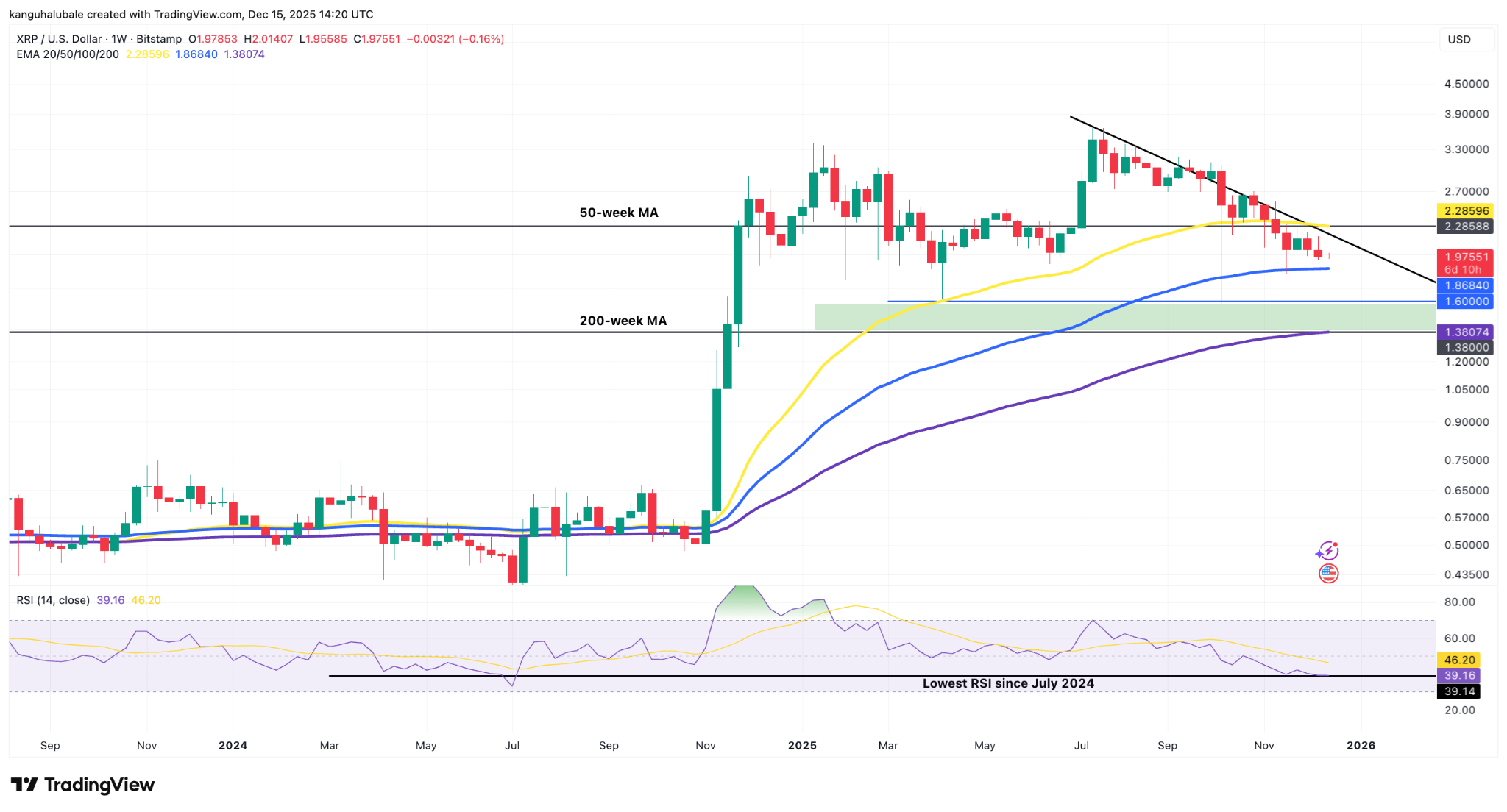
XRP/USDT weekly chart. Source: Cointelegraph/TradingView

XRP’s downside momentum is also increasing based on the relative strength index, or RSI, which has hit its lowest level since July 2024.

As Cointelegraph reported, a break below $2 will see the XRP/USDT pair extend the decline to $1.75 and subsequently to the local low at $1.61.

This article does not contain investment advice or recommendations. Every investment and trading move involves risk, and readers should conduct their own research when making a decision. While we strive to provide accurate and timely information, Cointelegraph does not guarantee the accuracy, completeness, or reliability of any information in this article. This article may contain forward-looking statements that are subject to risks and uncertainties. Cointelegraph will not be liable for any loss or damage arising from your reliance on this information.


Пов'язані матеріали

Gensyn AI: Don't Let AI Repeat the Mistakes of the Internet

In recent months, the rapid growth of the AI industry has attracted significant talent from the crypto sector. A persistent question among researchers intersecting both fields is whether blockchain can become a foundational part of AI infrastructure. While many previous AI and Crypto projects focused on application layers (like AI Agents, on-chain reasoning, data markets, and compute rentals), few achieved viable commercial models. Gensyn differentiates itself by targeting the most critical and expensive layer of AI: model training. Gensyn aims to organize globally distributed GPU resources into an open AI training network. Developers can submit training tasks, nodes provide computational power, and the network verifies results while distributing incentives. The core issue addressed is not decentralization for its own sake, but the increasing centralization of compute power among tech giants. In the era of large models, access to GPUs (like the H100) has become a decisive bottleneck, dictating the pace of AI development. Major AI companies are heavily dependent on large cloud providers for compute resources. Gensyn's approach is significant for several reasons: 1) It operates at the core infrastructure layer (model training), the most resource-intensive and technically demanding part of the AI value chain. 2) It proposes a more open, collaborative model for compute, potentially increasing resource utilization by dynamically pooling idle GPUs, similar to early cloud computing logic. 3) Its technical moat lies in solving complex challenges like verifying training results, ensuring node honesty, and maintaining reliability in a distributed environment—making it more of a deep-tech infrastructure company. 4) It targets a validated, high-growth market with genuine demand, rather than pursuing blockchain integration without purpose. Ultimately, the boundaries between Crypto and AI are blurring. AI requires global resource coordination, incentive mechanisms, and collaborative systems—areas where crypto-native solutions excel. Gensyn represents a step toward making advanced training capabilities more accessible and collaborative, moving beyond a niche controlled by a few giants. If successful, it could evolve into a fundamental piece of AI infrastructure, where the most enduring value in the AI era is often created.

marsbit6 год тому

Gensyn AI: Don't Let AI Repeat the Mistakes of the Internet

marsbit6 год тому

Why is China's AI Developing So Fast? The Answer Lies Inside the Labs

A US researcher's visit to China's top AI labs reveals distinct cultural and organizational factors driving China's rapid AI development. While talent, data, and compute are similar to the West, Chinese labs excel through a pragmatic, execution-focused culture: less emphasis on individual stardom and conceptual debate, and more on teamwork, engineering optimization, and mastering the full tech stack. A key advantage is the integration of young students and researchers who approach model-building with fresh perspectives and low ego, prioritizing collective progress over personal credit. This contrasts with the US culture of self-promotion and "star scientist" narratives. Chinese labs also exhibit a strong "build, don't buy" mentality, preferring to develop core capabilities—like data pipelines and environments—in-house rather than relying on external services. The ecosystem feels more collaborative than tribal, with mutual respect among labs. While government support exists, its scale is unclear, and technical decisions appear driven by labs, not state mandates. Chinese companies across sectors, from platforms to consumer tech, are building their own foundational models to control their tech destiny, reflecting a broader cultural drive for technological sovereignty. Demand for AI is emerging, with spending patterns potentially mirroring cloud infrastructure more than traditional SaaS. Despite challenges like a less mature data industry and GPU shortages, Chinese labs are propelled by vast talent, rapid iteration, and deep integration with the open-source community. The competition is evolving beyond a pure model race into a contest of organizational execution, developer ecosystems, and industrial pragmatism.

marsbit8 год тому

Why is China's AI Developing So Fast? The Answer Lies Inside the Labs

marsbit8 год тому

3 Years, 5 Times: The Rebirth of a Century-Old Glass Factory

Corning, a 175-year-old glass company, is experiencing a dramatic revival as a key player in AI infrastructure, driven by surging demand for high-performance optical fiber in data centers. AI data centers require vastly more fiber than traditional ones—5 to 10 times as much per rack—to handle high-speed data transmission between GPUs. This structural demand shift, coupled with supply constraints from the lengthy expansion cycle for fiber preforms, has created a significant supply-demand gap. Nvidia has invested in Corning, along with Lumentum and Coherent, in a $4.5 billion total commitment to secure the optical supply chain for AI. Corning's competitive edge lies in its expertise in producing ultra-low-loss, high-density, and bend-resistant specialty fiber, which is critical for 800G+ and future 1.6T data rates. Its deep involvement in co-packaged optics (CPO) with partners like Nvidia further solidifies its position. While not the largest fiber manufacturer globally, Corning's revenue from enterprise/data center clients now exceeds 40% of its optical communications sales, and it has secured multi-year supply agreements with major hyperscalers including Meta and Nvidia. Financially, Corning's optical communications revenue has surged, doubling from $1.3 billion in 2023 to over $3 billion in 2025. Its stock price has risen nearly 6-fold since late 2023. Key future catalysts include the rollout of Nvidia's CPO products and the scale of undisclosed customer agreements. However, risks include high current valuations and potential disruption from next-generation technologies like hollow-core fiber. The company's long-term bet on light over electricity, maintained even through the telecom bubble crash, is now being validated by the AI boom.

marsbit8 год тому

3 Years, 5 Times: The Rebirth of a Century-Old Glass Factory

marsbit8 год тому

Торгівля

Спот
Ф'ючерси

Популярні статті

Що таке XRP 2.0

XRP 2.0: Нова межа в світі криптовалют Вступ до XRP 2.0 У постійно змінюючомуся світі криптовалют нові проекти постійно з'являються, змагаючись за увагу та прийняття. Однією з таких обіцяючих ініціатив є XRP 2.0, новий криптовалютний проект, що має на меті використання сучасних технологій блокчейн та надійних методів шифрування. Хоча назва нагадує про XRP від Ripple, важливо зазначити, що XRP 2.0 функціонує автономно, концентруючи увагу на підвищенні безпеки транзакцій, конфіденційності та масштабованості. Оскільки цифровий фінансовий ландшафт все більше приймає децентралізовані рішення, XRP 2.0 прагне значно сприяти веб3 та загальному розширенню крипто проектів. Що таке XRP 2.0? У своїй основі XRP 2.0 є криптовалютним проектом, що має на меті створення безпечної та децентралізованої екосистеми цифрової валюти. Його фундаментальна технологія інтегрує складні принципи блокчейну з передовими техніками шифрування. Загальною метою XRP 2.0 є встановлення себе як надійної та ефективної платформи, що дозволяє швидко виконувати транзакції, при цьому надаючи пріоритет підвищеним захистам конфіденційності для своїх користувачів. Проект позиціонується як рішення багатьох обмежень, з якими стикаються існуючі криптовалюти, пропонуючи систему, яка може обробляти вищий обсяг транзакцій з покращеною швидкістю та конфіденційністю. Ця універсальність позиціонує XRP 2.0 як значного гравця на ринку, наповненому різними цифровими валютами. Хто творець XRP 2.0? Особистість творця XRP 2.0 була позначена як «Вілбур». Проте, вичерпні деталі про Вілбура або пов'язану з ним організацію залишаються недоступними. Анонімність багатьох творців криптовалют не є незвичним явищем в індустрії, часто запроваджена для збереження певного рівня конфіденційності та безпеки. Хто інвестори XRP 2.0? На даний момент конкретна інформація про інвестиційні фонди або організації, що підтримують XRP 2.0, не є публічно доступною. У секторі криптовалют підтримка від визнаних інвесторів може значно вплинути на кредитоспроможність і успіх проекту, але прозорість щодо фінансових підтримувачів XRP 2.0 не була встановлена. Як працює XRP 2.0? XRP 2.0 вирізняється використанням комбінації технології блокчейн та просунутих алгоритмів шифрування, що забезпечують безпечні та децентралізовані транзакції. Його інноваційна структура включає унікальні функції, спрямовані на залучення користувачів та розширення функціональності за межами традиційних транзакцій криптовалюти. Серед цих функцій, XRP 2.0 включає можливості на базі ШІ, такі як текст в зображення та текст в мову. Ці нововведення розроблені для покращення інтерактивного досвіду для користувачів, сприяючи ширшій застосовності в різних секторах. Завдяки поєднанню технологічних досягнень з орієнтованим на користувача дизайном, XRP 2.0 прагне привернути увагу різноманітних осіб і підприємств, які шукають способи інтеграції рішень криптовалют у свої операційні структури. Хронологія XRP 2.0 Розуміння XRP 2.0 вимагає вивчення основних етапів, які визначили його подорож до теперішнього часу: 23 липня 2023 року: XRP 2.0 представлено як новий криптовалютний проект, що має на меті революціонізувати безпечні та децентралізовані можливості транзакцій у галузі блокчейн. 8 вересня 2023 року: Запускається інший проект, XRP20, що відзначає виникнення токена ERC-20 на блокчейні Ethereum, який не пов'язаний з XRP 2.0. 13 листопада 2023 року: XRP Ledger зазнає значного оновлення з виходом програмного забезпечення rippled server версії 2.0.0. Важливо зазначити, що цей розвиток не пов'язаний з криптовалютним проектом XRP 2.0. Ключові моменти про XRP 2.0 Щоб узагальнити суть XRP 2.0, кілька критично важливих факторів emerge: Унікальні функції: Включення функцій, таких як текст в зображення і текст в мову на базі ШІ, ще більше розширює потенційні застосування XRP 2.0. Технологія блокчейн: Архітектура використовує сучасні механізми блокчейн і протоколи шифрування, забезпечуючи безпечне та децентралізоване середовище для транзакцій. Масштабованість і конфіденційність: XRP 2.0 надає пріоритет підвищеним захистам конфіденційності в процесах транзакцій і масштабованості, необхідній для задоволення зростаючої бази користувачів. Відсутність зв'язку з Ripple: Важливо, що, незважаючи на свою назву, XRP 2.0 не має жодної прив'язки чи співпраці з XRP від Ripple, що відрізняє його операційну структуру та цілі в рамках криптовалютної екосистеми. Висновок XRP 2.0 представляє амбітну ініціативу у світі криптовалют, прагнучи запропонувати поєднання безпеки, конфіденційності та ефективності у цифрових транзакціях. Інтегруючи складні технології та дружні до користувача функції, проект ставить за мету розширити горизонти того, що криптовалюта може досягти в сучасній цифровій економіці. Хоча анонімність його творця та відсутність розкритих інвесторів можуть викликати запитання у деяких, фокус XRP 2.0 на передових функціональностях і децентралізації підвищує його привабливість на дедалі більшому ринку криптовалют. Оскільки ландшафт криптовалют продовжує еволюціонувати, XRP 2.0 може ще стати важливим гравцем у розширенні безпечних і масштабованих рішень блокчейн.

162 переглядів усьогоОпубліковано 2024.04.05Оновлено 2024.12.03

Що таке XRP 2.0

Як купити XRP

Ласкаво просимо до HTX.com! Ми зробили покупку XRP (XRP) простою та зручною. Дотримуйтесь нашої покрокової інструкції, щоб розпочати свою криптовалютну подорож.Крок 1: Створіть обліковий запис на HTXВикористовуйте свою електронну пошту або номер телефону, щоб зареєструвати обліковий запис на HTX безплатно. Пройдіть безпроблемну реєстрацію й отримайте доступ до всіх функцій.ЗареєструватисьКрок 2: Перейдіть до розділу Купити крипту і виберіть спосіб оплатиКредитна/дебетова картка: використовуйте вашу картку Visa або Mastercard, щоб миттєво купити XRP (XRP).Баланс: використовуйте кошти з балансу вашого рахунку HTX для безперешкодної торгівлі.Треті особи: ми додали популярні способи оплати, такі як Google Pay та Apple Pay, щоб підвищити зручність.P2P: Торгуйте безпосередньо з іншими користувачами на HTX.Позабіржова торгівля (OTC): ми пропонуємо індивідуальні послуги та конкурентні обмінні курси для трейдерів.Крок 3: Зберігайте свої XRP (XRP)Після придбання XRP (XRP) збережіть його у своєму обліковому записі на HTX. Крім того, ви можете відправити його в інше місце за допомогою блокчейн-переказу або використовувати його для торгівлі іншими криптовалютами.Крок 4: Торгівля XRP (XRP)Легко торгуйте XRP (XRP) на спотовому ринку HTX. Просто увійдіть до свого облікового запису, виберіть торгову пару, укладайте угоди та спостерігайте за ними в режимі реального часу. Ми пропонуємо зручний досвід як для початківців, так і для досвідчених трейдерів.

1.4k переглядів усьогоОпубліковано 2024.12.10Оновлено 2025.03.21

Як купити XRP

Обговорення

Ласкаво просимо до спільноти HTX. Тут ви можете бути в курсі останніх подій розвитку платформи та отримати доступ до професійної ринкової інформації. Нижче представлені думки користувачів щодо ціни XRP (XRP).

活动图片













