XRP Short-Term Holder Activity Shows Clear Shift Toward Lower Exposure – What’s Driving The Move?

bitcoinistОпубліковано о 2026-01-09Востаннє оновлено о 2026-01-09

Анотація

Despite XRP's price holding above $2 after a brief rebound, market sentiment remains cautious. On-chain data reveals short-term holders are reducing their exposure, decreasing their share of the total supply from 5.75% to 4.9% in just one week. This shift indicates profit-taking and risk management amid sideways price action. However, whale activity is increasing, with addresses holding 1M to 100M XRP acquiring an additional 60 million tokens in a single day, signaling renewed long-term conviction. Additionally, XRP dominated trading in South Korea's Upbit exchange in 2025, with over $1 trillion in XRP/KRW trades, highlighting its growing liquidity and real-world usage in Asia.

Despite the price of XRP holding above the $2 mark following a brief rebound earlier this week, sentiment across the market has not fully recovered. On-chain data shows that short-term holders are closing their positions and exiting the market, which reflects growing caution.

A Dip In XRP Short-Term Holder Exposure

XRP may have gained brief upward traction, but short-term holders’ sentiment appears to be moving into a cautious state. From an on- chain standpoint, these key investors are currently stepping back, trimming their positions after several weeks of choppy price action and weakening momentum.

As observed in the XRP HODL Waves chart shared by Steph is Crypto, a market expert and investor, short-term holders have begun to reduce their exposure in the leading altcoin. This shift in sentiment is present among wallet addresses that purchased the token over the past week and month.

Such a development points to a cooling of speculative zeal, with supply held by these addresses known for their high turnover rate showing a discernible decline. Given the altcoin continues to face sideways price action, this shift strongly resembles profit-taking from the cohort in order to manage risk and cut their losses.
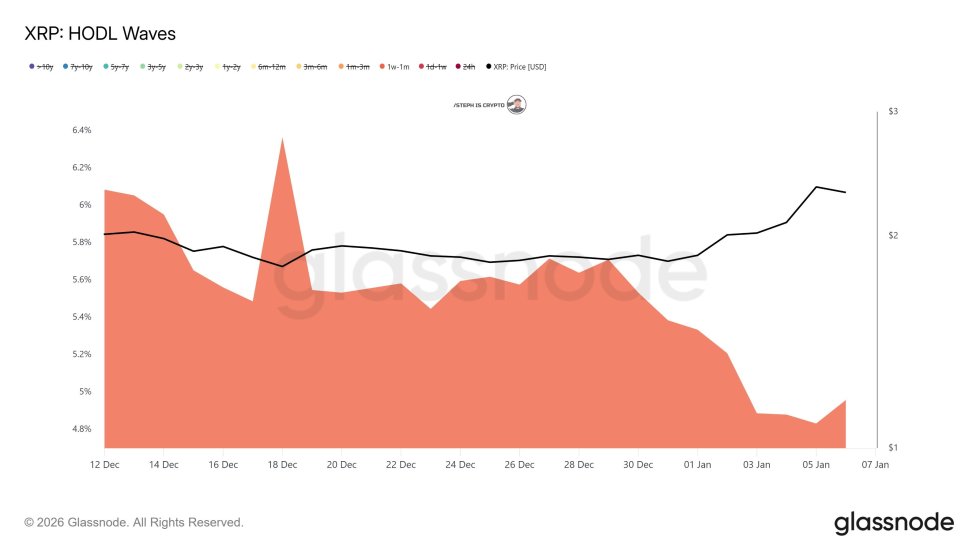
Source: Chart from Steph is Crypto on X

Steph is Crypto highlighted that the share of the total XRP supply held by these investors has fallen from 5.75 to 4.9% in just 7 days. While the pullback may seem small, the shift has the potential to reshape sentiment around the altcoin and its price dynamics in the upcoming weeks.

This is due to the fact that these investors are often one of the most reactive groups in the market. Once positions start to move into profit territory, the cohort tends to sell off their coins at a swift rate. With short-term holders going on a selling spree, the focus now is on whether institutional players and longer-term holdings will withstand the sell-side pressure.

However, while short-term players are exiting, large holders, also regarded as whales, are stepping back in at a significant rate. This implies that deep-pocket investors are exhibiting renewed conviction in the altcoin’s long-term prospects.

According to the report from Steph is Crypto, whales, particularly wallet addresses holding between 1,000,000 XRP and 100,000,000 XRP, recently acquired an additional 60 million XRP in a single day. After a period of relative quiet, the cohort seems to have moved back into accumulation mode.

Leading The Charge In Asia

Demand for XRP is growing in the Asian region, as a report from X Finance Bull shows that the altcoin dominated Bitcoin in South Korea. Data from Upbit reveals that the token was the most traded asset of 2025 across the most active retail market on Earth.

This is beyond price speculation. It is a testament to the altcoin’s increasing volume, liquidity, and usage. The XRP/KRW was ranked in the top spot most of the year, with Upbit executing over $1 trillion in trades. According to the expert, this is an important landmark because real markets reveal truth, and South Korea interacts with trades that work.

XRP trading at $2.1 on the 1D chart | Source: XRPUSDT on Tradingview.com

Пов'язані питання

QWhat on-chain data indicates a shift in sentiment among XRP short-term holders?

AThe XRP HODL Waves chart shows that the share of total XRP supply held by short-term holders (addresses that purchased in the past week and month) has fallen from 5.75% to 4.9% in just 7 days, indicating they are closing positions and reducing exposure.

QAccording to the expert Steph is Crypto, what is the potential impact of short-term holders reducing their XRP exposure?

AThe shift, while seemingly small, has the potential to reshape sentiment and price dynamics for XRP in the upcoming weeks, as this reactive group's selling can create sell-side pressure.

QHow are large holders, or 'whales', behaving differently from short-term holders regarding XRP?

AWhile short-term holders are exiting, whales (addresses holding 1M to 100M XRP) are stepping back in, acquiring an additional 60 million XRP in a single day, showing renewed conviction and moving into accumulation mode.

QWhat evidence from South Korea suggests growing demand for XRP beyond mere price action?

AData from the Upbit exchange shows that XRP/KRW was the most traded asset of 2025, with over $1 trillion in trades executed, demonstrating the altcoin's increasing volume, liquidity, and usage in a major retail market.

QWhat is the suggested primary reason for short-term holders closing their XRP positions?

AThe shift strongly resembles profit-taking and risk management from this cohort in response to the altcoin's recent choppy price action and weakening momentum, as they tend to sell swiftly once in profit.

Пов'язані матеріали

From Banning Doubao to Embracing Honor: Why Did WeChat Suddenly 'Change Its Face'?

The article explores the sudden shift in WeChat's strategy towards AI assistants from mobile phone manufacturers, transitioning from strict opposition to active collaboration. For over a year, WeChat fiercely resisted attempts by phone AI assistants (like ByteDance's Doubao in late 2025) to control its features via GUI automation ("simulated clicking"), citing security and data control concerns. This stance created a significant barrier for system-level AI integration. Now, Tencent has initiated A2A (Agent-to-Agent) partnerships with major phone brands like Honor, Xiaomi, OPPO, and vivo. This model allows a phone's system AI (e.g., Honor's YOYO) to parse a user's voice command and send a structured request directly to WeChat's own internal AI agent via secure APIs. WeChat then executes the action (e.g., sending a message) and returns the result. The article attributes Tencent's "change of face" to strategic pressure. While leading in social app usage, Tencent trails rivals like ByteDance and Alibaba in standalone AI app popularity. WeChat, with its vast mini-program ecosystem, is Tencent's key asset for an AI comeback. The upcoming WeChat AI agent aims to handle tasks like booking and payments within the app. However, phone system assistants remain the primary AI entry point for most users. The A2A collaboration allows Tencent to extend WeChat's AI reach to this crucial system layer while maintaining control over its core functions and data. For phone manufacturers, embracing A2A is a pragmatic move. The GUI route proved unviable due to WeChat's blocks. A2A offers a compliant path to integrate a vital service, enhancing their AI assistants' usefulness. It allows them to focus on developing their own AI ecosystems for other services while cooperating on WeChat access. The collaboration is framed as a mutual, strategic necessity: Tencent gains a distribution channel, and manufacturers gain a key functionality. The partnership relies on a "dual authorization" mechanism for security, requiring both user and app consent for each action. While questions about long-term data privacy practices remain, experts note A2A is more secure and compliant than GUI automation. Ultimately, this cooperation is seen as a tentative, calculated truce. Tencent's long-term goal is to make WeChat an AI-powered "service OS." Phone manufacturers aim to make their system AI the central user interface. Their paths may converge or clash in the future, but for now, the A2A deal represents the opening chapter in the battle for the AI-era user入口, driven by necessity and strategic calculus on both sides.

marsbit55 хв тому

From Banning Doubao to Embracing Honor: Why Did WeChat Suddenly 'Change Its Face'?

marsbit55 хв тому

On-Chain Figures on the Eve of Kickoff: 1.6 Billion Traded Before the World Cup Even Begins

"On-Chain Numbers on the Eve of the World Cup: $1.6 Billion Traded Before Kick-off" Analysis of on-chain markets before the 2026 FIFA World Cup reveals significant crypto integration into football. The most striking figure is the approximately **$1.6 billion** in total trading volume on the single "World Cup Winner" contract on the Polymarket prediction market platform, accumulated before a single match was played. This represents explosive growth for a sector whose annual volume surged from ~$16B in 2024 to ~$64B in 2025. The ecosystem is maturing beyond speculation. Key developments include: 1) **Infrastructure upgrades** like Polymarket's migration to native, regulated USDC stablecoin for settlements; 2) **Reliable data oracles**, such as Chainlink, being used to resolve real-world match outcomes on-chain; and 3) **Official recognition**, with FIFA appointing its first-ever "Prediction Markets" partner. Over 100 contracts now cover everything from the outright winner to individual match results and even non-sporting risks like venue relocation. This evolution marks a fundamental shift. While crypto firms are absent from FIFA's top-tier sponsor list, the technology has deeply penetrated the tournament's financial and predictive infrastructure through regulated stablecoin settlements, decentralized oracles, and new official partnership categories. The regulatory landscape remains complex and varies by jurisdiction, but on-chain markets for the World Cup are already a multi-billion-dollar reality.

marsbit1 год тому

On-Chain Figures on the Eve of Kickoff: 1.6 Billion Traded Before the World Cup Even Begins

marsbit1 год тому

From SpaceX's IPO to the Future of Crypto: Which Crypto Sectors Will Host the Trillion-Dollar Narrative?

From the SpaceX IPO, which targets a $750 billion raise at a $1.77 trillion valuation, we can extrapolate capital flow trends relevant to crypto. The focus shifts from speculative narratives to foundational infrastructure and real-world asset (RWA) integration. Key crypto sectors poised to benefit include: 1. **AI Infrastructure**: The narrative is moving from consumer-facing AI applications to underlying, scarce resources like compute power and decentralized GPU networks (e.g., TAO, RENDER, AKT, IO). These protocols are positioning as the essential "picks and shovels" providers for the AI economy. 2. **Real-World Assets (RWA)**: Beyond tokenized treasury bonds, RWA's future lies in on-chain equity and pre-IPO assets like SpaceX. This could democratize access to high-growth assets and reshape global capital flows, benefiting infrastructure projects like ONDO, LINK, and Plume that facilitate issuance, data, and liquidity. 3. **Core Financial Infrastructure**: Stablecoins, payment networks, and DePIN (Decentralized Physical Infrastructure Networks) are critical for settling the future on-chain economy. Their role expands from internal trading tools to foundational layers for global finance, AI systems, and real-world asset networks, leading to potential value reassessment. In summary, the next cycle may prioritize long-term infrastructure value—AI compute, asset tokenization networks, and settlement layers—over short-lived application hype, mirroring the broader market's shift towards funding the foundational systems of the future.

marsbit2 год тому

From SpaceX's IPO to the Future of Crypto: Which Crypto Sectors Will Host the Trillion-Dollar Narrative?

marsbit2 год тому

Торгівля

Спот
Ф'ючерси

Популярні статті

Як купити MOVE

Ласкаво просимо до HTX.com! Ми зробили покупку Movement (MOVE) простою та зручною. Дотримуйтесь нашої покрокової інструкції, щоб розпочати свою криптовалютну подорож.Крок 1: Створіть обліковий запис на HTXВикористовуйте свою електронну пошту або номер телефону, щоб зареєструвати обліковий запис на HTX безплатно. Пройдіть безпроблемну реєстрацію й отримайте доступ до всіх функцій.ЗареєструватисьКрок 2: Перейдіть до розділу Купити крипту і виберіть спосіб оплатиКредитна/дебетова картка: використовуйте вашу картку Visa або Mastercard, щоб миттєво купити Movement (MOVE).Баланс: використовуйте кошти з балансу вашого рахунку HTX для безперешкодної торгівлі.Треті особи: ми додали популярні способи оплати, такі як Google Pay та Apple Pay, щоб підвищити зручність.P2P: Торгуйте безпосередньо з іншими користувачами на HTX.Позабіржова торгівля (OTC): ми пропонуємо індивідуальні послуги та конкурентні обмінні курси для трейдерів.Крок 3: Зберігайте свої Movement (MOVE)Після придбання Movement (MOVE) збережіть його у своєму обліковому записі на HTX. Крім того, ви можете відправити його в інше місце за допомогою блокчейн-переказу або використовувати його для торгівлі іншими криптовалютами.Крок 4: Торгівля Movement (MOVE)Легко торгуйте Movement (MOVE) на спотовому ринку HTX. Просто увійдіть до свого облікового запису, виберіть торгову пару, укладайте угоди та спостерігайте за ними в режимі реального часу. Ми пропонуємо зручний досвід як для початківців, так і для досвідчених трейдерів.

328 переглядів усьогоОпубліковано 2024.12.13Оновлено 2026.06.02

Як купити MOVE

Обговорення

Ласкаво просимо до спільноти HTX. Тут ви можете бути в курсі останніх подій розвитку платформи та отримати доступ до професійної ринкової інформації. Нижче представлені думки користувачів щодо ціни MOVE (MOVE).

活动图片