XRP Marks 14th Birthday While Ripple Expands DC Presence

bitcoinistОпубліковано о 2026-06-03Востаннє оновлено о 2026-06-03

Анотація

XRP marked its 14th anniversary on June 2, with founders and the community celebrating its origins. The date commemorates a key 2012 code commit that established its fixed 100 billion token supply. Concurrently, Ripple announced an expansion of its Washington, D.C. office, emphasizing a commitment to engaging with U.S. policymakers and regulators on digital asset frameworks. The company aims to help shape policy around market structure, stablecoins, and financial innovation. XRP traded at $1.24 at the time of reporting.

XRP marked its 14th anniversary on Tuesday, June 2, with Ripple executives and long-time community figures reflecting on the asset’s origins just as the company announced a larger footprint in Washington, D.C. The timing places XRP’s history and Ripple’s policy ambitions side by side, at a moment when US digital asset regulation remains a central issue for the industry.

XRP Celebrates 14 Years

David Schwartz, Ripple’s former chief technology officer and one of the most visible architects associated with the XRP Ledger, framed the anniversary as a broader community milestone rather than a founder-centric celebration.

“14 years ago, we got together with an idea to build a better way to move value. What happened next was something none of us could have built alone. And by ‘us,’ I don’t just mean the three of us. I mean the developers, validators, businesses, community members, and everyone who helped shape XRP into what it is today.”

Schwartz closed the post with a simple message: “Happy Birthday, XRP!” Ripple CEO Brad Garlinghouse echoed the sentiment, writing that “14 years later” it was “still the honor of a lifetime to be part of the XRP family.”

The anniversary refers to a specific early code change in the rippled repository. On June 2, 2012, Arthur Britto committed a patch titled “Fix starting number of XNS,” modifying the creation of the first ledger so that its starting balance was defined by SYSTEM_CURRENCY_START rather than a hardcoded number.

At the time, the system currency code was still listed as “XNS,” an early name before XRP became the standard market ticker. The constants added in the commit multiplied 1,000 by 100,000,000 by 1,000,000, creating 100,000,000,000,000,000 base units; with six decimal places, that corresponds to 100 billion XNS, the fixed supply later known as 100 billion XRP.

Ripple Expands Presence in Washington D.C.

The anniversary lands as Ripple is also sharpening its institutional and policy presence in the United States. In a separate announcement, Ripple said it has opened an expanded Washington, D.C. office, describing the move as a reinforcement of its long-term commitment to engagement with policymakers, regulators and industry partners in the capital.

Ripple Chief Legal Officer Stuart Alderoty said the larger office reflects the company’s effort to stay close to the policy process as lawmakers and agencies weigh digital asset frameworks.

“Ripple has always believed the future of digital assets should be built with policymakers and regulators, not around them,” Alderoty said. “Expanding our Washington, D.C. presence reflects our long-term commitment to constructive engagement, regulatory clarity, and US leadership in financial innovation. As blockchain and digital assets become more integrated into the financial system, Ripple is committed to helping shape policy that protects consumers, supports responsible innovation, and keeps America competitive.”

The company said the D.C. expansion comes at a “defining moment” for US digital asset policy, pointing to ongoing discussions around market structure, stablecoins, payments modernization and responsible blockchain innovation. Ripple positioned the new office as a hub for policy engagement and stakeholder convening, including conversations with policymakers, regulators, financial institutions, industry partners and other leaders involved in financial infrastructure.

For Ripple, the move is also consistent with its broader enterprise-facing posture. The company describes itself as a provider of blockchain-based solutions across traditional and digital finance, with products spanning global payments, custody, liquidity and treasury management. Ripple also cited its stablecoin RLUSD and XRP as assets underpinning parts of its product suite.

At press time, XRP traded at $1.24.
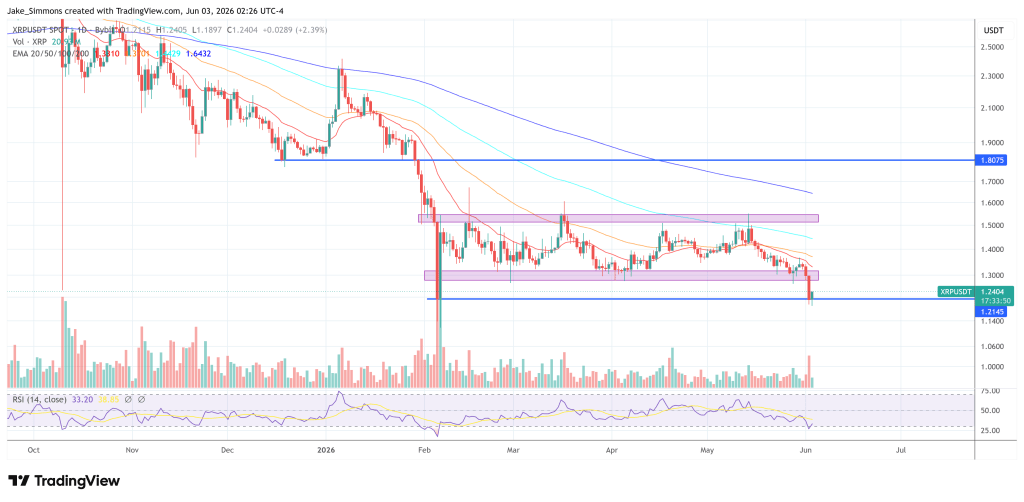
XRP falls below the range, 1-day chart | Source: XRPUSDT on TradingView.com

Трендові криптовалюти

Пов'язані питання

QWhat specific event on June 2, 2012, is considered the birth of XRP according to the article?

AThe event considered the birth of XRP was a code commit by Arthur Britto in the rippled repository. The commit, titled 'Fix starting number of XNS,' modified the creation of the first ledger to define its starting balance using `SYSTEM_CURRENCY_START` instead of a hardcoded number, effectively setting the fixed supply of what would later be named XRP.

QHow did Ripple's former CTO David Schwartz describe the significance of XRP's 14th anniversary?

ADavid Schwartz described XRP's 14th anniversary as a broader community milestone, not a founder-centric celebration. He emphasized that the success was built by a collective 'us' including developers, validators, businesses, and community members, not just the original architects.

QWhat reason did Ripple give for expanding its Washington, D.C. office, and who commented on this move?

ARipple said the expansion of its Washington, D.C. office reinforces its long-term commitment to engagement with policymakers, regulators, and industry partners. Chief Legal Officer Stuart Alderoty commented, stating it reflects the company's effort to stay close to the policy process and help shape regulations that support innovation and competitiveness.

QWhat were the original system currency code and the final fixed supply amount established for XRP as mentioned in the article?

AThe original system currency code was 'XNS.' The final fixed supply established was 100,000,000,000,000,000 base units, which, with six decimal places, corresponds to 100 billion XRP.

QAccording to the article, what broader industry context does Ripple's D.C. expansion occur within?

ARipple's D.C. expansion occurs at a 'defining moment' for U.S. digital asset policy, amid ongoing discussions around market structure, stablecoins, payments modernization, and responsible blockchain innovation.

Пов'язані матеріали

As Consensus Accelerates, What Are Young Investors Betting On?

Title: As Consensus Forms Faster, What Are Young Investors Betting On? In the rapid evolution of tech investment, a new generation of young investors is navigating a landscape where AI, robotics, commercial aerospace, and quantum computing are advancing simultaneously. Traditional investment logic based on financial models is giving way to a need for deep technical understanding and the ability to act before industry consensus forms. An analysis of trends from the "WAIC FUTURE TECH" list of young investment leaders reveals key shifts in focus. The first major trend is the movement of AI from the digital screen into the physical world. Investment is shifting from large language models and chatbots towards embodied AI, robotics, AI hardware, and edge computing. While demonstrations generate excitement, the real challenge lies in achieving scalable, reliable, and cost-effective delivery in complex real-world environments like factories and logistics. Success depends not just on algorithms but on the integration of sensors, actuators, and control systems. Second, the competitive focus for large models is moving beyond raw capability toward building an "intelligence flywheel." The goal is to create self-reinforcing systems where user interaction generates data, improving the model, which in turn enhances the user experience and attracts more engagement. Companies that successfully embed AI into workflows to create these closed-loop systems can build lasting value that isn't easily erased by the next model upgrade. Third, facing a potential bottleneck in high-quality human-generated data, investors are looking at new underlying technologies. Reinforcement learning and self-play, as demonstrated by AlphaGo Zero, offer paths for AI to generate its own experience. Scientific foundation models, which aim to build general AI capabilities for fields like life sciences and materials discovery, represent a non-consensus direction that could unlock new frontiers of knowledge and data. Finally, in deep-tech areas like quantum computing, commercial aerospace, and space-based infrastructure, patient capital is essential. These fields have long, uncertain development and validation cycles involving complex engineering, supply chains, and regulations. Investment here requires a long-term view, focusing on foundational team capabilities and the eventual emergence of market demand, even if commercial returns are distant. Collectively, these trends illustrate how young investors are adapting to a new era. They are learning to make earlier, technically-informed judgments, balance hype with real-world viability, and provide the patient capital needed to build the deep-tech foundations of the future.

marsbit25 хв тому

As Consensus Accelerates, What Are Young Investors Betting On?

marsbit25 хв тому

Can Japan Buy Growth with AI? Will the Bond Market Believe It?

Japan's cabinet has introduced the 2026 Basic Policy on Economic and Fiscal Management and Reform, shifting its primary fiscal target. The new framework moves away from the traditional annual primary balance goal and instead prioritizes a stable reduction of the debt-to-GDP ratio. This change is tied to a strategy of increased "responsible proactive fiscal" spending, aiming to boost long-term growth through investments in strategic sectors like AI, semiconductors, energy, and robotics. The government estimates total public and private investment in 62 key technologies could exceed 370 trillion yen by 2040. The market reaction has been mixed and cautious. While equity markets may respond to policy signals, bond markets are focused on fiscal credibility. Concerns center on whether the weakening of the clear primary balance anchor could lead to looser fiscal discipline. If investors doubt that these strategic investments will generate sufficient productivity gains, tax revenue, and nominal growth to outpace rising interest costs, they may demand higher yields on Japanese Government Bonds (JGBs). Recent volatility in the yen and JGB yields, with the 10-year yield briefly reaching 2.9%, reflects this skepticism. The success of this new framework hinges on two factors: whether Japan can achieve a nominal growth rate consistently higher than its long-term interest rates, and whether future budgets demonstrate disciplined control over bond issuance. The government's narrative is that strategic investment is essential to break Japan's cycle of low growth, aging, and labor shortages. However, the bond market will continuously assess the credibility of this plan, pricing the risk that it may represent fiscal expansion rather than a viable growth strategy.

marsbit1 год тому

Can Japan Buy Growth with AI? Will the Bond Market Believe It?

marsbit1 год тому

Misjudged A-Shares: Resilience, Expectations, and Confidence

China's A-share market recently faced selling pressure, especially in tech sectors, initially triggered by a global tech sell-off that began in South Korea. However, the article argues this is a case of "mistaken injury" and highlights the market's underlying resilience. This resilience stems from three main pillars: **1) Tech Sector Fundamentals:** Unlike Korea's market dominated by a few memory chip stocks, China's tech sector is diversified across computing, communications, electronics, and semiconductors, supported by dual narratives of global AI supply chains and domestic substitution. Core areas like optical modules and fiber optics continue to show strong earnings growth. **2) "National Team" Support:** State-backed institutions and large corporations have made significant market purchases and announced buybacks, providing liquidity and signaling confidence. This is seen as a stabilizing policy signal, often associated with market bottoms. **3) Broader Market Pillars:** Other major sectors are showing endogenous recovery momentum. Consumer stocks benefit from stabilizing CPI and signs of sector recovery (e.g., liquor price hikes). Cyclical sectors like aluminum have high earnings, potential price increases due to tight supply, and low valuations. The financial sector offers stable dividends and low valuations. The conclusion is that the sell-off was driven by external contagion, not a collapse in fundamentals. With strong policy support and recovering momentum across key sectors, the A-share market possesses the toughness to regain stability.

marsbit1 год тому

Misjudged A-Shares: Resilience, Expectations, and Confidence

marsbit1 год тому

Торгівля

Спот

Популярні статті

Що таке XRP 2.0

XRP 2.0: Нова межа в світі криптовалют Вступ до XRP 2.0 У постійно змінюючомуся світі криптовалют нові проекти постійно з'являються, змагаючись за увагу та прийняття. Однією з таких обіцяючих ініціатив є XRP 2.0, новий криптовалютний проект, що має на меті використання сучасних технологій блокчейн та надійних методів шифрування. Хоча назва нагадує про XRP від Ripple, важливо зазначити, що XRP 2.0 функціонує автономно, концентруючи увагу на підвищенні безпеки транзакцій, конфіденційності та масштабованості. Оскільки цифровий фінансовий ландшафт все більше приймає децентралізовані рішення, XRP 2.0 прагне значно сприяти веб3 та загальному розширенню крипто проектів. Що таке XRP 2.0? У своїй основі XRP 2.0 є криптовалютним проектом, що має на меті створення безпечної та децентралізованої екосистеми цифрової валюти. Його фундаментальна технологія інтегрує складні принципи блокчейну з передовими техніками шифрування. Загальною метою XRP 2.0 є встановлення себе як надійної та ефективної платформи, що дозволяє швидко виконувати транзакції, при цьому надаючи пріоритет підвищеним захистам конфіденційності для своїх користувачів. Проект позиціонується як рішення багатьох обмежень, з якими стикаються існуючі криптовалюти, пропонуючи систему, яка може обробляти вищий обсяг транзакцій з покращеною швидкістю та конфіденційністю. Ця універсальність позиціонує XRP 2.0 як значного гравця на ринку, наповненому різними цифровими валютами. Хто творець XRP 2.0? Особистість творця XRP 2.0 була позначена як «Вілбур». Проте, вичерпні деталі про Вілбура або пов'язану з ним організацію залишаються недоступними. Анонімність багатьох творців криптовалют не є незвичним явищем в індустрії, часто запроваджена для збереження певного рівня конфіденційності та безпеки. Хто інвестори XRP 2.0? На даний момент конкретна інформація про інвестиційні фонди або організації, що підтримують XRP 2.0, не є публічно доступною. У секторі криптовалют підтримка від визнаних інвесторів може значно вплинути на кредитоспроможність і успіх проекту, але прозорість щодо фінансових підтримувачів XRP 2.0 не була встановлена. Як працює XRP 2.0? XRP 2.0 вирізняється використанням комбінації технології блокчейн та просунутих алгоритмів шифрування, що забезпечують безпечні та децентралізовані транзакції. Його інноваційна структура включає унікальні функції, спрямовані на залучення користувачів та розширення функціональності за межами традиційних транзакцій криптовалюти. Серед цих функцій, XRP 2.0 включає можливості на базі ШІ, такі як текст в зображення та текст в мову. Ці нововведення розроблені для покращення інтерактивного досвіду для користувачів, сприяючи ширшій застосовності в різних секторах. Завдяки поєднанню технологічних досягнень з орієнтованим на користувача дизайном, XRP 2.0 прагне привернути увагу різноманітних осіб і підприємств, які шукають способи інтеграції рішень криптовалют у свої операційні структури. Хронологія XRP 2.0 Розуміння XRP 2.0 вимагає вивчення основних етапів, які визначили його подорож до теперішнього часу: 23 липня 2023 року: XRP 2.0 представлено як новий криптовалютний проект, що має на меті революціонізувати безпечні та децентралізовані можливості транзакцій у галузі блокчейн. 8 вересня 2023 року: Запускається інший проект, XRP20, що відзначає виникнення токена ERC-20 на блокчейні Ethereum, який не пов'язаний з XRP 2.0. 13 листопада 2023 року: XRP Ledger зазнає значного оновлення з виходом програмного забезпечення rippled server версії 2.0.0. Важливо зазначити, що цей розвиток не пов'язаний з криптовалютним проектом XRP 2.0. Ключові моменти про XRP 2.0 Щоб узагальнити суть XRP 2.0, кілька критично важливих факторів emerge: Унікальні функції: Включення функцій, таких як текст в зображення і текст в мову на базі ШІ, ще більше розширює потенційні застосування XRP 2.0. Технологія блокчейн: Архітектура використовує сучасні механізми блокчейн і протоколи шифрування, забезпечуючи безпечне та децентралізоване середовище для транзакцій. Масштабованість і конфіденційність: XRP 2.0 надає пріоритет підвищеним захистам конфіденційності в процесах транзакцій і масштабованості, необхідній для задоволення зростаючої бази користувачів. Відсутність зв'язку з Ripple: Важливо, що, незважаючи на свою назву, XRP 2.0 не має жодної прив'язки чи співпраці з XRP від Ripple, що відрізняє його операційну структуру та цілі в рамках криптовалютної екосистеми. Висновок XRP 2.0 представляє амбітну ініціативу у світі криптовалют, прагнучи запропонувати поєднання безпеки, конфіденційності та ефективності у цифрових транзакціях. Інтегруючи складні технології та дружні до користувача функції, проект ставить за мету розширити горизонти того, що криптовалюта може досягти в сучасній цифровій економіці. Хоча анонімність його творця та відсутність розкритих інвесторів можуть викликати запитання у деяких, фокус XRP 2.0 на передових функціональностях і децентралізації підвищує його привабливість на дедалі більшому ринку криптовалют. Оскільки ландшафт криптовалют продовжує еволюціонувати, XRP 2.0 може ще стати важливим гравцем у розширенні безпечних і масштабованих рішень блокчейн.

199 переглядів усьогоОпубліковано 2024.04.05Оновлено 2024.12.03

Що таке XRP 2.0

Як купити XRP

Ласкаво просимо до HTX.com! Ми зробили покупку XRP (XRP) простою та зручною. Дотримуйтесь нашої покрокової інструкції, щоб розпочати свою криптовалютну подорож.Крок 1: Створіть обліковий запис на HTXВикористовуйте свою електронну пошту або номер телефону, щоб зареєструвати обліковий запис на HTX безплатно. Пройдіть безпроблемну реєстрацію й отримайте доступ до всіх функцій.ЗареєструватисьКрок 2: Перейдіть до розділу Купити крипту і виберіть спосіб оплатиКредитна/дебетова картка: використовуйте вашу картку Visa або Mastercard, щоб миттєво купити XRP (XRP).Баланс: використовуйте кошти з балансу вашого рахунку HTX для безперешкодної торгівлі.Треті особи: ми додали популярні способи оплати, такі як Google Pay та Apple Pay, щоб підвищити зручність.P2P: Торгуйте безпосередньо з іншими користувачами на HTX.Позабіржова торгівля (OTC): ми пропонуємо індивідуальні послуги та конкурентні обмінні курси для трейдерів.Крок 3: Зберігайте свої XRP (XRP)Після придбання XRP (XRP) збережіть його у своєму обліковому записі на HTX. Крім того, ви можете відправити його в інше місце за допомогою блокчейн-переказу або використовувати його для торгівлі іншими криптовалютами.Крок 4: Торгівля XRP (XRP)Легко торгуйте XRP (XRP) на спотовому ринку HTX. Просто увійдіть до свого облікового запису, виберіть торгову пару, укладайте угоди та спостерігайте за ними в режимі реального часу. Ми пропонуємо зручний досвід як для початківців, так і для досвідчених трейдерів.

1.6k переглядів усьогоОпубліковано 2024.12.10Оновлено 2026.06.02

Як купити XRP

Обговорення

Ласкаво просимо до спільноти HTX. Тут ви можете бути в курсі останніх подій розвитку платформи та отримати доступ до професійної ринкової інформації. Нижче представлені думки користувачів щодо ціни XRP (XRP).

活动图片














