XRP Ledger Is A ‘Ghost Chain,’ Chainlink Community Liaison Claims

bitcoinistОпубліковано о 2026-03-17Востаннє оновлено о 2026-03-17

Анотація

Chainlink Community Liaison Zach Rynes sparked a debate by labeling the XRP Ledger a "ghost chain," arguing its core investment thesis has failed. He contends that XRP's proposed role as a global bridge currency has been overtaken by stablecoins and modern interoperability infrastructure, which institutions now prefer. Rynes criticized XRPL's low adoption in tokenized assets and stablecoins, stating USD stablecoins have become the dominant bridge asset. He also accused Ripple of socializing costs to XRP holders while privatizing gains for shareholders. XRP advocates, like lawyer Bill Morgan, countered that Ripple and XRPL are separate entities and defended Ripple's business structure. XRP price was $1.4757 at the time of reporting.

A fresh clash between XRP critics and defenders broke out on X after Chainlink Community Liaison Zach Rynes (@ChainLinkGod) argued that the XRP investment thesis has failed to keep pace with how crypto markets and financial infrastructure have evolved. His central claim was blunt: the XRP Ledger is now a “ghost chain,” while the use case once pitched for XRP as a bridge asset has largely been overtaken by stablecoins and broader interoperability infrastructure.

Rynes framed the dispute around what he called the long-running retail thesis behind XRP. “The bizarre retail thesis of XRP is that it will become the global reserve currency that everything trades against, the so-called ‘XRP standard,’” he wrote. “Rather than trading Dollars for Euros directly, you would trade USD for XRP, and then XRP for EUR, because this makes payments supposedly more efficient.”

He argued that XRP supporters prefer to describe this not as a bid for reserve-currency status, but as a narrower “bridge currency” role. In his view, that distinction does not materially change the argument. He said the larger problem is that the market structure envisioned by early XRP advocates was built in other ways over the past decade.

“The XRP vision was created over a decade ago before we had modern 200K TPS high-throughput chains, programmable smart contracts, DeFi protocols, fiat-backed stablecoins, tokenized deposits, atomic DvP/PvP swaps, and cross-chain infra,” Rynes wrote. “If you listen to what the world’s largest financial institutions and market infrastructures like Swift, DTCC, JP Morgan, BlackRock, and many others are saying, you’ll find zero of them talking about the need for a ‘bridge currency.’ Rather, they talk about the need for connectivity, interoperability, privacy, compliance, and orchestration.”

That critique extended to XRP Ledger’s position in tokenization and on-chain finance. Rynes said XRPL “will become the dominant chain for tokenized real world assets” remains a popular belief among XRP holders despite what he described as weak adoption metrics. He called XRPL “a ghost chain with less than 1% RWA market share and under 0.01% of stablecoins,” arguing that this makes the idea of XRPL emerging as the primary settlement layer difficult to defend.

He also pointed to stablecoins as the practical winner in the bridge-asset debate. According to Rynes, “USD-backed stablecoins have become the dominant crypto-native ‘bridge currency’ for payments, trading, and finance,” and the industry has already built “everything XRP was supposed to be, without XRP.” He cited Hyperliquid as an example of crypto-native finance where positions across multiple markets are effectively denominated against dollar-backed stablecoins rather than XRP.

The second half of his argument focused less on ledger design and more on Ripple’s business model. Rynes alleged that Ripple “socializes its costs to XRP holders and privatizes gains for its equity shareholders,” saying XRP sales fund products whose revenue accrues to Ripple rather than directly to token holders. He made the same point about RLUSD, writing that around 90% of its supply sits on Ethereum and other chains, which in his telling creates little to no direct demand for XRP itself.

XRP Community Fires Back

Not everyone in the thread accepted that framing. XRP advocate and lawyer Bill Morgan pushed back on Rynes’ comparison between token buybacks and equity buybacks, calling it “a false equivalence because a token is nothing like a share and has no rights attached it like a share.” He also rejected the idea that Ripple and XRPL should be treated as one and the same, writing that “Ripple does not own the XRPL which is a fully decentralised public permissionless Blockchain.”

Morgan argued that Ripple had opted for a different structure through Evernorth, which he described as an independent vehicle designed to acquire XRP and offer institutions regulated exposure. He said that model was preferable to Ripple itself running a reserve that could draw regulatory scrutiny, especially given how the SEC previously pointed to Ripple’s efforts to support XRP’s price in litigation.

At press time, XRP traded at $1.4757.
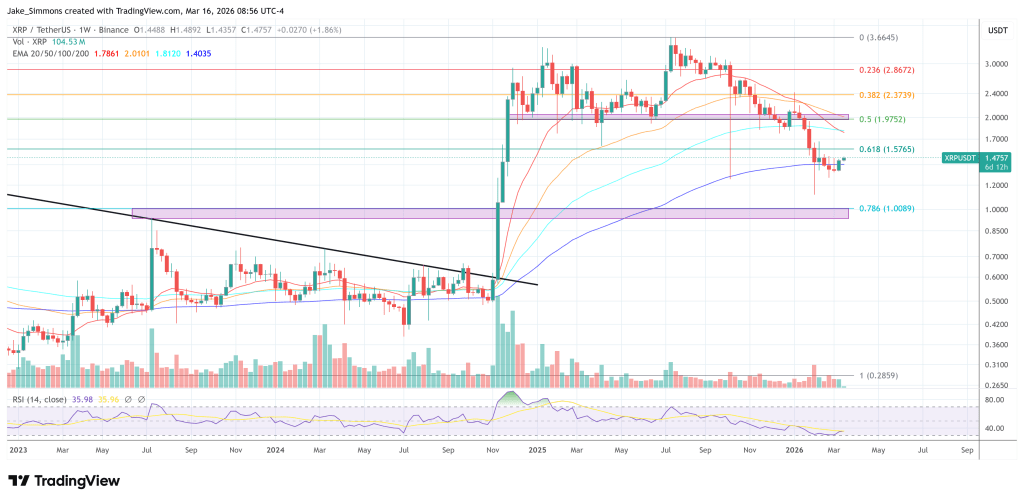
XRP rises back above the 200-week EMA, 1-week chart | Source: XRPUSDT on TradingView.com

Трендові криптовалюти

Пов'язані питання

QWhat is the main criticism that Chainlink Community Liaison Zach Rynes makes about the XRP Ledger?

AZach Rynes criticizes the XRP Ledger as being a 'ghost chain' and argues that its original investment thesis as a bridge asset has been overtaken by stablecoins and modern interoperability infrastructure.

QAccording to Rynes, what has become the dominant 'bridge currency' in the crypto industry instead of XRP?

AAccording to Rynes, USD-backed stablecoins have become the dominant crypto-native 'bridge currency' for payments, trading, and finance.

QHow does Rynes describe the relationship between Ripple's business model and XRP holders?

ARynes alleges that Ripple 'socializes its costs to XRP holders and privatizes gains for its equity shareholders,' meaning XRP sales fund products whose revenue goes to Ripple rather than directly to token holders.

QWhat was Bill Morgan's key counterargument regarding the comparison between XRP tokens and company shares?

ABill Morgan argued that it is a 'false equivalence' to compare token buybacks to equity buybacks because a token is nothing like a share and has no rights attached to it like a share does.

QWhat reason did Bill Morgan give for Ripple using an independent vehicle like Evernorth instead of managing XRP directly?

AMorgan stated that using an independent vehicle like Evernorth was preferable to avoid regulatory scrutiny, especially since the SEC had previously pointed to Ripple's efforts to support XRP's price in litigation.

Пов'язані матеріали

9.42 Million Retail Investors Compete for Changxin Technology, Who Got Allotted?

Evergreen Technology's IPO subscription results are now available. On July 20, the domestic memory chip giant announced the offline preliminary allotment results and online lottery results for its IPO. A total of approximately 9.43 million retail investors participated in the online subscription, generating 770,000 winning lots with a final winning rate of about 0.4714%, setting a record for new shares on the STAR Market. After triggering a clawback mechanism from institutional to retail investors, the online retail allocation was significantly increased to 3.851 billion shares. Simultaneously, 285 institutional investors participated in the offline subscription, ultimately receiving 2.173 billion shares at an allotment rate of approximately 0.1756%. Leading insurers and public funds were among the major recipients. Notably, Liang Wenfeng, founder of the major AI model company DeepSeek, through his quantitative investment firms Ningbo Huanfang Quantitative and Zhejiang Jiuzhang Asset, secured the largest share among private funds, with a total allotment worth approximately 175 million yuan. Estimates suggest potential profits could reach 730 million yuan if Evergreen Technology's market capitalization reaches 3 trillion yuan post-listing. The company is expected to list on July 27 and could become the highest-valued tech stock on the A-share market, with various brokerages providing valuations ranging from 1 trillion to over 4 trillion yuan. However, recent significant corrections in global tech stocks may impact its post-listing performance. (Character count: 1,196)

marsbit46 хв тому

9.42 Million Retail Investors Compete for Changxin Technology, Who Got Allotted?

marsbit46 хв тому

3 Million-Follower Goddess Fully AI-Synthesized, Fake Orphanage, Cross-Border ‘Fake Charity’ Collapses Overnight

An Australian influencer named Lily Jay, with nearly 3 million Instagram followers, is at the centre of a major AI-fueled charity scam. Her 'Lily Jay Foundation' claimed to build orphanages, mosques, and deliver aid in places like Uganda and Gaza, using emotionally powerful videos of herself with children. However, an investigation by ABC NEWS Verify revealed these scenes—including a key video announcing an orphanage's opening—were entirely AI-generated, complete with telltale flaws like garbled text on clothing. The foundation's 'humanitarian award' was also faked using AI images. The foundation admitted in small print on its website that it is not a registered charity, avoiding financial transparency laws. While based in Kosovo, its operations and the influencer's lavish personal lifestyle raised further red flags. Following media inquiries, the foundation selectively hid donation buttons and removed fraudulent content for Australian visitors, but kept them active internationally. Experts warn this case is a textbook example of how AI can be weaponized to exploit public trust and generosity, creating believable but entirely fabricated narratives of aid. The incident highlights the growing danger of deepfakes in eroding trust within the charitable sector, urging donors to critically verify causes before giving.

marsbit1 год тому

3 Million-Follower Goddess Fully AI-Synthesized, Fake Orphanage, Cross-Border ‘Fake Charity’ Collapses Overnight

marsbit1 год тому

L2 'Recalibration': When L1 Becomes Its Own Rollup, What Is Ethereum's Endgame?

The article discusses the evolving relationship between Ethereum's Layer 1 (L1) and Layer 2 (L2) solutions, moving beyond the initial "L2 for scaling" model. As Ethereum L1 itself scales (increasing Gas Limit, statelessness, zkEVM), the unique value proposition of L2s shifts from merely providing cheap execution to offering differentiated features like application-specific optimization, privacy, and flexible governance. The piece explores three key themes: 1. **L2's New Role:** L2s are transitioning from a pure scaling technology to a spectrum of execution environments with varying degrees of security inheritance from Ethereum L1. 2. **Interoperability as State Trust:** Solving L2 fragmentation is less about cross-chain bridges and more about enabling faster, trust-minimized state verification between environments. This involves initiatives like faster L1 finality, intent-based architectures (Open Intents Framework), and native account abstraction. 3. **Blurring Layers:** With the potential integration of zk-proofs into L1 validation (making L1 akin to its own "Rollup") and the concept of "Native Rollups," the rigid boundary between L1 and L2 may fade. The future could be a unified system with multiple execution domains (for DeFi, gaming, privacy, etc.) sharing a common security, settlement, and state framework. In conclusion, Ethereum's goal is not to abandon L2s or re-centralize everything on L1, but to re-integrate the fragmented user experience—liquidity, accounts, applications—while preserving the scaling benefits of a multi-environment ecosystem. The endgame is a cohesive "one chain" feeling for users, powered by diverse but securely interconnected execution layers.

marsbit1 год тому

L2 'Recalibration': When L1 Becomes Its Own Rollup, What Is Ethereum's Endgame?

marsbit1 год тому

Торгівля

Спот

Популярні статті

Що таке XRP 2.0

XRP 2.0: Нова межа в світі криптовалют Вступ до XRP 2.0 У постійно змінюючомуся світі криптовалют нові проекти постійно з'являються, змагаючись за увагу та прийняття. Однією з таких обіцяючих ініціатив є XRP 2.0, новий криптовалютний проект, що має на меті використання сучасних технологій блокчейн та надійних методів шифрування. Хоча назва нагадує про XRP від Ripple, важливо зазначити, що XRP 2.0 функціонує автономно, концентруючи увагу на підвищенні безпеки транзакцій, конфіденційності та масштабованості. Оскільки цифровий фінансовий ландшафт все більше приймає децентралізовані рішення, XRP 2.0 прагне значно сприяти веб3 та загальному розширенню крипто проектів. Що таке XRP 2.0? У своїй основі XRP 2.0 є криптовалютним проектом, що має на меті створення безпечної та децентралізованої екосистеми цифрової валюти. Його фундаментальна технологія інтегрує складні принципи блокчейну з передовими техніками шифрування. Загальною метою XRP 2.0 є встановлення себе як надійної та ефективної платформи, що дозволяє швидко виконувати транзакції, при цьому надаючи пріоритет підвищеним захистам конфіденційності для своїх користувачів. Проект позиціонується як рішення багатьох обмежень, з якими стикаються існуючі криптовалюти, пропонуючи систему, яка може обробляти вищий обсяг транзакцій з покращеною швидкістю та конфіденційністю. Ця універсальність позиціонує XRP 2.0 як значного гравця на ринку, наповненому різними цифровими валютами. Хто творець XRP 2.0? Особистість творця XRP 2.0 була позначена як «Вілбур». Проте, вичерпні деталі про Вілбура або пов'язану з ним організацію залишаються недоступними. Анонімність багатьох творців криптовалют не є незвичним явищем в індустрії, часто запроваджена для збереження певного рівня конфіденційності та безпеки. Хто інвестори XRP 2.0? На даний момент конкретна інформація про інвестиційні фонди або організації, що підтримують XRP 2.0, не є публічно доступною. У секторі криптовалют підтримка від визнаних інвесторів може значно вплинути на кредитоспроможність і успіх проекту, але прозорість щодо фінансових підтримувачів XRP 2.0 не була встановлена. Як працює XRP 2.0? XRP 2.0 вирізняється використанням комбінації технології блокчейн та просунутих алгоритмів шифрування, що забезпечують безпечні та децентралізовані транзакції. Його інноваційна структура включає унікальні функції, спрямовані на залучення користувачів та розширення функціональності за межами традиційних транзакцій криптовалюти. Серед цих функцій, XRP 2.0 включає можливості на базі ШІ, такі як текст в зображення та текст в мову. Ці нововведення розроблені для покращення інтерактивного досвіду для користувачів, сприяючи ширшій застосовності в різних секторах. Завдяки поєднанню технологічних досягнень з орієнтованим на користувача дизайном, XRP 2.0 прагне привернути увагу різноманітних осіб і підприємств, які шукають способи інтеграції рішень криптовалют у свої операційні структури. Хронологія XRP 2.0 Розуміння XRP 2.0 вимагає вивчення основних етапів, які визначили його подорож до теперішнього часу: 23 липня 2023 року: XRP 2.0 представлено як новий криптовалютний проект, що має на меті революціонізувати безпечні та децентралізовані можливості транзакцій у галузі блокчейн. 8 вересня 2023 року: Запускається інший проект, XRP20, що відзначає виникнення токена ERC-20 на блокчейні Ethereum, який не пов'язаний з XRP 2.0. 13 листопада 2023 року: XRP Ledger зазнає значного оновлення з виходом програмного забезпечення rippled server версії 2.0.0. Важливо зазначити, що цей розвиток не пов'язаний з криптовалютним проектом XRP 2.0. Ключові моменти про XRP 2.0 Щоб узагальнити суть XRP 2.0, кілька критично важливих факторів emerge: Унікальні функції: Включення функцій, таких як текст в зображення і текст в мову на базі ШІ, ще більше розширює потенційні застосування XRP 2.0. Технологія блокчейн: Архітектура використовує сучасні механізми блокчейн і протоколи шифрування, забезпечуючи безпечне та децентралізоване середовище для транзакцій. Масштабованість і конфіденційність: XRP 2.0 надає пріоритет підвищеним захистам конфіденційності в процесах транзакцій і масштабованості, необхідній для задоволення зростаючої бази користувачів. Відсутність зв'язку з Ripple: Важливо, що, незважаючи на свою назву, XRP 2.0 не має жодної прив'язки чи співпраці з XRP від Ripple, що відрізняє його операційну структуру та цілі в рамках криптовалютної екосистеми. Висновок XRP 2.0 представляє амбітну ініціативу у світі криптовалют, прагнучи запропонувати поєднання безпеки, конфіденційності та ефективності у цифрових транзакціях. Інтегруючи складні технології та дружні до користувача функції, проект ставить за мету розширити горизонти того, що криптовалюта може досягти в сучасній цифровій економіці. Хоча анонімність його творця та відсутність розкритих інвесторів можуть викликати запитання у деяких, фокус XRP 2.0 на передових функціональностях і децентралізації підвищує його привабливість на дедалі більшому ринку криптовалют. Оскільки ландшафт криптовалют продовжує еволюціонувати, XRP 2.0 може ще стати важливим гравцем у розширенні безпечних і масштабованих рішень блокчейн.

195 переглядів усьогоОпубліковано 2024.04.05Оновлено 2024.12.03

Що таке XRP 2.0

Як купити XRP

Ласкаво просимо до HTX.com! Ми зробили покупку XRP (XRP) простою та зручною. Дотримуйтесь нашої покрокової інструкції, щоб розпочати свою криптовалютну подорож.Крок 1: Створіть обліковий запис на HTXВикористовуйте свою електронну пошту або номер телефону, щоб зареєструвати обліковий запис на HTX безплатно. Пройдіть безпроблемну реєстрацію й отримайте доступ до всіх функцій.ЗареєструватисьКрок 2: Перейдіть до розділу Купити крипту і виберіть спосіб оплатиКредитна/дебетова картка: використовуйте вашу картку Visa або Mastercard, щоб миттєво купити XRP (XRP).Баланс: використовуйте кошти з балансу вашого рахунку HTX для безперешкодної торгівлі.Треті особи: ми додали популярні способи оплати, такі як Google Pay та Apple Pay, щоб підвищити зручність.P2P: Торгуйте безпосередньо з іншими користувачами на HTX.Позабіржова торгівля (OTC): ми пропонуємо індивідуальні послуги та конкурентні обмінні курси для трейдерів.Крок 3: Зберігайте свої XRP (XRP)Після придбання XRP (XRP) збережіть його у своєму обліковому записі на HTX. Крім того, ви можете відправити його в інше місце за допомогою блокчейн-переказу або використовувати його для торгівлі іншими криптовалютами.Крок 4: Торгівля XRP (XRP)Легко торгуйте XRP (XRP) на спотовому ринку HTX. Просто увійдіть до свого облікового запису, виберіть торгову пару, укладайте угоди та спостерігайте за ними в режимі реального часу. Ми пропонуємо зручний досвід як для початківців, так і для досвідчених трейдерів.

1.6k переглядів усьогоОпубліковано 2024.12.10Оновлено 2026.06.02

Як купити XRP

Обговорення

Ласкаво просимо до спільноти HTX. Тут ви можете бути в курсі останніх подій розвитку платформи та отримати доступ до професійної ринкової інформації. Нижче представлені думки користувачів щодо ціни XRP (XRP).

活动图片














