XRP Ledger Gets AI Agent Payments Through Virtuals And t54

bitcoinistОпубліковано о 2026-03-21Востаннє оновлено о 2026-03-21

Анотація

Virtuals Protocol and t54 have integrated "agent commerce" into the XRP Ledger, enabling AI agents to autonomously transact using XRP and RLUSD. The system combines Virtuals' Agent Commerce Protocol (ACP) for commercial workflows—including escrowed jobs, evaluator-based verification, and programmable settlement—with t54's x402 facilitator, which handles payment verification and settlement without traditional API keys or custodial wallets. This infrastructure allows AI agents to programmatically pay for services via standard web requests, leveraging the HTTP 402 payment standard. The collaboration, supported by RippleX, aims to create a native financial environment for autonomous agents, addressing needs like verifiable identity and real-time risk assessment.

Virtuals Protocol and t54 have announced that they are bringing “agent commerce” to the XRP Ledger, a move that would let AI agents transact natively using escrowed jobs, evaluator-based verification and programmable settlement.

The announcement was delivered through coordinated posts from Virtuals, t54 and RippleX rather than a visible standalone press release. Virtuals wrote via X:

“Virtuals is powering agent commerce on XRPL. $95B+ in cumulative transaction volume. 75+ regulatory licenses across global markets. The ledger built from day one for payments is now extending into agent commerce. Together with t54, Virtuals is bringing the commerce infrastructure for agents to transact natively on the XRPL.”

While RippleX only commented: “Agent Commerce is Coming,” t54 added: “Agent commerce is coming to the XRPL. With Virtuals, agents can transact autonomously: escrowed jobs, verification through evaluators, and programmable settlement. Using t54’s x402 facilitator, agents can already natively pay in XRP and RLUSD.”

AI Agents Can Now Pay In XRP And RLUSD

Under the hood, the architecture appears to split cleanly across two layers. Virtuals brings the commerce logic through its Agent Commerce Protocol, or ACP. t54 brings the payment rail through its x402 facilitator, which its documentation describes as infrastructure that “verifies and settles presigned payment transactions” so an API can charge per request “without API keys, custodial wallets, or custom payment glue.” In the same documentation set, t54 shows support for XRP payments and IOU-style assets, including RLUSD.

That matters because x402 is not just a product name inside this announcement. Coinbase describes x402 as an open payment protocol built around the dormant HTTP 402 “Payment Required” status code, designed to let APIs, websites and autonomous agents pay programmatically for access over standard web requests.

In practice, this means an agent can hit a paid endpoint, receive payment requirements, sign a transaction, and have the facilitator submit and settle it on-ledger without the old account-and-session model that most API monetization still relies on.

Virtuals’ role is to give those payments a commercial workflow instead of a raw transfer. In its whitepaper, the protocol describes ACP as a framework for “secure, transparent, and verifiable commerce between autonomous AI agents.”

The mechanics line up closely with RippleX’s summary on X: buyer and provider agents can create jobs, lock payment into smart-contract escrow, route approval through either the buyer or an optional evaluator, and release funds only after successful evaluation.

t54 has been making a broader institutional case for this market since its February seed round, which included strategic participation from Ripple and Virtuals Ventures. At the time, founder Chandler Fang said existing finance rails were built around human actors and now need “agent-native financial primitives” such as verifiable identity, real-time risk assessment and programmable accountability.

At press time, XRP traded at $1.44.
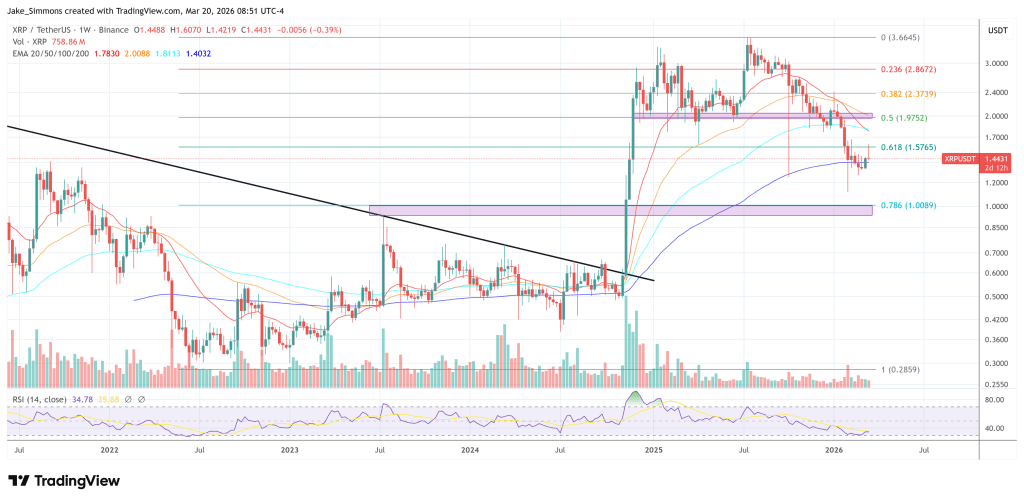
XRP must rise above the 0.618 Fib, 1-week chart | Source: XRPUSDT on TradingView.com

Пов'язані питання

QWhat is the main announcement made by Virtuals Protocol and t54 regarding the XRP Ledger?

AVirtuals Protocol and t54 are bringing 'agent commerce' to the XRP Ledger, enabling AI agents to transact natively using escrowed jobs, evaluator-based verification, and programmable settlement.

QWhich two key technologies are involved in this new agent commerce infrastructure on XRPL?

AVirtuals provides the commerce logic through its Agent Commerce Protocol (ACP), and t54 provides the payment rail through its x402 facilitator.

QWhat cryptocurrencies can AI agents use to pay natively via the t54 x402 facilitator?

AAI agents can natively pay in XRP and RLUSD using the t54 x402 facilitator.

QWhat is the purpose of the x402 payment protocol as described by Coinbase?

ACoinbase describes x402 as an open payment protocol built around the HTTP 402 'Payment Required' status code, designed to allow APIs, websites, and autonomous agents to pay programmatically for access over standard web requests without traditional account-and-session models.

QWhat was Ripple's involvement in t54's February seed round?

ARipple, along with Virtuals Ventures, participated strategically in t54's seed round in February.

Пов'язані матеріали

The Clarity Act's Journey Through Congress: The Thorny Path of Bipartisan Compromise in the U.S.

The U.S. Congress is struggling to advance the crypto market structure bill known as the Clarity Act, with bipartisan compromise proving difficult. Key hurdles include unresolved disputes over "yield" products and, more critically, the inclusion of strong ethics provisions for elected officials—a non-negotiable demand for many Democrats. While a compromise on yield was reached in May, securing only limited Democratic support in committee, the separate Senate Agriculture Committee version later passed with no Democratic votes due to the ethics impasse. As Republicans push for a full Senate vote in July, demands for ethics rules have expanded, and other contentious issues like developer protections and concerns from law enforcement and large banks further complicate negotiations. Despite consensus on the need for legislation, the path forward is unclear. Recent discussions between senators and White House officials aim to find acceptable ethics language. Some lawmakers question whether a compromise text can garner enough bipartisan support, with one Democrat stating the current proposal lacks the strong ethics provisions required for their vote. Potential short-term goals for the crypto community include symbolic Senate action before the August recess, a longer-term aim for passage by 2026, or establishing a detailed framework that addresses ethics and other compromises. The process remains arduous, relying on the traditional, vote-by-vote effort to build bipartisan support.

marsbit19 хв тому

The Clarity Act's Journey Through Congress: The Thorny Path of Bipartisan Compromise in the U.S.

marsbit19 хв тому

Are Kalshi and Polymarket Founders at Odds? This Business Rivalry Is More Brutal Than You Think

"The Rivalry Between Kalshi and Polymarket Founders Turns Bitter and Litigious" The intense feud between Tarek Mansour, CEO of Kalshi, and Shayne Coplan, founder of Polymarket, has escalated far beyond typical business competition into personal animosity and regulatory battles. Both lead billion-dollar prediction market platforms, but their approaches differ sharply. Kalshi positions itself as the compliant operator, securing U.S. regulatory approval before launching. In contrast, Polymarket initially operated offshore, allowing U.S. users to access its platform via VPN, which drew regulatory scrutiny. The conflict reached a peak in November 2024 when FBI agents raided Coplan's New York apartment. While Coplan publicly blamed political motives, his team privately suspected Kalshi was involved. According to sources, Kalshi's lawyers had previously reported Polymarket's operations to federal prosecutors, highlighting its accessibility to U.S. users despite a ban. This incident fueled mutual accusations and underhanded tactics, including social media smear campaigns and attempts to sabotage each other's major business deals. Their rivalry also played out in Washington, influencing regulatory debates. Kalshi actively lobbied against Polymarket's practices, framing them as illegal and unethical. Polymarket, after facing a CFTC fine and investigation, later acquired a licensed U.S. firm to launch a domestic app, regaining a foothold. Despite the hostility, both companies have seen massive growth, with combined trading volumes soaring. However, increased regulatory scrutiny, particularly around insider trading on Polymarket's platform, continues to pose challenges. The founders' deep-seated mutual disdain ensures their battle for market dominance remains as much a personal vendetta as a commercial one.

marsbit27 хв тому

Are Kalshi and Polymarket Founders at Odds? This Business Rivalry Is More Brutal Than You Think

marsbit27 хв тому

Торгівля

Спот
活动图片