XRP Ledger DEX Metrics Flash Strong Growth As Activity Touches New Key Levels

bitcoinistОпубліковано о 2026-01-31Востаннє оновлено о 2026-01-31

Анотація

The XRP Ledger's decentralized exchange (DEX) activity has surged to a 13-month high, with its 14-day moving average of transactions reaching approximately 1.014 million, breaking previous records. This growth reflects sustained user engagement and increased liquidity, signaling deeper adoption beyond speculative spikes. The milestone coincides with the rollout of the new Lending Protocol (XLS-66), which introduces institutional-grade credit capabilities to the network, including fixed-term, fixed-rate, and uncollateralized loans held in risk-isolated vaults. The protocol has already gained institutional support, with companies like Evernorth backing it to transition a $100 billion market into a yield-bearing ecosystem, further establishing the XRP Ledger as a growing hub for decentralized finance.

Even years after its inception, the XRP Ledger, one of the leading networks in the crypto space, continues to attract robust adoption and real-world usage. With thousands of transactions being conducted on the leading network’s DEX on a daily basis, it has now reached a historical level that marks its growing role in decentralized trading.

Decentralized Trading On XRP Ledger Accelerates

XRP is experiencing heightened interest not just in buying activity from traders; the XRP Ledger has been seeing significant usage over the past few weeks. While adoption has increased toward the network, the Ledger’s Decentralized Exchange (DEX) activity is breaking past prior highs.

Xaif Crypto, a market expert and investor on the X platform, reported that the Ledger DEX activity has surged to new levels. Specifically, data shows that the activity recently reached a 13-month high, signaling a sharp uptick in on-chain trading across the network.

As more liquidity and transactions move over XRPL’s native DEX infrastructure, the increase is indicative of increasing user involvement. Sustained growth in DEX activity frequently indicates deeper adoption and expanding use cases, in contrast to brief spikes caused solely by speculation.

According to the chart shared by the expert, the number of transactions on the 14-day MA rose to approximately 1.014 million, breaking the ceiling that held throughout all of 2025. With this level of DEX transactions, the XRP Ledger is becoming a more active center for decentralized trade within the larger cryptocurrency ecosystem.
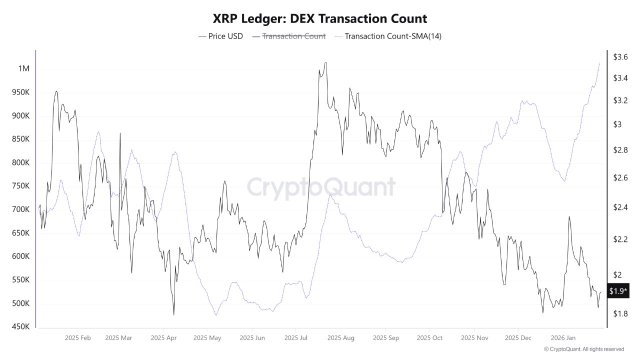
Source: Chart from Xaif Crypto on X

Xaif Crypto stated that this massive transaction count is not just a mere spike; it signals sustained momentum for the Ledger. Currently, the network is witnessing a fresh wave of liquidity and real user engagement. As a result, the expert declares that the Ledger is heating up in 2026.

This milestone comes as the XRP Ledger rolls out a new Lending Protocol (XLS-66), which is attracting institutional-grade credit to the network. With the new Lending Protocol, the Ledger is now evolving into a full financial layer with Rippled 3.1.0.

The protocol includes the ability to create loans on the Ledger, with loan brokers being able to generate fixed-term and fixed-rate, uncollateralized loans. These loans are predictable for professional use.

In addition, these loans are held in a Single Asset Vault, allowing risk-isolated liquidity. Another feature is the off-chain underwriting for uncollateralized options. It boasts native efficiency, which offers low-cost lending without a middleman or intermediaries. In the meantime, Decentralized Finance (DeFi) on the Ledger has just undergone a boost.

The Lending Protocol Gains Institutional Support

Following its historical launch a few days ago, the new XRP Lending Protocol is now experiencing significant support from institutional-level investors. One of the earliest companies to interact with the new protocol is Evernorth, a leading public treasury company.

According to BankXRP, the company is backing the native lending protocol to help transition a $100 billion market cap into a productive, yield-bearing ecosystem. These kinds of moves are an indication that the future of institutional DeFi is becoming native-driven.

XRP trading at $1.75 on the 1D chart | Source: XRPUSDT on Tradingview.com

Пов'язані питання

QWhat key milestone did the XRP Ledger DEX recently achieve according to the article?

AThe XRP Ledger DEX activity recently reached a 13-month high, with the number of transactions on the 14-day moving average rising to approximately 1.014 million, breaking the ceiling that held throughout all of 2025.

QWho reported the surge in XRP Ledger DEX activity and on which platform?

AThe surge was reported by Xaif Crypto, a market expert and investor, on the X platform.

QWhat major new protocol has the XRP Ledger recently rolled out that is attracting institutional interest?

AThe XRP Ledger has rolled out a new Lending Protocol (XLS-66), which is attracting institutional-grade credit to the network.

QWhat is one of the key features of the new XRP Lending Protocol mentioned in the article?

AOne key feature is the ability to create fixed-term and fixed-rate, uncollateralized loans that are held in a Single Asset Vault, allowing for risk-isolated liquidity.

QWhich company was mentioned as one of the earliest institutional supporters of the new XRP Lending Protocol?

AEvernorth, a leading public treasury company, was one of the earliest companies to interact with and back the new XRP Lending Protocol.

Пов'язані матеріали

North Korean Hackers Loot $500 Million in a Single Month, Becoming the Top Threat to Crypto Security

North Korean hackers, particularly the notorious Lazarus Group and its subgroup TraderTraitor, have stolen over $500 million from cryptocurrency DeFi platforms in less than three weeks, bringing their total theft for the year to over $700 million. Recent major attacks on Drift Protocol and KelpDAO, resulting in losses of approximately $286 million and $290 million respectively, highlight a strategic shift: instead of targeting core smart contracts, attackers are now exploiting vulnerabilities in peripheral infrastructure. For instance, the KelpDAO attack involved compromising downstream RPC infrastructure used by LayerZero's decentralized validation network (DVN), allowing manipulation without breaching core cryptography. This sophisticated approach mirrors advanced corporate cyber-espionage. Additionally, North Korea has systematically infiltrated the global crypto workforce, with an estimated 100 operatives using fake identities to gain employment at blockchain companies, enabling long-term access to sensitive systems and facilitating large-scale thefts. According to Chainalysis, North Korean-linked hackers stole a record $2 billion in 2025, accounting for 60% of all global crypto theft that year. Their total historical crypto theft has reached $6.75 billion. Post-theft, they employ specialized money laundering methods, heavily relying on Chinese OTC brokers and cross-chain mixing services rather than standard decentralized exchanges. Security experts, while acknowledging the increased sophistication, emphasize that many attacks still exploit fundamental weaknesses like poor access controls and centralized operational risks. Strengthening private key management, limiting privileged access, and enhancing coordination among exchanges, analysts, and law enforcement immediately after an attack are critical to improving defense and fund recovery chances. The industry's challenge now extends beyond secure smart contracts to safeguarding operational security at the infrastructure level.

marsbit31 хв тому

North Korean Hackers Loot $500 Million in a Single Month, Becoming the Top Threat to Crypto Security

marsbit31 хв тому

Circle CEO's Seoul Visit: No Korean Won Stablecoin Issuance, But Met All Major Korean Banks

Circle CEO Jeremy Allaire's recent activities in Seoul indicate a strategic shift for the company, moving away from issuing a Korean won-backed stablecoin and instead focusing on embedding itself as a key infrastructure provider within Korea’s financial and crypto ecosystem. Despite Korea accounting for nearly 30% of global crypto trading volume—with a market characterized by high retail participation and altcoin dominance—Circle has chosen not to compete for the role of stablecoin issuer. Instead, Allaire met with major Korean banks (including Shinhan, KB, and Woori), financial groups, leading exchanges (Upbit, Bithumb, Coinone), and tech firms like Kakao. This approach reflects a broader industry transition: the core of stablecoin competition is shifting from issuance rights to systemic positioning. With Korean regulators still debating whether banks or tech companies should issue stablecoins, Circle is avoiding regulatory uncertainty by strengthening its role as a service and technology partner. The company is deepening integration with trading platforms, building connections, and promoting stablecoin infrastructure. This positions Circle to benefit regardless of which entity eventually issues a won stablecoin. Allaire also noted the potential for a Chinese yuan stablecoin in the next 3–5 years, underscoring a regional trend of stablecoins becoming more regulated and integrated with traditional finance. Ultimately, Circle’s strategy highlights that future influence in the stablecoin market will belong not necessarily to the issuers, but to the foundational infrastructure layers that enable cross-system transactions.

marsbit59 хв тому

Circle CEO's Seoul Visit: No Korean Won Stablecoin Issuance, But Met All Major Korean Banks

marsbit59 хв тому

SpaceX Ties Up with Cursor: A High-Stakes AI Gambit of 'Lock First, Acquire Later'

SpaceX has secured an option to acquire AI programming company Cursor for $60 billion, with an alternative clause requiring a $10 billion collaboration fee if the acquisition does not proceed. This structure is not merely a potential acquisition but a strategic move to control core access points in the AI era. The deal is designed as a flexible, dual-path arrangement, allowing SpaceX to either fully acquire Cursor or maintain a binding partnership through high-cost collaboration. This "option-style" approach minimizes immediate regulatory and integration risks while ensuring long-term alignment between the two companies. At its core, the transaction exchanges critical AI-era resources: SpaceX provides its Colossus supercomputing cluster—one of the world’s most powerful AI training infrastructures—while Cursor contributes its AI-native developer environment and strong product adoption. This synergy connects compute power, models, and application layers, forming a closed-loop AI capability stack. Cursor, founded in 2022, has achieved rapid growth with over $1 billion in annual revenue and widespread enterprise adoption. Its value lies in transforming software development through AI agents capable of coding, debugging, and system design—positioning it as a gateway to future software production. For SpaceX, this move is part of a broader strategy to evolve from a aerospace company into an AI infrastructure empire, integrating xAI, supercomputing, and chip manufacturing. Controlling Cursor fills a gap in its developer tooling layer, strengthening its AI narrative ahead of a potential IPO. The deal reflects a shift in AI competition from model superiority to ecosystem and entry-point control. With programming tools as a key battleground, securing developer loyalty becomes crucial for dominating the software production landscape. Risks include questions around Cursor’s valuation, technical integration challenges, and potential regulatory scrutiny. Nevertheless, the deal underscores a strategic bet: controlling both compute and software development access may redefine power dynamics in the AI-driven future.

marsbit1 год тому

SpaceX Ties Up with Cursor: A High-Stakes AI Gambit of 'Lock First, Acquire Later'

marsbit1 год тому

Торгівля

Спот
Ф'ючерси

Популярні статті

Як купити T

Ласкаво просимо до HTX.com! Ми зробили покупку Threshold Network Token (T) простою та зручною. Дотримуйтесь нашої покрокової інструкції, щоб розпочати свою криптовалютну подорож.Крок 1: Створіть обліковий запис на HTXВикористовуйте свою електронну пошту або номер телефону, щоб зареєструвати обліковий запис на HTX безплатно. Пройдіть безпроблемну реєстрацію й отримайте доступ до всіх функцій.ЗареєструватисьКрок 2: Перейдіть до розділу Купити крипту і виберіть спосіб оплатиКредитна/дебетова картка: використовуйте вашу картку Visa або Mastercard, щоб миттєво купити Threshold Network Token (T).Баланс: використовуйте кошти з балансу вашого рахунку HTX для безперешкодної торгівлі.Треті особи: ми додали популярні способи оплати, такі як Google Pay та Apple Pay, щоб підвищити зручність.P2P: Торгуйте безпосередньо з іншими користувачами на HTX.Позабіржова торгівля (OTC): ми пропонуємо індивідуальні послуги та конкурентні обмінні курси для трейдерів.Крок 3: Зберігайте свої Threshold Network Token (T)Після придбання Threshold Network Token (T) збережіть його у своєму обліковому записі на HTX. Крім того, ви можете відправити його в інше місце за допомогою блокчейн-переказу або використовувати його для торгівлі іншими криптовалютами.Крок 4: Торгівля Threshold Network Token (T)Легко торгуйте Threshold Network Token (T) на спотовому ринку HTX. Просто увійдіть до свого облікового запису, виберіть торгову пару, укладайте угоди та спостерігайте за ними в режимі реального часу. Ми пропонуємо зручний досвід як для початківців, так і для досвідчених трейдерів.

377 переглядів усьогоОпубліковано 2024.12.10Оновлено 2025.03.21

Як купити T

Обговорення

Ласкаво просимо до спільноти HTX. Тут ви можете бути в курсі останніх подій розвитку платформи та отримати доступ до професійної ринкової інформації. Нижче представлені думки користувачів щодо ціни T (T).

活动图片