XRP Builder Funding Shifts In 2026 As Ripple Backs New Model

bitcoinistОпубліковано о 2026-02-28Востаннє оновлено о 2026-02-28

Анотація

Ripple is shifting its funding model for the XRP Ledger (XRPL) ecosystem in 2026, moving from a centralized structure to a more distributed network involving DAOs, independent hubs, universities, and venture partners. Over $550 million has been deployed since 2017 to support nearly 200 projects. The new approach includes the FinTech Builder Program for institutional-grade financial applications, expanded accelerator partnerships, and community-led initiatives like XAO DAO. Regional expansion includes a dedicated APAC hub and university collaborations. The goal is to provide builders with diverse funding channels and reduce reliance on Ripple as the sole gatekeeper.

Ripple is reshaping how builders on the XRP Ledger get funded in 2026, arguing that the ecosystem has reached a point where support needs to flow through more than Ripple-linked programs alone. The change matters because it signals a deliberate move away from a relatively centralized funding structure toward a broader network of DAOs, independent hubs, universities and venture partners.

In its latest ecosystem update, Ripple said more than $550 million has already been deployed into XRPL initiatives since 2017, spanning non-equity grants, builder incentives, strategic partnerships and growth programs. Since 2021, those efforts have included hackathons, builder bounties, XRPL Grants and the XRPL Accelerator, with nearly 200 projects supported across areas including payments, DeFi, tokenization, AI, gaming, e-commerce and enterprise finance.

XRP Ledger Enters New Phase

The core message is that 2026 marks a structural pivot. Ripple said ecosystem funding has historically flowed through Ripple-supported channels, but that the next phase will lean on a “more distributed model” in which independent organizations, regional hubs, venture firms and community-led initiatives take on a larger role. The company framed the objective as giving builders “multiple channels” to access capital and support, rather than relying on a single gatekeeper.

At the center of that shift is a new FinTech Builder Program aimed at startups building institutional-grade financial applications on XRPL. Ripple said the program will focus on use cases including stablecoin payments, credit infrastructure, tokenization and regulated financial services, while offering more than a traditional grants track. According to the post, founders will get support “across the entire development lifecycle,” from product design through market launch, with help on XRPL integration, strategy and partnerships.

Ripple also outlined a wider support stack around that program. That includes expanded accelerator partnerships with venture firms and startup platforms, regional startup competitions, and builder awards meant to help projects after hackathons or competitions, when early traction still needs a bridge to something durable. The emphasis throughout is less on one-off experimentation and more on getting teams to production-ready financial products.

The more interesting signal, though, may be where decision-making starts to move. Ripple highlighted XAO DAO as a hybrid DAO built for XRPL that will fund developers, community builders and early-stage ideas through microgrants. It said the DAO is designed to “amplify community voice” and create feedback loops where members submit proposals, vote on priorities and help steer the ecosystem’s direction.

In parallel, XRPL Commons is positioned as an independent pillar of support, with Ripple explicitly saying the aim is to ensure that “no single organization becomes the sole gatekeeper” for ecosystem funding.

Other pieces of the 2026 map point to geographic and institutional expansion. Ripple said XRP Asia is being developed as a dedicated APAC hub with a long-term plan for localized funding and regional ecosystem growth.

UDAX, first launched with UC Berkeley in fall 2025, is set to expand this year to Fundação Getulio Vargas in São Paulo, Oxford in the summer, and Berkeley again in the fall. Ripple also pointed to growing venture participation from firms including Dragonfly, Pantera, Franklin Templeton and Tenity as another sign that XRPL is trying to mature from grant-backed experimentation into a venue for fundable, production-scale startups.

At press time, XRP traded at $1.3773.
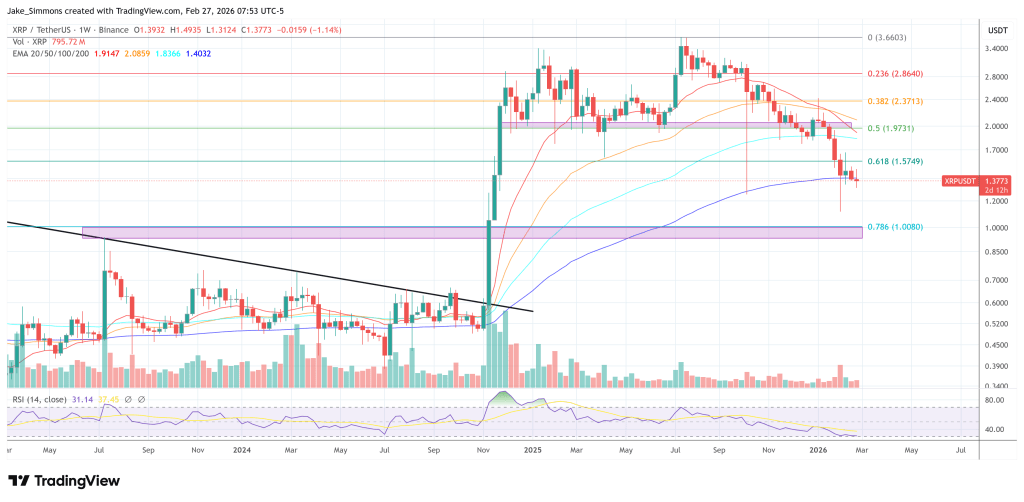
XRP falls below the 200-week EMA agan, 1-week chart | Source: XRPUSDT on TradingView.com

Пов'язані матеріали

STRC Breaks Below $95: Why Does It Continue to Depeg? Is There Default Risk?

"STRC Falls Below $95: Why the Persistent Depegging and Is There Default Risk?" The article discusses the recent decline in the price of STRC, a perpetual preferred stock issued by Strategy (MSTR) designed to trade around a $100 par value. As of publication, STRC traded at $94.65, raising market concerns. STRC is described as a high-yield cash flow product, offering an 11.50% annual dividend paid monthly. Its "preferred" status grants it priority over common stock for dividends and in liquidation. Key reasons cited for the price depegging include: 1. **Bitcoin's Price Drop:** MSTR's assets are heavily tied to Bitcoin (BTC), which fell over 21% from its recent high, pressuring all Strategy-related products. 2. **Competitive Pressure:** Rival Strive Asset Management's similar product, SATA, offers daily dividends and has maintained its $100 par value with a ~13% yield. In response, Strategy has proposed changing STRC's dividend frequency from monthly to bi-weekly, pending shareholder vote. 3. **Technical Selling:** A break below $100 may have triggered algorithmic selling and stop-losses, exacerbating the decline. Regarding default risk, the analysis suggests it is currently low. Strategy founder Michael Saylor confirmed the June 2026 dividend rate remains at 11.50% with no cuts or suspensions. The company's massive reserve of 843,706 BTC provides a significant backstop for its obligations. Industry opinions are mixed. Some analysts view the BTC holdings as reliable support for dividends, while critics like Peter Schiff warn of potential dividend cuts leading to price crashes and lawsuits. Others highlight inflation risk and the company's ability to reduce dividends without a formal default. In summary, STRC's drop is attributed to BTC volatility, competition, and technical factors. While immediate default risk appears contained, the product faces challenges from market conditions and competitive dynamics.

marsbit45 хв тому

STRC Breaks Below $95: Why Does It Continue to Depeg? Is There Default Risk?

marsbit45 хв тому

AI Trading Cools, South Korean Stocks Plunge 1.8%, Spot Gold Rises 1%, Bitcoin Dives

A sell-off in AI-related stocks, triggered by Broadcom's disappointing earnings forecast, sent shockwaves through global markets. South Korea's KOSPI led Asia's decline, plunging 1.8% as the risks from concentrated chip stock gains and surging leveraged investments came to the fore. The tech-heavy Nasdaq 100 futures fell 0.5% following Broadcom's 14% after-hours plunge, which signaled a slower-than-expected transition to AI clients. This pullback extended Wall Street's weakness, halting the S&P 500's nine-day rally amid hawkish Fed signals and renewed Middle East tensions. South Korean authorities convened an emergency meeting, pledging "immediate measures" against market volatility and warning of record-high stock margin debt. The adjustment rippled across assets: Bitcoin fell to around $64,000, its lowest since February, while safe-haven gold rose 1% on bargain hunting. Oil prices dipped on Middle East ceasefire news. Market analysts noted the sell-off was driven by profit-taking after massive gains, particularly in chip stocks like Samsung and SK Hynix, which now dominate the KOSPI. Wall Street banks are divided on Korea's outlook, with Goldman Sachs raising its target while Citigroup and others warn of overvaluation and a potential bubble. Bridgewater's Ray Dalio noted that great technological shifts often create bubbles. Meanwhile, Fed officials' hints at potential future rate hikes added to the cautious mood ahead of key U.S. jobs data.

华尔街日报1 год тому

AI Trading Cools, South Korean Stocks Plunge 1.8%, Spot Gold Rises 1%, Bitcoin Dives

华尔街日报1 год тому

Seeking Alpha's Hot Article: Why Might the U.S. Stock Market Crash in June?

In a recent Seeking Alpha article, financial professor and analyst Damir Tokic argues that the US stock market may be poised for a significant crash in June 2026. The core thesis centers on a "mega-bubble" in equities, particularly within the technology sector, which has driven the S&P 500 to near-record valuations, with a Shiller P/E ratio exceeding 40—a level comparable to the 2000 dot-com bubble. Tokic identifies two primary catalysts for a potential collapse. First, he points to unsustainable market exuberance fueled by what he terms the "Trump Stimulus"—massive AI capital expenditure by tech giants, which he believes is politically driven and cannot last. Second, and more urgently, he highlights the escalating Iran war as a critical threat. The ongoing closure of the Strait of Hormuz has created a severe global energy supply crunch. Strategic petroleum reserves are projected to hit critically low operational levels by June, potentially causing oil prices to spike above $200 per barrel and triggering a severe, supply-driven inflationary shock. This scenario, Tokic warns, would force the Federal Reserve's hand. Despite currently maintaining a dovish bias, the Fed would likely be compelled to officially pivot to a hawkish stance at its June FOMC meeting to combat soaring inflation and bond yields. He contends that such a shift—or even a failure to act, which would destroy Fed credibility—could be the trigger that punctures the market bubble. The resulting downturn, he concludes, could rival the bear markets of 2000 and 2008, advising investors to prepare for a major correction.

marsbit1 год тому

Seeking Alpha's Hot Article: Why Might the U.S. Stock Market Crash in June?

marsbit1 год тому

Торгівля

Спот
Ф'ючерси

Популярні статті

Як купити T

Ласкаво просимо до HTX.com! Ми зробили покупку Threshold Network Token (T) простою та зручною. Дотримуйтесь нашої покрокової інструкції, щоб розпочати свою криптовалютну подорож.Крок 1: Створіть обліковий запис на HTXВикористовуйте свою електронну пошту або номер телефону, щоб зареєструвати обліковий запис на HTX безплатно. Пройдіть безпроблемну реєстрацію й отримайте доступ до всіх функцій.ЗареєструватисьКрок 2: Перейдіть до розділу Купити крипту і виберіть спосіб оплатиКредитна/дебетова картка: використовуйте вашу картку Visa або Mastercard, щоб миттєво купити Threshold Network Token (T).Баланс: використовуйте кошти з балансу вашого рахунку HTX для безперешкодної торгівлі.Треті особи: ми додали популярні способи оплати, такі як Google Pay та Apple Pay, щоб підвищити зручність.P2P: Торгуйте безпосередньо з іншими користувачами на HTX.Позабіржова торгівля (OTC): ми пропонуємо індивідуальні послуги та конкурентні обмінні курси для трейдерів.Крок 3: Зберігайте свої Threshold Network Token (T)Після придбання Threshold Network Token (T) збережіть його у своєму обліковому записі на HTX. Крім того, ви можете відправити його в інше місце за допомогою блокчейн-переказу або використовувати його для торгівлі іншими криптовалютами.Крок 4: Торгівля Threshold Network Token (T)Легко торгуйте Threshold Network Token (T) на спотовому ринку HTX. Просто увійдіть до свого облікового запису, виберіть торгову пару, укладайте угоди та спостерігайте за ними в режимі реального часу. Ми пропонуємо зручний досвід як для початківців, так і для досвідчених трейдерів.

450 переглядів усьогоОпубліковано 2024.12.10Оновлено 2026.06.02

Як купити T

Обговорення

Ласкаво просимо до спільноти HTX. Тут ви можете бути в курсі останніх подій розвитку платформи та отримати доступ до професійної ринкової інформації. Нижче представлені думки користувачів щодо ціни T (T).

活动图片