Xiaomi and MiniMax Unleash Major Upgrades Simultaneously, Officially Kicking Off the Agent Pricing War

marsbitОпубліковано о 2026-03-20Востаннє оновлено о 2026-03-20

Анотація

Chinese AI companies MiniMax and Xiaomi's MiMo have both launched major Agent-focused models, M2.7 and V2-Pro, respectively, within two days in March. Both models rank in the top tier globally on Agent benchmarks but are priced significantly lower than leading Western models—MiniMax at $1.2 per million tokens (1/21 of Claude Opus) and MiMo at $3 (1/8 of Claude Opus). The two represent divergent technical strategies. MiMo-V2-Pro adopts a scale-driven approach with over 1 trillion parameters and a hybrid attention mechanism optimized for long-context and multi-tool agent tasks. In contrast, MiniMax’s M2.7 uses a self-iterative optimization method, autonomously refining its architecture over 100+ cycles to improve performance without disclosing parameter count. Their release rhythms also differ: MiniMax iterates rapidly with four versions in five months, while Xiaomi releases fewer but more substantial upgrades. Notably, Xiaomi debuted V2-Pro anonymously on OpenRouter as "Hunter Alpha," topping the platform’s usage chart before revealing its identity—a first for a Chinese AI model gaining global developer traction through pure performance.

On March 18 and 19, two Chinese companies successively released their major models in the Agent direction. Domestic AI startup MiniMax launched M2.7, while Xiaomi's large model team MiMo introduced V2-Pro. Both models have entered the global top tier on the Agent benchmark, but their API output pricing is 1/21 and 1/8 of Claude Opus 4.6, respectively.

They played their cards in the same week, but with completely different hands. They represent two截然不同的 technical routes, betting on two different futures for the Agent era.

The Same Exam, 1/17 the Tuition

First, let's look at the most直观 comparison.
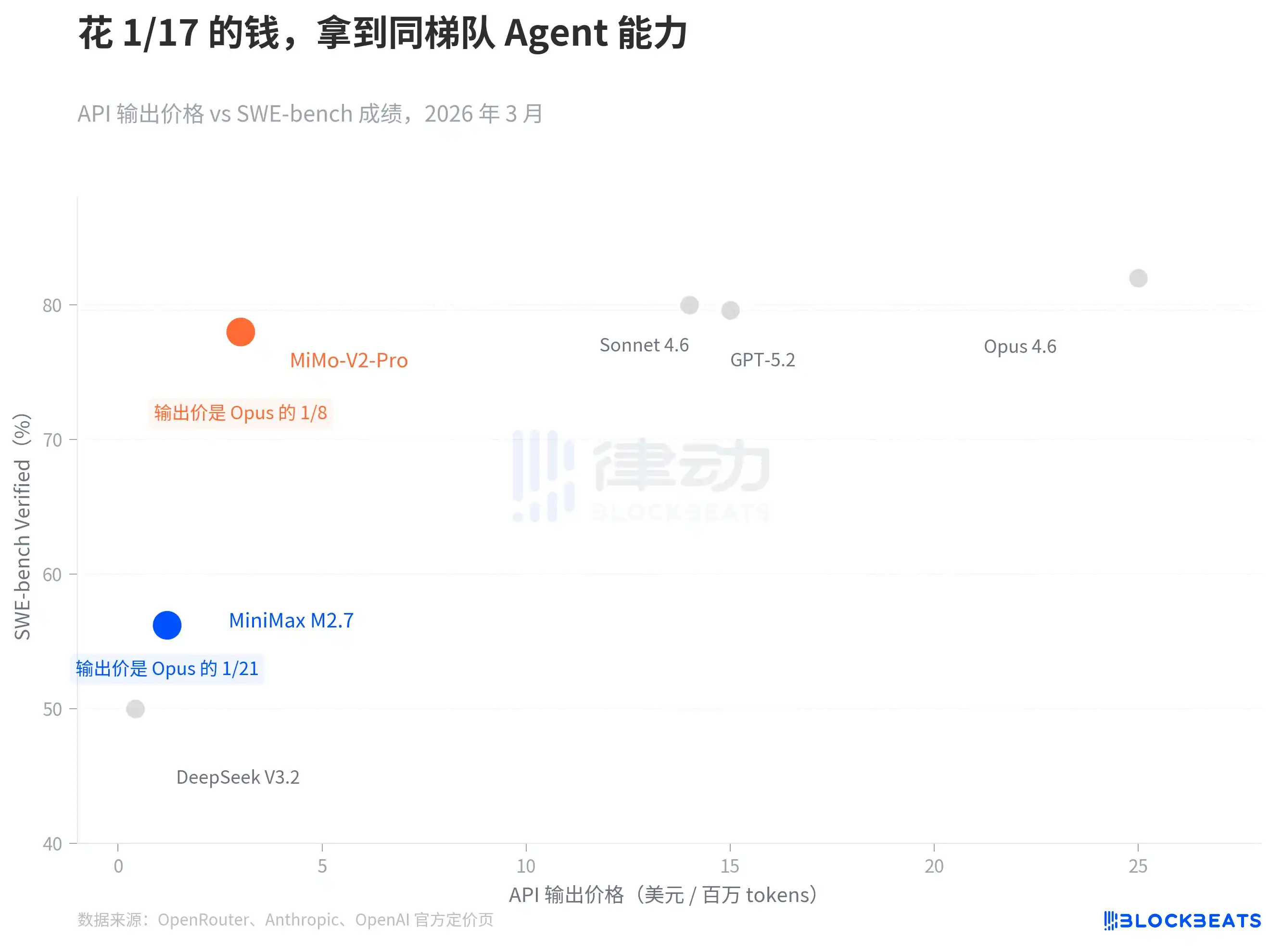
According to data from OpenRouter and the official pricing pages of various companies, based on API output price (per million tokens), MiniMax M2.7 is $1.2, and MiMo-V2-Pro is $3. As a reference, Claude Opus 4.6's output price is $25, GPT-5.2 is $14, and Claude Sonnet 4.6 is $15.

The price gap is by an order of magnitude, but the capability gap is not. On SWE-bench Verified (the current mainstream benchmark for measuring code engineering capabilities), MiMo-V2-Pro scored 78%, while Sonnet 4.6 scored 79.6%, a difference of less than two percentage points. M2.7's SWE-Pro score was 56.22%, on par with GPT-5.3-Codex. On VIBE-Pro (end-to-end project delivery capability), M2.7 scored 55.6%,接近 the level of Opus 4.6.

The key point of this chart is not who is higher or lower—the benchmark systems of various companies are not fully aligned, so direct comparisons should be made cautiously. The key point is that "price-performance剪刀差": domestic Agent models have already挤进 the same capability band but stand in completely different price ranges.

Trillion Parameters vs. Self-Evolution

Price is only the表象. The two companies have revealed two completely different底牌.

MiMo-V2-Pro follows the "more is better" route. According to Xiaomi's official announcement, V2-Pro has over 1 trillion total parameters, 42B activated parameters, and supports an ultra-long context of 1 million tokens. Its core innovation is the Hybrid Attention mechanism, adjusting the ratio of Sliding Window Attention (SWA) to Global Attention (GA) to 7:1—the previous generation V2-Flash was 5:1. This architecture makes the model more stable when handling long documents and multi-tool parallel calling Agent scenarios. On PinchBench (Agent tool calling capability evaluation), MiMo-V2-Pro scored 84%.

M2.7 takes a completely different path. According to the official technical blog released by MiniMax on March 18, M2.7's parameter count is not公开, but it demonstrates a "self-iterative evolution" mechanism: the model autonomously runs over 100 rounds of optimization cycles, including analyzing failure trajectories, planning modifications, modifying its own code architecture, running evaluations, and cycling again, ultimately achieving a 30% performance improvement on the internal evaluation set. On the MLE Bench Lite (machine learning competition difficulty evaluation) with 22 high-difficulty problems, M2.7 won 9 gold, 5 silver, and 1 bronze, with an average medal rate of 66.6%.
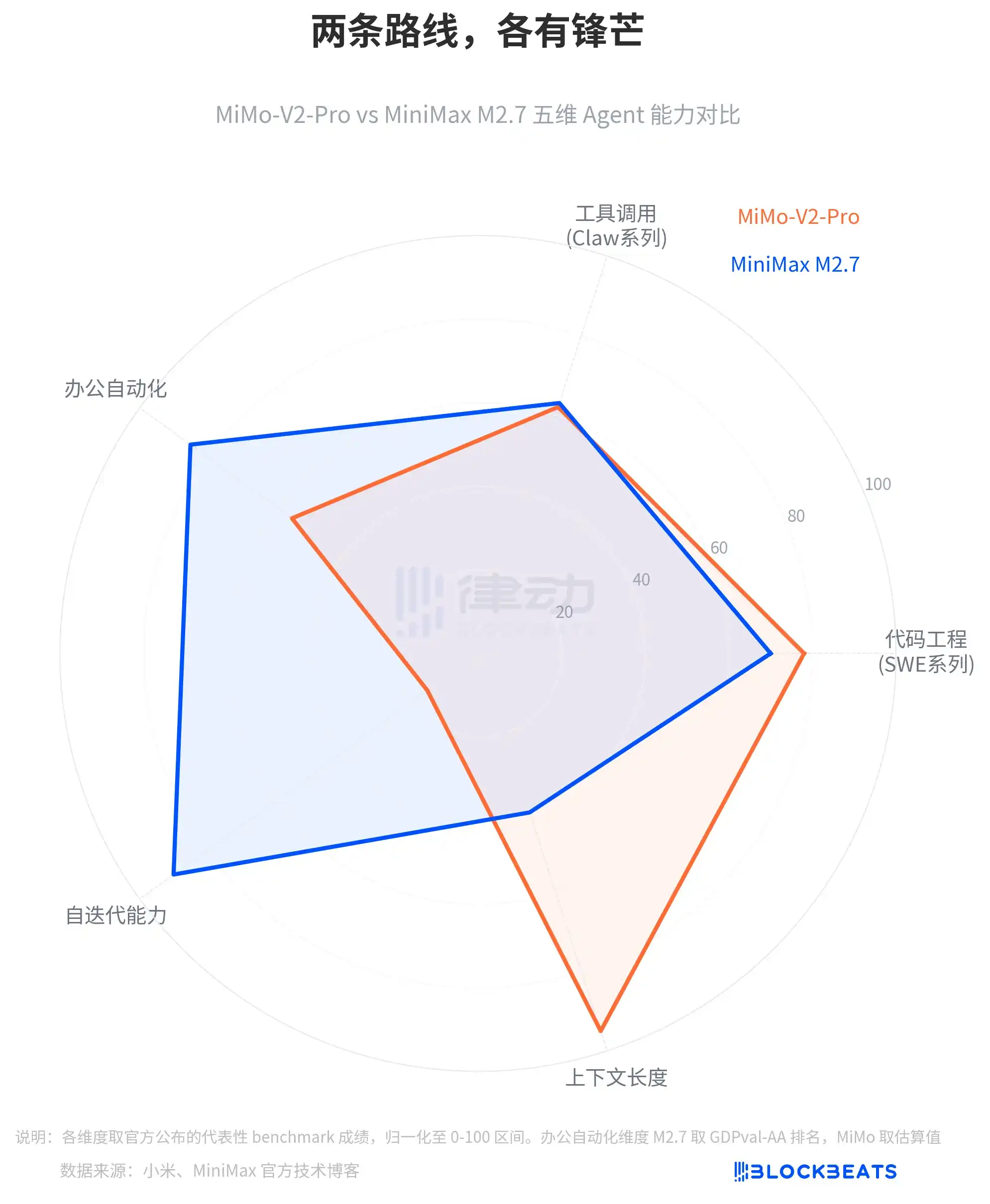
Looking from five dimensions, the锋芒 of the two routes朝向 completely different directions: MiMo-V2-Pro has obvious advantages in context length and code engineering dimensions, while M2.7 pulls ahead in office automation and self-iterative capabilities. According to the same MiniMax technical blog, M2.7 scored ELO 1495 on GDPval-AA (office document processing evaluation), ranking first among open-source models, and maintained a 97% skill adherence rate in the MM-Claw test covering over 40 complex skills.

Four Versions in Five Months

The two companies not only have different technical routes but also completely different iteration rhythms.

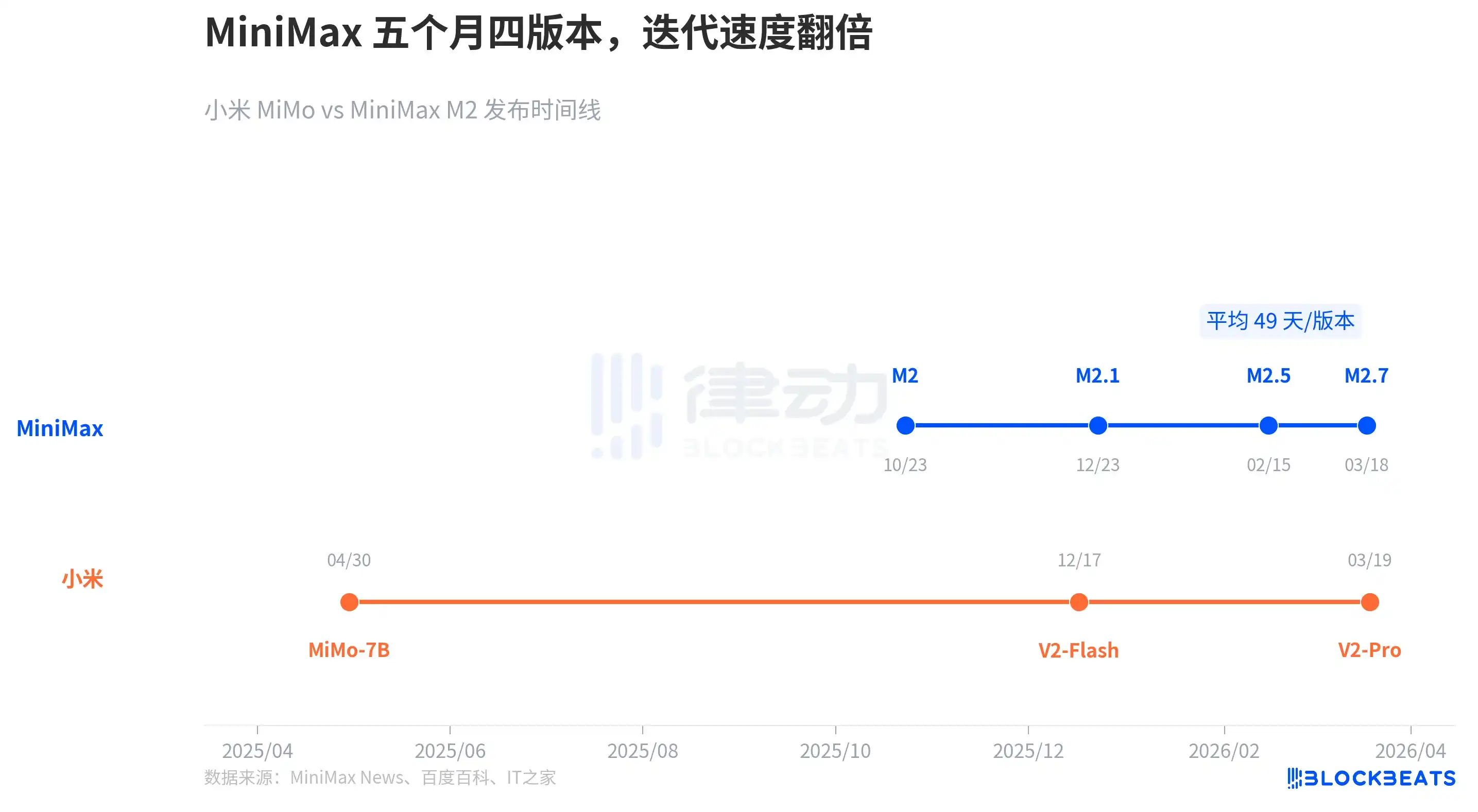
According to public release records, MiniMax iterated four major versions from the release of M2 in October 2025 to the release of M2.7 in March 2026—a new version every 49 days on average. The interval between M2.5 and M2.7 was only about 30 days.

Xiaomi MiMo's rhythm is different: MiMo-7B (a 7B parameter open-source inference model) was released in April 2025, V2-Flash (309B total parameters) in December 2025, and V2-Pro (1T total parameters) in March 2026. The parameter scale leap between each generation is larger, but the version intervals are also longer.

MiniMax chose small steps and quick runs, with small iteration amplitudes but extremely high frequency; M2.7's self-iterative mechanism is itself designed for "continuous evolution." Xiaomi chose蓄力一击, with each version representing a major leap in parameter scale and architecture.
Anonymous for 8 Days, Topping OpenRouter

Beyond the technical route, Xiaomi's release strategy also broke industry conventions.

According to a Reuters report, on March 11, an anonymous model named Hunter Alpha appeared on OpenRouter, the world's largest API aggregation platform. No brand endorsement, no launch event, no technical blog. Its API pricing was extremely low, yet its performance was surprisingly strong.

The community began speculating about its origin. According to Republic World and multiple tech media reports, the most mainstream guess was DeepSeek V4, as MiMo team leader Luo Fuli had previously conducted research at DeepSeek. Call volume surged rapidly, exceeding 1 trillion tokens during the anonymous period, topping the OpenRouter weekly chart.
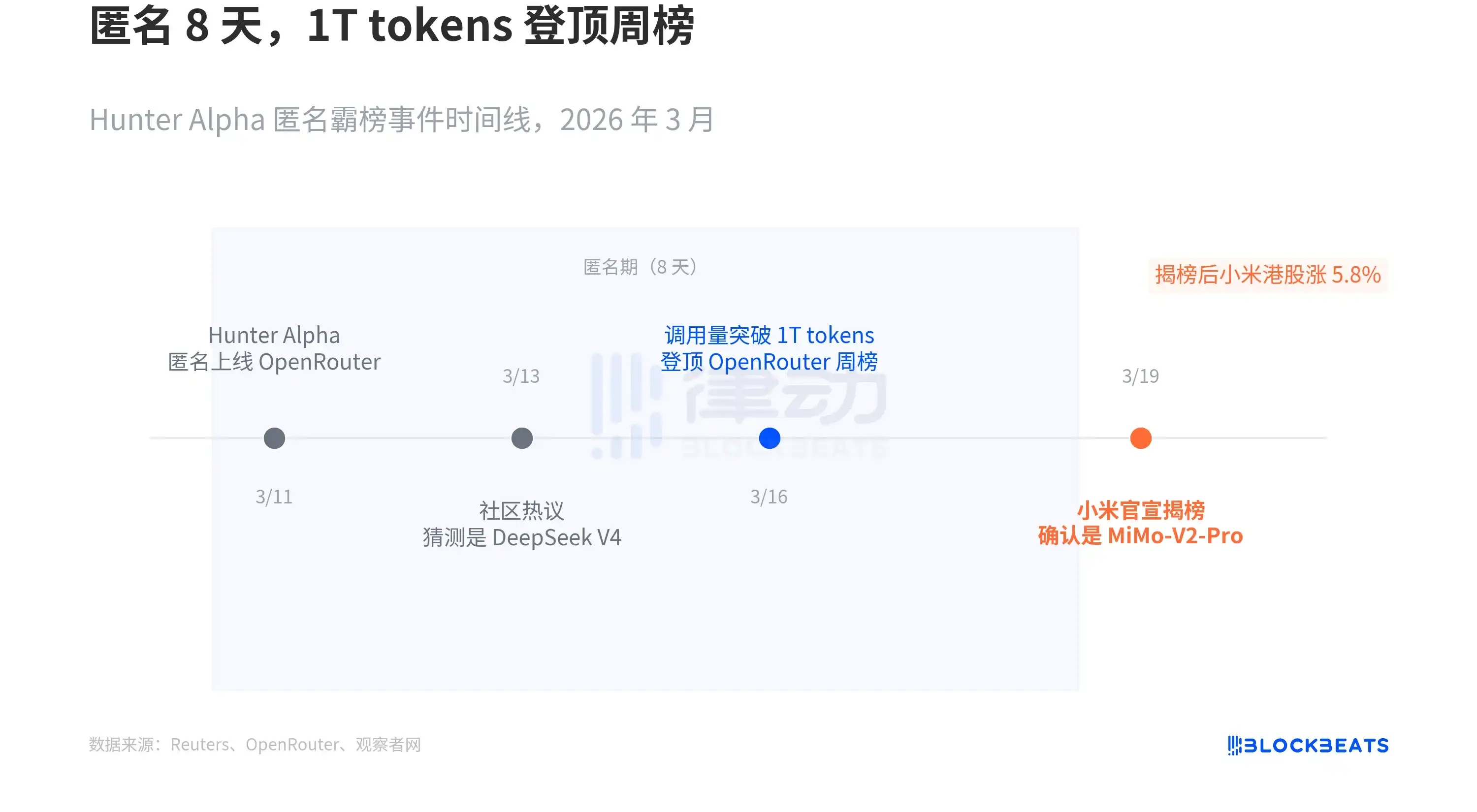
In the early hours of March 19, Xiaomi revealed the answer: Hunter Alpha was MiMo-V2-Pro. According to the same Reuters report, Xiaomi's Hong Kong stock saw a gain of up to 5.8% after the reveal.

This was the first time a domestic large model proved itself on a global platform through pure blind testing. Relying not on brand or宣传, but letting developers vote with their feet over 8 days.


Пов'язані питання

QWhat are the two Chinese companies that recently released their Agent-oriented large models, and what are the model names?

AMiniMax released the M2.7 model, and Xiaomi's MiMo team released the V2-Pro model.

QHow does the API output pricing of MiniMax M2.7 and MiMo-V2-Pro compare to Claude Opus 4.6?

AThe API output price for MiniMax M2.7 is $1.2 per million tokens, which is 1/21 of Claude Opus 4.6's $25. MiMo-V2-Pro is $3 per million tokens, which is 1/8 of Claude Opus 4.6's price.

QWhat are the core technical approaches of MiMo-V2-Pro and MiniMax M2.7?

AMiMo-V2-Pro follows a 'scale-up' approach with over 1 trillion total parameters and a Hybrid Attention mechanism. MiniMax M2.7 uses a 'self-iterative evolution' mechanism where the model autonomously runs optimization cycles to improve its own performance.

QWhat was unique about Xiaomi's release strategy for the MiMo-V2-Pro model?

AXiaomi first released the model anonymously on OpenRouter under the name 'Hunter Alpha' for 8 days. It gained significant developer traction and topped the OpenRouter weekly chart before Xiaomi revealed it was their model.

QHow did the iteration rhythms of MiniMax and Xiaomi's MiMo team differ?

AMiniMax iterated rapidly, releasing four versions in five months (approx. every 49 days). Xiaomi's MiMo team had longer release intervals with larger parameter scale jumps between versions, such as from 7B parameters to 309B, and then to 1T.

Пов'язані матеріали

ETH Bull and Bear Views Compilation: Can Ethereum's Value Flow Back to ETH?

Titled "ETH Bull and Bear Views: Can Ethereum's Value Flow Back to ETH?", this article synthesizes the current heated debate around Ethereum's native token, ETH, following Bankless co-founder David Hoffman's decision to sell his entire ETH holdings. The **bullish case**, represented by figures like Tom Lee (BitMine CEO) and Raoul Pal, argues that ETH's core thesis remains intact. They contend Ethereum is the essential, secure, and neutral foundational layer for future finance—encompassing stablecoins, RWA, DeFi, L2s, and Agentic AI. Bulls bet on ETH's long-term revaluation as institutional adoption of on-chain finance grows, with significant buying activity from entities like BitMine and Consensys cited as evidence. Conversely, the **bearish perspective**, led by Hoffman and analysts like Markus Thielen, questions ETH's value capture mechanism. They acknowledge Ethereum's network success but argue that the value created by L2s, DeFi, and applications does not sufficiently accrue to the ETH token itself. Bears point to ETH's prolonged underperformance versus the broader crypto market, lack of traditional cash flows, weakening "ultrasound money" narrative, and apparent institutional retreat (e.g., Harvard Management Company exiting its ETH ETF position) as key concerns. The debate highlights a pivotal shift: ETH is no longer just a community belief asset. The central question is whether ETH can transition from being a "**used infrastructure**" to a "**continuously bought and held core asset**" as more value enters the Ethereum ecosystem. The market is now critically examining the direct link between network growth and ETH's value.

marsbit43 хв тому

ETH Bull and Bear Views Compilation: Can Ethereum's Value Flow Back to ETH?

marsbit43 хв тому

Crypto is dead, Perps are forever

The crypto industry is shifting from a focus on creating native assets (like altcoins and protocol tokens) to becoming a "global asset pipeline." Native cryptocurrencies, except for Bitcoin, are seen as failing in their value storage and utility promises, with demand driven largely by speculation. Attention and liquidity are now moving toward real-world assets (RWAs) like U.S. stocks, bonds, gold, and oil traded on-chain via perpetual contracts (Perps). Stablecoins like USDT and USDC set the precedent, proving blockchain's core strength is efficient global settlement and transfer, not inventing new monetary systems. Meanwhile, assets like Ethereum and many DeFi tokens struggle as their narratives weaken against tangible traditional assets and the rapid real-world progress of AI. Perpetual contracts have emerged as a pivotal innovation. They simplify trading by offering pure price exposure to any asset, bypassing complexities of ownership, custody, and traditional market hours. Projects like Hyperliquid gained traction by combining CEX-like efficiency with on-chain transparency, capitalizing on post-FTX distrust, macroeconomic volatility, and the surge in demand for 24/7 stock trading. In conclusion, while the era of speculative native "crypto assets" may be over, perpetual contracts persist as the industry's most potent financial instrument—transforming all assets into globally accessible, constantly tradable instruments centered on price speculation.

marsbit48 хв тому

Crypto is dead, Perps are forever

marsbit48 хв тому

Tencent, Alibaba, ByteDance in a Battle for the Skill Store

Skill is becoming a key concept in the AI field, essentially serving as a structured "instruction manual" for AI Agents that specifies tool calls, decision logic, and output standards. This allows Agents to execute predefined tasks. As the number of Skills grows, distribution platforms have emerged. Major tech companies are swiftly entering this space. In March, Tencent, Alibaba, and ByteDance launched Skill stores within their respective Agent platforms. Subsequently, players like Zhipu AI, Meituan, and Xiaohongshu joined the fray. This competition for the "Skill store" is fundamentally a battle for the AI-era user entry point; whoever controls distribution controls the users. While ByteDance's Coze has experimented with paid Skills, most platforms offer them for free. The real value lies not in the stores themselves but in using them to attract and retain users within an ecosystem, driving revenue from services like cloud computing, model calls, or advertising. The landscape features three main player types: 1) **Internet giants** (e.g., Alibaba, ByteDance, Tencent, Meituan), leveraging Skills to drive traffic and monetize through their broader ecosystems (cloud services, transactions, ads). 2) **Large model companies** (e.g., Zhipu AI, Moonshot AI), using Skill stores to increase user engagement and monetize model API calls. 3) **Content platforms** (e.g., Xiaohongshu), treating Skills as a new content format to generate traffic and ad revenue. However, transforming Skill stores into a sustainable business faces significant hurdles. Key challenges include: the **difficulty in pricing Skills** due to inconsistent outputs across different models and contexts; **lack of cost transparency** (varying token consumption); **security risks** like Skill poisoning; and the **absence of standardized protocols** for development and evaluation. Unlike standardized mobile apps, Skills are often personalized workflows resistant to uniformity, which hinders the establishment of a reliable review and monetization system akin to the App Store. While there is genuine user demand for paid Skills—particularly in enterprise (e.g., contract review) and certain personal productivity scenarios—current platforms offer developers limited and unpredictable distribution. The future of Skill stores depends on overcoming these standardization, evaluation, and safety challenges to make acquiring a Skill as straightforward as downloading an app. For now, the stores function more as display shelves than robust marketplaces.

marsbit48 хв тому

Tencent, Alibaba, ByteDance in a Battle for the Skill Store

marsbit48 хв тому

The Crypto Scene Is Dead, Perpetual Swaps Are Eternal

The crypto industry is undergoing a fundamental shift. The era defined by minting novel, native digital assets (altcoins) is fading. These assets, lacking real-world cash flows or clear value, are losing relevance as attention and capital flow elsewhere. Two powerful external forces are reshaping the space. First, traditional assets like U.S. stocks, bonds, gold, and oil are being tokenized and traded on-chain. Second, the explosive growth of AI, with its tangible products, has overshadowed crypto's once-dominant "future narrative." This marks a critical pivot: crypto is transitioning from being a "factory for new assets" to becoming a "global conduit for existing assets." Its validated utility is not complex financial reinvention but efficient global settlement, transfer, and trading—the original promise of blockchain. Stablecoins like USDT and USDC exemplify this, offering faster dollar movement rather than replacing it. Consequently, native ecosystems like Ethereum face profound challenges. While still crucial infrastructure, ETH struggles to capture value as users interact with Layer 2s or trade traditional assets without needing to hold it. DeFi's grand narrative of rebuilding finance has narrowed to core needs like cheap transfers and deep liquidity. The true breakout innovation is the perpetual contract (Perp). It brilliantly bypasses the complexities of direct asset ownership (custody, compliance, dividends) by creating pure price exposure. Users can speculate on the price movement of *any* asset—NVIDIA, gold, oil—24/7, globally, and with leverage. This "price casino" model, while risky and ethically fraught, delivers unmatched liquidity and accessibility. Projects like Hyperliquid succeeded not by inventing new mechanics but by perfecting the timing and execution of this model. Key drivers included making on-chain Perps feel like centralized exchanges, post-FTX trust migration towards transparency, and rising demand to trade macro assets and equities round-the-clock. In conclusion, the crypto world's most enduring successes are the dollar (via stablecoins), Bitcoin, and trading. Its new frontier is not creating alternative assets but providing a seamless, perpetual trading layer—a new API—for the world's existing financial system. The age of native altcoins is over; the age of perpetual synthetic exposure has begun.

Odaily星球日报57 хв тому

The Crypto Scene Is Dead, Perpetual Swaps Are Eternal

Odaily星球日报57 хв тому

Торгівля

Спот
Ф'ючерси

Популярні статті

Як купити WAR

Ласкаво просимо до HTX.com! Ми зробили покупку WAR (WAR) простою та зручною. Дотримуйтесь нашої покрокової інструкції, щоб розпочати свою криптовалютну подорож.Крок 1: Створіть обліковий запис на HTXВикористовуйте свою електронну пошту або номер телефону, щоб зареєструвати обліковий запис на HTX безплатно. Пройдіть безпроблемну реєстрацію й отримайте доступ до всіх функцій.ЗареєструватисьКрок 2: Перейдіть до розділу Купити крипту і виберіть спосіб оплатиКредитна/дебетова картка: використовуйте вашу картку Visa або Mastercard, щоб миттєво купити WAR (WAR).Баланс: використовуйте кошти з балансу вашого рахунку HTX для безперешкодної торгівлі.Треті особи: ми додали популярні способи оплати, такі як Google Pay та Apple Pay, щоб підвищити зручність.P2P: Торгуйте безпосередньо з іншими користувачами на HTX.Позабіржова торгівля (OTC): ми пропонуємо індивідуальні послуги та конкурентні обмінні курси для трейдерів.Крок 3: Зберігайте свої WAR (WAR)Після придбання WAR (WAR) збережіть його у своєму обліковому записі на HTX. Крім того, ви можете відправити його в інше місце за допомогою блокчейн-переказу або використовувати його для торгівлі іншими криптовалютами.Крок 4: Торгівля WAR (WAR)Легко торгуйте WAR (WAR) на спотовому ринку HTX. Просто увійдіть до свого облікового запису, виберіть торгову пару, укладайте угоди та спостерігайте за ними в режимі реального часу. Ми пропонуємо зручний досвід як для початківців, так і для досвідчених трейдерів.

229 переглядів усьогоОпубліковано 2024.12.11Оновлено 2026.06.02

Як купити WAR

Обговорення

Ласкаво просимо до спільноти HTX. Тут ви можете бути в курсі останніх подій розвитку платформи та отримати доступ до професійної ринкової інформації. Нижче представлені думки користувачів щодо ціни WAR (WAR).

活动图片












