Xiaomi and MiniMax Unleash Major Upgrades Simultaneously, Officially Kicking Off the Agent Pricing War

marsbitОпубліковано о 2026-03-20Востаннє оновлено о 2026-03-20

Анотація

Chinese AI companies MiniMax and Xiaomi's MiMo have both launched major Agent-focused models, M2.7 and V2-Pro, respectively, within two days in March. Both models rank in the top tier globally on Agent benchmarks but are priced significantly lower than leading Western models—MiniMax at $1.2 per million tokens (1/21 of Claude Opus) and MiMo at $3 (1/8 of Claude Opus). The two represent divergent technical strategies. MiMo-V2-Pro adopts a scale-driven approach with over 1 trillion parameters and a hybrid attention mechanism optimized for long-context and multi-tool agent tasks. In contrast, MiniMax’s M2.7 uses a self-iterative optimization method, autonomously refining its architecture over 100+ cycles to improve performance without disclosing parameter count. Their release rhythms also differ: MiniMax iterates rapidly with four versions in five months, while Xiaomi releases fewer but more substantial upgrades. Notably, Xiaomi debuted V2-Pro anonymously on OpenRouter as "Hunter Alpha," topping the platform’s usage chart before revealing its identity—a first for a Chinese AI model gaining global developer traction through pure performance.

On March 18 and 19, two Chinese companies successively released their major models in the Agent direction. Domestic AI startup MiniMax launched M2.7, while Xiaomi's large model team MiMo introduced V2-Pro. Both models have entered the global top tier on the Agent benchmark, but their API output pricing is 1/21 and 1/8 of Claude Opus 4.6, respectively.

They played their cards in the same week, but with completely different hands. They represent two截然不同的 technical routes, betting on two different futures for the Agent era.

The Same Exam, 1/17 the Tuition

First, let's look at the most直观 comparison.
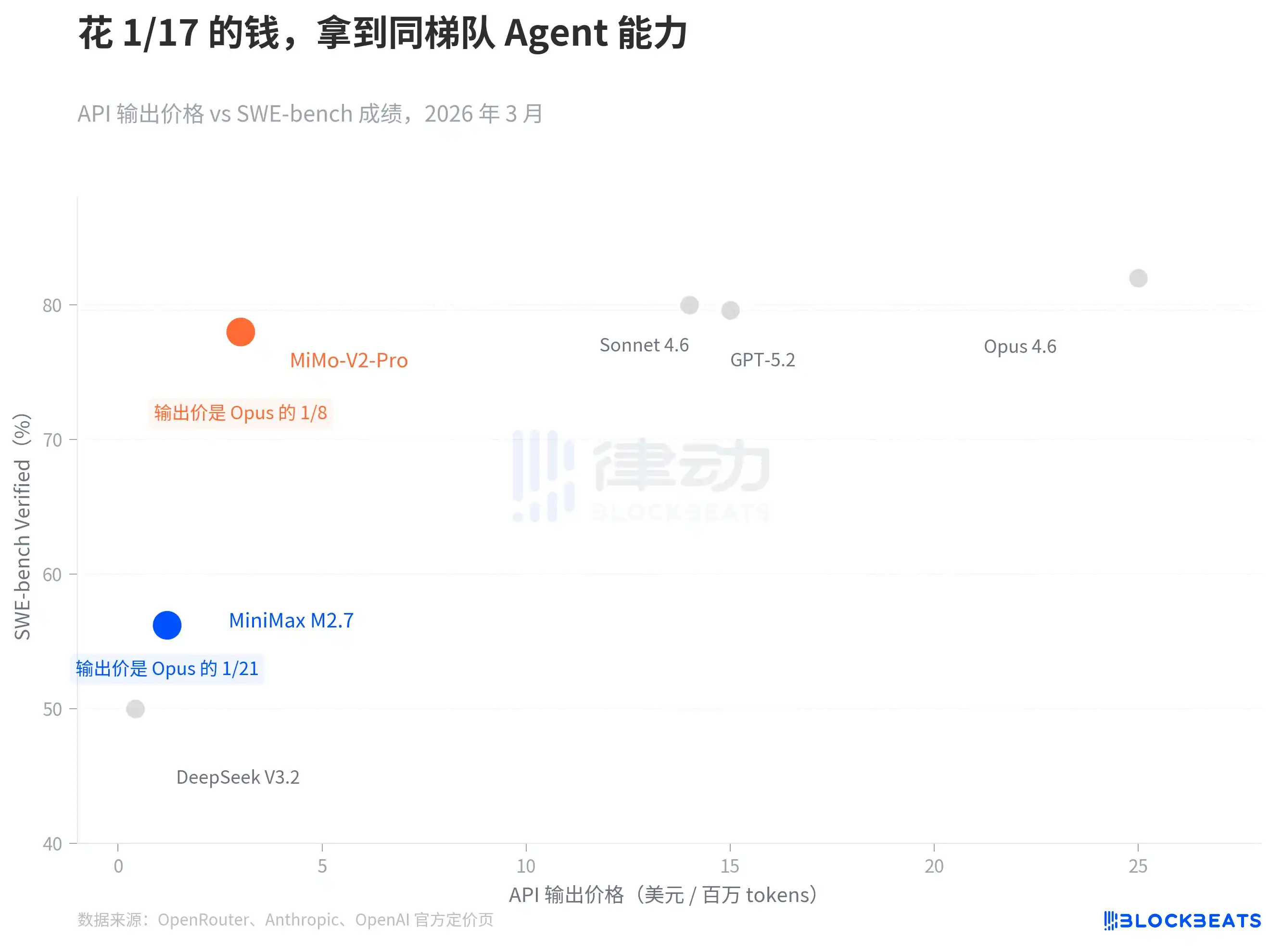
According to data from OpenRouter and the official pricing pages of various companies, based on API output price (per million tokens), MiniMax M2.7 is $1.2, and MiMo-V2-Pro is $3. As a reference, Claude Opus 4.6's output price is $25, GPT-5.2 is $14, and Claude Sonnet 4.6 is $15.

The price gap is by an order of magnitude, but the capability gap is not. On SWE-bench Verified (the current mainstream benchmark for measuring code engineering capabilities), MiMo-V2-Pro scored 78%, while Sonnet 4.6 scored 79.6%, a difference of less than two percentage points. M2.7's SWE-Pro score was 56.22%, on par with GPT-5.3-Codex. On VIBE-Pro (end-to-end project delivery capability), M2.7 scored 55.6%,接近 the level of Opus 4.6.

The key point of this chart is not who is higher or lower—the benchmark systems of various companies are not fully aligned, so direct comparisons should be made cautiously. The key point is that "price-performance剪刀差": domestic Agent models have already挤进 the same capability band but stand in completely different price ranges.

Trillion Parameters vs. Self-Evolution

Price is only the表象. The two companies have revealed two completely different底牌.

MiMo-V2-Pro follows the "more is better" route. According to Xiaomi's official announcement, V2-Pro has over 1 trillion total parameters, 42B activated parameters, and supports an ultra-long context of 1 million tokens. Its core innovation is the Hybrid Attention mechanism, adjusting the ratio of Sliding Window Attention (SWA) to Global Attention (GA) to 7:1—the previous generation V2-Flash was 5:1. This architecture makes the model more stable when handling long documents and multi-tool parallel calling Agent scenarios. On PinchBench (Agent tool calling capability evaluation), MiMo-V2-Pro scored 84%.

M2.7 takes a completely different path. According to the official technical blog released by MiniMax on March 18, M2.7's parameter count is not公开, but it demonstrates a "self-iterative evolution" mechanism: the model autonomously runs over 100 rounds of optimization cycles, including analyzing failure trajectories, planning modifications, modifying its own code architecture, running evaluations, and cycling again, ultimately achieving a 30% performance improvement on the internal evaluation set. On the MLE Bench Lite (machine learning competition difficulty evaluation) with 22 high-difficulty problems, M2.7 won 9 gold, 5 silver, and 1 bronze, with an average medal rate of 66.6%.
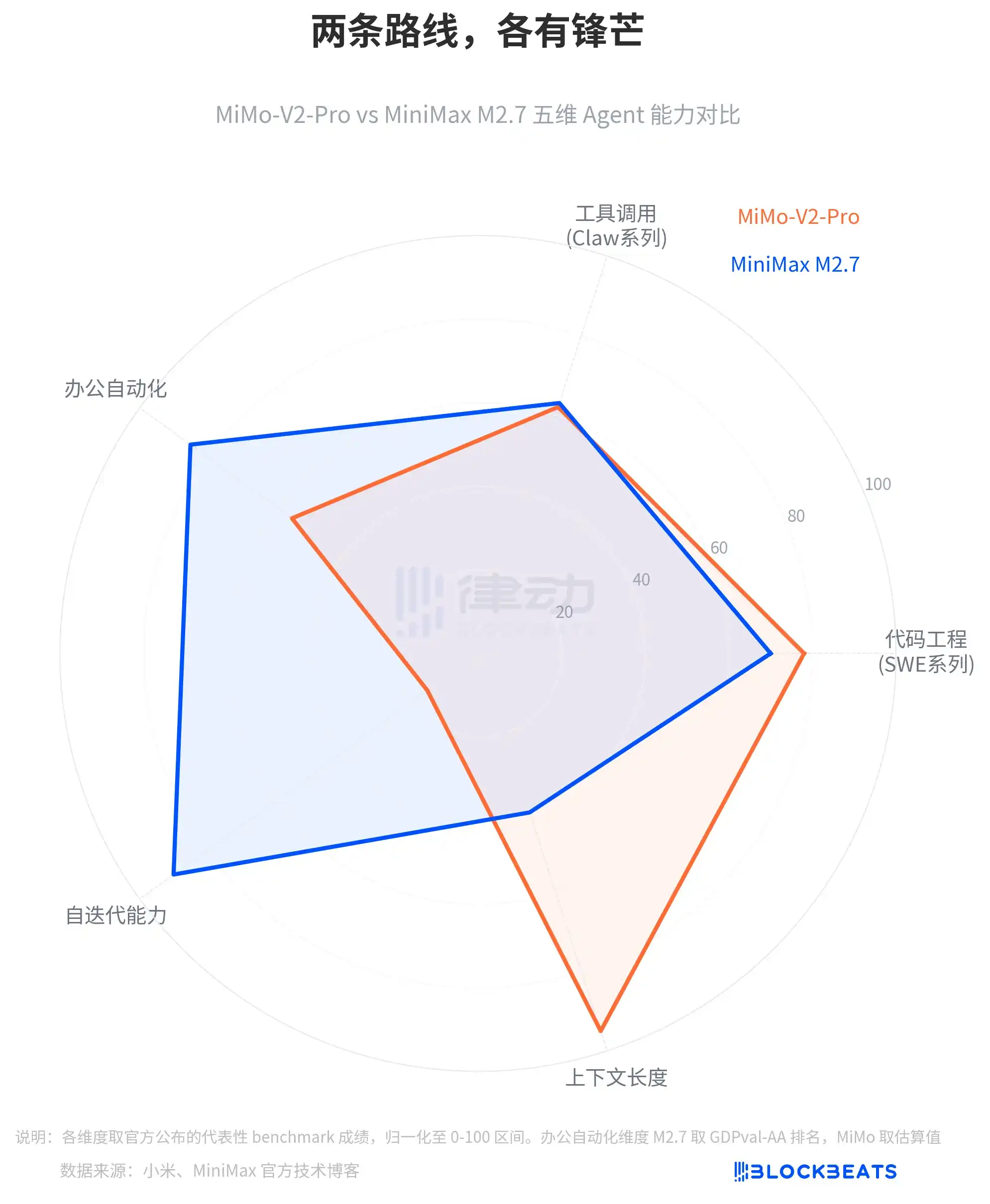
Looking from five dimensions, the锋芒 of the two routes朝向 completely different directions: MiMo-V2-Pro has obvious advantages in context length and code engineering dimensions, while M2.7 pulls ahead in office automation and self-iterative capabilities. According to the same MiniMax technical blog, M2.7 scored ELO 1495 on GDPval-AA (office document processing evaluation), ranking first among open-source models, and maintained a 97% skill adherence rate in the MM-Claw test covering over 40 complex skills.

Four Versions in Five Months

The two companies not only have different technical routes but also completely different iteration rhythms.

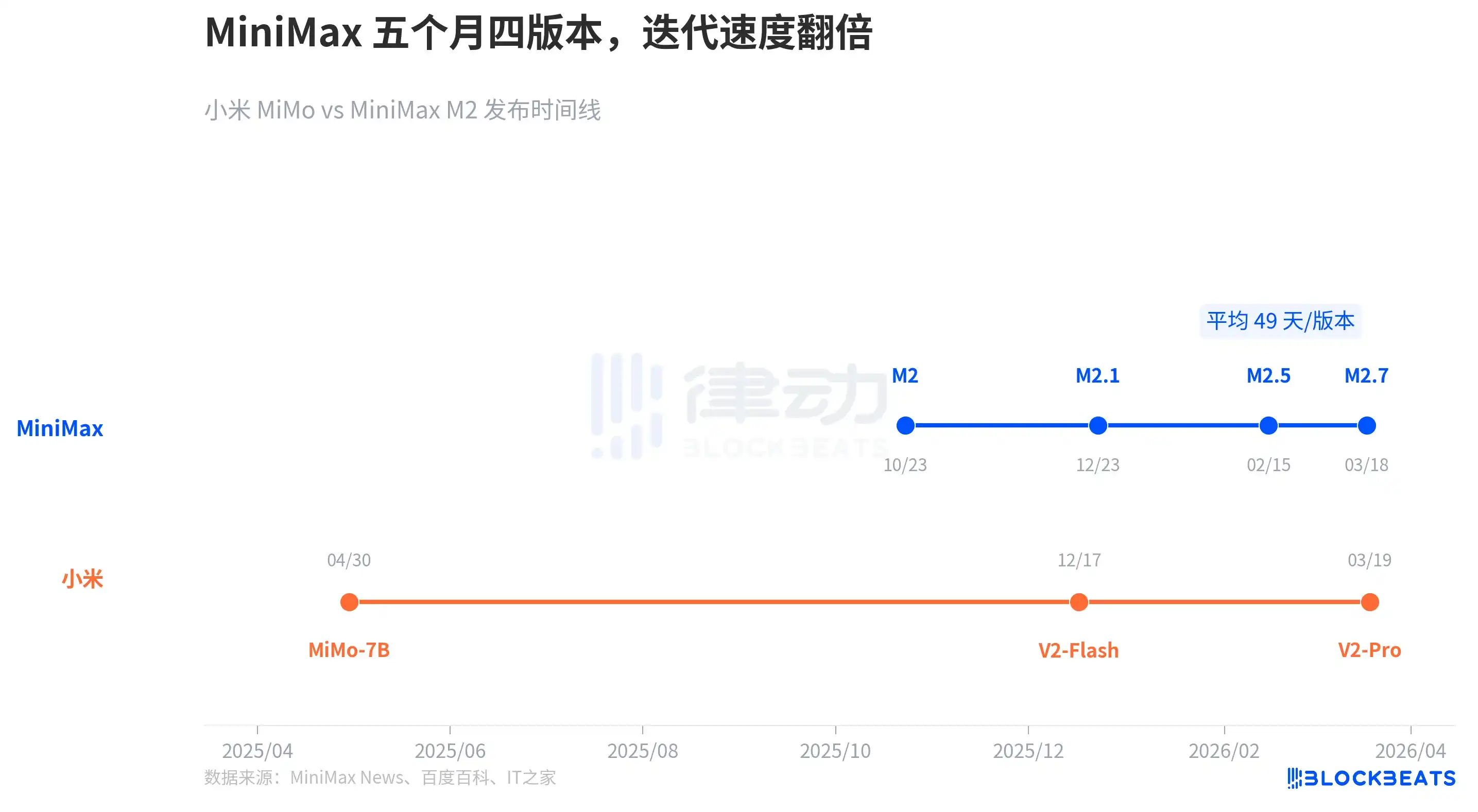
According to public release records, MiniMax iterated four major versions from the release of M2 in October 2025 to the release of M2.7 in March 2026—a new version every 49 days on average. The interval between M2.5 and M2.7 was only about 30 days.

Xiaomi MiMo's rhythm is different: MiMo-7B (a 7B parameter open-source inference model) was released in April 2025, V2-Flash (309B total parameters) in December 2025, and V2-Pro (1T total parameters) in March 2026. The parameter scale leap between each generation is larger, but the version intervals are also longer.

MiniMax chose small steps and quick runs, with small iteration amplitudes but extremely high frequency; M2.7's self-iterative mechanism is itself designed for "continuous evolution." Xiaomi chose蓄力一击, with each version representing a major leap in parameter scale and architecture.
Anonymous for 8 Days, Topping OpenRouter

Beyond the technical route, Xiaomi's release strategy also broke industry conventions.

According to a Reuters report, on March 11, an anonymous model named Hunter Alpha appeared on OpenRouter, the world's largest API aggregation platform. No brand endorsement, no launch event, no technical blog. Its API pricing was extremely low, yet its performance was surprisingly strong.

The community began speculating about its origin. According to Republic World and multiple tech media reports, the most mainstream guess was DeepSeek V4, as MiMo team leader Luo Fuli had previously conducted research at DeepSeek. Call volume surged rapidly, exceeding 1 trillion tokens during the anonymous period, topping the OpenRouter weekly chart.
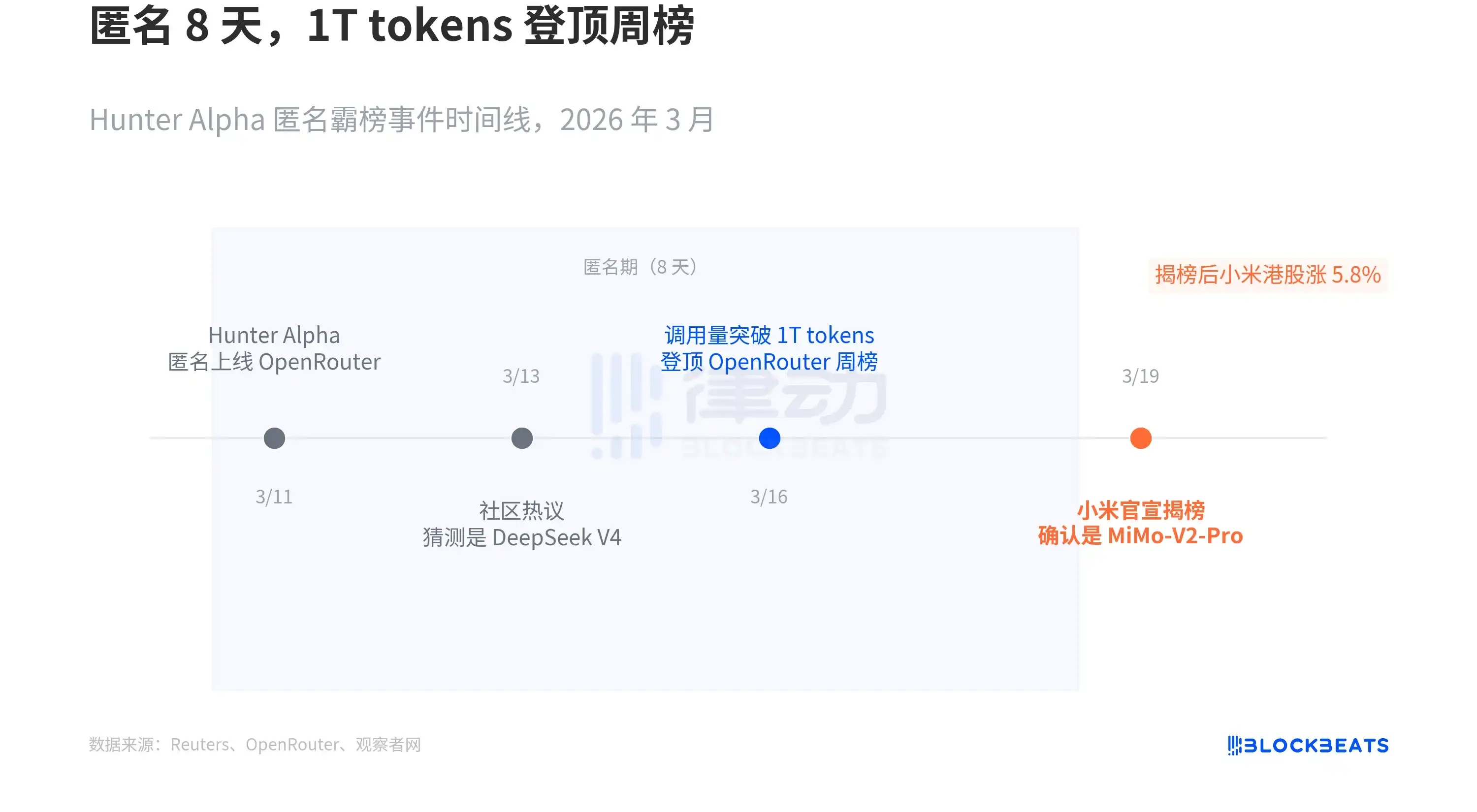
In the early hours of March 19, Xiaomi revealed the answer: Hunter Alpha was MiMo-V2-Pro. According to the same Reuters report, Xiaomi's Hong Kong stock saw a gain of up to 5.8% after the reveal.

This was the first time a domestic large model proved itself on a global platform through pure blind testing. Relying not on brand or宣传, but letting developers vote with their feet over 8 days.


Пов'язані питання

QWhat are the two Chinese companies that recently released their Agent-oriented large models, and what are the model names?

AMiniMax released the M2.7 model, and Xiaomi's MiMo team released the V2-Pro model.

QHow does the API output pricing of MiniMax M2.7 and MiMo-V2-Pro compare to Claude Opus 4.6?

AThe API output price for MiniMax M2.7 is $1.2 per million tokens, which is 1/21 of Claude Opus 4.6's $25. MiMo-V2-Pro is $3 per million tokens, which is 1/8 of Claude Opus 4.6's price.

QWhat are the core technical approaches of MiMo-V2-Pro and MiniMax M2.7?

AMiMo-V2-Pro follows a 'scale-up' approach with over 1 trillion total parameters and a Hybrid Attention mechanism. MiniMax M2.7 uses a 'self-iterative evolution' mechanism where the model autonomously runs optimization cycles to improve its own performance.

QWhat was unique about Xiaomi's release strategy for the MiMo-V2-Pro model?

AXiaomi first released the model anonymously on OpenRouter under the name 'Hunter Alpha' for 8 days. It gained significant developer traction and topped the OpenRouter weekly chart before Xiaomi revealed it was their model.

QHow did the iteration rhythms of MiniMax and Xiaomi's MiMo team differ?

AMiniMax iterated rapidly, releasing four versions in five months (approx. every 49 days). Xiaomi's MiMo team had longer release intervals with larger parameter scale jumps between versions, such as from 7B parameters to 309B, and then to 1T.

Пов'язані матеріали

Vitalik's Vision for the Next Evolution of On-Chain Finance: How to Reconstruct DeFi with an 'Options Mindset'?

Vitalik Buterin recently proposed a conceptual shift for DeFi: replacing traditional Collateralized Debt Positions (CDPs) and forced liquidations with an options-based mechanism. This aims to address key vulnerabilities in current DeFi lending. The traditional CDP model, foundational to protocols like MakerDAO and Aave, allows users to borrow against collateral but relies on real-time oracles and triggers sudden, mandatory liquidations during price volatility. This can cause cascading sell-offs, oracle manipulation risks, and significant MEV extraction, exacerbating market stress. Vitalik's alternative envisions splitting an asset like 1 ETH into two complementary components: one offering stable/index-like exposure and the other absorbing the opposite risk/reward. Instead of a hard liquidation threshold, a user's exposure to the target asset would gradually and smoothly deviate (following a near-quadratic curve) as the collateral price moves. The system would primarily depend on "slow oracles" for periodic settlement rather than instant price feeds. Key potential benefits include: the elimination of abrupt, forced liquidations; drastically reduced reliance on vulnerable real-time oracles; and inherent resistance to certain MEV exploits centered on liquidation auctions. The article posits that for Ethereum DeFi to maintain its relevance amid competition from faster, cheaper chains, it must compete on sophisticated financial engineering and robustness—not just transaction speed or yields. The core value proposition should shift towards offering users clearer, more manageable risk structures, greater autonomy, and resilience in extreme scenarios, moving DeFi from high-risk experimentation towards becoming reliable financial infrastructure.

marsbit32 хв тому

Vitalik's Vision for the Next Evolution of On-Chain Finance: How to Reconstruct DeFi with an 'Options Mindset'?

marsbit32 хв тому

AI Agent Completely Transforms Web3 Gaming: From the Rugpull Bakery Bot Controversy to the New 2026 Agent Paradigm

This article explores how the AI Agent paradigm is fundamentally transforming Web3 gaming, moving from a disruptive force to a core, legitimized element. It begins with the controversy in the competitive baking game Rugpull Bakery, where automated scripts caused fairness issues. Instead of banning them, the developers integrated AI Agents into the official gameplay by providing technical documentation (skill.md, agent.json), marking a shift towards "Agentic Gaming." The piece outlines three primary implementation models for AI Agents in Web3 games by 2026: 1. **Autonomous Competitors & Economic Entities:** AI Agents act as independent players with unique strategies. Examples include TEN Protocol's poker agents, AI Arena's trainable NFT fighters, and Satoshi Strike Force's "Digital Athletes" trained on player data. The Somnia blockchain is highlighted as a dedicated "Agentic L1" infrastructure supporting this model at scale. 2. **Modular Infrastructure & Programmable Environments:** This model, exemplified by EVE Frontier, allows AI Agents to program game world logic itself. Using "Smart Assemblies" (e.g., Smart Turrets, Smart Gates), Agents can modify shared economic and physical rules on-chain, creating dynamic, player/AI-built worlds. The ERC-8183 standard further enables these automated entities to hire other AI services for complex tasks. 3. **Hybrid Companions & Dynamic Adaptation:** Here, AI serves as a collaborative partner. In Parallel Colony, highly autonomous AI Avatars work alongside human players who provide high-level guidance. Illuvium plans to use AI to make NPCs dynamic and responsive, creating personalized, emergent narratives for each player. The conclusion posits that Web3 gaming has reached a "post-human" inflection point. Blockchains' transparency and programmability, combined with new standards and infrastructure like Somnia, make integrating and governing AI Agents not just viable but essential. The future lies in a symbiotic digital order where players transition from manual laborers to commanders and partners of algorithmic intelligence.

marsbit1 год тому

AI Agent Completely Transforms Web3 Gaming: From the Rugpull Bakery Bot Controversy to the New 2026 Agent Paradigm

marsbit1 год тому

Торгівля

Спот
Ф'ючерси

Популярні статті

Як купити WAR

Ласкаво просимо до HTX.com! Ми зробили покупку WAR (WAR) простою та зручною. Дотримуйтесь нашої покрокової інструкції, щоб розпочати свою криптовалютну подорож.Крок 1: Створіть обліковий запис на HTXВикористовуйте свою електронну пошту або номер телефону, щоб зареєструвати обліковий запис на HTX безплатно. Пройдіть безпроблемну реєстрацію й отримайте доступ до всіх функцій.ЗареєструватисьКрок 2: Перейдіть до розділу Купити крипту і виберіть спосіб оплатиКредитна/дебетова картка: використовуйте вашу картку Visa або Mastercard, щоб миттєво купити WAR (WAR).Баланс: використовуйте кошти з балансу вашого рахунку HTX для безперешкодної торгівлі.Треті особи: ми додали популярні способи оплати, такі як Google Pay та Apple Pay, щоб підвищити зручність.P2P: Торгуйте безпосередньо з іншими користувачами на HTX.Позабіржова торгівля (OTC): ми пропонуємо індивідуальні послуги та конкурентні обмінні курси для трейдерів.Крок 3: Зберігайте свої WAR (WAR)Після придбання WAR (WAR) збережіть його у своєму обліковому записі на HTX. Крім того, ви можете відправити його в інше місце за допомогою блокчейн-переказу або використовувати його для торгівлі іншими криптовалютами.Крок 4: Торгівля WAR (WAR)Легко торгуйте WAR (WAR) на спотовому ринку HTX. Просто увійдіть до свого облікового запису, виберіть торгову пару, укладайте угоди та спостерігайте за ними в режимі реального часу. Ми пропонуємо зручний досвід як для початківців, так і для досвідчених трейдерів.

259 переглядів усьогоОпубліковано 2024.12.11Оновлено 2026.06.02

Як купити WAR

Обговорення

Ласкаво просимо до спільноти HTX. Тут ви можете бути в курсі останніх подій розвитку платформи та отримати доступ до професійної ринкової інформації. Нижче представлені думки користувачів щодо ціни WAR (WAR).

活动图片












