X Tightens Promotion Rules: Is the Wild West Era of Crypto Twitter Marketing Over?

marsbitОпубліковано о 2026-02-25Востаннє оновлено о 2026-02-25

Анотація

X, the platform formerly known as Twitter, is systematically tightening its rules on promotional content and automated activity, particularly targeting the crypto community. Over the past five months, it has implemented six major policy changes. These include removing 1.7 million spam bots, banning "InfoFi" applications that reward users for posting, cracking down on accounts using automation/AI, and introducing a mandatory "Paid Promotion" disclosure label for sponsored content. It has specifically prohibited undisclosed ads for prediction markets and restricted automated API replies. These actions dismantle key, previously free, marketing channels for crypto: incentivized posting, undisclosed influencer promotions, and automated engagement. Consequently, user acquisition costs are expected to rise as organic reach diminishes. The platform is simultaneously favoring paid advertising, having relaxed its policies for crypto ads in many regions. This shift forces a recalibration of the crypto influencer economy, moving from hidden endorsements to transparent, performance-based advertising. While this may lead to a cleaner information environment for users, it signals the end of an era of unregulated "wild" marketing on the platform, making visibility a paid privilege.

Author: David, Deep Tide TechFlow

On February 21, X's product lead Nikita Bier publicly demanded in a post that the poster add a disclaimer stating it was a paid promotion, otherwise the account would be suspended.

This post came from the account @infodexx, with content ranking the "Most Valuable Startups in 2025," placing the prediction market platform Kalshi second with an $11 billion valuation.

The post garnered over 420,000 views, but the poster's bio stated "Kalshi partner," and the post itself initially had no paid promotion label.
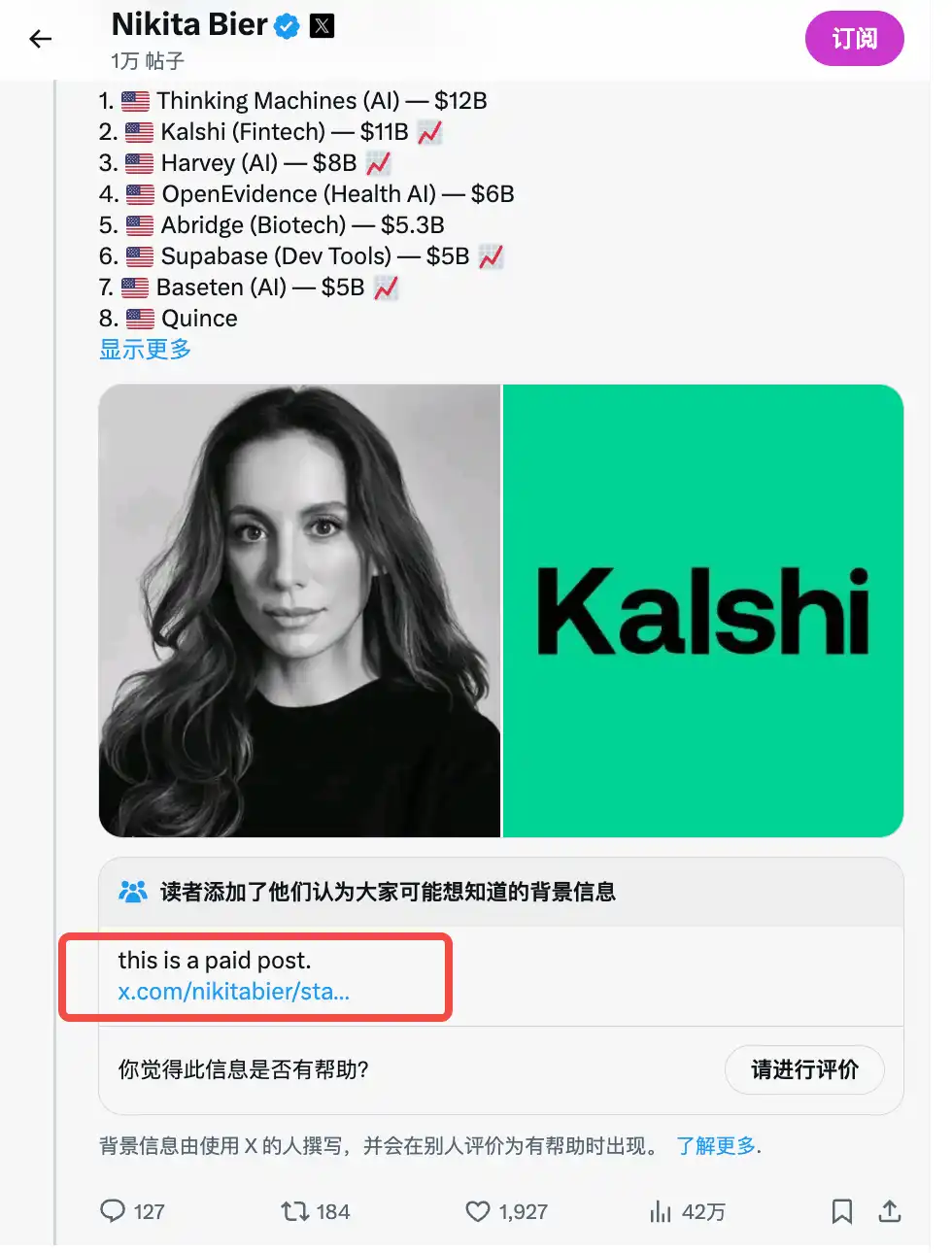
Subsequently, a user flagged it as commercial promotion content—essentially an ad—through X's Community Notes feature (a user-collaborative fact-checking mechanism where approved notes are displayed directly below the post).

Bier then announced that X would launch a set of paid promotion disclosure features the following week, requiring all posts with paid partnerships to be labeled, with violators facing account suspension.

The poster later added a context note to the original post, indicating it was a paid promotion.

Mandatory disclosure is just the latest step in this round of adjustments.

Over the past five months, X has successively cleaned up 1.7 million spam bot accounts, banned API access for InfoFi-type applications, launched anti-automation detection mechanisms, and restricted programmatic reply interfaces...

Although these actions occurred at different points in time, when pieced together, they form a clear timeline.

The wild marketing era on Crypto Twitter is perhaps being ended by the platform itself.

6 Major Cuts in 5 Months, Hitting the Artery of Crypto Marketing

X's changes to marketing rules have delivered six significant, overt blows over the past 5 months. We have compiled the key timeline and major events of these rule changes as follows:
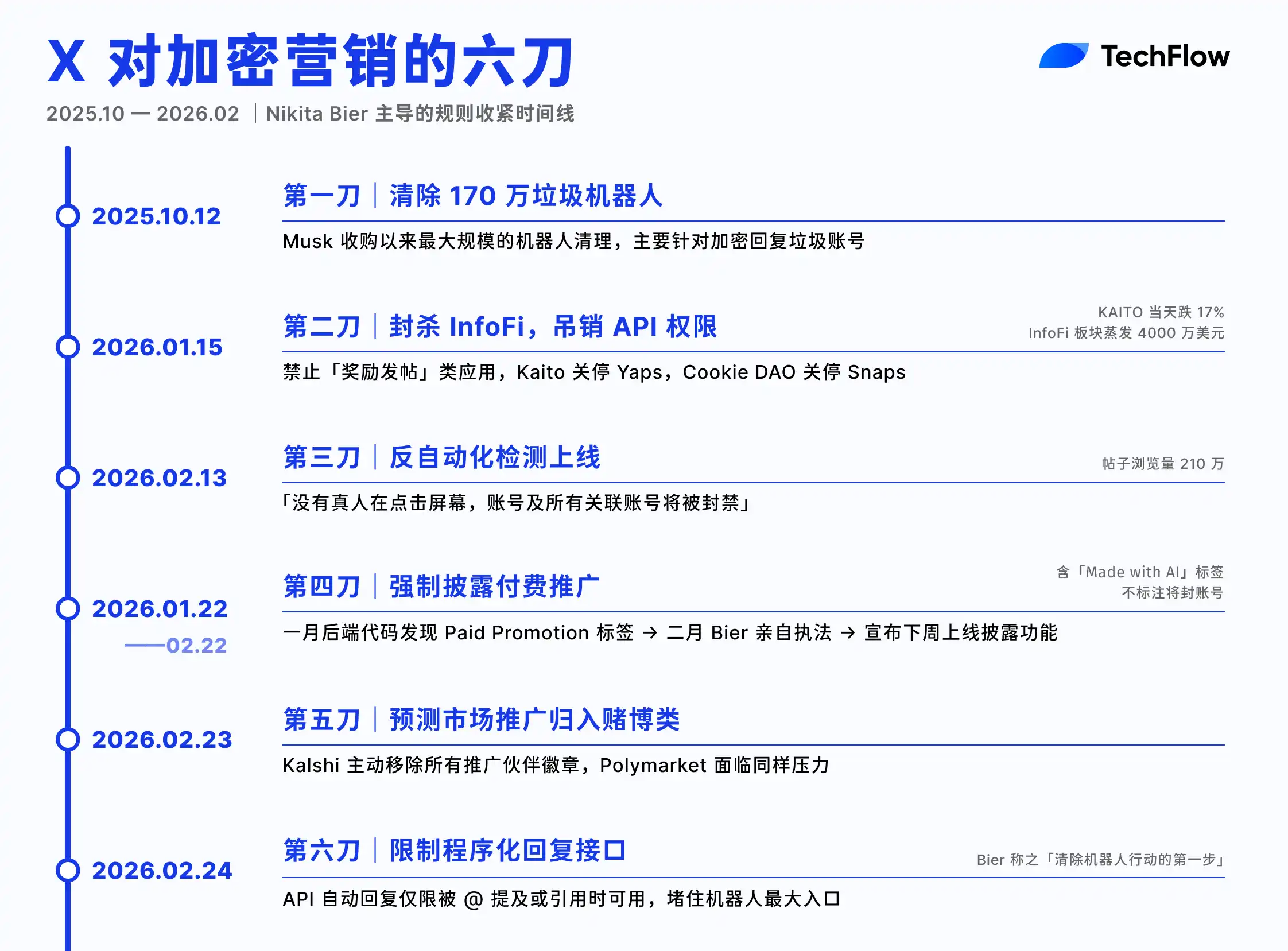
First Cut: Spam Bots

In October 2025, Bier announced that X had removed 1.7 million reply spam bots in one week, the largest cleanup since Musk's acquisition. The primary targets were crypto-related automated accounts, familiar to anyone who has scrolled through crypto posts on X:

Scam links instantly replying under popular posts, fake accounts impersonating Elon Musk, and repetitive "gm" bots.

Removing 1.7 million was just the first step; the underlying issue was much larger.

Second Cut: InfoFi and the "Post-to-Earn" Model

The proliferation of these bots was largely due to InfoFi.

Third-party platforms tracked users' posts and interactions on X and rewarded them with tokens or points. The original intent was to incentivize valuable information production, but when posting itself could earn money, it evolved into quantity over quality. Bot farms and AI-generated批量 replies quickly dominated the leaderboards.

At its peak, the largest project, Kaito, had over 157,000 active users on its Yaps product. By January 9, 2026, CryptoQuant detected 7.75 million crypto-related posts on X in a single day, 12 times the normal level.

On January 15, 2026, Bier announced changes to the developer API policy, prohibiting all applications that "reward users for posting on X," immediately revoking relevant API access.

Kaito subsequently shut down Yaps, its token KAITO fell about 17% that day; Cookie DAO shut down a similar product, Snaps; the entire InfoFi sector lost approximately $40 million in market cap in one day.

(Reference reading: X Pulls the Rug, the Era of 'Farming with Your Mouth' Ends)

Third Cut: Accounts Simulating Human Operations

On February 13, Bier announced the launch of a new round of automation detection.

If no real person is clicking the screen, the account and all associated accounts may be banned. This cut is aimed not just at traditional bots, but at all accounts operated via scripts, automation tools, or AI agents.

Bier stated that X would support compliant agent use cases in the future, but recommended developers pause integrations until rules are clear, using the official API if necessary.

Fourth Cut: Stealth Ads

The first three cuts dealt with automation and spam. The fourth cut targeted a larger gray area: paid promotions without disclosure.

Anyone familiar with Crypto Twitter knows this has been an industry standard in the crypto space.

In September 2025, on-chain investigator ZachXBT publicly released a spreadsheet listing the promotion rates and receiving wallet addresses of over 200 crypto KOLs. About 160 had accepted promotions, but fewer than 5 had labeled their posts as "ad."
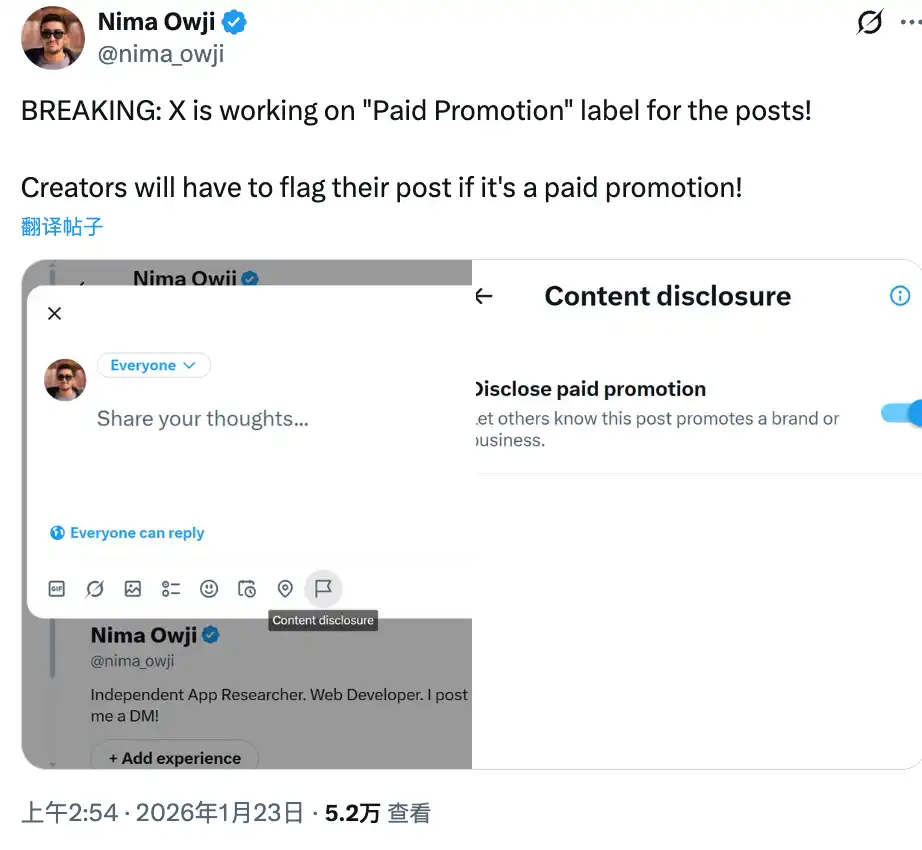
On January 22, app researcher Nima Owji discovered a Paid Promotion label feature under development in X's backend code. Creators would need to check if a post was a paid promotion when posting, and the label would be displayed directly on the post.

By February 21, when Bier personally intervened in the Kalshi post, this feature was ready for launch. He also announced a "Made with AI" label, requiring AI-generated content to be labeled.

Fifth Cut: Prediction Market Promotion

Following the disclosure feature announcement, X updated its paid partnership policy, explicitly categorizing prediction markets (like Kalshi and Polymarket) as gambling products, and comprehensively banning undisclosed related advertising.

Kalshi proactively removed its promotion partner badge on X on February 23, its spokesperson stating the enforcement was too difficult, as users easily misinterpreted accounts with the badge as being officially endorsed by Kalshi.

Sixth Cut: Programmatic Replies

The final cut landed on February 24. The X developer platform announced restrictions on automated replies sent via API.

Programmatic replies are only permitted if the original post @mentions or quotes the account. Product lead Bier called this the first step in clearing out bots, first plugging the biggest entry point.

After these six cuts—targeting bots, incentive mechanisms, automation tools, stealth ads, specific category promotions, and programmatic interfaces—X's control over crypto content has progressed layer by layer.

Combined, the entire marketing infrastructure that Crypto Twitter has relied on for operation over the past few years has been systematically dismantled.

X Rejects Free Riders, Welcomes Paying Customers

These rule changes combined are altering the cost structure of crypto marketing. In recent years, the main ways crypto projects acquired customers on X were through three free channels:

  1. InfoFi platforms incentivizing users to post for visibility,
  2. KOLs accepting stealth promotions without ad labels,
  3. Automation tools批量引流 under hot posts.

Now, all three channels are restricted or closed. Meanwhile, X's algorithm is widening the visibility gap between paid and free accounts.

Premium users receive a 2x to 4x weighting boost in the For You feed and reply排序. Some creators testing found that after March 2025, the median interaction for non-Premium accounts posting links had dropped to nearly zero.

The organic reach of crypto content萎缩 earlier. Crypto trader Lisa Edwards posted an analysis in December 2025 stating that after an algorithm update that month, the reach rate of posts containing symbols like BTC and ETH dropped by about 80%.

Simultaneously, as free channels are blocked, paid channels are opening.

X's policy on crypto ads has actually been loosening. According to X's official ad policy update log, since 2024, DeFi product ads have been approved, blockchain game ads opened in the US and Brazil, and the applicable markets for crypto exchange and wallet ads expanded from over a dozen original countries to include Denmark, Israel, Netherlands, Portugal, Ghana, Kenya, etc.

According to AWISEE statistics, X's crypto ad approval rate is about 60%, the highest among major platforms; Meta's is about 50%, and Google's is lower and explicitly bans DeFi ads.

On one side, free distribution is being systematically compressed; on the other, paid advertising categories and markets are continuously expanding. This is the monetization path all content platforms have taken:

First, cultivate a free content ecosystem to attract users and creators. Once network effects are established and creators become dependent on the platform, gradually tighten organic distribution, directing traffic to paid channels.

Facebook did the exact same thing to brand pages in 2014, with organic reach plummeting from double digits to single digits, forcing brands to shift from content operations to ad spending.

What X is doing to crypto content is essentially the same playbook.

Who Pays the Bill? Who Gets Eliminated?

With free channels cut, the bill will ultimately be分摊 across every role in the industry. This has at least three layers of impact on crypto marketing.

First, customer acquisition costs rise.

Before, a crypto project could rely on InfoFi points to incentivize tens of thousands of people to create buzz for it on X. Now that path is gone.

Formal KOL promotions will become more transparent with the disclosure feature, but posts labeled "ad" will have lower trust and engagement rates. Project teams will either increase budgets to compensate or accept reduced effectiveness.

Second, the KOL economy is repriced.

Data exposed by ZachXBT last year showed over 160 KOLs accepted promotions but almost none disclosed, with single post rates ranging from hundreds to $60,000. After mandatory disclosure, the room for operations that "look like organic content but are actually ads" is compressed. KOL pricing logic will shift from "I can help you伪装成 organic content" to "How much conversion can my labeled ad still drive?".

The former is priced on information asymmetry, the latter on performance.

For the industry, this might not be a bad thing, but短期内 a batch of KOLs and agencies surviving in the gray area will be eliminated.

Third, platform dependency risk is repriced.

Bier's exact words when banning InfoFi were,建议被封的开发者 "go to Threads and Bluesky to pivot."

A platform's product lead openly advising developers to go to competitors indicates X doesn't mind crypto projects分流, and might even be actively pushing them. After this round of changes, for project teams and KOLs, putting all social assets on X alone is no longer conservative, but risky.

For ordinary users, this isn't all bad news.

Before, scrolling through Crypto Twitter, six out of ten posts might have been paid for, but none would tell you. After the disclosure feature launches, users can at least distinguish between promotions and genuine opinions. The information environment becomes cleaner, and the cost of judgment decreases.

Of course, the timing of the rule tightening also coincides with a bear market.

Bear markets themselves compress marketing budgets; fewer projects are willing to spend on promotion, so the information flow naturally quiets down. Whether the clean environment is due to the rules or the冷清 will only be truly tested when the bull market returns.

Regardless, whether for project teams, KOLs, or ordinary creators, the price of admission to be seen on Crypto Twitter is now rising.

The logic of this business was "whoever is loudest wins"; in the future, it will become "whoever is willing to pay gets a voice."


Трендові криптовалюти

Пов'язані питання

QWhat major actions has X taken in the past five months to tighten its promotion rules, particularly affecting crypto marketing?

AX has implemented six key changes: 1) Cleared 1.7 million spam bot accounts in October 2025; 2) Banned 'earn-to-post' applications (InfoFi) by revoking their access in January 2026; 3) Introduced new automation detection targeting scripted or AI-operated accounts in February 2026; 4) Enforced mandatory disclosure for paid promotions; 5) Classified prediction markets as gambling and banned undisclosed ads for them; 6) Restricted automated API replies unless the original post mentions the account.

QHow did the crackdown on InfoFi applications impact the crypto market?

AThe ban on InfoFi applications, which rewarded users for content creation with tokens or points, led to the shutdown of major platforms like Kaito's Yaps and Cookie DAO's Snaps. The entire InfoFi sector lost approximately $40 million in market capitalization in a single day, with Kaito's token (KAITO) dropping around 17%.

QWhat is the new requirement for paid promotions on X, and what are the consequences for non-compliance?

AX now requires all posts involving paid partnerships to be clearly labeled as 'Paid Promotion.' Failure to disclose such partnerships will result in account suspension. This policy aims to increase transparency and reduce undisclosed advertising, particularly prevalent in crypto marketing.

QHow has X's algorithm change affected the visibility of free versus paid accounts?

AX's algorithm now gives Premium accounts a 2 to 4 times weighting boost in the 'For You' feed and reply rankings. Non-Premium accounts posting links have seen their median engagement drop to nearly zero since March 2025. Additionally, posts containing crypto symbols like BTC or ETH experienced an 80% decrease in organic reach after a December 2025 algorithm update.

QWhat broader implications do these rule changes have for crypto marketers and KOLs?

AThe changes are increasing customer acquisition costs by closing free marketing channels like InfoFi and undisclosed KOL promotions. KOLs must now shift from pricing based on disguising ads as organic content to pricing based on measurable conversion rates. This transparency may push out KOLs and agencies that relied on ambiguous practices, while encouraging a more honest and effect-based marketing economy.

Пов'язані матеріали

Beyond the Stadium: The Profitable Games Surrounding the World Cup

"Beyond the Pitch: The Profit Game Around the World Cup" The FIFA World Cup transcends being a sporting spectacle, evolving into a massive global arena for speculation and profit-seeking. The 2026 tournament has amplified this dynamic, creating a multi-layered ecosystem of financial opportunism alongside the football. **Prediction markets** have surged into the mainstream. Platforms like Polymarket and Kalshi saw trading volumes for World Cup contracts soar, attracting new users with their financial trading model and high-profile, chain-based wealth stories that overshadow traditional sports betting in terms of growth and narrative. However, **traditional sportsbooks** remain the dominant force, leveraging established user habits, legal markets, and comprehensive product offerings to handle the vast majority of speculative wagers, with projections suggesting record-breaking betting volumes. Capital markets also react. **"Concept stocks"** in countries like South Korea and Japan experience volatile price swings based on team performance and anticipated fan spending on items like chicken, beer, and viewing parties, effectively becoming a stock market reflecting fan sentiment. The **ticket resale market** has become a sophisticated arena for arbitrage. Prices fluctuate wildly based on team draws and star power, with sellers sometimes listing tickets they don't yet own in a practice akin to short-selling, while FIFA's own "Right to Buy" tokens add another layer of speculative trading. **Collectibles and merchandise** offer another avenue. Panini sticker albums, with their inherent scarcity and nostalgic value, can become high-value collectibles. Limited-edition or locally themed jerseys command significant premiums on secondary markets, and even counterfeit vendors profit from fans' desire for affordable match-day identity. The **cryptocurrency** space has seen a frenzy of speculative, unauthorized World Cup-themed meme coins on chains like Solana. These tokens, often exploiting team names and player imagery, experience extreme pump-and-dump cycles, creating stories of massive gains for a few early entrants and steep losses for many others. Finally, an entire industry thrives on **providing information and tools** to other speculators. Developers create platforms like SeatSidekick to track ticket inventory and prices, while paid Telegram groups and subscriptions sell betting tips and predictions, monetizing the widespread desire for an informational edge. In essence, the World Cup has become a compressed, global laboratory for speculation. While the games determine champions on the field, a parallel, complex network of financial transactions—spanning prediction contracts, bets, stocks, tickets, collectibles, crypto, and information services—settles its own scores in the global market.

marsbit25 хв тому

Beyond the Stadium: The Profitable Games Surrounding the World Cup

marsbit25 хв тому

How Does Codex Use a Computer? Three Entry Points and Permission Boundaries

This article explains the three primary methods for Codex to interact with a computer, each with distinct use cases, permission boundaries, and trust levels. **1. Computer Use:** This offers the broadest access, allowing Codex to visually control and interact with the graphical user interface of authorized macOS/Windows apps, system settings, and even iOS simulators. It's ideal for tasks lacking APIs or structured tools, such as operating legacy software or multi-app workflows. However, it's the slowest method and has the widest permission scope, requiring careful supervision for sensitive actions. **2. Chrome Extension:** This grants Codex access to the user's logged-in Chrome browser state, including cookies, profiles, and open tabs. It's best for tasks requiring user identity across websites like Gmail, LinkedIn, Salesforce, or internal dashboards. Its key advantage is multi-tab control for complex workflows. While more powerful for browser-based tasks than Computer Use, it carries higher sensitivity as actions are performed under the user's identity. **3. In-App Browser:** This is a browser isolated within the Codex thread, separate from the user's personal browsing data. It excels in web development and debugging scenarios—previewing local servers, testing responsive layouts, or annotating designs directly on the page. Its isolation is a strength for development but a limitation for tasks requiring login sessions. The core principle is to choose the narrowest, safest, and most structured interface for the task. Use plugins or MCPs first, resort to visual control (Computer Use) only for GUI-dependent tasks, employ the Chrome extension for identity-reliant browser work, and prefer the In-App Browser for isolated development. **Appshots** are clarified as a fourth, complementary tool for *inputting* context—capturing a screenshot of a window to point Codex to something—rather than a method for Codex to *act*. Together, this layered approach highlights a key to AI agent productization: not granting unlimited permissions, but constraining them within clear boundaries for specific tasks while preserving user oversight.

marsbit1 год тому

How Does Codex Use a Computer? Three Entry Points and Permission Boundaries

marsbit1 год тому

The "Iron Rule" of Chip Equipment Is Being Broken

For years, the semiconductor equipment industry followed an unwritten "iron rule": suppliers offered steep discounts for new tool introductions (Design-in) and faced consistent price pressure during repeat orders, especially during market downturns. This long-standing buyer's market dynamic is now being upended. Recently, SK Hynix's primary equipment suppliers have reportedly requested a 3-4% price *increase*, a nearly unprecedented move. This shift is driven by a severe supply-demand imbalance fueled by the AI compute boom. Securing equipment has become an urgent arms race as chipmakers' expansion speed dictates their ability to fulfill massive AI chip orders. Key areas feeling the strain include: **TCB (Thermal Compression Bonding) Equipment:** Demand is exploding, driven by the simultaneous needs of HBM4 memory stacking, AI chip Chip-on-Substrate (C2S), and logic Chiplet Chip-on-Wafer (C2W) packaging. Players like Hanmi Semiconductor, Hanwha Semitech, and ASMPT are receiving major orders. While hybrid bonding is seen as the future, TCB remains the pragmatic choice for HBM4 mass production, with its lifecycle extended by relaxed specifications and ongoing technological upgrades. **Test Equipment Bottlenecks:** Ironically, AI-driven shortages are now crippling test equipment manufacturing. Critical components like FPGAs, Driver ICs, and CPUs face severe shortages and extended lead times (up to 52 weeks for FPGAs), as AI data center and server vendors prioritize supply. This creates a paradoxical cycle: AI chip shortages drive fab expansion, which requires more test equipment, whose production is delayed because its key parts are diverted to make AI chips. The industry is entering a broad, AI-powered upcycle. SEMI forecasts global semiconductor equipment sales to hit a record $156 billion by 2027, fueled by investment in advanced logic/foundry, HBM-driven DRAM, and advanced packaging (like CoWoS). Major players like TSMC, SK Hynix, and Micron are aggressively ramping capital expenditure. In conclusion, leading equipment vendors are no longer just selling tools; they are selling the critical capability to deliver AI-era capacity. Pricing power is shifting decisively to those with indispensable technology in key process nodes like advanced logic, HBM, and advanced packaging, rewriting the industry's traditional power structure.

marsbit2 год тому

The "Iron Rule" of Chip Equipment Is Being Broken

marsbit2 год тому

Торгівля

Спот
Ф'ючерси

Популярні статті

Як купити ERA

Ласкаво просимо до HTX.com! Ми зробили покупку Caldera (ERA) простою та зручною. Дотримуйтесь нашої покрокової інструкції, щоб розпочати свою криптовалютну подорож.Крок 1: Створіть обліковий запис на HTXВикористовуйте свою електронну пошту або номер телефону, щоб зареєструвати обліковий запис на HTX безплатно. Пройдіть безпроблемну реєстрацію й отримайте доступ до всіх функцій.ЗареєструватисьКрок 2: Перейдіть до розділу Купити крипту і виберіть спосіб оплатиКредитна/дебетова картка: використовуйте вашу картку Visa або Mastercard, щоб миттєво купити Caldera (ERA).Баланс: використовуйте кошти з балансу вашого рахунку HTX для безперешкодної торгівлі.Треті особи: ми додали популярні способи оплати, такі як Google Pay та Apple Pay, щоб підвищити зручність.P2P: Торгуйте безпосередньо з іншими користувачами на HTX.Позабіржова торгівля (OTC): ми пропонуємо індивідуальні послуги та конкурентні обмінні курси для трейдерів.Крок 3: Зберігайте свої Caldera (ERA)Після придбання Caldera (ERA) збережіть його у своєму обліковому записі на HTX. Крім того, ви можете відправити його в інше місце за допомогою блокчейн-переказу або використовувати його для торгівлі іншими криптовалютами.Крок 4: Торгівля Caldera (ERA)Легко торгуйте Caldera (ERA) на спотовому ринку HTX. Просто увійдіть до свого облікового запису, виберіть торгову пару, укладайте угоди та спостерігайте за ними в режимі реального часу. Ми пропонуємо зручний досвід як для початківців, так і для досвідчених трейдерів.

478 переглядів усьогоОпубліковано 2025.07.17Оновлено 2026.06.02

Як купити ERA

Обговорення

Ласкаво просимо до спільноти HTX. Тут ви можете бути в курсі останніх подій розвитку платформи та отримати доступ до професійної ринкової інформації. Нижче представлені думки користувачів щодо ціни ERA (ERA).

活动图片