World Models Shift from Prediction to Planning: HWM and the Challenge of Long-Horizon Control

marsbitОпубліковано о 2026-04-17Востаннє оновлено о 2026-04-17

Анотація

World models have evolved from focusing on representation learning and future prediction to addressing long-horizon planning challenges. While models like V-JEPA 2 demonstrate strong predictive capabilities using large-scale video pre-training, they struggle with multi-stage control tasks due to error accumulation and exponential growth in action search space. HWM (Hierarchical World Model) introduces a two-level planning structure: a high-level planner outlines coarse subgoals over longer time horizons, while a low-level executor handles short-term actions. This decomposition reduces planning complexity and error propagation. In experiments, HWM achieved 70% success in real-world robotic tasks where flat models failed entirely. Complementary efforts include V-JEPA (focused on representation), HWM (on hierarchical planning), and WAV (World Action Verifier, on self-correction). Together, they mark a shift from pure world modeling to integrated systems capable of prediction, planning, and verification—key to deploying world models in real-world agents and long-term tasks.

Over the past year, the research focus of world models has initially centered on representation learning and future prediction. Models first understand the world and then internally simulate future states. This approach has already produced a number of representative results. V-JEPA 2 (Video Joint Embedding Predictive Architecture 2—a video world model suite released by Meta in 2025) used over 1 million hours of internet video for pre-training, combined with a small amount of robot interaction data, demonstrating the potential of world models in understanding, prediction, and zero-shot robot planning.

However, a model's ability to predict does not equate to its ability to handle long-horizon tasks. When faced with multi-stage control, systems typically encounter two challenges. One is that prediction errors accumulate over long rollouts (multi-step simulations), causing the entire path to increasingly deviate from the goal. The other is that the action search space expands rapidly as the planning horizon increases, leading to continuously rising planning costs. HWM does not rewrite the underlying learning approach of world models but instead adds a hierarchical planning structure on top of existing action-conditioned world models, enabling the system to first organize stage paths and then handle local actions.

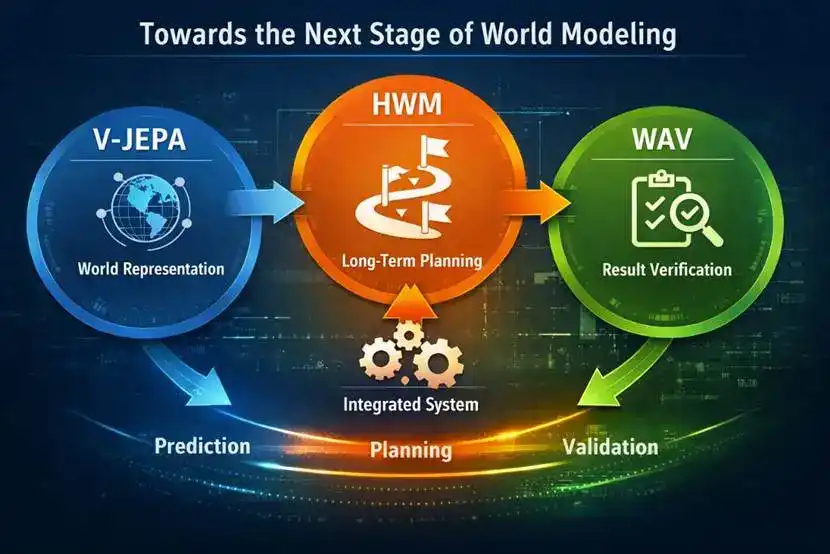
From a technical perspective, V-JEPA 2 (https://ai.meta.com/research/vjepa/) leans more toward world representation and basic prediction, HWM leans more toward long-horizon planning, and WAV (World Action Verifier: Self-Improving World Models via Forward-Inverse Asymmetry, https://arxiv.org/abs/2604.01985) leans more toward the model's ability to identify and correct its own prediction distortions. These three lines of research are gradually converging. The focus of world model research has shifted from merely predicting the future to transforming predictive capabilities into executable, correctable, and verifiable system capabilities.

I. Why Long-Horizon Control Remains a Bottleneck for World Models

The difficulties of long-horizon control become clearer when applied to robotic tasks. Take robotic arm manipulation as an example: picking up a cup and placing it in a drawer is not a single action but a sequence of continuous steps. The system must approach the object, adjust its posture, complete the grasp, move to the target location, and then handle the drawer and placement. As the chain lengthens, two problems arise simultaneously. One is that prediction errors accumulate along the rollout, and the other is that the action search space expands rapidly.
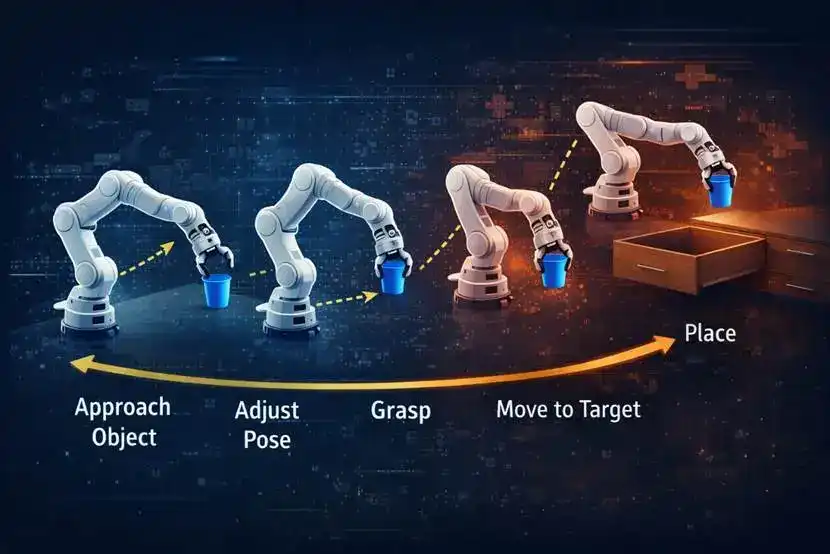
What the system often lacks is not local predictive ability but the capacity to organize distant goals into stage paths. Many actions may appear to deviate from the goal locally but are actually intermediate steps required to achieve it. For example, raising the arm before grasping or moving back slightly and adjusting the angle before opening a drawer.

In demonstration tasks, world models can already provide coherent predictions. However, when entering real control scenarios, performance begins to decline, and problems emerge. The pressure comes not only from the representation itself but also from the immaturity of the planning layer.

II. How HWM Restructures the Planning Process

HWM splits the originally single-layer planning process into two layers. The upper layer is responsible for stage direction at a longer time scale, while the lower layer handles local execution at a shorter time scale. The model plans at two different temporal rhythms simultaneously, rather than at a single pace.

When handling long tasks, single-layer methods typically need to search the entire action chain directly in the underlying action space. The longer the task, the higher the search cost, and the more likely prediction errors are to diffuse along multi-step rollouts. After HWM's decomposition, the high layer only handles route selection at a longer time scale, and the low layer only handles the execution of the current segment. The entire long task is broken into multiple shorter segments, reducing planning complexity.

Another key design is that high-level actions are not simply the difference between two states but use an encoder to compress a sequence of low-level actions into a higher-level action representation. For long tasks, the key is not just the difference between the start and end points but also how the intermediate steps are organized. If the high layer only looks at displacement differences, it may lose path information in the action chain.

HWM embodies a hierarchical task organization approach. Faced with a multi-stage task, the system no longer unfolds all actions at once but first forms a coarse stage path and then executes and corrects it segment by segment. Once this hierarchical relationship is incorporated into the world model, predictive capabilities begin to transform more stably into planning capabilities.

III. From 0% to 70%: What the Experimental Results Indicate

In the real-world grasp-and-place task set up in the paper, the system was given only the final goal condition without manually decomposed intermediate goals. Under these conditions, HWM achieved a success rate of 70%, while the single-layer world model had a 0% success rate. A long task that was nearly impossible to complete originally became highly achievable after introducing hierarchical planning.
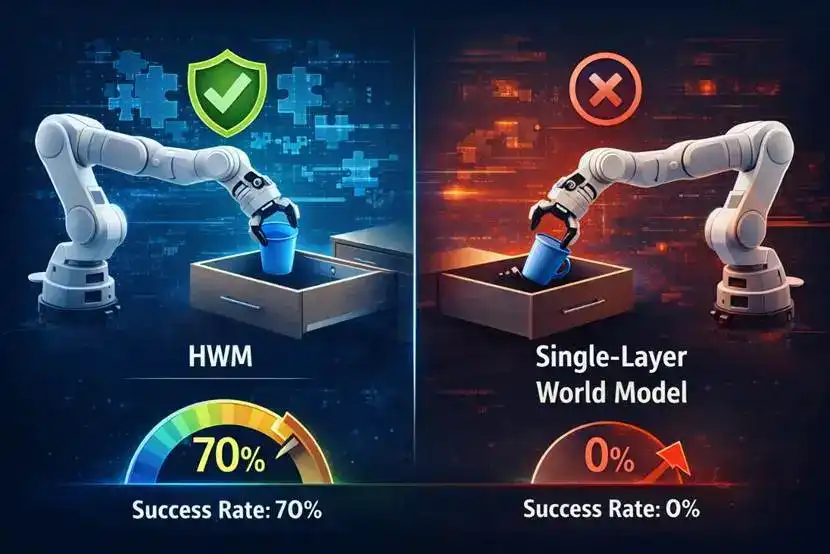
The paper also tested simulation tasks such as object pushing and maze navigation. The results showed that hierarchical planning not only improved success rates but also reduced the computational cost of the planning phase. In some environments, the computational cost of the planning phase could be reduced to about a quarter of the original while maintaining higher or comparable success rates.

IV. From V-JEPA to HWM to WAV

V-JEPA 2 represents the world representation approach. V-JEPA 2 used over 1 million hours of internet video for pre-training, combined with less than 62 hours of robot video for post-training (targeted training after pre-training), resulting in a latent action-conditioned world model (a world model that predicts in an abstract representation space incorporating action information) usable for understanding, predicting, and planning in the physical world. It demonstrates that models can acquire world representations through large-scale observation and transfer these representations to robot planning.

HWM is the next step. The model already possesses world representation and basic predictive capabilities, but once multi-stage control is involved, the problems of error accumulation and search space expansion erupt. HWM does not change the underlying representation learning approach but adds a multi-timescale planning structure on top of existing action-conditioned world models. It addresses how the model organizes distant goals into a set of intermediate steps and then advances segment by segment.

WAV further focuses on verification capabilities. For world models to enter policy optimization and deployment scenarios, they cannot just predict; they must also identify areas where they are prone to distortion and make corrections accordingly. It focuses on how the model checks itself.

V-JEPA leans toward world representation, HWM toward task planning, and WAV toward result verification. Although their focuses differ, their overall direction is consistent. The next phase of world models is no longer just internal prediction but the gradual integration of prediction, planning, and verification into a system capability.
V. From Internal Prediction to Executable Systems

Many past world model efforts were closer to improving the continuity of future state predictions or the stability of internal world representations. However, the current research focus is beginning to change. Systems must not only form judgments about the environment but also translate those judgments into actions and continue to adjust the next steps after results are obtained. To get closer to real deployment, it is necessary to control error propagation in long-horizon tasks, compress the search space, and reduce inference costs.

Such changes will also affect AI agents. Many agent systems can already handle short-chain tasks, such as calling tools, reading files, and executing multi-step commands. However, once tasks become long-chain, multi-stage, and require mid-course re-planning, performance declines. This is not fundamentally different from the difficulties in robotic control; both stem from insufficient high-level path organization capabilities, leading to a disconnect between local execution and overall goals.

The hierarchical approach provided by HWM—where the high level is responsible for paths and stage goals, the low level handles local actions and feedback processing, and result verification is layered on top—will continue to appear in more systems in the future. The next phase of world models will focus not only on predicting the future but on organizing prediction, execution, and correction into a viable path.


Пов'язані питання

QWhat are the main challenges in long-horizon control for world models, as discussed in the article?

AThe main challenges are the accumulation of prediction errors during long rollout sequences, which causes the system to increasingly deviate from the goal, and the exponential expansion of the action search space as the planning horizon grows, leading to rising computational costs.

QHow does HWM (Hierarchical World Model) address the problem of long-term task planning?

AHWM restructures the planning process into two layers: a high-level layer that plans stage directions over longer time scales, and a low-level layer that handles local execution over shorter time scales. This hierarchical approach breaks long tasks into shorter segments, reducing planning complexity and error propagation.

QWhat key improvement did HWM demonstrate in experimental results for real-world tasks?

AIn a real-world grasping and placement task where only the final target was provided without intermediate goals, HWM achieved a 70% success rate, compared to a 0% success rate for a single-layer world model. It also reduced computational costs by up to a quarter in some environments while maintaining high success rates.

QWhat are the distinct focuses of V-JEPA 2, HWM, and WAV in world model research?

AV-JEPA 2 focuses on world representation and foundational prediction using large-scale video pre-training. HWM emphasizes hierarchical task planning for long-horizon control. WAV (World Action Verifier) concentrates on self-verification, identifying and correcting prediction distortions to improve model reliability.

QHow is the research focus of world models evolving beyond mere prediction?

AThe research is shifting from internal future prediction to building executable systems that integrate prediction, planning, and verification. This involves controlling error propagation, compressing search spaces, reducing inference costs, and organizing hierarchical structures for reliable long-term task execution.

Пов'язані матеріали

From Gold to Bitcoin: Fixed Supply + Institutional Frenzy, Might It Repeat the 'Explosive' Price Trend?

"From Gold to Bitcoin: Fixed Supply and Institutional Frenzy May Lead to 'Explosive' Price Rally Analysts suggest Bitcoin's price action could mirror gold's over the past two decades, following the launch of spot Bitcoin ETFs. Gold ETFs, introduced in 2004, drove gold's price surge to a current market cap near $28 trillion. Both gold and Bitcoin are non-yielding stores of value, with prices driven purely by investor sentiment rather than cash flows or credit. Gold ETFs experienced dramatic cycles: explosive growth, painful drawdowns, and slow recoveries, with each cycle reaching higher peaks. Bitcoin ETFs, approved in early 2024, saw rapid institutional adoption but are now facing similar volatility. Recent warnings highlight the risk of significant ETF outflows disrupting the current rebound. BlackRock's IBIT, a leading Bitcoin ETF, has sold nearly 100,000 BTC to meet redemptions while still holding over 733,000. The core parallel is fixed supply: when demand surges, prices explode, but demand is often volatile and wave-like, not steady. Institutional interest, through ETFs and corporate adoption, remains a key support pillar, helping to cushion sell-offs. If Bitcoin captures even a fraction of gold's role as a store of value, its upside potential is immense, though the path will be marked by high volatility. For investors, focusing on long-term trends and managing risk is crucial as this 'price explosion' narrative unfolds."

Foresight News7 хв тому

From Gold to Bitcoin: Fixed Supply + Institutional Frenzy, Might It Repeat the 'Explosive' Price Trend?

Foresight News7 хв тому

Why Is AI Agent Shopping Hard to Popularize?

The article argues that the popular narrative of "AI agent shopping" – equipping AI with a wallet to autonomously handle purchases – is fundamentally flawed and oversimplifies the complexity of shopping. It deconstructs shopping into two core actions: **information retrieval** (standardized, easily automated) and **value judgment** (deeply subjective and human-centric). The narrative mistakenly assumes AI can fully handle both. Value judgment itself has two layers: **evaluation** (assessing options against criteria) and **demand definition** (setting the criteria, weights, and values). The latter is inherently human and dynamic, as preferences are not fixed but constructed during the decision-making process ("constructive preferences"). The real dividing line for automation is not product standardization, but whether the **act of choosing** itself holds experiential value. For mundane purchases (e.g., printer paper), full AI delegation works. For experiential goods (e.g., wine, furniture), the joy of selection is core to consumption, so AI should act as an assistant that narrows options, leaving the final choice to humans. The "AI wallet" concept confuses three separate elements: decision-making, execution, and fund custody. Current payment industry solutions (e.g., from Stripe, Mastercard, Google, Visa) show that limited, scoped payment authorization tokens are sufficient for most consumer scenarios, not full fund custody. The true use case for autonomous AI wallets is in **B2B procurement** and **machine-to-machine (M2M) settlements** for standardized, high-frequency, low-value transactions. The real bottlenecks for AI shopping are not payment technology, but **1) the lack of trusted data sources** (e.g., fake reviews, counterfeit goods) and **2) the impossibility of automating human demand definition**. The conclusion is that the focus should be on safely automating the assessment and filtering process while reserving for humans the rights to define their criteria and enjoy the final act of choice. For experiential goods, the platform's competitive advantage shifts to providing a superior selection experience.

Foresight News1 год тому

Why Is AI Agent Shopping Hard to Popularize?

Foresight News1 год тому

After Nine Months of Shorting, a Full Turn to Long: Renowned Trader Opens Bitcoin Positions Around 64K, Crypto Market Long-Short Divergence Intensifies

After nine months of being short, prominent crypto trader Doctor Profit has closed all his bearish positions and started buying Bitcoin near $64,000, signaling a complete bullish reversal. He argues that structural market changes—such as impending U.S. regulation (CLARITY Act) and institutional adoption via securities tokenization—are rewriting the traditional four-year cycle script, potentially bringing the market bottom forward from the widely expected September/October timeframe. This view finds some technical support from on-chain analyst gumsays, who notes a bullish divergence on Bitcoin's weekly chart has persisted for 147 days, nearing the 161-day duration seen before the 2022 cycle low. However, cycle researcher Jake Pahor presents a counter-argument based on historical data. Analyzing patterns since 2014, he identifies three common features of past bear market bottoms: a ~12-month duration from peak to trough, a sustained period of extreme fear (with a proprietary risk score below 20), and the price falling below Bitcoin's realized price (~$53,000 currently). The current cycle, only nine months from its October 2025 peak, meets none of these conditions. The debate highlights a market torn between "front-running" a potential early bottom driven by new fundamentals and waiting for confirmation through traditional on-chain and sentiment metrics. While Doctor Profit opts for aggressive buying, Pahor maintains a disciplined, tiered accumulation strategy, continuing weekly buys at current risk levels but reserving larger orders for if more extreme fear emerges.

marsbit1 год тому

After Nine Months of Shorting, a Full Turn to Long: Renowned Trader Opens Bitcoin Positions Around 64K, Crypto Market Long-Short Divergence Intensifies

marsbit1 год тому

Senior Trader's Confession: How to Trade Market's False Expectations?

Veteran trader's case study: trading the market's "wrong expectations". This trade centered on a textbook "expectation error" after a weak CPI report. While the market initially priced in broad monetary easing (sending Nasdaq to 30,060), the crucial 30-year real yield hit a 20-year high. This signaled a fractured transmission mechanism: short-term rates eased, but long-term funding costs (vital for tech valuations) refused to fall. The trader executed five short positions on the Nasdaq (NQ) as it fell from 30,060 to 28,768. The core methodology: don't just trade the data, but analyze the market's implied causal chain and identify where it breaks. In this case, the chain was: Weak CPI → Policy Easing → Lower Long-Term Funding Costs → NQ Valuation Expansion. The break occurred between policy easing and long-term rates. The "veto variable" – long-term real yields – refused to confirm the bullish narrative. Trades were structured around "fast variables" (price) temporarily repairing while "slow variables" (funding conditions) remained broken. The article outlines a repeatable framework: 1) Map the market's implied causal chain. 2) Identify the veto variable. 3) Observe if it rejects the narrative. 4) Enter when price still follows the old script. 5) Choose the cleanest asset expression (e.g., short NQ, not broad S&P). 6) Define both invalidation and fulfillment exit conditions. The key insight: Alpha often comes not from an information edge, but from a "reaction function edge" – recognizing when the market is applying an outdated causal logic to new data. The critical question: What causal chain is the market's first reaction relying on, and is that chain still valid today?

marsbit1 год тому

Senior Trader's Confession: How to Trade Market's False Expectations?

marsbit1 год тому

Торгівля

Спот
活动图片