World Liberty proposes using 5% of treasury to boost its stablecoin

cointelegraphОпубліковано о 2025-12-18Востаннє оновлено о 2025-12-18

Анотація

World Liberty Financial, backed by the Trump family, has proposed allocating 5% of its WLFI token treasury—worth approximately $120 million—to expand the supply of its USD1 stablecoin. The goal is to increase adoption and competitiveness in the stablecoin market by forming new CeFi and DeFi partnerships. The team argues that a larger USD1 circulation would drive demand for WLFI-governed services and strengthen the ecosystem. The proposal is currently under community vote, with initial responses showing slight opposition. USD1, launched in March, is the seventh-largest USD-pegged stablecoin with a $2.74 billion market cap, but still trails significantly behind competitors like PayPal’s PYUSD.

Trump family-backed World Liberty Financial has proposed using 5% of the project’s WLFI token treasury to grow the supply of its stablecoin USD1.

The proposal was posted to the World Liberty Financial governance forum on Wednesday, with the team highlighting the importance of increasing USD1 supply to keep up with “an increasingly competitive stablecoin landscape.”

The proposal outlines that the additional supply would help spread “USD1 use cases across select high-profile CeFi & DeFi partnerships,” with increased adoption helping to create more “value capture” opportunities in the WLFI ecosystem.

“As USD1 grows, more users, platforms, institutions, and chains integrate with World Liberty Financial infrastructure. This increases the scale and influence of the network governed by WLFI holders,” the team said.

“More USD1 in circulation leads to more demand for WLFI-governed services, integrations, liquidity incentives, and ecosystem programs,” it added.
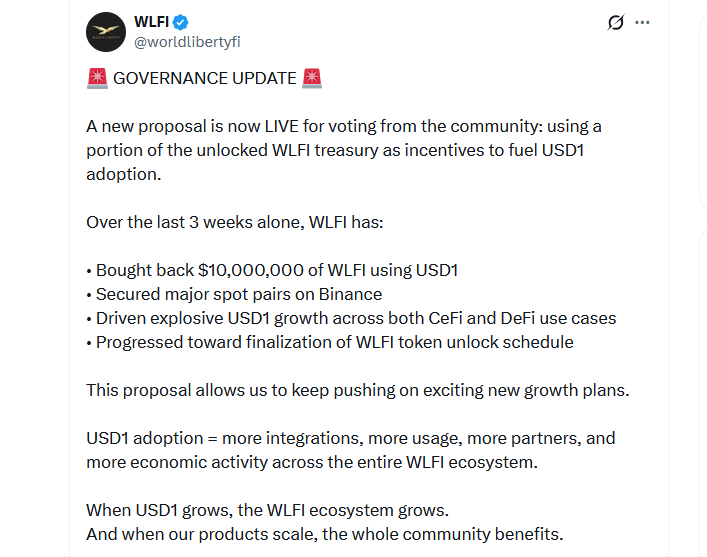
Source: World Liberty Financial

World Liberty Financial’s WLFI token started trading on exchanges in September. Leading up to the launch, the project indicated that 19.96 billion of the total WLFI supply would be allocated to the treasury. At current prices, that total sum is worth almost $2.4 billion, with a 5% unlock equating to around $120 million.

The team outlined three potential voting options in the proposal: for, against or abstain. The vote is now live, but it is not explicitly clear how the voting is taking place.

Related: Binance mulls new US strategy, CZ potentially reducing stake: Report

The reaction to the proposal is currently mixed, with “against” slightly edging out those who indicate they support the proposal.
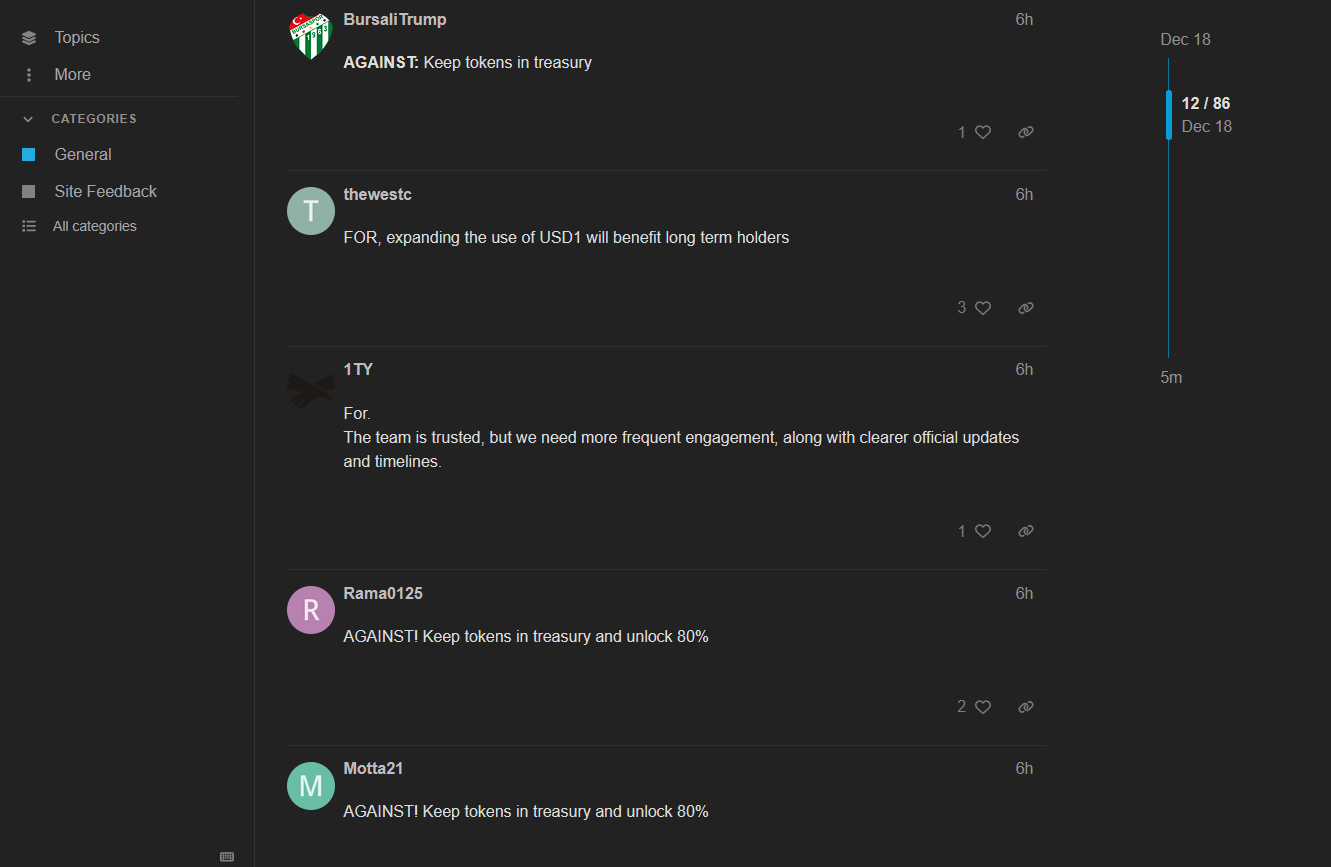
Community responses to the proposal. Source: World Liberty Financial

The project’s stablecoin launched in March and has a market cap of $2.74 billion according to CoinGecko data, making it the seventh-largest USD-pegged stablecoin on the market.

The 5% treasury unlock may help spur growth of the asset; however, it has a lot of catching up to do if it wants to displace competitors, with sixth-placed PYUSD from PayPal having a market cap $1.1 billion larger than USD1.

Magazine: Big questions: Would Bitcoin survive a 10-year power outage?

Пов'язані матеріали

Google and Amazon Simultaneously Invest Heavily in a Competitor: The Most Absurd Business Logic of the AI Era Is Becoming Reality

In a span of four days, Amazon announced an additional $25 billion investment, and Google pledged up to $40 billion—both direct competitors pouring over $65 billion into the same AI startup, Anthropic. Rather than a typical venture capital move, this signals the latest escalation in the cloud wars. The core of the deal is not equity but compute pre-orders: Anthropic must spend the majority of these funds on AWS and Google Cloud services and chips, effectively locking in massive future compute consumption. This reflects a shift in cloud market dynamics—enterprises now choose cloud providers based on which hosts the best AI models, not just price or stability. With OpenAI deeply tied to Microsoft, Anthropic’s Claude has become the only viable strategic asset for Google and Amazon to remain competitive. Anthropic’s annualized revenue has surged to $30 billion, and it is expanding into verticals like biotech, positioning itself as a cross-industry AI infrastructure layer. However, this funding comes with constraints: Anthropic’s independence is challenged as it balances two rival investors, its safety-first narrative faces pressure from regulatory scrutiny, and its path to IPO introduces new financial pressures. Globally, this accelerates a "tri-polar" closed-loop structure in AI infrastructure, with Microsoft-OpenAI, Google-Anthropic, and Amazon-Anthropic forming exclusive model-cloud alliances. In contrast, China’s landscape differs—investments like Alibaba and Tencent backing open-source model firm DeepSeek reflect a more decoupled approach, though closed-source models from major cloud providers still dominate. The $65 billion bet is ultimately about securing a seat at the table in an AI-defined future—where missing the model layer means losing the cloud war.

marsbit4 год тому

Google and Amazon Simultaneously Invest Heavily in a Competitor: The Most Absurd Business Logic of the AI Era Is Becoming Reality

marsbit4 год тому

Computing Power Constrained, Why Did DeepSeek-V4 Open Source?

DeepSeek-V4 has been released as a preview open-source model, featuring 1 million tokens of context length as a baseline capability—previously a premium feature locked behind enterprise paywalls by major overseas AI firms. The official announcement, however, openly acknowledges computational constraints, particularly limited service throughput for the high-end DeepSeek-V4-Pro version due to restricted high-end computing power. Rather than competing on pure scale, DeepSeek adopts a pragmatic approach that balances algorithmic innovation with hardware realities in China’s AI ecosystem. The V4-Pro model uses a highly sparse architecture with 1.6T total parameters but only activates 49B during inference. It performs strongly in agentic coding, knowledge-intensive tasks, and STEM reasoning, competing closely with top-tier closed models like Gemini Pro 3.1 and Claude Opus 4.6 in certain scenarios. A key strategic product is the Flash edition, with 284B total parameters but only 13B activated—making it cost-effective and accessible for mid- and low-tier hardware, including domestic AI chips from Huawei (Ascend), Cambricon, and Hygon. This design supports broader adoption across developers and SMEs while stimulating China's domestic semiconductor ecosystem. Despite facing talent outflow and intense competition in user traffic—with rivals like Doubao and Qianwen leading in monthly active users—DeepSeek has maintained technical momentum. The release also comes amid reports of a new funding round targeting a valuation exceeding $10 billion, potentially setting a new record in China’s LLM sector. Ultimately, DeepSeek-V4 represents a shift toward open yet realistic infrastructure development in the constrained compute landscape of Chinese AI, emphasizing engineering efficiency and domestic hardware compatibility over pure model scale.

marsbit5 год тому

Computing Power Constrained, Why Did DeepSeek-V4 Open Source?

marsbit5 год тому

Торгівля

Спот
Ф'ючерси
活动图片