World Gold Council Proposes “Gold as a Service” Framework Impacting Tokenized Gold Market

TheNewsCryptoОпубліковано о 2026-03-20Востаннє оновлено о 2026-03-20

Анотація

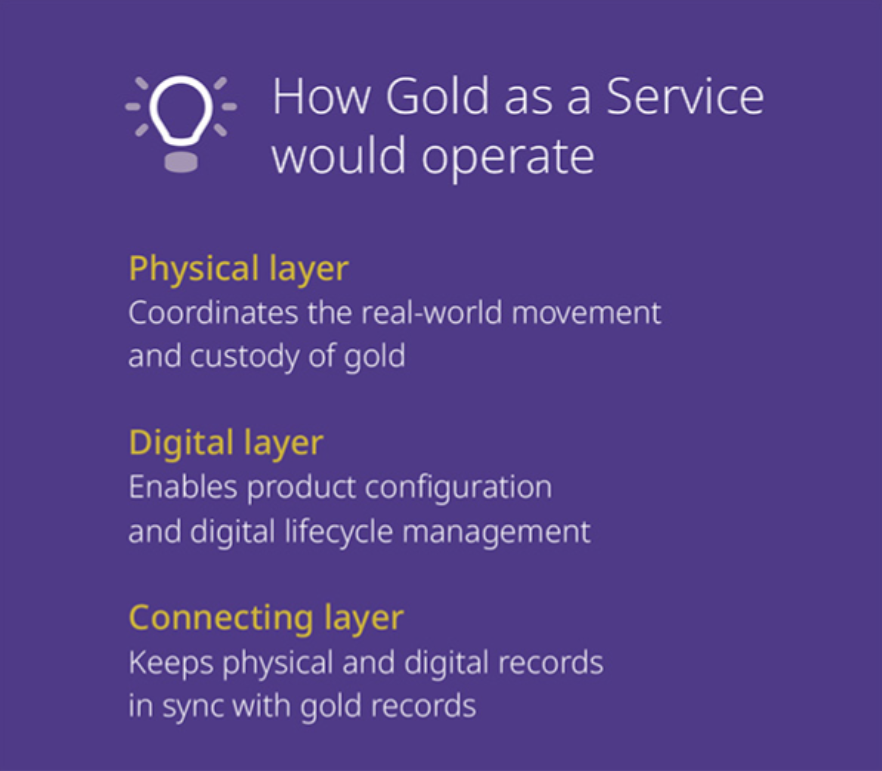
The World Gold Council has introduced a "Gold as a Service" framework aimed at modernizing the global tokenized gold infrastructure. This system connects physical gold custody with digital issuance, enabling more efficient creation of gold-backed products. It is structured around three core components: physical custody, digital issuance, and synchronization systems that link assets to blockchain records. The framework is expected to impact major market players like Tether Gold (XAUT) and Paxos Gold (PAXG), which currently dominate the tokenized gold sector but operate on fragmented systems. By introducing standardized processes for custody, compliance, and redemption, the initiative seeks to unify the market, improve regulatory alignment, and reduce operational costs. This development is seen as a significant step in merging traditional gold markets with blockchain technology, potentially driving greater adoption among institutional investors and fintech companies. The Council emphasized that the framework is designed to foster future growth rather than target existing issuers.

The World Gold Council created a “Gold as a Service” framework to help modernize tokenized gold infrastructure worldwide. It does this by connecting physical gold custody and digital issuance systems, allowing companies to issue gold-backed products more efficiently. It is built on three levels of physical custody, digital issuance, and synchronization systems that connect assets and blockchain records.
Source: World Gold Council

The World Gold Council CEO, David Tait, said, “Financial services are undergoing a rapid and pervasive digital transformation.” He further added that shared infrastructure would help in improving accessibility, tradability, and integration of gold in modern financial systems worldwide.

Impact on Tether Gold and Paxos Gold Market Leaders

Currently, Tether Gold (XAUT) and Paxos Gold (PAXG) currently dominate the overall tokenized gold market. Also, they collectively command a large market share in the overall market worldwide. Both of these operate on different systems for custody, audit, and redemption, and this is causing fragmentation in the overall digital gold market worldwide.

The new framework also outlines a set of standardized processes that include custody coordination, compliance checks, and redemption systems that are to be followed on all platforms globally. Such a framework would ensure that all platforms are aligned in terms of regulatory compliance. It has been noted that such a platform can enable hundreds of new issuances to happen in a more efficient manner.

The Potential and Development Mark

The platform can potentially lead to lower operational costs as well as better integration between tokenized gold assets on various blockchain platforms globally. This can further increase adoption rates among institutional investors as well as fintech companies that are entering the tokenized commodity space. Officials emphasized that the platform focuses on enabling growth. Rather than targeting existing issuers in the space.

The development marks a significant convergence between traditional gold markets and blockchain technology as the adoption of digital assets continues to gain momentum globally. Analysts noted that tokenized gold can act as a major growth driver in traditional gold markets globally.

Highlighted Crypto News:

Ondo Finance Expands Tokenized Securities Offering With BlackRock IBIT and Galaxy Digital

TagsBlockchainCryptocurrencyDigital assetsGoldservice

Пов'язані питання

QWhat is the main purpose of the 'Gold as a Service' framework proposed by the World Gold Council?

AThe main purpose is to modernize tokenized gold infrastructure worldwide by connecting physical gold custody and digital issuance systems, allowing companies to issue gold-backed products more efficiently.

QWhich two products currently dominate the tokenized gold market according to the article?

ATether Gold (XAUT) and Paxos Gold (PAXG) currently dominate the tokenized gold market.

QWhat are the three levels that the 'Gold as a Service' framework is built upon?

AIt is built on three levels: physical custody, digital issuance, and synchronization systems that connect assets and blockchain records.

QWhat benefits does the World Gold Council CEO believe shared infrastructure will bring to gold?

ADavid Tait believes shared infrastructure will help improve accessibility, tradability, and integration of gold in modern financial systems worldwide.

QHow can the new framework potentially impact operational costs and adoption rates?

AThe framework can lead to lower operational costs and better integration, which can further increase adoption rates among institutional investors and fintech companies entering the tokenized commodity space.

Пов'язані матеріали

China's Tech Industry Is Crossing the 'Visibility Threshold' in Bulk

China's tech industries are successively crossing a "visibility threshold" into the global market spotlight. This wave, exemplified by AI, robotics, and innovative pharmaceuticals (the "new-new three"), differs from past waves like garments/appliances or EVs/batteries/solar panels. Earlier industries met existing demand, but these new sectors are helping to *define* emerging markets and applications. Crossing this threshold signifies an industry has achieved scale, competitive advantages, rapid growth, and the ability to drive its supply chain. Recent data shows China's AI sector growing over 30%, producing 80% of certain intelligent robots, and a surge in new drug approvals. This acceleration stems from China's industrial evolution from "completeness" to "density": different sectors now share technologies, talent, and infrastructure, enabling capabilities (e.g., from EVs) to rapidly migrate to adjacent fields (e.g., robotics). This dense ecosystem, combined with improved system integration and faster market access, acts as an infrastructure for generating new industries. The nature of competition is also evolving. The visible product is just an interface; long-term advantage lies in the underlying patents, standards, and open ecosystems. While building this "moat," China's approach emphasizes openness—through open-source models and collaborative R&D—to foster wider adoption and iterative improvement. Crossing the visibility line marks the start of market validation. The consecutive emergence of these industry waves signals China is developing a sustained capacity to generate new, globally relevant innovations, shifting from being defined by global narratives to participating in shaping them.

marsbit33 хв тому

China's Tech Industry Is Crossing the 'Visibility Threshold' in Bulk

marsbit33 хв тому

10 Billion Repurchase Fails to Halt HYPE's Decline, Are Core Members and Multicoin Quietly Selling Tokens?

Foresight News reports that despite a massive $1 billion buyback program by the Assistance Fund, the HYPE token has fallen from its July high of $70 to around $52.40. Analyst MLM tracked data showing that since team token vesting began in December 2025, approximately 4.93 million HYPE (worth ~$270M) were allocated to core contributors. Of these, 1.19 million (~$32.5M) were sold on the open market, and 3.14 million (~$132M) were transferred to OTC desks. However, the report argues that direct team selling is not the primary driver of the price decline. In the same period, the protocol's Assistance Fund used 99% of trading fees to repurchase about 9.8 million HYPE for approximately $364 million, a rate more than double the team's selling pressure. The analysis points to other significant factors: major venture capital firms like Multicoin Capital and a16z have been unstaking and moving substantial amounts of HYPE to exchanges, with some confirming sales for portfolio management. Additionally, HYPE spot ETFs have experienced consistent daily net outflows since early July, reversing the strong inflows seen in May and June. The report concludes that while protocol buybacks absorb team selling, declining trading volume reduces this buyback power, and combined selling pressure from large investors and ETFs has significantly impacted the price.

marsbit57 хв тому

10 Billion Repurchase Fails to Halt HYPE's Decline, Are Core Members and Multicoin Quietly Selling Tokens?

marsbit57 хв тому

Торгівля

Спот
活动图片