Will the STRC Issue Price Determined by ChatGPT Really Fall into a Death Spiral?

链捕手Опубліковано о 2026-06-23Востаннє оновлено о 2026-06-23

Анотація

"Strategy's" (STRC) preferred share, a financial instrument designed by CEO Michael Saylor in consultation with AI to trade steadily at $100, faces mounting pressure. Since its July 2025 launch alongside a ~40% Bitcoin price drop, STRC has traded at a steep discount, hitting a low of $82.53. This discount pushes its effective dividend yield above 12.9%. The core debate revolves around whether STRC's structure is sustainable or a "centralized Ponzi scheme," as economist Peter Schiff claims. The mechanism relies on issuing new shares ("at-the-market" offerings) to fund Bitcoin purchases and dividend payments. However, the deep discount has paused these ATM offerings, slowing Bitcoin accumulation and forcing a minor sale of 32 BTC to cover obligations. Proponents, like The Smarter Web Company's Jesse Myers, argue the sell-off is a leveraged unwinding, not a fundamental failure. They note Strategy has ample resources to cover dividends for years if Bitcoin appreciates modestly. The deep discount also makes STRC attractive for yield-seeking buyers, as dividends are calculated on the $100 face value. The key test is whether Strategy can maintain dividends without sustained Bitcoin sales. A critical watchpoint is June 30th, when STRC switches to semi-monthly dividends. An automatic rule will likely raise the dividend rate further because the price remains below $95$, potentially creating a "death spiral": lower prices trigger higher yields, increasing the cash burden and forcing ...

Author: Chloe, ChainCatcher

Since the launch of STRC by Strategy at the end of July 2025, Bitcoin has fallen by about 40%, nearly 50%. This preferred stock, designed to "trade at around its $100 par value," is now mired in a discount: last Thursday, it hit a historic low of $82.53 intraday, and even now, closing back at only $88.59, it remains about 13% below par. As the discount widens, STRC's effective yield has been pushed to over 12.9%, approaching 13%.
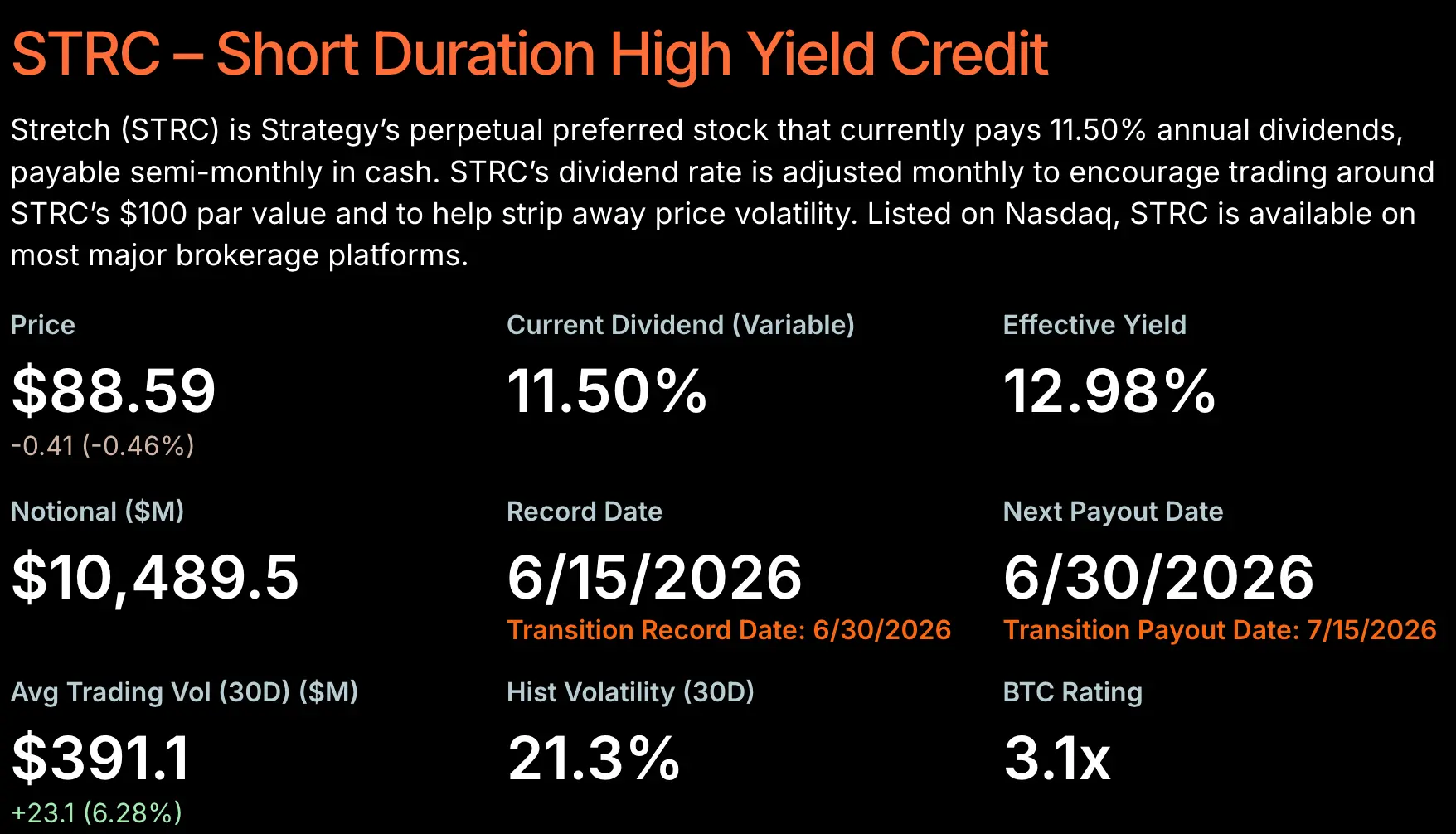
Jesse Myers, Bitcoin Strategy Lead at The Smarter Web Company, has stated, "Strategy is fine," while economist Peter Schiff has once again labeled the entire structure as a "classic centralized Ponzi scheme."

Thus, those old questions have been brought back to the table: Will Strategy be forced to sell Bitcoin? Is the flywheel it relies on for expansion actually a Ponzi scheme?

Was STRC's Mechanism Designed by AI?

To discuss STRC, we must first address a detail that is easily overlooked but has resurfaced during this downturn: this structure was the product of Saylor's conversations with AI.

The controversy stems from a May CoinDesk interview clip recirculating on X. In the clip, Saylor admits to extensively using artificial intelligence while developing Strategy's preferred stock product. He said that when creating Stretch, he designed these things using AI; he couldn't have done it alone. He spent hours discussing and refining ideas back and forth with the AI.

According to him, he constantly threw various structural proposals at the AI, testing whether unconventional ideas were legally sound. When he proposed, "I want a preferred stock that pays monthly dividends and is stable at $100," the AI responded: No one has ever done this in history, but it is completely legal and completely reasonable.

Interestingly, as STRC fell below par and the market began questioning whether this mechanism could hold, many foreign media outlets simply went back to ask AI—including ChatGPT, Grok, and Claude—if STRC could return to $100.

Will Strategy Sell More Bitcoin?

Not long ago, Strategy sold 32 BTC, worth about $2.5 million, to meet its dividend obligations. This amount is negligible compared to its overall Bitcoin reserves, but it proves one thing: when the financing efficiency led by STRC declines, cash obligations can indeed force limited selling of Bitcoin.

More alarmingly, buying momentum has frozen. Strategy's pace of accumulating Bitcoin has noticeably slowed: In April this year, it spent $2.54 billion to buy 34,164 BTC in a single week; in May, it added about 24,869 BTC with $2.01 billion. But by June, weekly purchases had shrunk to around $100 million. For the week ending June 8, it bought 1,550 BTC ($101 million); for the week ending June 15, it bought 1,587 BTC ($100 million), bringing its total holdings to 846,842 BTC.

Furthermore, the widening discount not only pushes up the yield but also suspends the "at-the-market" (ATM) issuance mechanism—issuing new shares into the public market at current prices to raise cash in batches. This financing channel is a key part of sustaining the entire Bitcoin flywheel.

However, bulls do not buy into this "death spiral" narrative. Jesse Myers believes this wave of STRC selling looks more like leveraged unwinding than a deterioration in fundamentals. He estimates that if conditions remain unchanged, Strategy's current state is sufficient to pay STRC dividends for up to 32 years; and as long as Bitcoin appreciates by about 2% annually, this obligation can be covered indefinitely. Moreover, the equity issuance tool itself has not disappeared. Even if ATM issuance is temporarily paused, Strategy still retains multiple backup financing options, including restarting the issuance of MSTR common stock, using cash reserves, and only resorting to selling Bitcoin if necessary.

On the bearish side is Schiff's classic script. He argues that if Saylor raises the yield to 13%, he must sell more MSTR at a larger discount to finance it; if he doesn't raise the yield, the STRC price will continue to fall. In his view, the only way to stop this death spiral is to cancel the dividends outright, but that would immediately crush STRC, dragging down MSTR and Bitcoin along with it.

Is This Flywheel a Ponzi Scheme?

Schiff's accusation is straightforward: STRC is a "classic centralized Ponzi" because its operation depends on whether Strategy can continue to raise new funds through another round of equity issuance or simply sell Bitcoin to fulfill its obligations. Even trader DonAlt has publicly questioned why STRC's price action after falling below par "trades like a Ponzi."

Strategy has not directly responded to such accusations, only continuing to position STRC as preferred stock backed by its Bitcoin DAT strategy. A more concrete move was changing STRC's dividend payment from monthly to semi-monthly, meaning twice a month.

The core argument from the opposing side is "leveraged unwinding." Myers points out that the problem lies not with the structure itself, but with the fact that STRC traded near $99 to $100 for a long time, enticing investors to deploy heavy leverage, with many assuming the instrument would remain firmly above $95. Once the price slipped, margin calls and forced liquidations amplified and accelerated this decline.

Analyst Scott Melker offers another perspective: the discount may actually attract yield-seeking buyers. Because STRC's dividends are calculated based on the $100 liquidation preference, not the market price. With an 11.5% dividend rate, someone buying at $90 gets an effective yield of about 12.8%, and at $85, about 13.5%. The deeper the discount, the higher the effective yield, which is itself a lure.

So the question of "whether it's a Ponzi" ultimately depends on which explanation the market believes. One narrative is that this mechanism can only keep turning by constantly pulling in new money, with funds from new entrants used to pay earlier entrants—a hallmark of a Ponzi scheme. The other narrative is that the instrument itself is fine; it's just that people previously thought it was stable and heavily leveraged, and when the price slid this time, these players were forced to cut losses, amplifying the decline—a one-time washout, not a problem with the instrument itself.

Semi-Monthly Dividends Officially Take Effect; The Answer May Be Revealed by June?

Looking back at the above, since this mechanism was designed by Saylor using AI, many foreign media outlets simply threw the same question back at AI: Can STRC return to $100, and what should Strategy do to rebuild market confidence? The common answer from ChatGPT, Grok, and Claude is, "Returning to $100 comes with conditions."

ChatGPT believes a return to $100 is still possible but requires stronger market confidence, sustainable dividend coverage, and a recovery in Bitcoin's price—all three combined. It emphasizes that the quickest repair path is to make investors believe again that dividends can be maintained without relying on selling assets. If more Bitcoin sales are actually needed later, confidence may deteriorate further.

Grok is the most reserved, bluntly stating, "Maybe, but it will be extremely difficult." In its view, the market is essentially asking: Can the engine that fuels this Bitcoin-buying machine still run? It believes a sustained rally in Bitcoin would be the most effective catalyst; conversely, prolonged weakness will weigh on both STRC and MSTR.

Claude points out that preferred stocks can indeed often recover from a discount to par, but the precondition is that investors regain belief in the issuer's ability to fulfill long-term obligations. "Recovery is possible, but the market needs to see evidence that this structure can operate even in adversity, not just work effectively when Bitcoin is rising."

So, is this strategy flawed? Whether it's the bearish Schiff, the bullish Myers, or top AI models, they all point to the same decisive variable: whether Strategy can continue to meet its dividend obligations without selling Bitcoin.

The flywheel is still spinning but clearly slower: ATM issuance is paused, the Bitcoin buying speed has shrunk from tens of billions of dollars per week earlier this year to about $100 million per week in June; the sale of those 32 BTC further proves that when equity issuance falters, the door of "selling Bitcoin to pay dividends" is already open. As for whether it's a Ponzi or a one-time leveraged washout, it depends on whether STRC can climb back to par and what Strategy ultimately uses to pay dividends.

The most concrete observation point falls on June 30: on that day, STRC's shift to semi-monthly dividends officially takes effect, but the real focus is on the rule that automatically adjusts the dividend rate based on price—suggesting a rate hike if the monthly average is below $95, and stopping only when it reaches above $99. Currently, it is deeply mired below $95, almost guaranteeing another rate hike. The dividend rate has already climbed from 9% in August 2025 to 11.5%.

This is the core of Schiff's death spiral: the lower the price, the more the mechanism automatically pushes the dividend rate higher, the larger the cash bill becomes, and ultimately, it can only be filled by issuing more shares or selling more Bitcoin. Whether this mechanism is a "stabilizer" or an "accelerator," the answer lies hidden in the price and interest rates to come.

Пов'язані питання

QWhat is the current trading situation of the STRC preferred share, and why is it significant?

AThe STRC preferred share, designed to trade near its $100 par value, is currently trading at a significant discount, hitting a low of $82.53. As of the article, it closed at $88.59, about 13% below par. This deep discount has pushed its effective yield above 12.9%. The significance lies in this departure from its intended stable price and the resulting high yield, which raises questions about the sustainability of the issuing company's strategy and its obligation to pay dividends.

QHow was the STRC product structure developed according to Michael Saylor?

AAccording to Michael Saylor in a CoinDesk interview, the structure for the STRC preferred share product was developed with extensive use of artificial intelligence. He spent hours in a back-and-forth dialogue with AI, testing unconventional structural ideas for legal viability. The AI confirmed that a preferred share with monthly dividends and a stable $100 price, while historically unprecedented, was completely legal and reasonable.

QWhat is the core argument of the 'death spiral' narrative for STRC, as mentioned by economist Peter Schiff?

AEconomist Peter Schiff's 'death spiral' argument posits that as the STRC price falls below par, its automatic mechanism increases the dividend yield to attract buyers. This creates a larger cash obligation for the issuer, Strategy. To meet this obligation, Strategy must issue more shares (like MSTR) at a discount or sell Bitcoin. This potential selling pressure could further depress Bitcoin's price, hurting Strategy's core asset value and making it harder to support STRC, creating a vicious cycle. Schiff argues the only way to stop it is to cancel dividends, which would crash STRC's value.

QWhat alternative explanation is given for STRC's price decline, countering the 'death spiral' or 'Ponzi' claims?

AAn alternative explanation, offered by proponents like Jesse Myers, is 'leveraged liquidation.' This view suggests the problem is not with the STRC structure itself, but with investor behavior. Because STRC traded stably near $100 for so long, many investors used high leverage, expecting minimal price volatility. When the price began to fall, it triggered margin calls and forced liquidations among these leveraged holders, which amplified and accelerated the downward price movement, creating a sharp sell-off that doesn't necessarily reflect a fundamental flaw in the product.

QWhat is a key upcoming date or mechanism that will test the STRC structure, according to the article?

AA key upcoming test is the implementation of the semi-monthly dividend and, more importantly, the automatic dividend rate adjustment rule tied to STRC's average price. Starting around June 30th, if the monthly average price is below $95, the mechanism recommends increasing the dividend rate. With STRC trading deeply below $95, another rate hike is almost certain. This will directly test whether the automatic adjustment acts as a stabilizing 'flywheel' or an accelerating 'death spiral' by increasing the cash burden on Strategy as the price falls.

Пов'язані матеріали

Selling Block Space Is No Longer Profitable, Arbitrum and MegaETH Venture into Applications

Selling block space is no longer a sustainable core business for blockchains, as it is easily commoditized and generates insufficient revenue to support their valuations, especially when compared to the high fees generated by applications built on them. This report, following up on the "Verticalization" thesis, examines how chains like Arbitrum, Polygon, MegaETH, and Sophon are adapting. It categorizes their strategies into two main paths: **Ecosystem Expansion** and **Product Expansion**. **Ecosystem Expansion** involves chains extending their reach by offering their technology stack to others. Examples include Arbitrum, which earns revenue from chains like Robinhood's L2 built on Arbitrum Stack, and Polygon, which is positioning itself as a payment chain for fintech. However, this model faces challenges, as seen with Optimism's revenue drop after Base left its Superchain, and often fails to translate chain success into sustained token value due to ongoing emissions. **Product Expansion** sees chains vertically integrating by building their own applications to capture more value internally. MegaETH shifted focus to developing first-party consumer apps and launched a native stablecoin, USDm, to capture yield. Similarly, Sophon pivoted from being an independent chain to becoming an application builder on Base. The goal is to directly own the lucrative application fee streams that typically don't flow back to the underlying chain. The conclusion is that with hundreds of chains offering similar block space, differentiation through liquidity alone is not enough. To justify high valuations and ensure sustainability, chains are moving beyond their foundational role. They are evolving into broader ecosystems or application builders themselves, actively working to internalize the value generated within their networks. This represents a pragmatic shift towards utility, where chains are becoming more than just infrastructure providers in a highly competitive landscape.

marsbit17 хв тому

Selling Block Space Is No Longer Profitable, Arbitrum and MegaETH Venture into Applications

marsbit17 хв тому

A Glimpse into Crypto Miners in Q2: Rushing into AI Data Centers – Are They Profiting?

Mining companies presented mixed Q2 results as they navigate the shift towards AI data centers alongside their core Bitcoin mining operations. While mining output increased for some, declining Bitcoin prices and rising network difficulty pressured revenues. For instance, MARA mined more Bitcoin year-over-year but saw a 27% revenue drop and a significant net loss, partly due to unrealized losses on Bitcoin holdings. The standout trend is the growing contribution of AI/high-performance computing (HPC) hosting revenue. Core Scientific now derives over 80% of its revenue from high-density hosting, while TeraWulf generates about 71% from HPC leasing. However, the transition is at varying stages. Companies like Riot Platforms and Cipher Digital are in earlier phases, with AI-related revenue still a smaller portion of their total income. The article cautions against conflating massive, long-term AI hosting contracts (often valued in billions) with current quarterly revenue, as income recognition depends on capacity delivery and lease commencement. Financially, net losses were common but driven by different factors: some by Bitcoin price revaluations or warrant fair value changes, others by operational costs exceeding revenue. The sector is diverging into three paths: pure-play miners focusing on efficiency, companies successfully transitioning to AI hosting, and those in a challenging transitional phase where legacy mining income is declining before new AI revenue scales up. The key to future performance lies in reliable power access, timely data center delivery, and converting long-term contracts into consistent quarterly income.

marsbit20 хв тому

A Glimpse into Crypto Miners in Q2: Rushing into AI Data Centers – Are They Profiting?

marsbit20 хв тому

DeepSeek's "Self-Evolution" Blueprint, Revealed

DeepSeek, in collaboration with Peking University, has unveiled a new research paper titled "A Programming Paradigm for Spatiotemporal Composability," which outlines the core architecture behind its "Harness" agent platform. The paper introduces **Cordis**, a foundational "Lego-like baseboard" that enables a highly modular and composable system where **everything is a plugin and everything can be reassembled**. The core innovation addresses two major challenges for self-evolving AI agents: **temporal composability** (the ability to dynamically load, unload, and update plugins at runtime without restarting the entire process) and **spatial composability** (managing complex, dynamic dependencies between components). Cordis solves these using two key theoretical concepts adapted for dynamic environments: **revertible effects** (which allow state changes to be cleanly rolled back) and **reactive coeffects** (which enable automatic, declarative dependency resolution). This design is not merely theoretical. It has been validated over four years in the **Koishi** chatbot framework, which is built on Cordis and hosts over 4,000 community plugins. The framework demonstrates live plugin management—enabling, disabling, or updating plugins without disrupting others—and robust handling of dependencies across a decentralized ecosystem. The paper represents DeepSeek's vision for a foundational infrastructure that supports true **self-evolution** in AI agents, allowing them to dynamically modify their own capabilities and tools at runtime. The authors are Yifan Shi (Peking University/DeepSeek, creator of Koishi), Wei Zhang (Peking University), and Tianyi Cui (DeepSeek Harness team lead).

marsbit22 хв тому

DeepSeek's "Self-Evolution" Blueprint, Revealed

marsbit22 хв тому

On-Chain Finance Finally Posts a Profitable Ledger: Figure's Quarterly Revenue Doubles, Net Profit Hits $87 Million

Blockchain finance firm Figure Technology Solutions reported a strong second-quarter earnings report, potentially serving as the first major proof of profitability for the sector. The company’s GAAP net revenue reached $226 million, up 113% year-over-year, while net profit surged 192% to $87.4 million, yielding a net profit margin of 38.8%. Its quarterly consumer loan origination volume hit $4.3 billion, marking 132% growth. Figure's business focuses on streamlining the U.S. Home Equity Line of Credit (HELOC) market by shifting the entire loan lifecycle—from origination to securitization—onto its proprietary Provenance blockchain. This backend infrastructure significantly reduces processing time and costs while remaining invisible to end borrowers, who simply benefit from faster, cheaper loans. A key growth driver is the Figure Connect platform, a blockchain-based marketplace connecting loan originators and institutional investors. It accounted for 65% ($2.8 billion) of the quarter's volume, demonstrating strong network effects with 489 partner firms. The company is building an integrated on-chain finance ecosystem that includes its SEC-approved yield-generating stablecoin, YLDS. Notably, Figure has achieved this scale and profitability without relying on token sales or speculative crypto economics, instead choosing a traditional IPO path. Its success suggests blockchain's most practical application in finance may be as an efficient, invisible infrastructure layer that solves specific real-world inefficiencies rather than attempting to overhaul the entire system.

marsbit23 хв тому

On-Chain Finance Finally Posts a Profitable Ledger: Figure's Quarterly Revenue Doubles, Net Profit Hits $87 Million

marsbit23 хв тому

Торгівля

Спот
活动图片