Will new Uniswap protocol fee proposals drive ‘substantial UNI burn’?

ambcryptoОпубліковано о 2026-07-18Востаннє оновлено о 2026-07-18

Анотація

Uniswap has submitted three governance proposals to activate protocol fees across multiple versions (V2, V3, V4) and various blockchains, including Robinhood, Ethereum, Base, Arbitrum, BNB Chain, Polygon, and Optimism. CEO Hayden Adams stated these fees would be directed into the existing UNI token burn mechanism, expecting a "substantial" impact on token reduction based on current trading volumes, particularly from the newly launched Robinhood chain. The move has drawn mixed reactions, as it would reduce fees for liquidity providers (LPs), who have earned over $5 billion cumulatively versus only $25 million in protocol revenue. Some LPs, like Gamma Strategies, oppose the V4 proposal, arguing it could make Uniswap less competitive against rival decentralized exchanges. If approved, the increased protocol revenue could significantly boost the UNI burn rate, which has already tripled in the past week. Meanwhile, UNI's price rallied 41% in July, partly driven by Robinhood traction, but faces potential consolidation or a pullback unless new momentum from fee proposals and Robinhood activity fuels further gains.

Uniswap has officially submitted three governance proposals for protocol fee activation across several chains and different versions of the DEX.

The first fee proposal will be for versions 2 (V2) and 3 (V3) on the Robinhood chain. The new Ethereum L2 debuted this month, attracting several DEXes, including Uniswap. About 10 days after launch, Uniswap crossed $1B in trading volume – ultimately showing its growing traction.

Similarly, the project seeks to activate fees on V4 across Ethereum, Base, Arbitrum, Robinhood, BNB Chain, Polygon and Optimism. Hayden Adams, Uniswap’s CEO, added that a third fee proposal for remaining V4 chains will also be submitted soon.

Adams said,

Both direct all new protocol fees into the existing UNI burn mechanism. Based on current volumes, especially Robinhood, we expect the impact on UNI burn to be substantial.

Mixed reactions to Uniswap’s fee proposal

For clarity, fees are what users pay for each swap on the DEX, and they mostly go to liquidity providers (LPs). Protocol revenue (which is partly directed for UNI burn) is a percentage of the swap fees that goes to the project after a governance vote.

In other words, such proposals would directly reduce fees collected by LPs. As such, it was not surprising that some LP providers like Gamma Strategies opposed V4 fee proposals because they would affect their lifeline.

Still, Gamma Strategies made a sound argument for their opposition, noting that Uniswap V4 was still not competitive enough and the fees would make it lose to rivals.

It (V4) still lags Uniswap V3 in terms of volumes, and there’s evermore increasing competition from AMMs, propAMMs, RFQ’s, and spot limit order book DEX’s such as Lighter/Hyperliquid.
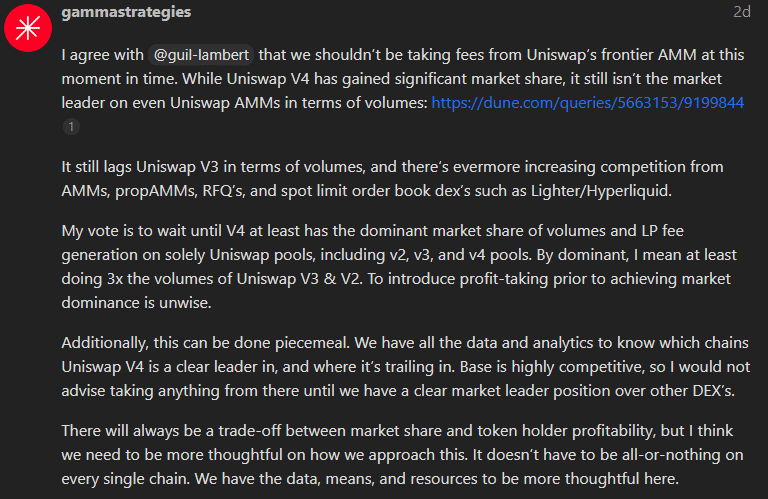
Source: Uniswap governance

That said, Uniswap has only activated fees across a few chains and versions. However, most of the fees collected go to LPs.

In fact, LPs have made a whopping +$5B in cumulative fees since 2018. Yet, the protocol has made only $25M in cumulative revenue.
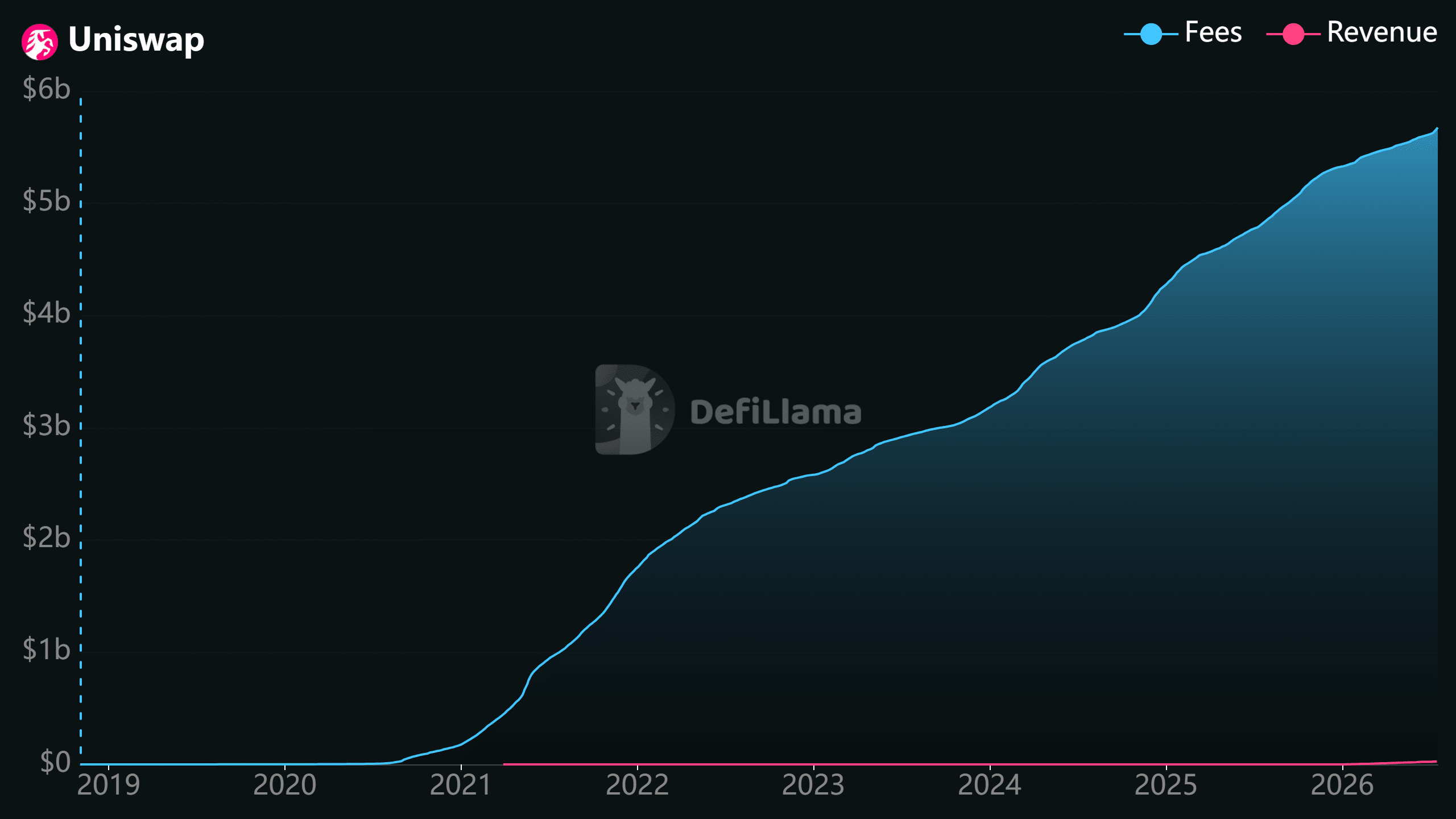
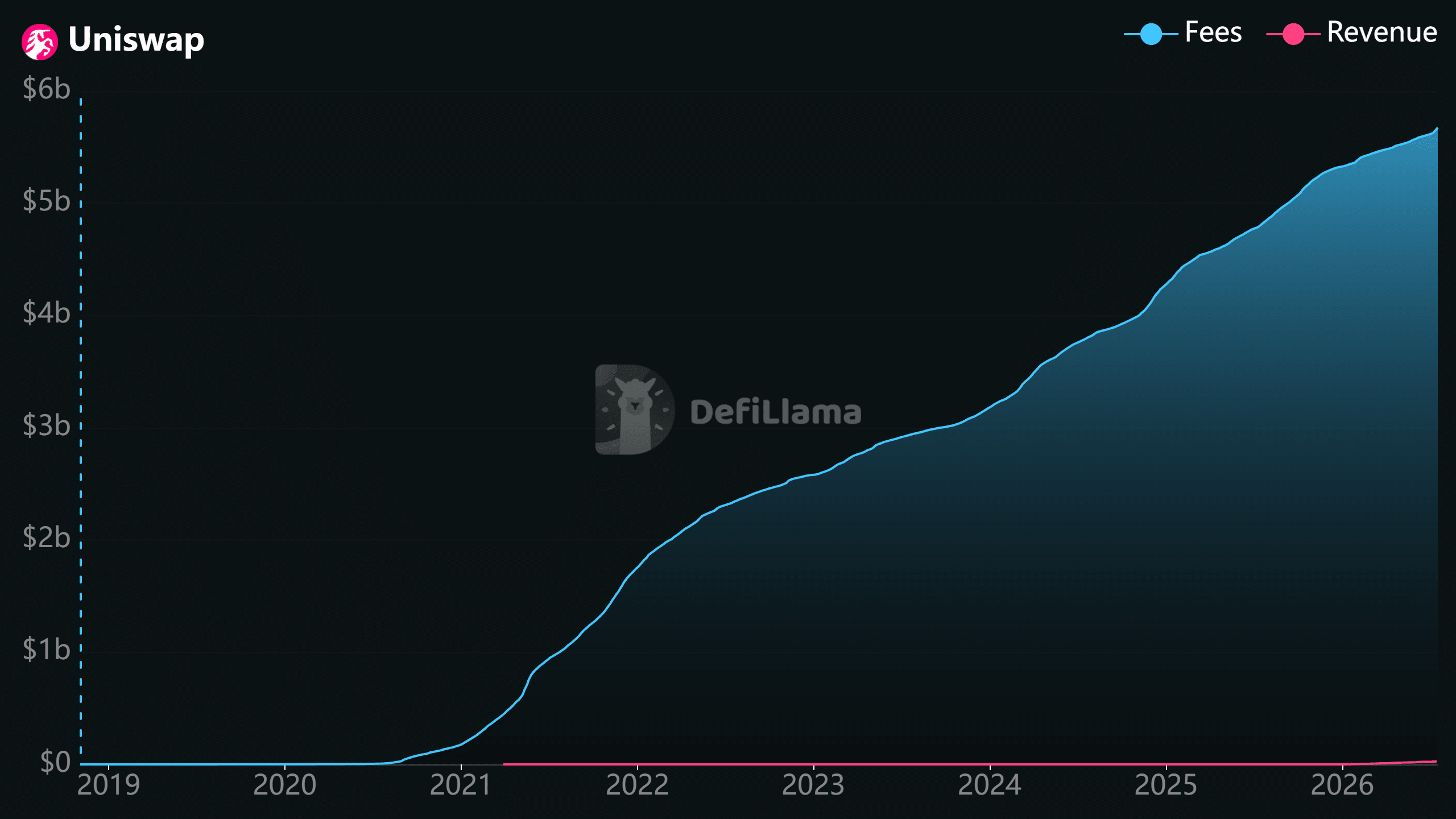
Source: DeFiLlama

If the proposal goes through and is balanced with competition, more protocol revenue would translate to more UNI burn rates, as Adams projected.

That said, the project has now burned a total of 107.49M UNI tokens. UNI burn rate surged 3x from $51K to over $160K in the past week.

Can UNI extend its July rally?

The Robinhood traction was front-run by traders as the Uniswap [UNI] price surged. In July, UNI price surged 41% from $2.7 to $3.8.

But the bullish strength has eased as the price stalled below the 200-day Moving Average (blue line). As such, price could remain sideways above $3.5 or slip to $3 if Robinhood momentum stabilizes.
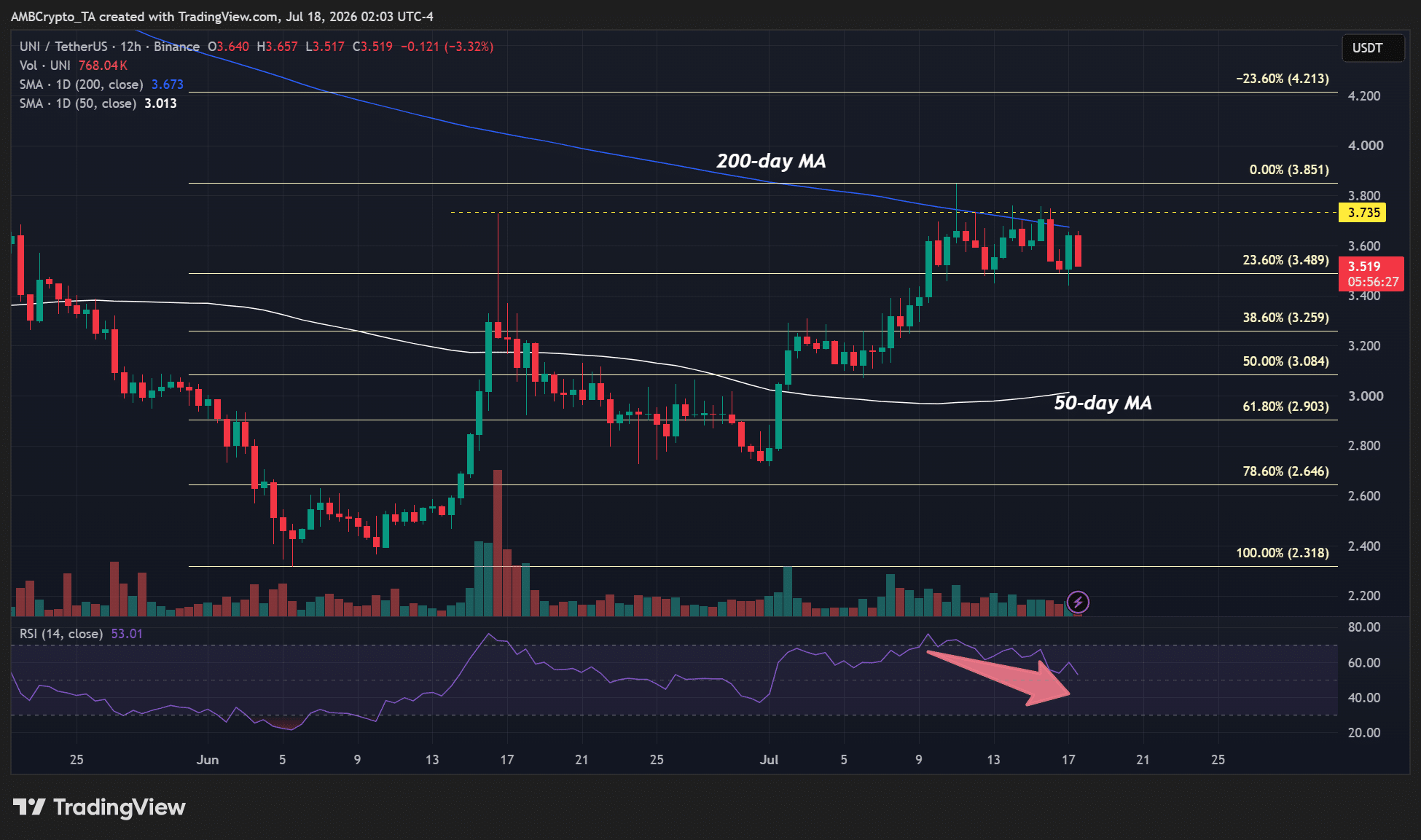
Source: UNI/USDT, TradingView

But the next move higher could be triggered by renewed Robinhood momentum and if the fee proposals drive more UNI burn.


Final Summary

  • Uniswap pushes three fee protocol fee proposals to accelerate UNI burn.
  • Currently, Uniswap LPs have accrued over $5B while the protocol makes relatively little revenue

Пов'язані питання

QWhat are the three governance proposals submitted by Uniswap, and what is their primary goal?

AUniswap has submitted three governance proposals to activate protocol fees. The first is for versions V2 and V3 on the Robinhood chain. The second is to activate fees for V4 across Ethereum, Base, Arbitrum, Robinhood, BNB Chain, Polygon, and Optimism. A third proposal for remaining V4 chains will follow soon. Their primary goal is to direct all new protocol fees into the existing UNI token burn mechanism, aiming for a substantial increase in UNI burn.

QAccording to Hayden Adams, what impact does Uniswap expect the new fee proposals to have on UNI burn?

AHayden Adams, Uniswap's CEO, stated that based on current trading volumes, especially on the Robinhood chain, they expect the impact of the new protocol fee proposals on UNI burn to be substantial.

QWhy do some liquidity providers (LPs), like Gamma Strategies, oppose the V4 fee proposal?

ALiquidity providers like Gamma Strategies oppose the V4 fee proposal because it would directly reduce the fees collected by LPs, which are their primary source of revenue. They also argue that Uniswap V4 is not yet competitive enough, and adding fees could make it lose ground to rival decentralized exchanges.

QWhat is the historical relationship between fees earned by Liquidity Providers (LPs) and protocol revenue for Uniswap?

AHistorically, Liquidity Providers (LPs) have earned the vast majority of fees on Uniswap, accruing over $5 billion in cumulative fees since 2018. In contrast, the protocol itself has generated only about $25 million in cumulative revenue from a small percentage of swap fees on select chains and versions.

QHow has UNI's price performed recently, and what factors could trigger its next upward move according to the article?

AIn July, the price of UNI surged 41%, from $2.7 to $3.8, partly driven by anticipation of Uniswap's traction on the Robinhood chain. Its bullish momentum has since eased, with the price stalling below the 200-day Moving Average. The article suggests the next upward move could be triggered by renewed momentum on Robinhood and if the new fee proposals successfully drive a higher UNI burn rate.

Пов'язані матеріали

L2 'Recalibration': When L1 Becomes Its Own Rollup, What Is Ethereum's Endgame?

The article discusses the evolving relationship between Ethereum's Layer 1 (L1) and Layer 2 (L2) solutions, moving beyond the initial "L2 for scaling" model. As Ethereum L1 itself scales (increasing Gas Limit, statelessness, zkEVM), the unique value proposition of L2s shifts from merely providing cheap execution to offering differentiated features like application-specific optimization, privacy, and flexible governance. The piece explores three key themes: 1. **L2's New Role:** L2s are transitioning from a pure scaling technology to a spectrum of execution environments with varying degrees of security inheritance from Ethereum L1. 2. **Interoperability as State Trust:** Solving L2 fragmentation is less about cross-chain bridges and more about enabling faster, trust-minimized state verification between environments. This involves initiatives like faster L1 finality, intent-based architectures (Open Intents Framework), and native account abstraction. 3. **Blurring Layers:** With the potential integration of zk-proofs into L1 validation (making L1 akin to its own "Rollup") and the concept of "Native Rollups," the rigid boundary between L1 and L2 may fade. The future could be a unified system with multiple execution domains (for DeFi, gaming, privacy, etc.) sharing a common security, settlement, and state framework. In conclusion, Ethereum's goal is not to abandon L2s or re-centralize everything on L1, but to re-integrate the fragmented user experience—liquidity, accounts, applications—while preserving the scaling benefits of a multi-environment ecosystem. The endgame is a cohesive "one chain" feeling for users, powered by diverse but securely interconnected execution layers.

marsbit25 хв тому

L2 'Recalibration': When L1 Becomes Its Own Rollup, What Is Ethereum's Endgame?

marsbit25 хв тому

The Encryption Bill Clarity's Challenge: A Thorny Path of Bipartisan Compromise in the U.S.

U.S. lawmakers are attempting to advance the Clarity Act, a significant crypto market structure bill, but its path is fraught with partisan hurdles. The process has been rocky since January, when a prior bipartisan deal in the Senate Banking Committee was upended. A key compromise in May on "yield" issues allowed the bill to move forward in committee, but only with the conditional support of two Democratic senators, Angela Alsobrooks and Ruben Gallego. They emphasized that their final vote depends on reaching an agreement on ethics provisions for elected officials. Ultimately, the Senate Agriculture Committee passed its version along party lines without Democratic support. As Republicans push for a full Senate vote in July, the demand for strong ethics language has expanded beyond Democrats. Additional controversies surround provisions related to yields (aligning some Republicans with large banks) and developer protections (opposed by enforcement agencies). Core concerns about illicit finance and consumer protection remain central to the debate. Despite consensus on the need for legislation, achieving the necessary bipartisan compromise is proving difficult. While momentum exists—including recent meetings between senators and White House officials—a reconciled bill text faces skepticism. Senator Gallego has stated that without ethics terms acceptable to Democrats, they will not provide the needed votes. The immediate goals for the crypto community in Congress are unclear: a symbolic Senate vote before the August recess, eventual passage into law by 2026, or forging a final compromise framework. The arduous, vote-by-vote effort to build bipartisan support continues, mirroring the traditional legislative grind the industry must now navigate.

Foresight News1 год тому

The Encryption Bill Clarity's Challenge: A Thorny Path of Bipartisan Compromise in the U.S.

Foresight News1 год тому

Торгівля

Спот
活动图片