Why We No Longer Love Crypto

比推Опубліковано о 2026-03-11Востаннє оновлено о 2026-03-11

Анотація

The article "Why We No Longer Passionate About Crypto" explores the growing sense of disillusionment among crypto veterans. Many who once found excitement in the space now feel stuck, particularly those not working on stablecoins, financial infrastructure, or DeFi. The author notes that the previous era—where developer-focused products thrived on vibes rather than revenue—ended about 18 months ago. The crypto market for non-financial applications is now seen as limited, with an estimated annual addressable market of only $200–300 million, leading many builders to feel they have few viable paths forward. The rise of AI has intensified this frustration, as it offers faster innovation and more tangible product development compared to crypto’s current constraints. The author outlines several unappealing options for those exploring crypto-AI intersections: tokenizing traditional AI products without real utility, building decentralized AI infrastructure (which lacks immediate feedback), or competing with giants in AI-focused stablecoin infrastructure. Despite this pessimism, the author concludes with a note of optimism: Crypto’s unique value lies in its ability to serve as "capital superconductor" for growth. The convergence of AI-driven product innovation and crypto’s programmable capital mechanisms could fuel a new generation of "agent-based companies," creating a renewed sense of purpose for those who remain.

Author: Kydo (@0xkydo)

Original Title: Why crypto is not that fun anymore

Compiled and Arranged: BitpushNews


These days, a tweet struck a chord. It revealed a shared, yet rarely mentioned sense of helplessness—many of us no longer enjoy working here (in crypto) anymore.
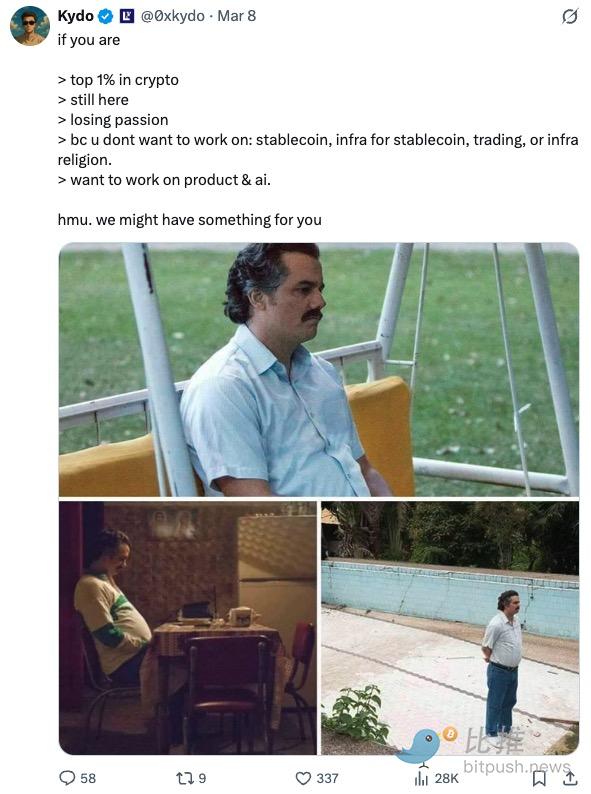
Tweet:

If you are

> in the top 1% of the crypto space

> still here

> but losing passion

> because you don't want to work on: stablecoins, stablecoin infrastructure, trading, or infrastructure-level "evangelism"

> want to build products and AI

Contact me. We might have something for you.

I want to elaborate.

If you are not working on stablecoins or are not someone extremely passionate about financial markets, you are likely not happy in the cryptocurrency space right now.

Worse, you are seeing the AI field developing at a pace and with an excitement that makes your daily work feel like standing still. I understand this all too well because that's exactly how I felt. That's why I wrote that tweet.

And the fact that it resonated with so many people (I've received 60 DMs so far) tells me that many of you feel the same way but haven't said it out loud.

So, let me say the "unsaid" things.

Selling to Crypto Developers is No Longer Viable

In the previous "meta," selling things to crypto developers worked. Back then, metrics were more important than revenue. Partner logos were more important than revenue. A "vibe" was more important than revenue. You were a cost center for others, and everyone was spending money.

That "meta" died about 18 months ago. We wish we had pivoted earlier.

There is also a growing consensus today: cryptocurrency is only suitable for finance. Haseeb from Dragonfly has said it, Kyle from Multicoin has said it, Toly from Solana has said it. Most of you think so too, even if you won't say it publicly.

I understand why people reach this conclusion. Most tokens are meme coins. They don't own anything and can't owe you anything because the only thing that can truly be "owned" is on-chain state, which is extremely limited.

This is also why crypto-native applications like trading and lending are currently the only two categories that can truly make money on-chain.

But many of us are not building in DeFi. Many of us build infrastructure to enable new use cases beyond DeFi.

Here's an uncomfortable truth: according to our analysis, the total addressable market for this kind of work is only about $200-300 million per year. This pie is to be divided among hundreds of institutions. The most successful companies can only achieve tens of millions in annual revenue. After years of maturation, this is the ceiling.

If you are building a venture-scale enterprise, this gives you a very clear set of choices. If you want to serve crypto developers, the market is small. So, you either put on a suit and sell your infrastructure to traditional finance; or, like many others, choose to pack up and switch to AI.

Many are switching to AI because they understand their strengths. They understand their team's expertise. They know their competitive advantage is not in long, complex B2B sales in traditional finance. This is why so many of you feel lost right now.
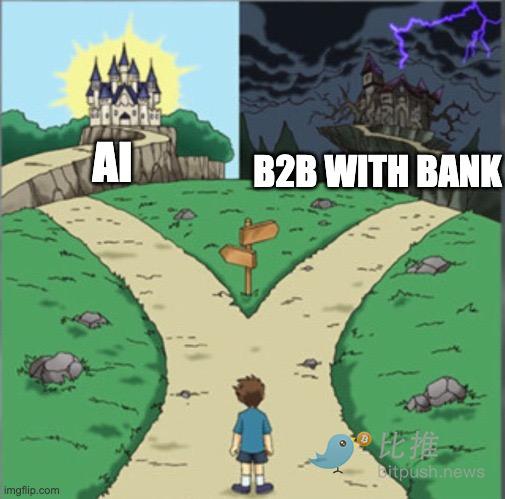
The Dead End of Crypto x AI

So you look at the only area that still feels vibrant—the intersection of crypto and AI—trying to find your footing. But the options laid out there aren't great either.

Option One: Traditional business + AI + issue a token. This token has no real utility, like most other tokens. You're essentially building a regular product and slapping a layer of financialization on top. It's frustrating because you've been playing this game for five years.

Option Two: Decentralized AI infrastructure. Privacy, security, verifiability: this is the missionary route, the old "meta." But I guess this doesn't interest many of you: not many want to embark on another long-term "building a religion" style endeavor with no immediate feedback, no revenue.

Option Three: Stablecoin infrastructure for AI agents. This is interesting from a business perspective, but extremely competitive. Circle, Stripe, and all the major stablecoin players are going all in. As a startup, going to war with them without any clear beachhead to capture is frustrating.

The Choices Faced, and Why People Are Leaving

So, these are the actual choices on the table today:

You can stay in the "religious realm" of crypto, building for a resilient, decentralized future.

You can put on a suit and join the big players to evangelize the gospel of stablecoins.

You can build a "shovel-selling" company for the stablecoin ecosystem.

You can stay in DeFi: trading, lending, and the financial plumbing of the internet.

Or, you can build a niche vertical product that, while not a billion-dollar venture target, actually makes money and satisfies real users.

Beyond that, you don't have better options. This is why you are likely to switch to AI. Honestly, I understand.

This is why cryptocurrency is no longer that fun.

The above is my diagnosis. This is the conclusion I reached after six months of feeling, analyzing, and stress-testing. If you came here for an honest take on "why crypto feels stuck," you've got it. You can close this article now. Go for a walk, touch some grass.

But I'll tell you this: I have never been so excited about the work I'm doing. The last time I felt this way was probably when I first heard about cryptocurrency and its potential. And it's not just me—everyone around me feels the same. So, if you want to hear the short version of what I believe in, read on.

Just know that from here on out, I'm selling my beliefs.

What I Truly Find Interesting

The question I've been trying to answer for the past six months is: How do you find a market large enough, with a clear business model rooted in crypto, and a product-oriented, non-financial solution that can be used by people both inside and outside the crypto space?

The answer I kept coming back to is: Cryptocurrency is a superconductor for capital. Capital fuels growth. The problem in the past was that we were fueling things that weren't growing—pouring gasoline on ice and expecting it to burn brighter.

AI has dramatically reduced the difficulty of starting and growing things—from a product perspective. Now one person can build what used to require a fifty-person team. The cost of creating a real product, a real business, is plummeting. These things are growing fast, with revenue, real users, and real feedback loops. They need fuel to accelerate. And cryptocurrency is the best fuel mechanism ever invented for this purpose.

This is the only interesting problem I see now: How do you take crypto's superpower—instant, global, programmable capital formation—and point it at things that are actually growing?

We think the answer is "agentic companies." To achieve this, you first need tokens to be able to "own" things, and coincidentally, we've spent the last five years building that foundation. Now, we're going to turn it into a product and achieve that goal.


Twitter:https://twitter.com/BitpushNewsCN

Bitpush TG Discussion Group:https://t.me/BitPushCommunity

Bitpush TG Subscription: https://t.me/bitpush

Original article link:https://www.bitpush.news/articles/7618924

Трендові криптовалюти

Пов'язані питання

QWhy does the author believe that many people in the crypto space are no longer enjoying their work?

AThe author believes that many are no longer enjoying their work because the focus has shifted heavily towards financial applications like stablecoins and trading, which may not align with their interests. Additionally, the rapid and exciting progress in AI makes their current work in crypto feel stagnant in comparison.

QWhat are the main options available for crypto developers today, according to the article?

AThe main options are: staying in the 'religious' crypto space for a decentralized future, selling infrastructure to traditional finance, building 'picks and shovels' for the stablecoin ecosystem, continuing in DeFi (trading and lending), or creating a niche product that generates real revenue but isn't a billion-dollar venture-scale business.

QWhat is the estimated annual market size for non-DeFi crypto infrastructure work mentioned in the article?

AThe estimated annual addressable market size for non-DeFi crypto infrastructure work is about $200-300 million, which is shared among hundreds of organizations, with the most successful companies generating tens of millions in annual revenue.

QWhat does the author identify as the core problem with previous attempts to fuel growth in crypto?

AThe author states that the core problem was that capital was being provided to things that weren't growing—'pouring gasoline on ice and expecting it to burn hotter'—instead of fueling things that are actually growing.

QWhat is the author's proposed solution to make crypto fun and impactful again?

AThe author's proposed solution is to leverage crypto's superpower as an instant, global, programmable capital formation mechanism and direct it towards things that are genuinely growing, specifically 'agentic companies,' by enabling tokens to 'own' things and using this foundation to build products.

Пов'язані матеріали

GPT-5.6 Countdown: Abandon the Illusion of a Single API, Computational Iteration Can't Outpace a Single Page of Compliance

In mid-June, three seemingly independent industry events—the compliance-driven throttling of Fable 5, the open-sourcing of GLM-5.2, and the leaked release timeline for GPT-5.6—are pushing the global AI industry toward a watershed moment. These shifts signal a fundamental restructuring of the industry's underlying logic. First, **"usability" has substantially overtaken "advanced capabilities"** as the primary weight, pushing the global large language model (LLM) supply chain into a "dual-track" phase of controlled closed-source and local open-source coexistence. Second, **the competitive moats of closed-source giants are shifting**. Their technical focus is moving from "language intelligence" toward "spatial intelligence (world models)"—a domain heavily reliant on computing power. Third, faced with常态化 transnational compliance risks, **a "model-agnostic" decoupled design has become a survival necessity for application-layer developers to maintain business continuity.** The article details how Anthropic's Fable 5, despite its advanced engineering feats, was restricted for non-U.S. citizens within 72 hours of launch, highlighting how geopolitical compliance can instantly limit even the most advanced models. In response, the open-source camp, exemplified by Zhipu AI's MIT-licensed GLM-5.2, is gaining market share by offering stable performance improvements and significant cost advantages (up to 70% savings for enterprises), while achieving full adaptation with domestic semiconductor platforms. Meanwhile, closed-source leaders like OpenAI are pivoting. The anticipated GPT-5.6 reportedly shifts focus from language to spatial intelligence and world models, aiming to rebuild a generational gap in areas like 3D understanding, simulation, and industrial design that demand immense compute. The core conclusion is that the LLM supply chain's logic has changed. Enterprises must now evaluate infrastructure based on a composite of technical performance and policy compliance. For developers, complete reliance on a single closed-source API poses unacceptable risk. Implementing a truly model-agnostic architecture—enabling swift switches to compliant, locally deployable open-source alternatives—is no longer just good practice but a fundamental baseline for business continuity.

marsbit1 год тому

GPT-5.6 Countdown: Abandon the Illusion of a Single API, Computational Iteration Can't Outpace a Single Page of Compliance

marsbit1 год тому

Is the 'Token Subsidy War' Among AI Giants Almost Over?

The article discusses the ongoing "token subsidy war" among AI giants like OpenAI and Anthropic, questioning whether it's nearing its end. It reveals that current AI subscription prices are heavily subsidized, with some plans offering tokens at up to 70 times the actual cost to attract and retain heavy users, especially developers and enterprises. This strategy mirrors past internet-era subsidy battles, but with a key difference: AI tokens lack "lock-in" effects. Unlike ride-hailing or food delivery apps, users can easily switch between AI providers as APIs become standardized, making it difficult for companies to raise prices post-subsidy. The piece highlights a structural asymmetry in the competition. Giants like Google, with massive advertising revenue, can afford to subsidize tokens indefinitely, akin to using "tokens as a weapon." In contrast, venture-backed companies like OpenAI and Anthropic face pressure to become profitable, especially as they approach IPO. The article cites Google Ventures founder Bill Maris, who suggests Google could slash token prices by 80%, putting immense pressure on competitors. Two potential endgames are presented: the "internet service" model (subsidize, monopolize, then raise prices) and the "utility" model (tokens become a standardized, low-margin commodity like electricity). Given the low switching costs, the latter seems more likely. The competition may not have a single winner but could instead accelerate AI's evolution into a foundational, infrastructure-level technology, akin to a public utility. For now, users continue to benefit from heavily subsidized token costs.

marsbit1 год тому

Is the 'Token Subsidy War' Among AI Giants Almost Over?

marsbit1 год тому

Beyond the Stadium: The Profitable Games Surrounding the World Cup

"Beyond the Pitch: The Profit Game Around the World Cup" The FIFA World Cup transcends being a sporting spectacle, evolving into a massive global arena for speculation and profit-seeking. The 2026 tournament has amplified this dynamic, creating a multi-layered ecosystem of financial opportunism alongside the football. **Prediction markets** have surged into the mainstream. Platforms like Polymarket and Kalshi saw trading volumes for World Cup contracts soar, attracting new users with their financial trading model and high-profile, chain-based wealth stories that overshadow traditional sports betting in terms of growth and narrative. However, **traditional sportsbooks** remain the dominant force, leveraging established user habits, legal markets, and comprehensive product offerings to handle the vast majority of speculative wagers, with projections suggesting record-breaking betting volumes. Capital markets also react. **"Concept stocks"** in countries like South Korea and Japan experience volatile price swings based on team performance and anticipated fan spending on items like chicken, beer, and viewing parties, effectively becoming a stock market reflecting fan sentiment. The **ticket resale market** has become a sophisticated arena for arbitrage. Prices fluctuate wildly based on team draws and star power, with sellers sometimes listing tickets they don't yet own in a practice akin to short-selling, while FIFA's own "Right to Buy" tokens add another layer of speculative trading. **Collectibles and merchandise** offer another avenue. Panini sticker albums, with their inherent scarcity and nostalgic value, can become high-value collectibles. Limited-edition or locally themed jerseys command significant premiums on secondary markets, and even counterfeit vendors profit from fans' desire for affordable match-day identity. The **cryptocurrency** space has seen a frenzy of speculative, unauthorized World Cup-themed meme coins on chains like Solana. These tokens, often exploiting team names and player imagery, experience extreme pump-and-dump cycles, creating stories of massive gains for a few early entrants and steep losses for many others. Finally, an entire industry thrives on **providing information and tools** to other speculators. Developers create platforms like SeatSidekick to track ticket inventory and prices, while paid Telegram groups and subscriptions sell betting tips and predictions, monetizing the widespread desire for an informational edge. In essence, the World Cup has become a compressed, global laboratory for speculation. While the games determine champions on the field, a parallel, complex network of financial transactions—spanning prediction contracts, bets, stocks, tickets, collectibles, crypto, and information services—settles its own scores in the global market.

marsbit2 год тому

Beyond the Stadium: The Profitable Games Surrounding the World Cup

marsbit2 год тому

How Does Codex Use a Computer? Three Entry Points and Permission Boundaries

This article explains the three primary methods for Codex to interact with a computer, each with distinct use cases, permission boundaries, and trust levels. **1. Computer Use:** This offers the broadest access, allowing Codex to visually control and interact with the graphical user interface of authorized macOS/Windows apps, system settings, and even iOS simulators. It's ideal for tasks lacking APIs or structured tools, such as operating legacy software or multi-app workflows. However, it's the slowest method and has the widest permission scope, requiring careful supervision for sensitive actions. **2. Chrome Extension:** This grants Codex access to the user's logged-in Chrome browser state, including cookies, profiles, and open tabs. It's best for tasks requiring user identity across websites like Gmail, LinkedIn, Salesforce, or internal dashboards. Its key advantage is multi-tab control for complex workflows. While more powerful for browser-based tasks than Computer Use, it carries higher sensitivity as actions are performed under the user's identity. **3. In-App Browser:** This is a browser isolated within the Codex thread, separate from the user's personal browsing data. It excels in web development and debugging scenarios—previewing local servers, testing responsive layouts, or annotating designs directly on the page. Its isolation is a strength for development but a limitation for tasks requiring login sessions. The core principle is to choose the narrowest, safest, and most structured interface for the task. Use plugins or MCPs first, resort to visual control (Computer Use) only for GUI-dependent tasks, employ the Chrome extension for identity-reliant browser work, and prefer the In-App Browser for isolated development. **Appshots** are clarified as a fourth, complementary tool for *inputting* context—capturing a screenshot of a window to point Codex to something—rather than a method for Codex to *act*. Together, this layered approach highlights a key to AI agent productization: not granting unlimited permissions, but constraining them within clear boundaries for specific tasks while preserving user oversight.

marsbit3 год тому

How Does Codex Use a Computer? Three Entry Points and Permission Boundaries

marsbit3 год тому

Торгівля

Спот
Ф'ючерси

Популярні статті

Як купити FUN

Ласкаво просимо до HTX.com! Ми зробили покупку FUNTOKEN (FUN) простою та зручною. Дотримуйтесь нашої покрокової інструкції, щоб розпочати свою криптовалютну подорож.Крок 1: Створіть обліковий запис на HTXВикористовуйте свою електронну пошту або номер телефону, щоб зареєструвати обліковий запис на HTX безплатно. Пройдіть безпроблемну реєстрацію й отримайте доступ до всіх функцій.ЗареєструватисьКрок 2: Перейдіть до розділу Купити крипту і виберіть спосіб оплатиКредитна/дебетова картка: використовуйте вашу картку Visa або Mastercard, щоб миттєво купити FUNTOKEN (FUN).Баланс: використовуйте кошти з балансу вашого рахунку HTX для безперешкодної торгівлі.Треті особи: ми додали популярні способи оплати, такі як Google Pay та Apple Pay, щоб підвищити зручність.P2P: Торгуйте безпосередньо з іншими користувачами на HTX.Позабіржова торгівля (OTC): ми пропонуємо індивідуальні послуги та конкурентні обмінні курси для трейдерів.Крок 3: Зберігайте свої FUNTOKEN (FUN)Після придбання FUNTOKEN (FUN) збережіть його у своєму обліковому записі на HTX. Крім того, ви можете відправити його в інше місце за допомогою блокчейн-переказу або використовувати його для торгівлі іншими криптовалютами.Крок 4: Торгівля FUNTOKEN (FUN)Легко торгуйте FUNTOKEN (FUN) на спотовому ринку HTX. Просто увійдіть до свого облікового запису, виберіть торгову пару, укладайте угоди та спостерігайте за ними в режимі реального часу. Ми пропонуємо зручний досвід як для початківців, так і для досвідчених трейдерів.

256 переглядів усьогоОпубліковано 2025.06.25Оновлено 2026.06.02

Як купити FUN

Обговорення

Ласкаво просимо до спільноти HTX. Тут ви можете бути в курсі останніх подій розвитку платформи та отримати доступ до професійної ринкової інформації. Нижче представлені думки користувачів щодо ціни FUN (FUN).

活动图片